
Roman Mediterranean gardening did not happen in a postcard climate of endless lavender and polished stone. It happened in heat, winter rain, dust, trade, food production, household display, and unequal access to land, water, and labour. There was no single Roman garden style: a farm villa, an urban vineyard, a shop-house plot, and a wealthy peristyle court did different work.12
That variety is more useful than the familiar stage set of marble, cypress, clipped herbs, and an ornamental pool. A Roman-inspired garden becomes convincing when its parts answer practical questions. Where is the midday shade? How does water arrive and leave? Which plants fit the soil and winter? Can a person carry a basket, pull a chair into shelter, and reach the herbs without stepping into the bed?
The historical details still matter, but they should guide design rather than dictate costume. Stone, terracotta, vines, and fountains are materials and features, not proof of authenticity by themselves.
A peristyle was not automatically a pleasure garden
At Pompeii, an elite domus might lead from an atrium toward a hortus, or garden, later framed by a columned peristyle. The same official account distinguishes residential villas from country villas organized around production and storage, while noting that one property could combine both roles.1 “Roman garden” therefore describes a family of spaces, not a standard plan issued across the empire.
Productive planting existed inside the city too. A recent survey identified 47 agricultural gardens at Pompeii, including 35 created or enlarged after the earthquake of 62 CE. They could contain vines, fruit or nut trees, vegetables, flowers, processing areas, and outdoor dining; some served commercial or commercial-dining properties rather than private kitchen use alone.2 The archaeological range behind Roman gardens built for shade, status, supper, and work is much wider than the villa ideal.
Nor did every colonnade enclose leisure. The Archaeological Park of Pompeii describes one house where a peristyle served a textile workshop worked by enslaved people.3 A modern design can borrow spatial intelligence from Roman courts without turning the social order that maintained them into romance.
Shade and exposure shaped the useful garden
Pliny the Younger’s description of his Laurentine estate is unusually specific. He mentions a shady vine walk, mulberry and fig trees, violets, and a path edged with box—or rosemary where box failed in the exposed sea wind. Porticoes admitted or blocked wind and sun according to season.4 This is a wealthy owner’s chosen account of his own estate, not a survey of ordinary gardens, but it records design responding to microclimate instead of merely decorating it.
Start a modern plan the same way: observe the site at the hours when it will be used. A vine or deciduous climber over a sound support can provide summer shade while admitting more winter light, but its mature weight, pruning, fruit drop, and local hardiness all count. A tree may give deeper shade, yet roots, foundations, overhead wires, and mature spread set the real location. In a small courtyard, a fabric shade or open pergola may solve the comfort problem with less permanent structure.
Water was infrastructure before it was display
Pompeian atria could collect roof water through an opening into an impluvium, then channel it to an underground cistern.1 Pliny, despite describing baths and fine rooms, says his Laurentine villa had no running water and relied on local wells or springs.4 Other gardens used different combinations of cisterns, wells, pipes, channels, basins, and carried water. A fountain is only the visible end of a supply, overflow, and maintenance system.
For a home courtyard, draw that system before buying a basin. Mark the tap or stored-water source, the high and low points, roof runoff, safe overflow, and the route of a hose or watering can. If a basin will hold water, include a realistic plan for cleaning it and maintaining its pump. Our closer look at Roman water from aqueduct to garden explains why gravity, storage, sediment, and maintenance matter more than arches or spectacle.
Herbs do not all share a Roman thirst
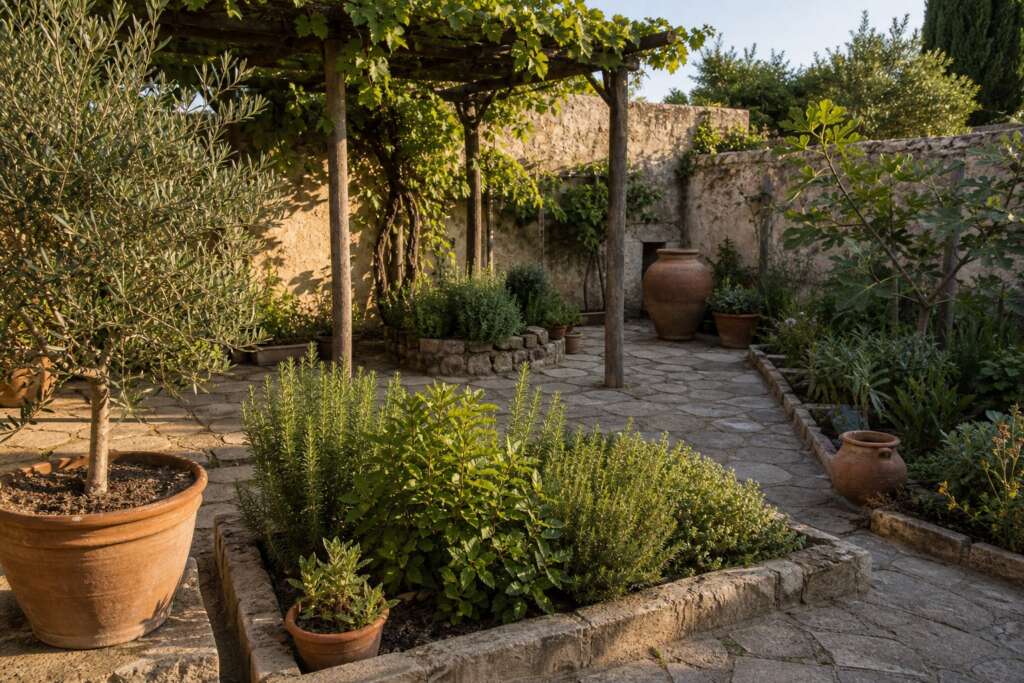
The Getty Villa is valuable here as a declared modern interpretation. Its gardens combine architecture, fountains, sculpture, and plants associated with the ancient Mediterranean, while the museum describes the spaces as Roman-inspired rather than preserved Roman gardens.5 Use it to study sequence, enclosure, and proportion—not as evidence that every ancient household grew the same herb collection.
Modern plant care should be equally explicit. Penn State Extension recommends growing container herbs in pots with drainage holes and a potting mix that drains well. It advises letting rosemary, thyme, sage, oregano, marjoram, and bay dry slightly between waterings, while basil should not dry completely.6 Mint presents a different management problem: Utah State University Extension describes it as fast-spreading and recommends a container or another place where its roots are confined.7
Make separate irrigation zones rather than a single “Mediterranean herb bed.” Put sun-loving woody herbs in the sharpest-draining position. Give leafy annuals and parsley a richer, more reliably moist pocket. Keep culinary plants away from contaminated runoff, and identify each species confidently before eating it. Ancient medicinal use is historical evidence, not proof that a plant or dose is safe treatment today.
Build the layout from use, not props
Begin with one firm route and one comfortable destination: a seat, potting surface, dining table, or doorway kept clear at mature plant size. Add shade where the route pauses. Place the most-used culinary plants within easy reach, with enough width to harvest and prune. Repeated containers can define an edge, but every pot needs a drainage hole, a stable base, and access for watering. Pots also expose roots to larger temperature swings unless they can be moved or protected.
Choose one structural plant for the space you actually have. A grape, fig, olive, bay, or pomegranate may fit some climates; none is universally suitable. The Royal Horticultural Society notes that classic Mediterranean choices vary in frost tolerance and mature size, and suggests substitutes where olive or cypress is too tender or large.8 Check local hardiness, invasive status, disease restrictions, drainage, and ultimate spread before using historical association as a reason to plant.
Let materials earn their place. Gravel should drain without migrating onto a path. Stone should provide secure footing rather than glare or reflected heat beside a seat. A jar should store water safely or remain clearly ornamental. Terracotta can create rhythm, but five manageable pots are more useful than twenty that dry out while the owner is away.
The Roman lesson is coordination
The strongest Roman-inspired garden does not announce itself with a replica statue. Its shade falls where someone needs it. Water can be delivered, stored, and drained without drama. Productive and fragrant plants occupy conditions they can tolerate. Paths connect rooms and tasks, while a few deliberate materials hold the composition together.
That result may look Mediterranean, or it may use entirely different plants in a cold, wet, windy, or drought-prone region. The point is not to reenact Rome. It is to treat the garden as lived space—beautiful because its climate, movement, water, planting, and daily work have been considered together.
References
- Archaeological Park of Pompeii: “Roman Housing (Houses and Villas)”
- Jessica Venner, Journal of Roman Archaeology: “Rise and vine: the phenomenon of opportunistic agricultural gardens in post-earthquake Pompeii, 62–79 CE”
- Archaeological Park of Pompeii: “Amaryllis”
- Pliny the Younger, Letters 2.17, translated by J. B. Firth
- J. Paul Getty Museum: “Gardens” at the Getty Villa
- Penn State Extension: “Growing Herbs Indoors”
- Utah State University Extension: “How to Grow Mint in Your Garden”
- Royal Horticultural Society: “Mediterranean garden plants”