
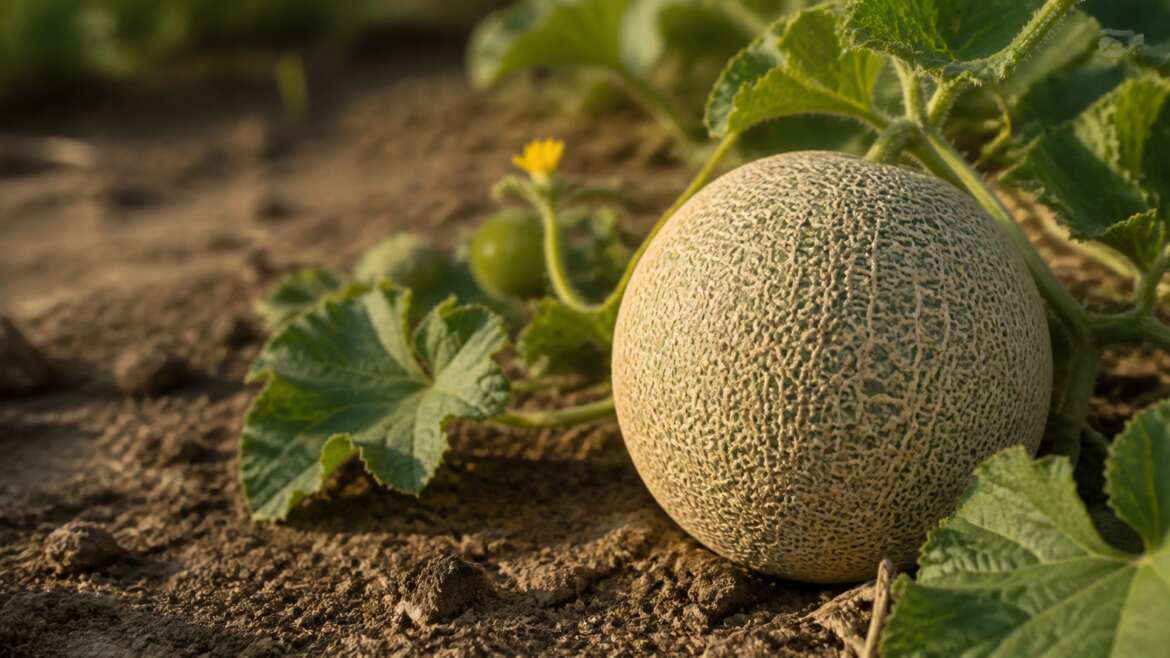
A young cantaloupe can look almost unfinished: green, firm, and surprisingly smooth. Then pale lines appear near the blossom end. They lengthen, branch, cross one another, and rise until the fruit is wrapped in the rough beige lattice that makes it recognizable from across a market.
The pattern is not painted onto the rind, and it is not a mat of fibers laid over the surface. It records a repeated sequence of failure and repair. As the melon enlarges, fine fissures open through its outer tissues; cells below them build a corky wound covering. The intersecting repairs become the net.
That makes a cantaloupe rind more than packaging. It is a developmental map—part mechanics, part chemistry, and part family history—still changing while the sweet flesh grows underneath.
First, untangle the name
In North American gardens and groceries, “cantaloupe” usually means a netted muskmelon, one of the many cultivated forms of Cucumis melo. Horticultural references often separate these netted melons from European Cantalupensis-group melons—sometimes called “true cantaloupes” in older references—which may be ribbed, warty, or comparatively smooth. The names and botanical groupings have shifted over time, so the useful point is simpler: not every melon in this species makes a net.1
Honeydews usually carry a smooth rind. Charentais melons may show shallow ribs with little or no netting. Other cultivars make a fine veil, a coarse rope-like mesh, or deep bare seams between netted panels. These are largely inherited fruit-surface traits, not different stages on one universal path; development and growing conditions can still alter how fine, coarse, or complete the pattern becomes.16
Here, “cantaloupe” means the familiar netted, aromatic muskmelon. Its young fruit has epidermal cells covered by a cuticle—a layer rich in cutin and waxes that limits water loss and helps shield living tissue from the environment.5
A growing fruit puts its skin under tension
After successful pollination and fertilization, the ovary begins to swell. Flesh cells enlarge, the surface area increases, and the rind has to accommodate the change. In a netted melon, tiny fissures eventually interrupt the cuticle and underlying epidermal or hypodermal cells. Some superficial tears go no farther. Deeper fissures widen and lengthen as the fruit continues expanding.2
It is tempting to say the inside simply grows faster than a thin skin. The actual comparison is more interesting. Researchers studying two netted and two smooth cultivars found similar patterns of fruit enlargement. During rapid growth, the netted types had more cuticle, not less, but that cuticle was arranged differently around the epidermal cells. Their surface cells were also flatter and had less contact with neighboring cells. Those inherited details may make the layer less able to stretch under tension.3
The crack itself is a mechanical event; the response to it is living biology. A melon does not consciously or purposefully split its surface. Once tissue is disrupted, however, it activates the same broad kind of sealing machinery that plants use around other wounds.4
The melon builds cork into each fissure
Cells beneath a fissure begin dividing to form a replacement covering called wound periderm. Its outward cells develop walls rich in suberin, a complex water-resistant plant polymer also familiar from cork and potato skin. Microscopy of netted melon rind shows lignified cells beneath that suberized upper layer. The new tissue pushes through the broken surface and stands slightly above it; as it matures, it becomes dry and pale.45
“Scar-like” is a useful analogy, provided it is not mistaken for animal scar tissue. The net is plant wound periderm: new protective tissue assembled below a developmental fissure. It is not dried sap, fungal growth, or a superficial wax coating that can be rubbed away.
The causal link has been tested, not merely inferred from appearance. In one experiment, shallow cuts induced net-like wound periderm in all three cultivars tested: one naturally netted type and two normally smooth types. The response even occurred in a smooth melon without climacteric ripening, showing that this ripening pattern was not required.4
Many repairs merge into one pattern
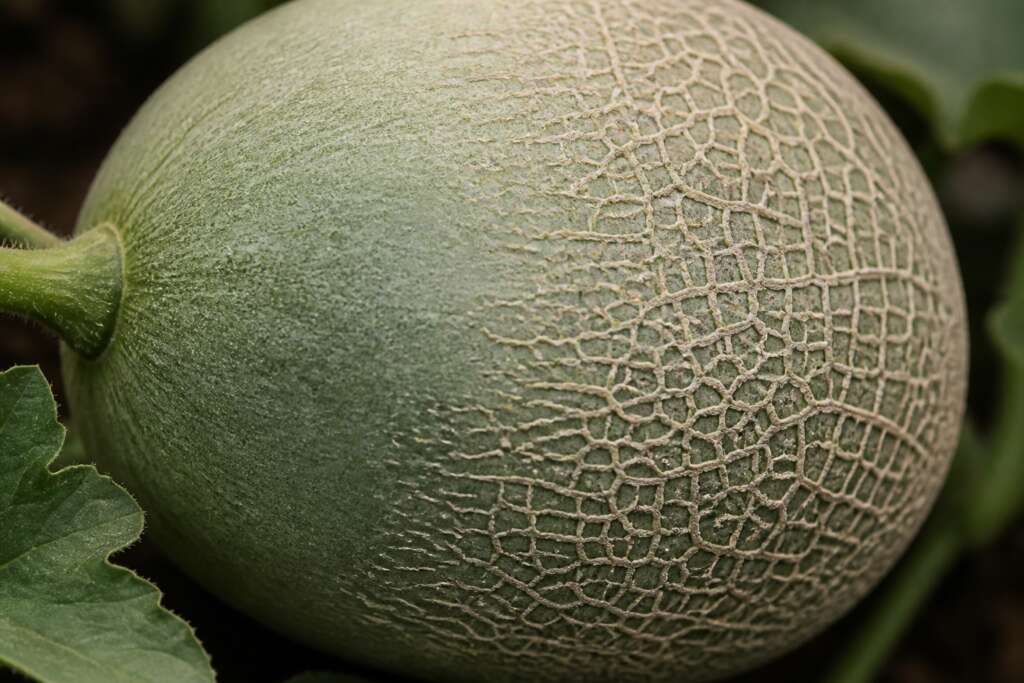
Netting often becomes visible near the blossom end after fruit expansion is well under way. Fissures extend, branch, and eventually meet. In some studied cultivars the first elements run mostly lengthwise before cross-connections turn them into a mesh. The schedule is cultivar-specific: in one three-cultivar study, visible fissures appeared 14–19 days after flower opening and the mature net stage was reached at 38–46 days.27
Reticulated and smooth skins differ not only in appearance but also in tissue structure, metabolites, and the activity of pathways involved in suberin, lignin, and cell-wall organization.5 A 2022 survey profiled 28 cultivars; among its 18 reticulated cultivars, total suberin content did not significantly track measured reticulation density. The visible design is more complicated than turning one chemical dial.6
Direct genetic evidence has also emerged. A 2023 map-based study associated a major chromosome-2 locus, CmSN, which encodes an EamA-like transporter, with netting in one smooth-by-netted cross.8 In 2024, transient overexpression reduced local netting, while silencing CmSN in smooth fruit produced local cork-like tissue but not a connected mesh; a near-isogenic line carrying the netted donor region developed netted fruit.9 Other crosses have mapped net density and width to several quantitative trait loci, so CmSN is important but not a universal one-gene explanation.10
The finished net becomes a new barrier
An open fissure leaks water more readily than intact cuticle. As wound periderm develops and its walls become suberized, that loss falls. In three netted cultivars, mature net tissue could resist water loss about as effectively as the remaining cutinized surface when suberized cell-wall layers with wax deposits had formed beneath the fissures.7
The rind has not returned to its original state. Some cracks may remain visible, and the raised surface has different chemistry and anatomy from the smooth areas between it. The fruit has instead built a functional replacement over many local failures.
Older work proposed—not demonstrated—that cork cells may improve resistance to mechanical injury.2 It is reasonable to describe the net as protective, but claims that it evolved specifically to make the melon “breathe” or that it guarantees disease exclusion run ahead of the evidence. Its best-demonstrated functional effect is restoration of the water-loss barrier as suberized layers with wax deposits mature.7
Normal netting is not the same as a split melon
Mature normal reticulation is dry, shallow, corky, and repeated across the rind. Its lines look healed. A damaging split is deeper and may expose moist tissue, gape open, soften at the edges, discolor, smell fermented, or invite decay. A fruit can make its expected net and still suffer a separate, harmful crack.
This distinction matters because patterned reticulation and damaging splitting can share a mechanical backdrop without being equivalent. Normal netting is a cultivar-typical series of shallow fissures followed by organized wound-periderm formation. A deep rupture is destructive structural failure. Excess watering late in ripening can increase melon-splitting risk; tomatoes after rain are a useful analogy, but the cellular mechanisms need not be identical.13
A 2026 study supplied a different, adjacent clue from destructive rind cracking rather than normal reticulation. It found higher peroxidase activity and lignin in cracking-susceptible or cracked rind, and identified CmPRX39, CmPRX48, and CmPRX51 as highly expressed candidate genes.11 Their protein interactions were predicted, and functional silencing, overexpression, or knockout tests have not yet been reported. The study identifies candidates; it does not prove that these genes initiate ordinary netting or damaging cracks.
Do not try to scrape or smooth normal netting. A melon with a deep or wet crack, decay, animal damage reaching the flesh, or a soft sunken area is not “extra net.” Damaged cantaloupes carry increased pathogen risk; discard a badly cracked or decayed fruit. Local Extension or a plant diagnostic service can help distinguish a dry cultivar trait from a disorder.12
The net cannot name harvest day by itself
Netting becomes coarser as many cantaloupes mature, but it starts well before peak eating quality and differs too much among cultivars to serve as a solo clock.7 University of Minnesota Extension gives a broad range of 35–45 days from flowering to maturity, depending on temperature, but the seed packet and the individual fruit are better guides than a universal countdown.13
For a slip-type muskmelon, look for several signals together. The background rind between the raised lines changes from green toward tan or yellow and loses some shine. The net feels coarse. A musky aroma develops. Most decisively, a mature abscission layer forms at the stem, and the fruit releases with little pressure or a gentle twist—“full slip.” Pick it then rather than waiting for it to fall and over-ripen.11315
Those cues are not universal across C. melo. Honeydew and several other groups do not reach full slip; some must be clipped and judged by cultivar-specific changes in color, smell, or firmness. Cantaloupe-style melons can continue some ripening after harvest, but their sugar content does not increase once detached. Read the cultivar description rather than turning one cue into a test for every melon.11415
Steady care beats tricks for a prettier net
A melon’s genes do more to decide whether it will be smooth, finely netted, or heavily reticulated than any home remedy. There is no sound reason to scratch the rind, mist the fruit, or deliberately stress the vine to “bring out” a pattern. Artificial wounds can make wound periderm in an experiment; in a garden they also create an unnecessary entry point and can ruin the crop.412
Keep soil moisture reasonably steady during flowering and fruit expansion. Minnesota guidance recommends deep, infrequent watering totaling about 1–2 inches a week, adjusted for rainfall and soil, then a gradual reduction as fruit ripens. Excess water in the final two weeks can split fruit, while prolonged drought, disease, or loss of healthy leaf area can limit the sugars the vine supplies.13
Water the soil rather than wetting the foliage, and support trellised melons with a broad sling before they become heavy.13 None of this draws each line of the net. It gives the plant the stable conditions in which its inherited surface program can unfold.
Wash the rind the knife will cross
A mature net can help restore the fruit’s water barrier, but its rough recesses can also harbor soil and microorganisms. A knife can move contamination from an unwashed rind onto the flesh. FDA notes that a netted rind and low acidity make cantaloupe particularly vulnerable, which is why commercial guidance treats netted melons as a crop needing particular care.712
Before cutting, rinse the whole melon under running water, scrub the rind with a clean produce brush, and dry it with a clean towel. Do not wash produce with soap, detergent, or commercial produce wash. Use a clean knife and board, refrigerate cut melon at 40°F (4°C) or below, and throw out fruit that is rotten or has a deeply damaged rind.1216
The rind keeps the record
Seen up close, the beige mesh is not merely an ornament and is not automatically a defect. Every strand marks a place where an expanding fruit exceeded an old surface and constructed a new one. The pattern feels ancient because it is made from an old plant solution: when a boundary breaks, build cork.
At harvest, read the net as a record rather than a clock. Combine it with color, scent, and—where the cultivar forms one—the stem’s abscission zone, plus the instructions for that cultivar. Then wash the history written on the rind before the knife passes through it.
References
- University of Missouri Extension: High tunnel melon and watermelon production
- Webster and Craig, 1976: Net morphogenesis and characteristics of the surface of muskmelon fruit
- Keren-Keiserman et al., 2004: Differing rind characteristics of developing fruits of smooth and netted melons
- Gerchikov et al., 2008: Wounding of melon fruits as a model system to study rind netting
- Cohen et al., 2019: A multilevel study of melon fruit reticulation provides insight into skin ligno-suberization hallmarks
- Manasherova and Cohen, 2022: Melon cultivars with varied skin appearances and the contribution of suberin to periderm formation and reticulation
- Puthmee et al., 2013: The role of net development as a barrier to moisture loss in netted melon fruit
- Liang et al., 2023: Natural allelic variation in the EamA-like transporter CmSN is associated with fruit skin netting in melon
- Liang et al., 2024: CmSN regulates fruit skin netting formation in melon
- Wang et al., 2016: Mapping quantitative trait loci for fruit traits and powdery mildew resistance in melon
- Hu et al., 2026: Genome-wide identification of the class III peroxidase gene family and its association with fruit rind cracking in Cucumis melo
- U.S. Food and Drug Administration: Case study on food-safety guidelines for cantaloupes; commodity-specific guidelines for cantaloupes and netted melons
- University of Minnesota Extension: Growing melons in the home garden
- University of Minnesota Extension: Harvesting and storing melons, squash, and pumpkins
- University of Illinois Extension: Muskmelon
- U.S. Food and Drug Administration: Selecting and serving produce safely