
By early September, a vegetable bed can look oddly exposed. The tomatoes may still be standing, but the first cleared spaces have begun to appear: a row where beans finished, a square where onions came out, the tired patch where cucumbers finally gave up. The garden is not empty, but it has begun opening little windows of bare soil.
That bare soil is easy to overlook because nothing dramatic seems to be happening. There is no wilting plant asking for water, no caterpillar chewing a leaf, no fruit demanding harvest. But an uncovered bed is still active. Rain strikes it. Wind dries it. Weed seeds read the light. Soluble nutrients move with water. Soil organisms continue their quiet work, only with less shelter above them.
A cover crop is a way of giving that bed a living task after the main crop is finished. Instead of leaving soil open until spring, you sow plants that are grown not for harvest, but for what they do while they are alive and what they leave behind after they die. University of Maryland Extension describes potential benefits that include preventing erosion, scavenging nutrients that might otherwise leach, building soil organic matter, and suppressing weeds.2 Which benefits appear depends on the species, growth window, and management.
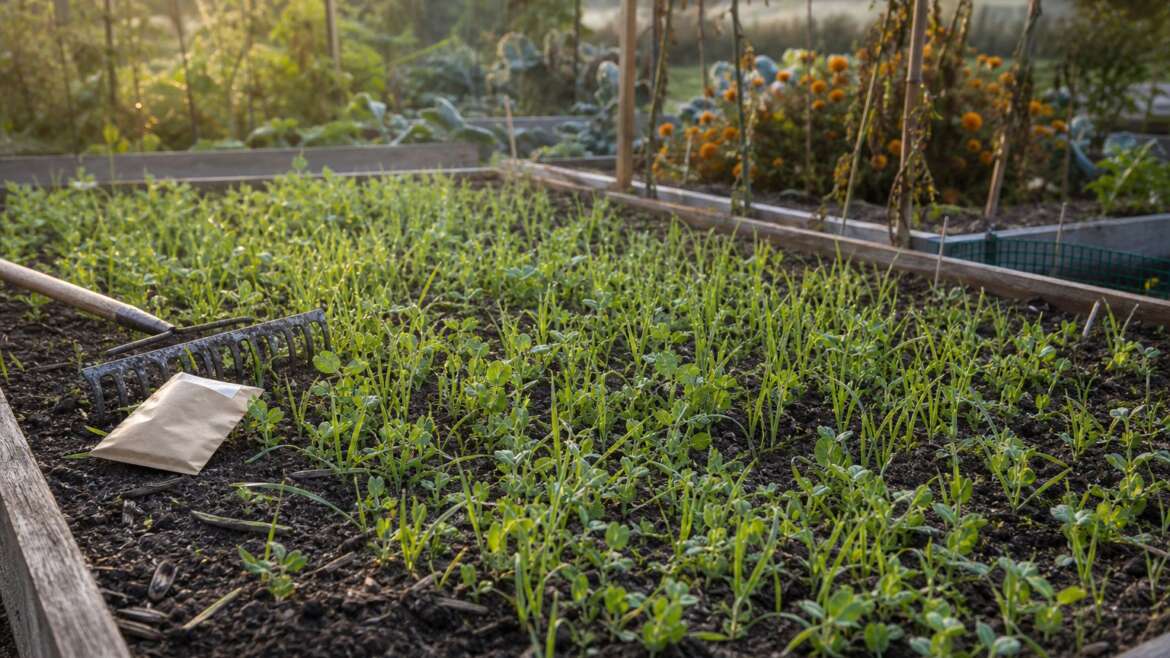
It is one of the most satisfying autumn jobs because it changes the feeling of the season. A bed that looked done becomes green again. Not in the lush, greedy way of July, but in a quieter register: small blades, pea tendrils, clover seedlings, rye roots, a living blanket stitched across soil before winter gets its say.
Why cover the soil at all?
Garden soil is more than a container for roots. It is a structure, a habitat, a bank account of minerals and organic matter, and a sponge whose usefulness depends on how well it is protected. When rain hits bare soil, droplets can break apart surface aggregates and start the slow work of crusting and erosion. When beds sit exposed, weeds gain an easy invitation. When nutrients are left soluble in wet seasons, some can move below the root zone before the next crop has a chance to use them.
Cover crops interrupt that pattern. Their leaves soften rainfall. Their roots hold soil in place. Their growth takes up nutrients that might otherwise drift away, then returns some of that material as the crop decomposes. University of Maryland Extension describes cover crops, also called green manures, as a tool that can lessen winter erosion, add organic material when turned under in spring, improve soil quality, and add nutrients.2
That sounds utilitarian, and it is. But the garden also changes visually. A bed of oats and peas in September has a different mood from a bed covered with old stems and dust. It tells you the season is not ending all at once. It is reorganizing.
The beginner’s choice: oats and peas
For a first attempt, spring oats paired with field peas can be approachable where local guidance predicts that both will winter-kill. Penn State Extension notes that oats grow quickly in fall, suppress weeds, scavenge residual nitrogen, and winter-kill after prolonged freezing.3 That last phrase matters: winter-kill is a climate outcome, not a promise printed into every seed. A mild winter or protected bed can leave survivors that still need a spring plan.6
A University of Minnesota vegetable-production article lists fall-planted oats, field peas, and radish among winter-killed cover crops used in its cold-region context and explains that choosing winter-killed species can reduce the need to incorporate living growth in spring.1 For a home gardener in a comparably cold climate who wants soil covered without a complicated termination job, that can be a generous combination. Check the exact crop and cultivar on the packet rather than assuming every pea or oat has the same winter hardiness.
Oats bring quick grassy growth and a fibrous root system. Peas bring broader leaves, tendrils, and the possibility of nitrogen fixation when compatible soil bacteria are present. Together they make a soft, green cover that is easy to understand. They are especially useful after crops that finish early enough to leave a fall growing window: sweet corn, onions, early potatoes, cucumbers, or any bed you decide not to replant with vegetables.
The main limitation is timing. Winter-killed crops need enough fall growth to provide the cover you expect. If you seed them too late, they may sprout politely and then disappear into cold before making much biomass. University of Maryland’s cover-crop guide emphasizes that species, planting date, and length of the growth window determine the result.6 Cover crops are plants, not magic dust. Give them time, seed-to-soil contact, and moisture for establishment.
The hardy option: winter rye
Winter rye is the cover crop for gardeners who missed the earlier window or want a plant that takes winter seriously. It is tough, quick to establish, and famously willing to keep soil occupied. University of Maryland Extension lists winter rye among popular fall-planted cover crops and notes that it is very hardy, with a massive root system and the ability to be planted latest in fall.2
That strength is also the caution. A cover crop that survives winter does not politely vanish when you want to sow carrots. University of Maryland’s guide notes that cereal rye can still perform after relatively late fall planting, but every winter-hardy cover needs an effective termination plan before it becomes a weed in the next crop.6
In a large field, that may be a machinery question. In a raised bed, it is a calendar question. If you plant winter rye where you want early peas, spinach, or carrots, spring may become awkward. The rye will be alive when you are impatient. Mechanical methods depend on species and growth stage, and University of Maryland notes that small plantings can instead be covered with an opaque tarp for 3 to 4 weeks.6 If rye occupies a bed intended for tomatoes, peppers, squash, or another later crop, you have more time to terminate it and manage the residue.
Winter rye is not bad because it is vigorous. It is useful because it is vigorous. The trick is not to use it casually. Think of it as a living winter tenant with a lease that you must remember to end.
What legumes add
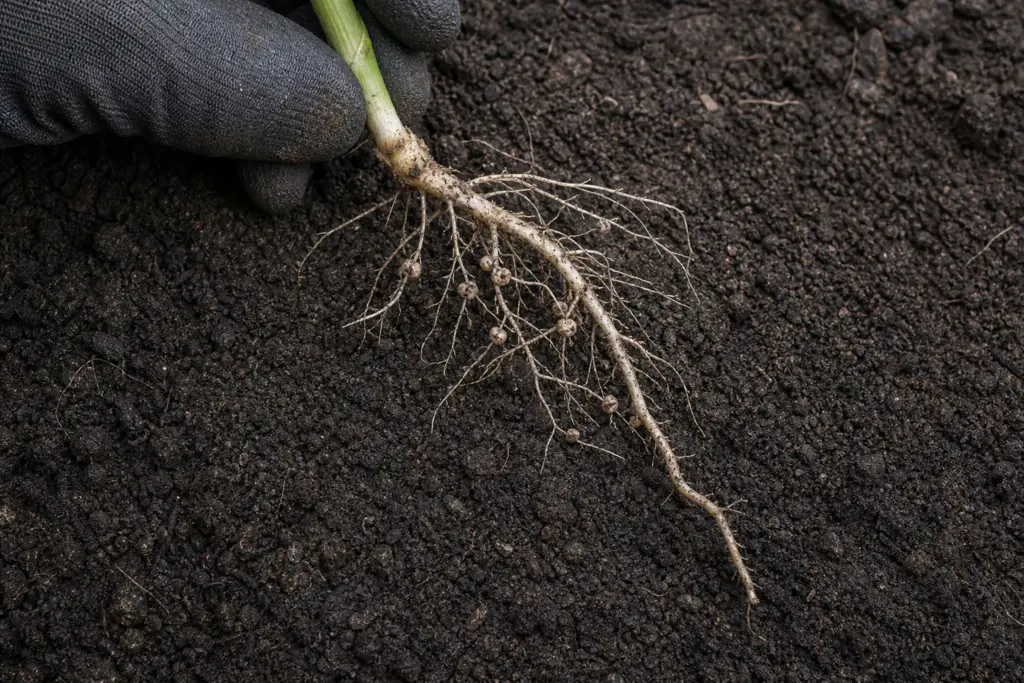
Legumes are the cover-crop group that makes gardeners use the word nitrogen with unusual enthusiasm. Crimson clover, hairy vetch, field peas, and related plants can form partnerships with rhizobia in root nodules. Through that partnership, atmospheric nitrogen is transformed into forms the plant can use. When the plant later decomposes, some of that nitrogen can become available to future crops. Our closer look at how pea root nodules work follows that partnership from root infection to an active nodule.
Oregon State University Extension explains the basic pattern: legumes such as crimson clover, Austrian field pea, and common vetch are nitrogen fixers, with bacteria in their root nodules taking nitrogen from the air and supplying it to the plant; after decomposition, some nitrogen becomes available for the following vegetables.4
This does not mean a packet of clover instantly replaces thoughtful soil fertility. Legumes need enough time to grow, the right bacterial partner, and appropriate management. University of Georgia Extension notes that using a cereal grain with a legume is common, because the grain establishes quickly and helps protect soil while the legume gets going; it also points out that legume inoculant may be important because rhizobia are specific to different legumes.5
For a small garden, this is less intimidating than it sounds. If you buy a cover crop mix, check whether the legume seed is inoculated or whether inoculant is recommended. If you are simply learning, start with oats and peas, or a small patch of crimson clover, and observe. The first year is allowed to be education.
Sowing is more like feeding birds than planting beans
Cover-crop sowing is refreshingly plain. Clear the bed of crop debris that needs to leave, remove established weeds, loosen and smooth the surface, and broadcast seed across the bed. The goal is not ruler-straight rows. The goal is even coverage.
Good soil contact matters. Oregon State University Extension recommends raking in larger seeds such as peas, vetch, and cereals lightly, mixing small seeds with sand to make broadcasting easier, watering them in, and keeping the area irrigated if dry weather continues.4 That advice fits a raised bed as well as a field. Seed left on top of dry crumbs is bird feed. Seed tucked into a moist surface becomes a crop.
Do not bury small seeds deeply. Do not polish the bed into dust. Rake enough to make contact, water gently, and keep an eye on the weather. September can be kind, but it can also be dry in precisely the week you are waiting for germination. A cover crop that is meant to protect soil still needs your help at the beginning.
In mixed beds where late tomatoes or peppers are still standing, you can sometimes sow around them. Pull mulch back, scatter seed in the open spaces, rake lightly where you can, and water. Oregon State suggests interseeding before the established crop casts too much shade.4 The cover may be less uniform than it would be in a cleared bed, but it can gain establishment time before the summer crop is removed.
The spring problem that is really an autumn decision
The most common cover-crop mistake is not bad seeding. It is forgetting spring. Every autumn cover crop should be chosen with the next planting in mind. Will it winter-kill? Will it survive? How early do you need that bed? Are you willing to cut it down, dig it in, tarp it, or wait?
University of Maryland Extension warns that cover crops should not be grown without a plan for termination, because they can become weeds in later crops.6 This is not meant to scare gardeners away. It is the practical center of the whole subject. A cover crop is only helpful if you know how it leaves.
Spring oats and forage radish typically winter-kill in colder parts of the Mid-Atlantic, although University of Maryland advises keeping a backup termination plan after a mild winter.6 Rye, winter wheat, and hairy vetch need more attention because they commonly resume growth. Depending on the crop and stage, gardeners may mow and then incorporate, remove tops for mulch or compost, or use an opaque tarp. Do not let a surviving cover set viable seed while you wait.
The waiting period matters because decomposition is not instant. University of Maryland explains that species and growth stage affect the carbon-to-nitrogen ratio of residue, which in turn affects decomposition and whether nutrients are released or temporarily immobilized.6 The interval is not one universal number; material, moisture, temperature, termination method, and the next crop all matter. If you want early spring salad crops, choose a cover expected to die on its own in your climate or plan the bed differently.
A simple September plan
For a small garden, the easiest approach is to match cover crop to bed schedule. A bed that finishes early enough for several weeks of growth may take spring oats and field peas where both are expected to winter-kill. A later-cleared bed may take cereal rye if it remains inside the local sowing window and you are comfortable managing it in spring. A bed reserved for very early sowing can be protected with suitable mulch or a reliably winter-killed crop rather than a vigorous overwintering grass.
September is a useful reminder, not a universal sowing date. University of Maryland gives late-summer and fall dates that vary by location, species, and forecast, while Oregon State recommends September to early October for overwintering covers in its Oregon context.2, 4 Use local extension guidance and the actual seed label. The practical question is whether that species has enough suitable weather to establish before growth slows or a killing freeze arrives.
If you are unsure, start with one bed. Sow it well, water it, and watch what happens. Notice how quickly weeds stop being the main thing you see. Notice whether the bed stays less crusted after rain. Notice what the residue looks like in March. Cover cropping becomes easier once you have watched one patch through a full cycle.
The practice also changes how you think about harvest. Pulling the last bean plant is no longer only an ending. It becomes the moment you choose the bed’s winter job.
Useful cover crop supplies
- Sow Right Seeds cover crop collection: three individual packets of winter rye, Dutch white clover, and winter oats for gardeners who do not need farm-scale quantities.
- Scotts Whirl hand-powered spreader: useful for broadcasting seed over larger beds or small garden plots; calibrate it for the seed and target rate rather than relying on a lawn-product setting.
- Bully Tools 16-inch bow rake: a sturdy rake for smoothing cleared beds and lightly working seed into the soil surface.
Final thoughts
A cover crop asks the gardener to think of the off-season as part of the garden rather than an absence from it. The bed is still becoming something in September, October, and November. Roots are exploring. Soil is being held. Nutrients are being gathered into living tissue. Rain is landing on leaves instead of naked ground.
That is the quiet beauty of the practice. It is not flashy. It does not give you a bowl of tomatoes or a vase of dahlias. It gives you a bed that goes into winter with a job, and a gardener who has learned to care for soil even when the main harvest is past.
Start small, choose a crop you know how to end, and let one tired bed turn green again. By spring, the lesson will be under your hands.
References
- University of Minnesota Fruit and Vegetable IPM: Reducing tillage in vegetable crops
- University of Maryland Extension: Cover Crops For Gardens
- Penn State Extension: Making the most of mixtures—considerations for winter cover crops
- Oregon State University Extension: Cover crops improve soil and support pollinators over winter
- University of Georgia Extension: Using Cover Crops in the Home Garden
- University of Maryland Extension: Introduction to Growing Cover Crops in the Mid-Atlantic