
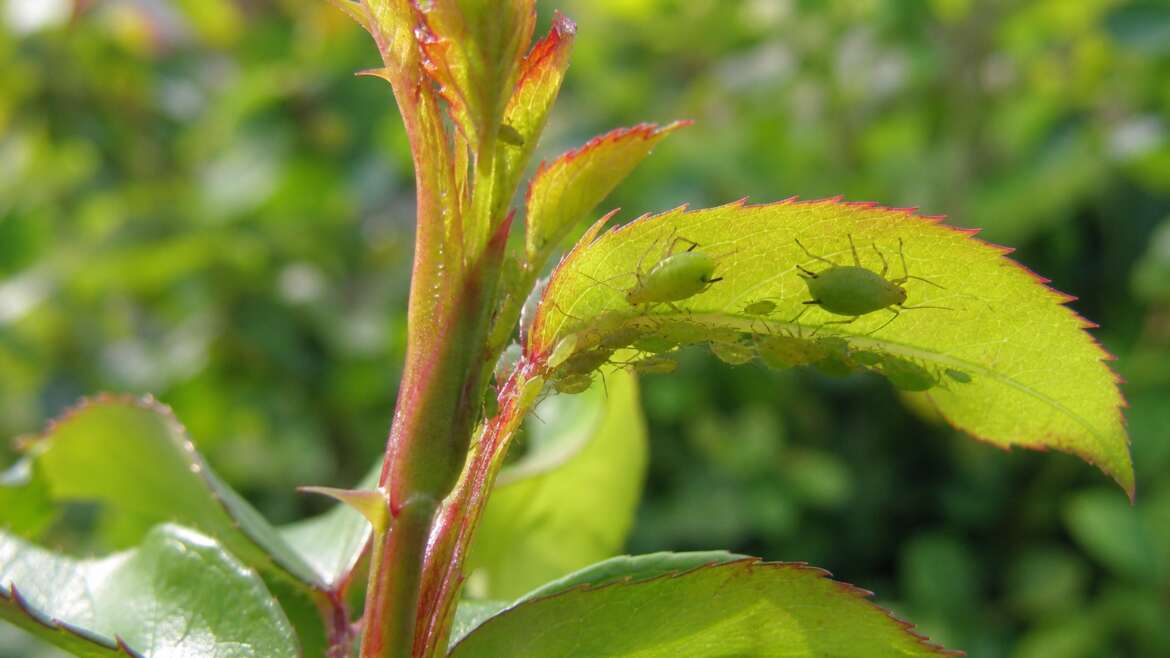
Turn over the curled tip of a rose in August and the family resemblance is hard to miss. Green adults stand among smaller nymphs, with pale cast skins caught on the leaf hairs. There may be no eggs in sight, no obvious males, and no neat division between one generation and the next.
That is not an accident of timing. Through much of the growing season, many aphid species reproduce by viviparous parthenogenesis: females develop daughters without fertilization and give birth to live nymphs instead of laying an external egg. Inside a reproducing female, embryos of different ages are already lined up. Inside some of the older daughter embryos, the next generation has begun.
Three generations can therefore overlap in one body: a mother, her unborn daughter, and the daughter’s developing embryos. Biologists call this telescoping of generations. It helps explain why a quiet shoot can seem to acquire a colony between two garden rounds, but speed is only part of the story. Maternal conditions can alter offspring fate before birth, although the signals and their route are still being worked out.1
The word “clone” needs a footnote
Parthenogenesis means development from an unfertilized reproductive cell. In the common summer phase of many aphids, there is no reduction to a haploid egg followed by restoration through sperm. A modified developmental program retains the maternal chromosome set, and the daughters in one clonal line are generally genetically alike.1
“Clone” is useful, but it does not mean that every aphid is interchangeable. New mutations can arise. Individuals sharing a genotype can develop differently because of temperature, nutrition, crowding, maternal effects, and microbial partners. Most strikingly, a wingless mother can produce winged daughters with essentially the same aphid genome. The difference is not necessarily a different set of genes; it can be a different developmental use of them.1, 4
Nor is parthenogenesis the complete aphid life cycle. Many species alternate asexual and sexual generations, and some alternate host plants as well. A few lineages reproduce asexually all year, especially where winters are mild or in protected crops. Any sentence beginning “aphids always” is likely to lose a species, a season, or both.1
Live birth removes two pauses
A summer aphid does not have to locate a mate before reproduction. She also does not lay an external, yolk-provisioned egg that must complete development outside her body. Her low-yolk embryos develop within tubes called ovarioles and receive maternal nutrients across the thin ovariole sheath. This form of live bearing is called pseudoplacental viviparity; it performs some of the provisioning work associated with a placenta without being the mammalian organ that the familiar word suggests.3
The newborn is a first-instar nymph, not a larva waiting for a pupal transformation. Aphids undergo incomplete metamorphosis. A nymph already has the recognizable aphid plan—six legs, antennae, a piercing beak, and usually the paired rear tubes called cornicles—then grows through a series of molts before adulthood.7
Under favorable conditions, the interval from newborn to reproducing female can be measured in days. Remove the search for a mate, overlap embryonic development with the mother’s life, and repeat the process across daughters, and population growth becomes multiplicative rather than merely quick. The colony did not materialize overnight. Much of its next week was already under construction.7
A grandmother can reach through her daughter
Telescoping generations are more than a biological packing trick. Developing daughters share an intimate physiological environment with their mother, and maternal nutrients cross the ovariole sheath. Environmental conditions clearly alter offspring fate, but the developmental signal and its route remain unresolved. Because early embryos may already be present within those daughters, maternal effects can extend to daughters and, in some situations, granddaughters.1, 3
This is why the popular line that an aphid is “born pregnant” is memorable but incomplete. A newborn summer female may indeed carry developing embryos. She has not mated, however, and pregnancy is being used as a loose analogy for a reproductive system unlike ours. The statement also fails for males, egg-laying sexual females, and the many moments in an aphid’s annual cycle when conditions are different.
The more accurate wonder is that development is nested. The mother is not simply producing copies; her body is also the first environment in which future generations develop. Biologists are still working out how that environment is translated into developmental instructions.
The same lineage can grow an escape plan
On a tender, uncrowded shoot, wingless females have an advantage. They do not complete and maintain a functional flight apparatus, and they can invest heavily in reproduction. Depending on the species and clonal line, tactile crowding—and sometimes host condition or enemy cues—can increase production of winged daughters, called alates, capable of leaving on the wind and searching for another plant.1, 4
The cue is not universal. In pea aphids, physical crowding produces a strong transgenerational wing response. Experiments with ladybird cues produced weaker and inconsistent results depending on the predator. “Predators make aphids grow wings” is therefore too simple. A mother appears to integrate evidence that the present patch is becoming a poor bet, and the sensitivity of that system varies among species and even among clonal lines.1, 4
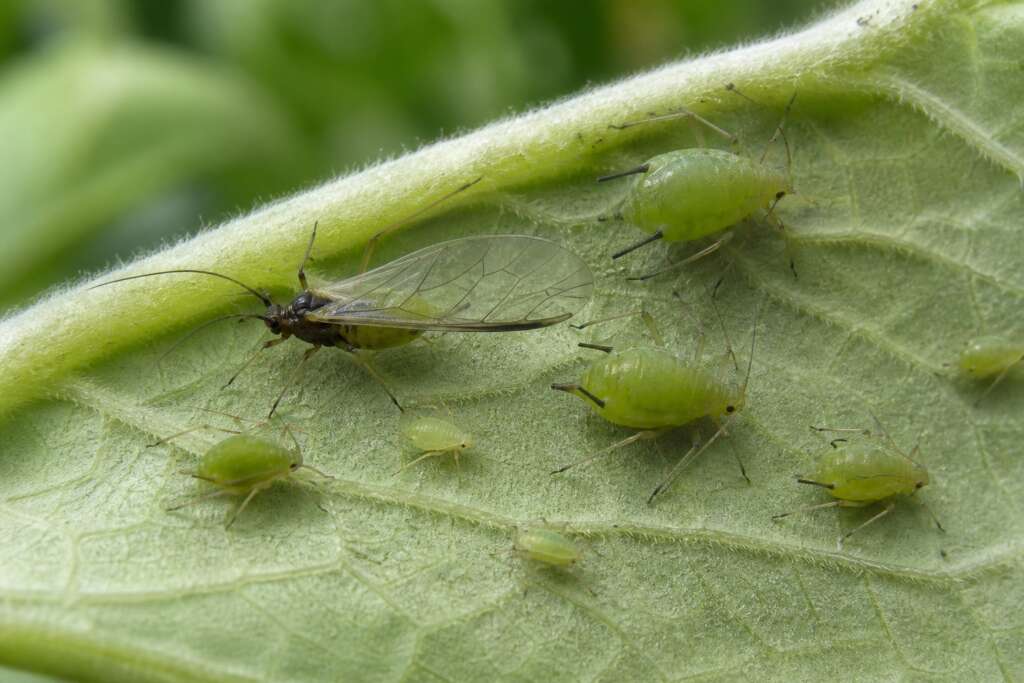
A winged daughter is not a wingless aphid with accessories added at the last moment. Her thorax, muscles, sensory system, development time, and reproductive schedule differ. Flight opens a route out, but it is costly and uncertain. A windborne aphid may reach a suitable host; many do not. Producing both forms lets one lineage exploit a good plant and prepare to abandon it.1, 4
Shortening days can bring back sex and eggs
For aphids with a cyclical life history in temperate climates, summer’s shortcut does not last forever. Lengthening nights are a reliable warning that tender foliage and warm weather will end. The changing photoperiod is detected somewhere within the nested maternal–embryonic system; studies have not resolved whether the mother alone or developing embryos participate in that perception. Later generations include males and egg-laying females; after mating, those females produce cold-resistant eggs that can bridge winter.1, 2
Some species make the seasonal plot more elaborate by moving between a primary woody host and summer herbaceous hosts. Others remain on one kind of plant. Temperature can modify the response to day length, and populations in mild climates or greenhouses may continue asexual reproduction instead of completing a sexual phase. The familiar diagram—spring female, summer clones, autumn sex, winter egg—is a good map for many species, not a passport issued to every aphid.1, 7, 8
The colony inherits bacteria with the family name
An aphid family line includes a partner too small to see with a hand lens. Almost all aphids house the bacterium Buchnera aphidicola inside specialized cells called bacteriocytes. Plant phloem is rich in sugars but its balance of essential amino acids can be inadequate for rapid insect growth. Experiments with pea aphids showed that Buchnera can supply much of that nutritional shortfall.5, 9
The association is not renewed from soil or leaf with each birth. In pea aphids, maternal Buchnera cells are selectively transferred into very young embryos at the ends of the ovarioles. Microscopy has caught them crossing at the interface between a mother’s bacteriocyte and an adjacent embryo. The bacteria are therefore nested and inherited alongside the aphids they help feed.6
Buchnera is the durable core of the partnership: a reduced, intracellular bacterium whose history has been tied to aphid bodies for roughly 200 million years. Even this widespread rule has exceptions. A few aphid lineages have lost Buchnera and replaced its nutritional role with another maternally inherited microbe.9
What a fast-growing colony does to a plant
Aphids insert slender stylets between plant cells and many species tap phloem. A modest colony on an established plant may cause little lasting harm. Heavy feeding on young tissue can yellow leaves, stunt shoots, or lock expanding leaves into curls that shelter the colony. The response depends on the aphid, the host, the plant’s age, and whether the insects carry a plant virus.7, 8
Because phloem sap has a high sugar-to-amino-acid ratio, aphids process large volumes and excrete excess sugar as honeydew. Shiny leaves, sticky furniture beneath a tree, ants commuting up stems, and black sooty mold can reveal aphids above eye level. Sooty mold grows on the honeydew rather than invading healthy leaf tissue, although a heavy coating is still a sign worth tracing to its source.5, 7, 8
Virus transmission changes the calculation. Some nonpersistently transmitted aphid-borne viruses can be acquired and inoculated during brief probes, so a few transient visitors may matter more than a large settled colony. Killing aphids after mottling appears does not cure an infected plant, and insecticide may act too slowly to prevent transmission in this particular class of virus.7, 10
Read the colony before reaching for a spray
Start with the plant, not the number of insects. A few aphids on a mature rose are different from a rapidly curling colony on a seedling or a virus-sensitive vegetable crop. Check several growing tips and leaf undersides. Look for fresh distortion, sticky honeydew, and ants, then look just as carefully for the aphids’ enemies.
Lady beetle larvae, flower-fly larvae, predatory midges, and lacewing larvae all consume aphids. Parasitic wasps leave swollen tan or gold aphid “mummies,” often with a round exit hole after the adult wasp emerges. A colony containing active predators or many mummies may already be declining. Broad-spectrum insecticides can remove that delayed control along with the visible pests.7, 8
On a sturdy plant, a forceful stream of water can knock off exposed aphids and rinse away honeydew. Localized, badly curled shoots can sometimes be pruned. Avoiding unnecessary high-nitrogen fertilizer also matters because lush, nitrogen-rich growth can favor aphid reproduction. These methods are unglamorous, selective, and often enough.7, 8
If damage continues and treatment is justified, a labeled insecticidal soap or horticultural oil is generally more compatible with natural-enemy conservation than a persistent broad-spectrum product. Coverage has to reach the insects, especially on leaf undersides, because these materials work by contact. Do not improvise a garden dose from household detergent, and do not assume “natural” means harmless. Follow the product label for the plant, temperature, pollinator precautions, and local law; soaps and oils can injure sensitive or drought-stressed foliage.7, 8, 11
Watch the colony without pulling it apart
A hand lens can turn an untreated colony into a short natural-history study. Look for the cornicles: paired structures near the end of the abdomen, conspicuous tubes in many species but reduced to low pores in some. Distinguish living pale nymphs from empty white skins. Note whether adults are wingless or whether an alate—often dark-thoraxed and clear-winged—has appeared. Then return at the same time on the next two days.7
The census may rise, but also watch for absences. Rain and hose water dislodge insects. Winged forms leave. Lacewing and flower-fly larvae feed mostly out of sight. A parasitoid turns a soft aphid into a dry shell. An ant trail may intensify as honeydew increases. The leaf is not a closed laboratory, and that is precisely what makes it informative.
The leaf is carrying a family tree
An aphid colony looks static at first: small bodies parked along a vein. In reality it is several clocks running inside one another. Embryos develop within daughters within mothers. A crowded mother can prepare winged offspring for a place she will never reach. Shorter days can redirect descendants toward sex and a winter egg. Even the bacterial partner that balances their diet crosses directly into the next generation.
That does not make aphids invincible. Weather, plant defenses, hunger, predators, parasitoids, disease, and the hazards of flight erase enormous numbers. It does explain their peculiar talent for being scarce on Monday and conspicuous by Friday. The colony’s growth begins before the first daughter touches the leaf. By the time you find the family, part of its future is already alive inside it.
Image note: Both article images are AI-generated photorealistic reconstructions, reviewed for plausible aphid anatomy and plant context.
References
- Ogawa and Miura, 2014: Aphid polyphenisms: trans-generational developmental regulation through viviparity
- Le Trionnaire et al., 2009: Transcriptomic and proteomic analyses of seasonal photoperiodism in the pea aphid
- Bermingham and Wilkinson, 2009: Embryo nutrition in parthenogenetic viviparous aphids
- Purandare, Tenhumberg and Brisson, 2014: Comparison of the wing polyphenic response of pea aphids to crowding and predator cues
- Akman Gündüz and Douglas, 2009: Symbiotic bacteria enable insect to use a nutritionally inadequate diet
- Koga et al., 2012: Cellular mechanism for selective vertical transmission of an obligate insect symbiont at the bacteriocyte–embryo interface
- University of California Statewide IPM Program: Aphids in home gardens and landscapes
- University of Minnesota Extension: Aphids in home yards and gardens
- Chong and Moran, 2018: Evolutionary loss and replacement of Buchnera, the obligate endosymbiont of aphids
- Zitter and Murphy, 2009: Cucumber mosaic virus
- Colorado State University Extension: Insect control with insecticidal soap