

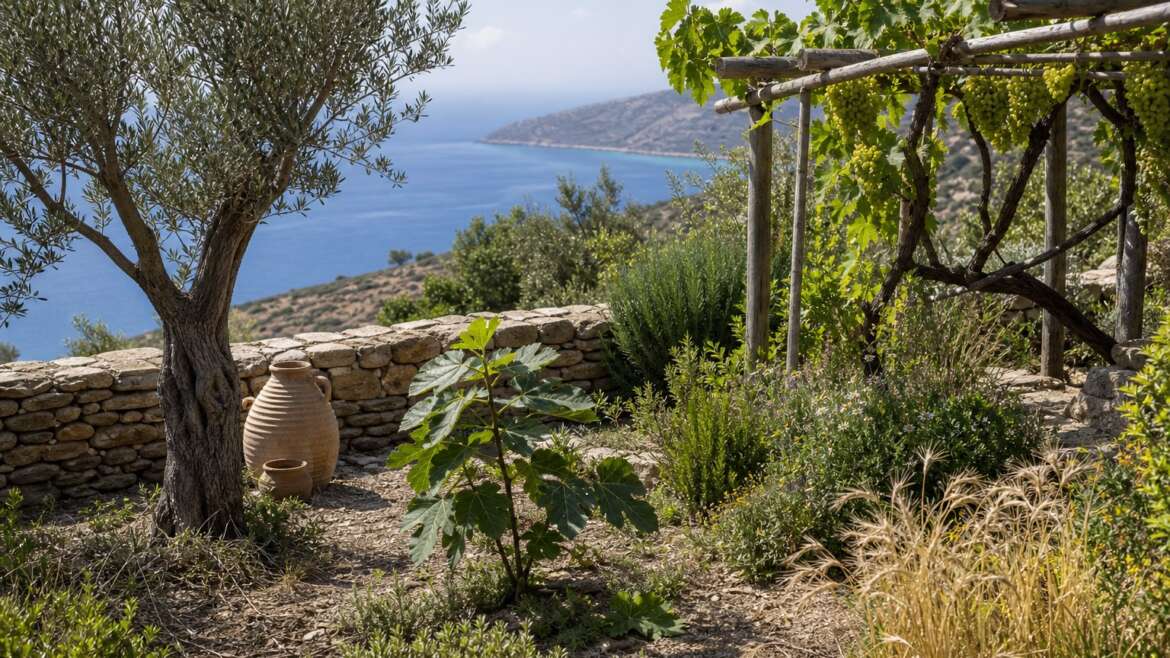
Olives and grapes can become so symbolic that their horticulture disappears. In ancient Greek stories and art, the olive may stand for Athena, victory, or peace, while the vine evokes Dionysus and wine. On actual cultivated ground, both were perennial woody plants. Someone had to establish them, prune them, judge a harvest, move the crop, and turn bitter fruit or sweet juice into something that would keep.
There was no single ancient Greek farm, and neither crop grew everywhere equally well. “Ancient Greece” spans many regions and centuries, with different rainfall, soils, access to labour, and routes to market. Olives and vines often belonged to mixed agricultural systems rather than replacing grain, pulses, figs, livestock, or gathered foods. Their importance lay partly in how perennial plants changed the calendar: the wood remained, but useful harvests still depended on recurring decisions.
The evidence covers millennia, not one timeless landscape
The Aegean history of grape use begins long before the city-states familiar from schoolbooks. At Dikili Tash in northern Greece, charred grape pips and pressed skins from the late fifth millennium BCE provide clear evidence that people extracted grape juice; the excavators describe wine as the probable product, not a certainty.1 That find establishes early processing, but it cannot tell us how a Classical Athenian trained a household vine thousands of years later.
Olive history also needs careful verbs. Archaeobotanist Evi Margaritis distinguishes simply exploiting wild olives from cultivating trees, domesticating populations, and organizing production. Her review finds small-scale use in the Neolithic Aegean and wider exploitation during the Early Bronze Age, while proposing that repeated cutting of olive wood may have encouraged later pruning and fruit management.2 It is a model for a long transition, not proof that an orchard system appeared all at once.
Perennial crops reorganized the working year
Olive and vine made sense within a riskier, more varied agricultural economy. A Cambridge history of the ancient Greek economy describes dry-farmed grain and pulses alongside perennial vines and olives. Because harvest failure was a recurring threat, diversification and storage were rational strategies, even as some farms also produced for sale.3 A household did not become secure merely by planting the two crops celebrated on painted pottery.
Hesiod’s Works and Days, an Archaic didactic poem, preserves one view of the labour calendar. Its speaker connects spring signs with vine pruning, then later directs the reader to cut ripe clusters, expose them to sun, keep them in shade, and finally draw the liquid into jars.4 Poetry is not a universal farm manual, and its timings should not be copied as modern instructions. It nevertheless makes the sequence visible: pruning, ripening, harvest, processing, and storage were separate pieces of work.
Xenophon’s fourth-century BCE Oeconomicus makes a related point through dialogue. The would-be manager asks how a planter reads wet and dry ground and handles figs, vines, and olives; the lesson treats productive planting as knowledge that can be observed and taught.5 The exact techniques belong to their text and setting, but the underlying habit is familiar to gardeners: inspect the site before choosing what the plant should do there.
Olive oil was made, not merely gathered
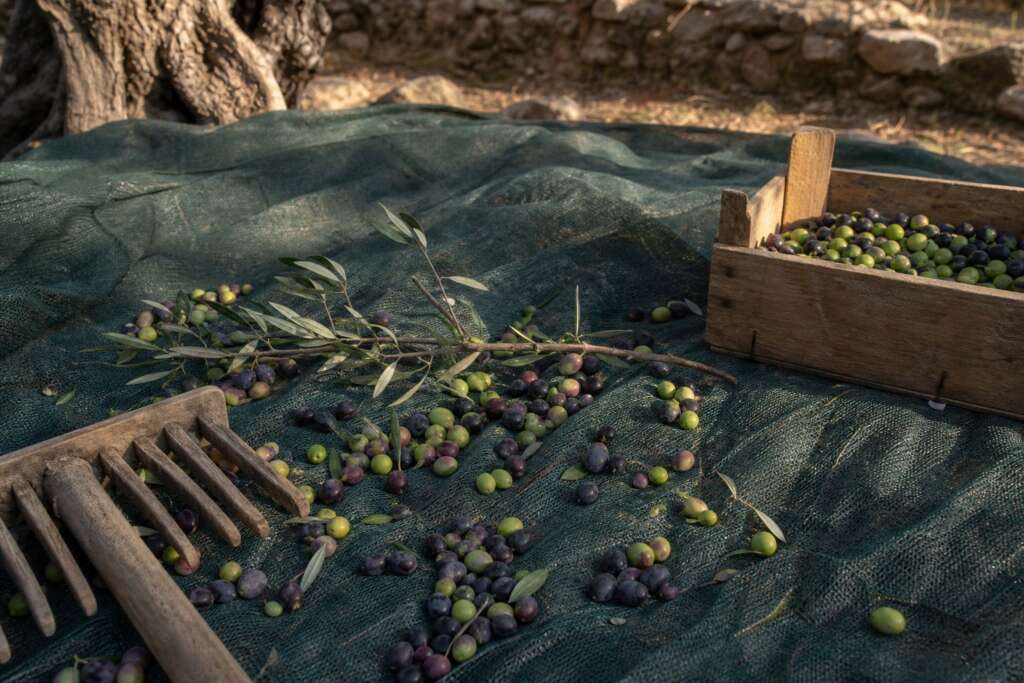
Fresh olives are not table-ready fruit. Harvest was followed by sorting and, depending on the intended product, curing or oil extraction. The Museum of the Olive and Greek Olive Oil in Sparta displays Linear B evidence from the second millennium BCE and traces oil through food, body care, lighting, worship, and changing production technology.6 Its prehistoric, Hellenistic, and Byzantine press reconstructions are also a useful warning: “the ancient olive press” was not one unchanged machine.
Oil could carry a highly specific public meaning as well as an everyday use. A Panathenaic prize amphora in the Getty collection, made at Athens around 500–480 BCE, was intended to be filled with oil from Athena’s sacred olives and awarded at the festival.7 That object does not describe all Greek oil or all Greek cities. It shows how cultivation, skilled processing, a religious institution, craft production, and competition could meet in one valuable container.
A permanent vine demanded annual decisions
A grapevine can live for years, but permanent wood does not mean a self-managing crop. Shoots have to be selected and supported; shade, airflow, and fruit load change as growth advances. Hesiod’s seasonal sequence matters here because it separates the enduring plant from the repeated work. Training a vine over a pergola may combine summer shade with fruit, but the support must carry mature growth and still allow access for pruning and harvest.
Ripeness was only one harvest question. Damaged clusters, birds, rain, and disease could affect what reached the vessel. A sound grape also carries a natural waxy bloom that can look dusty; our guide to distinguishing grape bloom from powdery mildew explains why appearance alone is a poor diagnosis. Close observation is more useful than treating every pale surface as disease—or every shrivelled berry as harmless.
Growing olives and grapes now
The old pairing is attractive, but a modern garden must begin with its own climate. The Royal Horticultural Society’s advice, written for UK conditions, places olives in warm, sunny, sheltered, freely draining sites and recommends containers where plants need frost-free winter protection.8 Elsewhere, local extension guidance should take priority. “Drought-tolerant” means an established plant can cope with limited water better than many alternatives; it does not mean a newly planted tree can be left dry, or that roots will tolerate waterlogged soil.
For grapes, match the cultivar and rootstock to winter cold, summer heat, disease pressure, soil, and whether the crop is for the table or for wine. Vines need sun, drainage, a durable support, and regular training and pruning; late frost and humid-season fungal disease can make a picturesque site unproductive.9 Leave enough access to work on both sides of a trellis rather than squeezing a vigorous vine into a decorative corner.
- Plan for processing. Home-grown olives remain intensely bitter until properly cured. Use a tested food-safety method rather than tasting them straight from the tree.
- Separate water needs. A young olive, a fruiting grapevine, and nearby Mediterranean herbs may not need identical irrigation. Grouping plants by appearance can conceal different root zones and establishment needs.
- Allow working space. Nets, crates, ladders, pruning tools, and fallen fruit all need room. A productive vine over a seat also brings insects, staining fruit, and seasonal cleanup.
- Keep grapes from dogs. Grapes and raisins can cause acute kidney injury in dogs, and the toxic dose is unpredictable. Contact a veterinarian promptly if a dog eats them.10
Borrow the relationship, not the scenery
The useful historical lesson is not that every garden needs an olive, a vine, and an amphora. It is that plants acquired meaning through repeated work: choosing ground, waiting for wood to mature, pruning, harvesting, processing, and storing. A cold or wet garden may need entirely different species to provide edible fruit, summer shade, or evergreen structure.
If the site can genuinely support these plants, give each one a clear role and enough room to perform it. Our article on translating ancient Greek garden ideas into a modern layout begins with routes, shade, water, and use rather than replica props. That approach keeps the most interesting part of olive and grape history in view: a celebrated landscape was also a working one.
References
- Soultana Maria Valamoti and colleagues, “Grape-pressings from northern Greece: the earliest wine in the Aegean?”, Antiquity
- Evi Margaritis, “Distinguishing exploitation, domestication, cultivation and production: the olive in the third millennium Aegean”, Antiquity
- Daniel Jew, “The Agricultural Economy”, in The Cambridge Companion to the Ancient Greek Economy
- Hesiod, Works and Days, especially lines 565–575 and 609–614, translated by Gregory Nagy
- Xenophon, Oeconomicus 19, translated by E. C. Marchant
- Piraeus Bank Group Cultural Foundation, Museum of the Olive and Greek Olive Oil
- J. Paul Getty Museum, “Attic Panathenaic Amphora”, object 77.AE.9
- Royal Horticultural Society, “How to Grow Olives”
- Royal Horticultural Society, “How to Grow Grapes”
- Cornell University College of Veterinary Medicine, “Grape and raisin toxicity”