
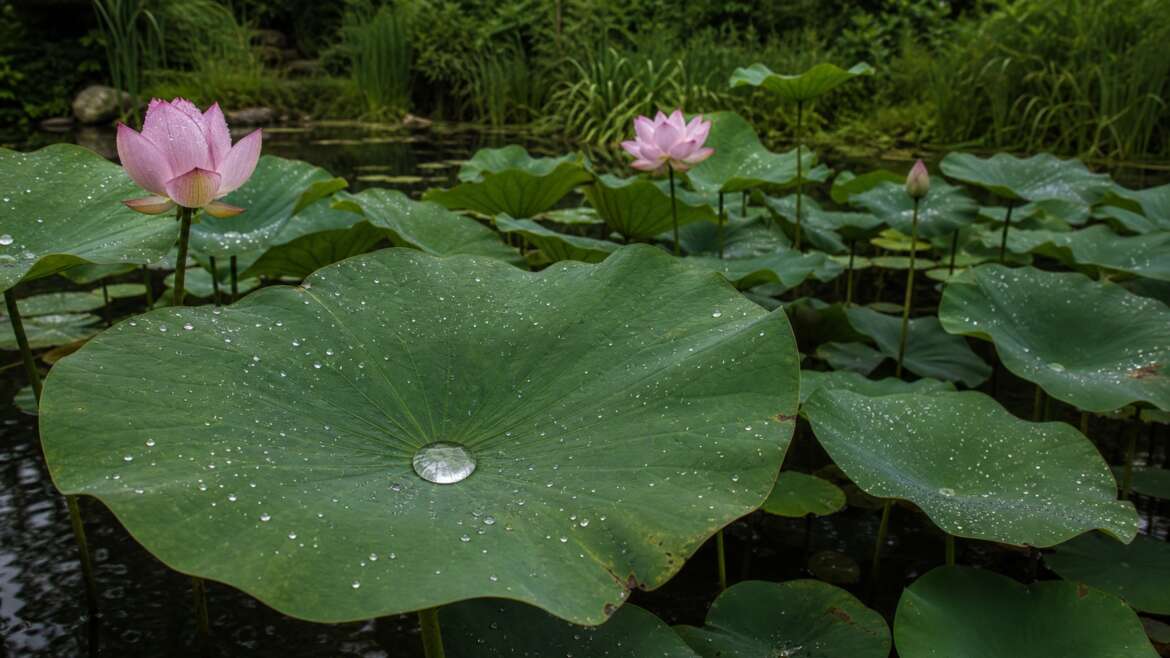
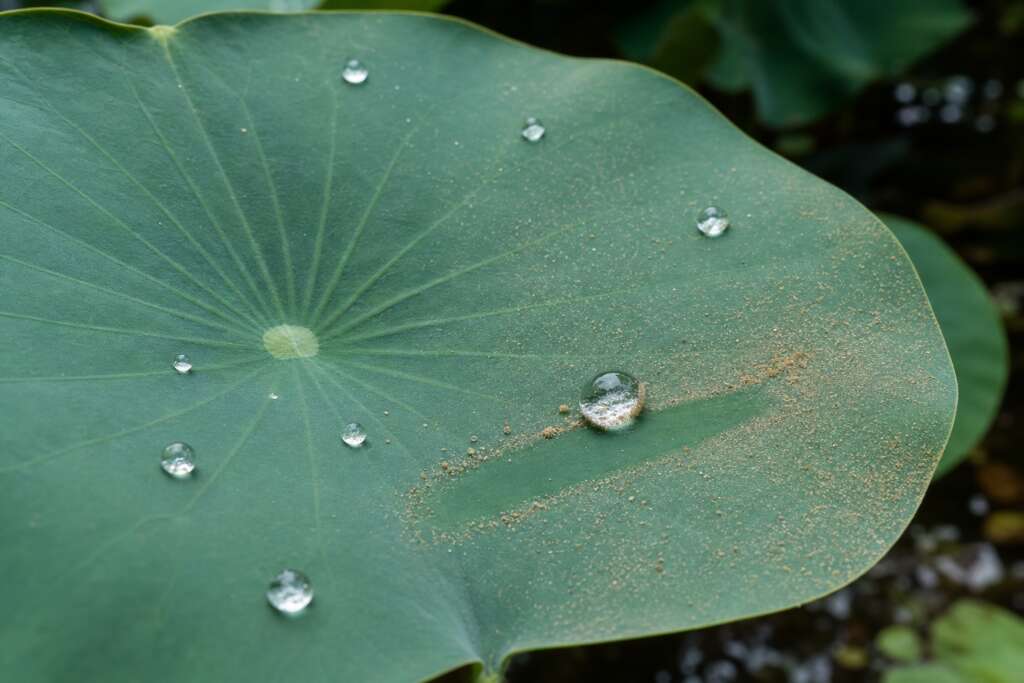
After a July shower, a sacred lotus pond seems to hold a second, smaller weather system. Bright beads sit on the leaves without spreading. A breath of wind sends them skittering toward an edge, gathering dust as they go. Where a droplet has passed, the green can look newly polished.
The leaf is not secreting soap, and water is not sliding from a perfectly smooth skin. The trick is almost the opposite: a landscape of tiny bumps carrying an even finer forest of wax crystals. Together they keep a raindrop from making much contact with the leaf at all.
This is the Lotus Effect, one of botany’s most influential lessons for materials science. It is often reduced to the phrase “self-cleaning,” but the real story is better. The effect depends on architecture at two scales, a cushion of trapped air, weak adhesion, and a moving droplet that can pick up the right kind of dirt. It is less like washing a plate than rolling a soft, temporary lint brush across a surface.
The leaf is rough in two different ways
To the unaided eye, a lotus leaf can look smooth. Under a scanning electron microscope, however, its upper surface rises into closely packed microscopic papillae: rounded projections made by the epidermal cells. Each papilla is covered with densely arranged wax tubules roughly 100 nanometers wide. One scale is measured in millionths of a meter, the other in billionths.12
Botanists call this a hierarchical surface because the larger relief carries a smaller one. Wax alone can repel water, but chemistry is only part of the result. The papillae and crystals greatly reduce the area where water and leaf can meet. A similar outer layer of epicuticular wax crystals makes the bloom on a grape, although its structure and job are not identical to the lotus surface.
In a 1997 survey of 200 water-repellent plant species, Christoph Neinhuis and Wilhelm Barthlott found that persistent repellency was associated with convex or papillose epidermal cells and a very dense layer of epicuticular wax. The lotus is a spectacular example, not the only plant to have discovered roughness as a way of managing water.3
A droplet balances on leaf and air
On ordinary glass, water spreads into a low dome because much of the liquid can touch the solid. On a lotus leaf, a drop rests mainly on the high points of the waxy texture, with pockets of air held beneath it. This suspended arrangement is known as the Cassie state. The drop behaves as though part of the surface below it were missing.
Scientists describe the shape with a contact angle: the angle where the edge of a droplet meets a surface. A larger angle means a rounder bead. Superhydrophobic surfaces are generally defined by contact angles of at least 150 degrees together with very low resistance to sliding. Measurements on intact lotus leaves have reached about 162 degrees.28
Roundness alone is not enough. A rose petal can hold an almost spherical drop so firmly that the drop remains attached when the petal is turned over.1 A lotus drop has both a high contact angle and low adhesion: there is little difference between its advancing and receding contact angles, a property called low contact-angle hysteresis. Tip the leaf slightly, or let a new raindrop strike, and the bead can move.
Press hard enough, damage the wax, or add a substance that lowers water’s surface tension, and liquid can invade the texture. In that more intimate Wenzel state, the same roughness can increase pinning instead of preventing it. The air cushion is an achievement, not a permanent emptiness.
Rolling water can carry particles away
Dust adheres weakly to the pointed waxy landscape because it, too, has relatively little true contact with the leaf. When a droplet rolls past, many loose particles cling more strongly to the water than to the surface. They ride away on or within the bead. Experiments with contaminated leaves showed that moving droplets could remove particles and leave the surface visibly cleaner.3
That simple picture is useful, but recent experiments have made it more exact. Particle removal depends on particle size, wetting properties, the force holding the particle to the surface, and whether the drop actually collides with it. Very small particles may be swept up differently from larger grains, while strongly attached contamination or particles lodged between surface features may remain. A stationary bead beside a speck does no cleaning merely by being round.4
“Self-cleaning” therefore means that a particular surface makes routine contamination harder and allows moving water to remove much of what does arrive. It does not mean that every stain disappears or that the leaf never becomes dirty. Rain supplies the transport; the leaf supplies unusually weak landing places.
The larger bumps protect the smaller ones
A surface made from delicate wax crystals sounds poorly suited to life outdoors. This is where the larger papillae do a second job. Their tops take much of the mechanical contact, sheltering wax in the valleys between them. In rubbing experiments, lotus leaves retained strong water repellency after damage that made flatter waxy leaves much more adhesive to droplets.2
The protection is not unlimited. Fingers, cloth, windblown grit, age, and atmospheric exposure can wear away surface structure. Nor should every waxy plant be polished in the hope of revealing a shine. The pale coating on a plum, cabbage, or succulent is part of the plant, not dirt.
Living surfaces also have an advantage over manufactured copies: some plants can rebuild damaged epicuticular wax. A study across 17 species found wax structures closing experimental gaps, although the ability and pattern varied by species.5 The comparison is general rather than proof of a measured repair rate for lotus, but it points to a problem engineers still face. A paint cannot grow a new epidermis.
Keeping the upper surface dry may protect breathing pores
Sacred lotus is unusual in placing most of its stomata on the upper side of the floating or emergent leaf. These microscopic pores exchange carbon dioxide and water vapor with the air. On a wettable leaf, a persistent film of water can cover stomata, slow gas exchange, and create the moist conditions that many microbes need.
A water-repellent surface sheds that film quickly. Researchers have consequently proposed that leaf hydrophobicity helps preserve photosynthesis and gas exchange while also reducing the attachment and growth of pathogens.18 Those functions are biologically plausible and supported across plant studies, but it is wise not to turn one beautiful surface into a single-purpose adaptation. Cuticles and waxes also limit uncontrolled water loss and mediate interactions with heat, light, insects, and chemicals.
Leaves solve these pressures in many ways. Some repel water with wax; others use hairs, folds, or combinations of structures. The soft nap described in why some leaves grow velvet changes the boundary between leaf and air by a different piece of miniature engineering.
A true lotus is not a water lily
The plant behind the famous effect is sacred lotus, Nelumbo nucifera. It is an aquatic perennial that grows from rhizomes in mud and sends up round, peltate leaves, meaning that the stalk joins near the middle of the blade rather than at a notched edge. Mature leaves often stand above the water like shallow green dishes.7
Water lilies belong to a different family. Their floating leaves often have a deep slit running from the margin toward the stalk. Some Nymphaea species are called lotus in common names, which has caused genuine confusion in scientific and popular accounts, but their leaves should not be treated as interchangeable with Nelumbo.1
A useful first clue at a pond is an unnotched, nearly circular leaf held clear of the surface, with its stalk attached beneath the blade. Identification should come before the droplet experiment.
Watch the effect without rubbing it away
A living lotus offers a simple observation on a still morning. Choose a healthy, mature leaf and use a pipette or spoon to place a few drops of clean water near its center. Do not add detergent. Tilt is already built into many leaves, so the beads may roll outward at once; on a level leaf, a gentle tap on the supporting stalk may be enough. Observe without bending or tearing the blade.
Compare the result with a nasturtium, cabbage, or another leaf after identifying it. Note three separate things: how round the drop becomes, how easily it begins to move, and whether it leaves a wet trail. Those observations are more informative than the label “waterproof.” A surface may make a high bead yet hold it tightly, or shed the bead while retaining some dirt.
Avoid rubbing the leaf before or after the test. Rubbing changes the very structure under investigation, and soaps or spray adjuvants can make the surface wettable by lowering surface tension. A magnifying glass will not reveal the nanoscopic wax tubes, but side light makes the droplet’s spherical profile and clean edge easier to see.
Also check where the water came from. Pearls present at leaf tips or margins at dawn on an otherwise dry plant may be plant-released guttation droplets, not rain or dew. The bead’s shape tells you about the surface; it does not by itself tell you the source.
One leaf changed how engineers think about roughness
For much of industrial history, a cleanable surface was expected to be flat and easy to wipe. The lotus suggested another route: make a surface rough in carefully chosen ways so water and contaminants cannot obtain a strong hold. The 1997 work that brought the effect wide attention helped open a large field of biomimetic research into paints, roof tiles, textiles, glass, sprays, and other coatings.16
Copying the principle is harder than embossing a field of bumps. A useful artificial surface must combine the right feature sizes, surface chemistry, low droplet adhesion, optical and mechanical requirements, and resistance to abrasion. Its texture also has to survive weather and manufacturing at a sensible cost. Some applications can do this; others lose their performance when their finest structures wear down or become fouled.
The lesson from the plant is therefore not a recipe for a universal coating. It is a design relationship: chemistry, shape, and scale work together. Measure only the contact angle and you can miss whether a drop rolls, pins, floods the texture, or removes a particle. The living leaf is a system, not a number.
What the Lotus Effect cannot promise
Rolling water works best on loose particles that remain above the texture and are weakly attached. It should not be assumed to remove oils, sticky residues, mineral crusts, or biofilms. Surfactants can collapse water repellency, while mechanical damage and age can alter the waxy surface.12 Particle size relative to the texture, the depth of contamination, and the path of the droplet all matter. Even a perfectly spherical bead may roll around a particle rather than collect it.4
These limits do not diminish the effect. They rescue it from advertising language and return it to botany. Sacred lotus has not evolved to keep a laboratory coupon spotless. It has evolved a renewable boundary between living tissue and an untidy pond environment, one that makes wetting and attachment unusually difficult.
The clean leaf above the mud
The old image of a pure lotus rising from mud gains something from the microscope. The leaf is not clean because the pond fails to reach it. Rain, dust, spores, and insects arrive as they do everywhere. Cleanliness emerges from how little purchase the surface gives them and from what happens when the next drop begins to roll.
From a path, the movement lasts only a second: one silver bead gathers another and slips over the rim. Inside that second are structures too small to see, air held where water might have been, and a principle that crossed from a summer pond into factories and laboratories. The lotus does not avoid the weather. It has built a surface that puts the weather to work.
References
- Barthlott, 2026: The purity of sacred lotus: superhydrophobic self-cleaning plant surfaces and the consequences revisited
- Ensikat et al., 2011: Superhydrophobicity in perfection: the outstanding properties of the lotus leaf
- Neinhuis and Barthlott, 1997: Characterization and distribution of water-repellent, self-cleaning plant surfaces
- Geyer et al., 2020: When and how self-cleaning of superhydrophobic surfaces works
- Koch et al., 2009: Self-healing of voids in the wax coating on plant surfaces
- Koch, Bhushan and Barthlott, 2008: Diversity of structure, morphology and wetting of plant surfaces
- Royal Botanic Gardens, Kew: Nelumbo nucifera species profile
- Hashimoto and Itoh, 2026: Managing water on plant leaf surfaces