


Turn over a bean leaf in July and you may find a row of white pinheads hovering beneath it. They are too orderly for dust and too widely spaced for mold. Each one hangs at the end of a filament so fine that the egg seems to be floating a fraction of an inch away from the leaf.
The obvious impulse is to wipe the strange growth away. That would remove one of the garden’s more elegant nurseries. The pinheads are green lacewing eggs, and the threads beneath them are not accidents. A female built a separate stalk for every egg she laid.
Why go to the trouble? The familiar answer is cannibalism: a newly hatched lacewing larva is a hungry predator, and distance keeps it from immediately reaching its unhatched siblings. Experiments support that explanation, but it is only part of the story. Depending on the lacewing and the enemy, a stalk can also frustrate ants, slow other predators, and even carry chemical defenses. The mother’s choice of leaf can place the future hunter close to its first meal.
The leaf is holding eggs on threads
Green lacewings belong to the family Chrysopidae. Their adults are the delicate insects with long antennae, golden eyes, and four transparent, densely veined wings held like a roof over the body. Their eggs look nothing like the adult. University of California’s Integrated Pest Management program describes them as oblong, no more than about 1.5 millimeters long, and placed individually at the ends of silken stalks. Fresh eggs may be pale yellow-green or white, then shift toward blue-green and gray as hatching approaches.1
Eggs may be laid singly or in small groups.7 Stalk length and spacing also vary. The family resemblance is strong enough to make a useful garden clue, but a photograph of an egg cluster is rarely enough for a species identification.
Look from the side. A lacewing egg should resolve into a small oval, one filament, and one attachment point. It is not a tuft, a branching growth, or a bead strung into a web. Its odd architecture becomes obvious only when the light catches the stalk.
A lacewing begins as a suspended pinhead
The female makes that architecture in seconds. She places a drop of silk material on the leaf or stem, raises her abdomen, and draws the drop into a thread. After the filament stiffens, she deposits the egg at its tip. Research on green lacewing silk found a rare cross-beta protein structure. The resulting stalk combines high sideways stiffness with considerable stretch, which lets something almost invisible hold an egg clear of the leaf.2
It is a very different solution from the shelters other young insects use. A spittlebug nymph builds a bubble nursery around its own body. A lacewing mother leaves no chamber at all. She changes the geometry of the leaf, lifting a vulnerable egg into a narrow piece of space that many crawling mouths cannot easily use.
The stalk is often called silken, but it is not a miniature strand pulled from a moth cocoon. It is a specialized secretion made by the female’s reproductive system and hardened in air. Its job begins before the larva exists and ends after it holds a pale empty shell above the leaf.
Distance buys time from hungry siblings
Green lacewing larvae are predators from the beginning. They emerge with curved, paired mouthparts and no family sentiment. University of Georgia Extension explains the stalk as a way to reduce cannibalism when the young predators hatch.3 The useful word is reduce. A stalk is an obstacle, not a force field.
In experiments with Chrysopa oculata, first-instar larvae ate more eggs when the stalks had been removed than when they remained attached. Unfed adults also readily ate stalkless eggs while avoiding many eggs still on their supports. Hungry lady beetles consumed eggs in both treatments, although the stalks provided some protection.4
That result makes the little pedestal easier to understand. It separates the egg from the surface where a predator is already walking. When one larva hatches, it must leave its shell, negotiate the filament, and reach the leaf before it can hunt. Nearby siblings may still be suspended beyond an immediate sweep of its jaws.
Cannibalism is not a mistake in a predator’s design. An unhatched egg is food, and eating a future competitor can help a larva survive when prey is scarce. Natural selection does not need to make siblings gentle. It only needs to make enough eggs inconvenient to reach.
The delicate adult leaves behind a predator
The adult gives little warning of what is coming. A common green lacewing is a soft-bodied, weak-flying insect, often seen near a porch light on a summer evening.7 Its wings are a fine lattice, its body is usually green, and its eyes can shine copper or gold. UC IPM gives an average adult length of about three-quarters of an inch.1
Adult diets vary. Many feed on nectar, pollen, honeydew, and yeasts; adults of some groups also hunt. The larval stage is the more consistent predator. Lacewing larvae are flattened, mottled, and vaguely alligator-shaped, with paired mouthparts that curve inward. They seize small prey and draw out its contents through those jaws. Aphids are famous victims, but the menu can include mites, thrips, mealybugs, scales, leafhoppers, small caterpillars, and insect eggs.1, 9
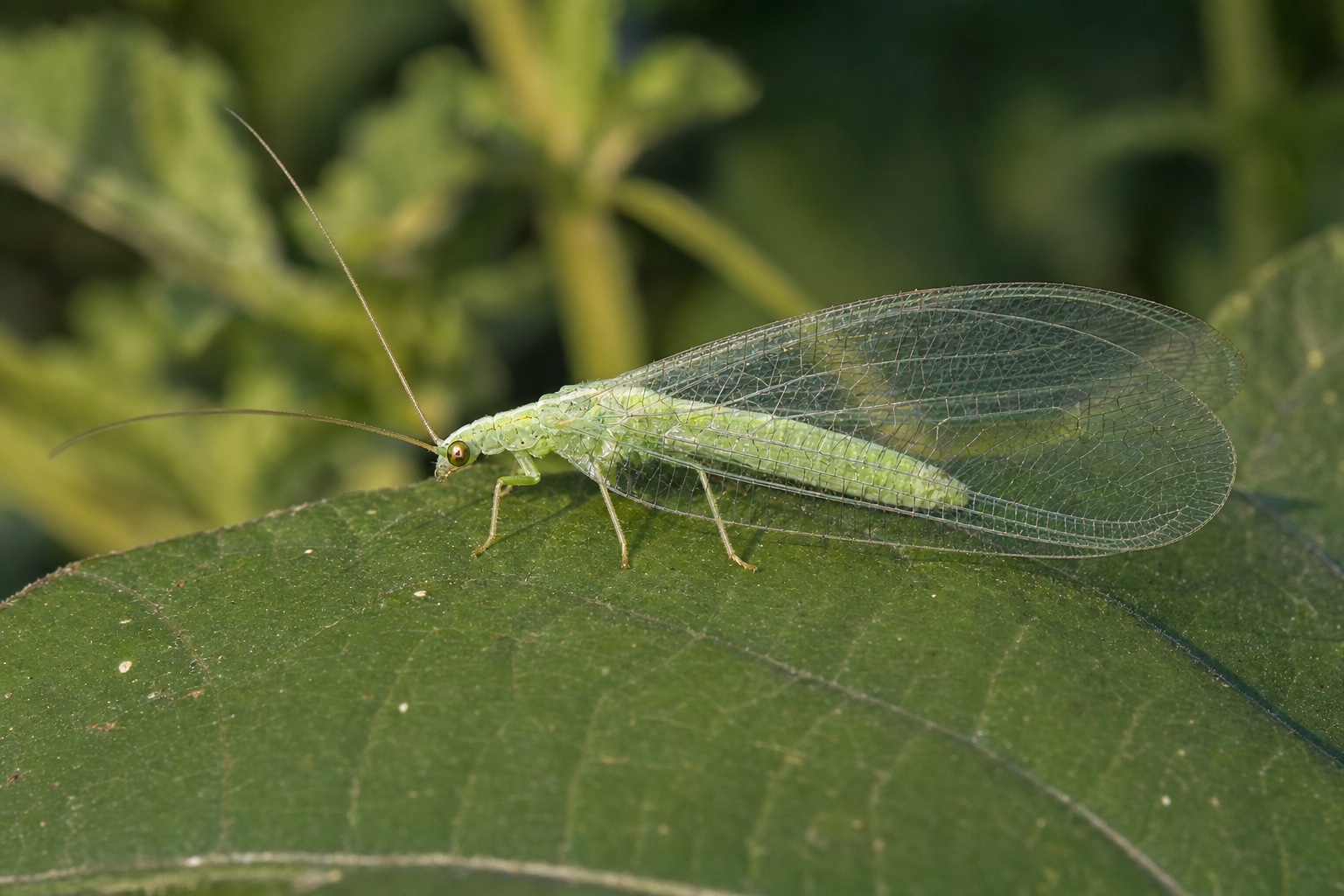
In warm conditions, the passage from egg through three larval instars, pupa, and adult can take roughly four to six weeks, and several generations may follow one another in a season.1 The quiet adult on the window screen and the bristled hunter under a leaf are the same life arranged into two very different jobs.
Some stalks do more than lift
The cleanest version of the story says that all lacewing stalks keep siblings apart. Biology is less uniform. One green lacewing, Ceraeochrysa smithi, coats its egg stalks with droplets of oily fluid. Researchers found fatty acids, an ester, and aldehydes in the coating. Compared with a related lacewing whose stalks lacked the fluid, those eggs were better protected from ants, and components of the secretion were strongly irritating in a test with cockroaches. After hatching, the larva drank from the stalk, perhaps gaining nutrition, defensive chemicals, or both.5
That is a remarkable adaptation, not a description of every lacewing egg. Most garden eggs should not be expected to glitter with defensive oil. The case matters because it shows that a stalk can be a platform as well as a barrier.
Another experiment followed Mallada desjardinsi, a lacewing that lays among ant-tended aphids. Ants left nearly all eggs with intact stalks alone, but destroyed 50 to 80 percent of eggs whose stalks had been cut at the base. A competing lacewing larva, however, ate most eggs whether the stalks were present or not. In that system the ants also protected the suspended eggs indirectly by driving away the competing larvae.6
One structure can therefore change several encounters without solving all of them. It may stop an ant, inconvenience a sibling, and fail against a predator equipped to reach the prize. The answer to “what is the stalk for?” depends partly on who is climbing.
The egg is placed where lunch may be waiting
A female commonly lays near a food source for the larvae.7 That is why the eggs often appear on tender growth with aphids or other small, soft-bodied insects nearby. The stalk protects the waiting stage; the location serves the stage that follows.
When the egg hatches, the tiny larva climbs down and starts searching. Minnesota Extension notes that a larva can consume as many as 200 aphids in a week, although appetite, prey, temperature, lacewing species, and larval age all change the number.8 “Aphid lion” is an excellent nickname, but it can make the animal sound more specialized than it is. Lacewing larvae are generalist hunters and may eat other beneficial insects as well as pests.
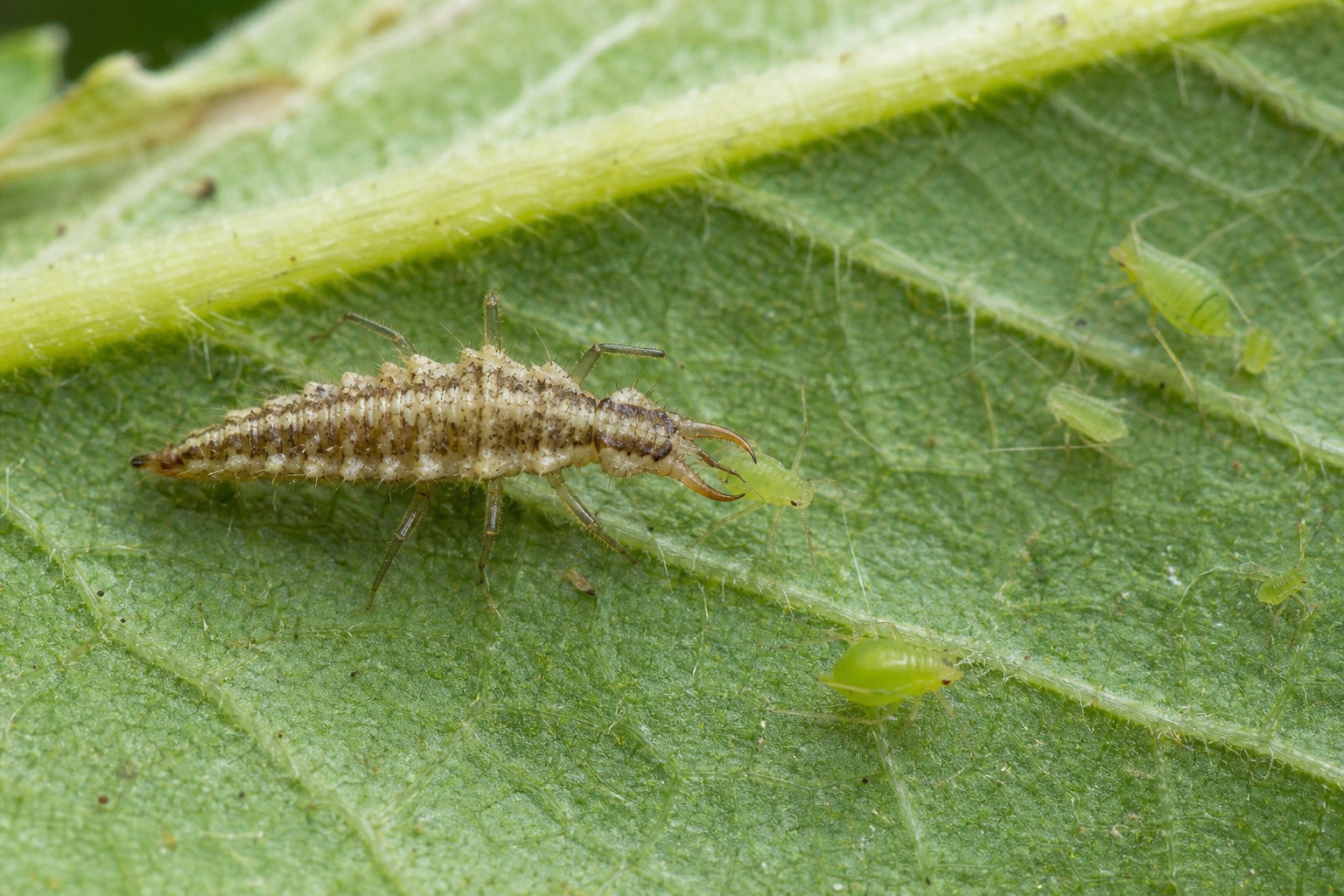
When no lacewings have been released, an egg cluster is evidence that a free-ranging female inspected that plant and often suggests suitable larval prey was nearby. It does not prove that aphids are still on that leaf. The prey may remain, may have moved, or may already have been eaten.
Not every white pinhead is a lacewing egg
The underside of a leaf is full of false alarms. Fern sori mistaken for insect eggs are one familiar example. Fungal growth, aphid cast skins, whitefly eggs, plant hairs, and stray fibers can all look convincing until magnification gives them edges.
For a likely green lacewing egg, look for a smooth oval at the end of a single long, hairlike stalk. Several may occur together, but each normally has its own support. Fresh eggs tend to be pale; older ones darken, and hatched shells remain empty. A hand lens or the macro setting on a phone is usually more useful than touching them.
Do not use the image alone to name a species. Brown lacewings are relatives and useful predators too, but their eggs are generally laid directly on vegetation rather than on the conspicuous stalks typical of green lacewings.9 If the object branches, spreads like fuzz, or connects several surfaces, it is probably telling a different story.
Leave the nursery before buying one
When stalked eggs appear in a garden, the best immediate action is no action. Do not scrape them off, hose them away, or spray the leaf simply because the structure is unfamiliar. As with the tidy circles leafcutter bees take from leaves, identification turns an alarming mark into a reason to pause.
Support the whole life cycle rather than only the predatory larval stage. Keep a succession of modest, accessible flowers for adults that use nectar and pollen. Tolerate a small amount of prey where the plant is not being seriously damaged. Avoid broad-spectrum, persistent insecticides, which do not distinguish the hunter from the hunted. Leave some autumn plant debris and leaf litter in suitable places because lacewings may overwinter in protected material, with the stage depending on species and climate.8
Green lacewing eggs and larvae are also sold for biological control.1 They can be useful in greenhouses and other contained situations, and wingless larvae may remain near a release site while prey is available. Outdoors, a purchase is not a guarantee. Weather, pesticides, ants, prey density, timing, and dispersal all affect the result. Minnesota Extension also stresses that lacewing larvae are generalists: they can eat other natural enemies as well as the pest you had in mind.8
A free-ranging female has already made one important choice: she selected that leaf and drew a stalk there. Preserving the nursery she left is often more useful than replacing it with a shipment.
A tiny structure with several answers
By late summer, the leaf that held the eggs may show only pale empty shells and nearly invisible threads. The larvae have descended into the foliage. The adult may be resting somewhere by day and drifting toward a porch light after dusk. The nursery looks abandoned because it worked.
The stalk’s first achievement is simple distance. That distance can mean fewer hungry siblings, fewer ants, a harder approach for some predators, and a place for chemical defense. The mother’s choice of leaf adds another advantage: the larva may hatch where food is close. What looks like a pinhead balanced on nothing is a piece of silk, a small experiment in survival, and a good reason to turn leaves over before deciding that the garden needs cleaning.
References
- University of California Integrated Pest Management: Green Lacewings
- Weisman et al.: Fifty years later—The sequence, structure and function of lacewing cross-beta silk
- University of Georgia Extension: Lacewings
- Růžička: Protective role of the egg stalk in Chrysopidae
- Eisner et al.: Chemical egg defense in a green lacewing
- Hayashi and Nomura: Eggs of Mallada desjardinsi are protected by ants
- University of Kentucky Entomology: Green Lacewing
- University of Minnesota Extension: Lacewing
- Oklahoma State University Extension: Conserving Beneficial Arthropods in Residential Landscapes