
Ancient Mesopotamia covered many centuries and environments, so there was never one timeless “Mesopotamian garden.” A useful modern interpretation has to be more precise. This one takes its cue from the irrigated lowlands of southern Mesopotamia and from crops documented elsewhere in the region, while treating the Hanging Gardens as an unresolved historical question. The aim is not to build a stage set of Babylon. It is to borrow a sound design habit: arrange shade, roots, soil, and water as one system.
Irrigation made a landscape, not a single invention
In the southern alluvium, dependable cultivation required people to bring river water to fields and remove excess water again. Recent mapping around Eridu has identified a dense network of former canals in a region occupied from the sixth to the early first millennium BC. The researchers stress that these channels accumulated as settlements, river courses, and working landscapes changed; they were not one vast system operating at a single moment.1 That long, shifting history is more interesting than the claim that irrigation appeared fully formed.
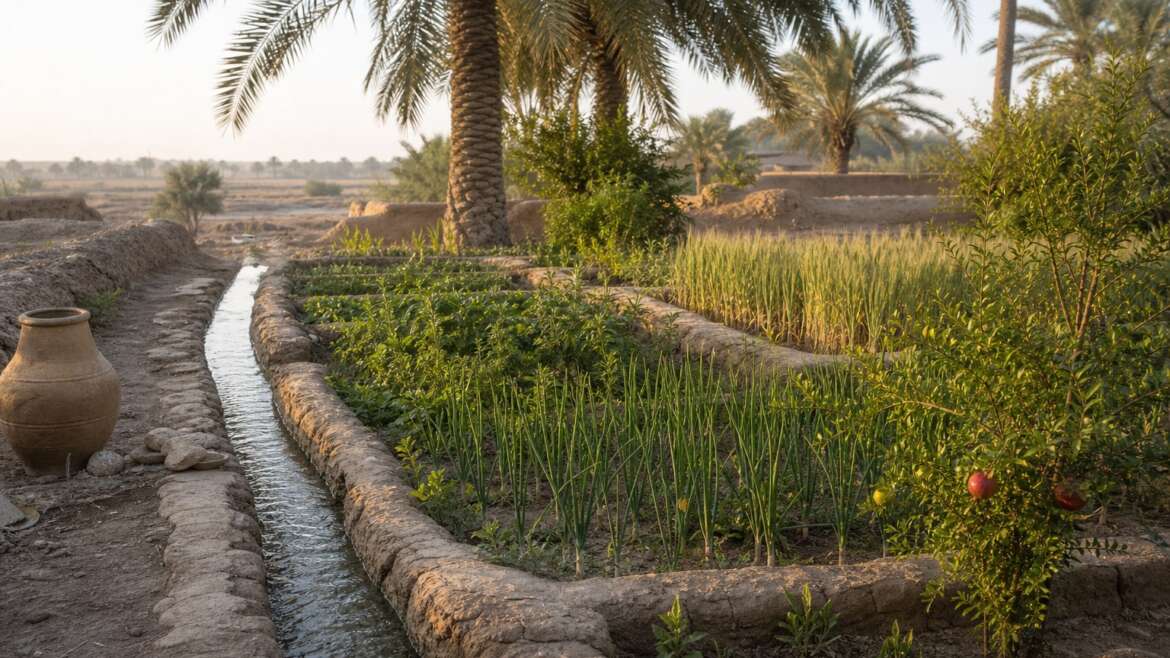
The practical lesson is placement. A channel only works if its slope carries water gently, a basin only works if roots can still breathe, and every watered bed needs an overflow route. Our closer look at Mesopotamian canals and the garden made by water explores how much surveying, cleaning, and cooperation lay behind the landscape. A home garden can echo that logic with drip tubing, a shallow basin, or a buried clay pot; mudbrick scenery is optional.
The Hanging Gardens remain an unresolved story
The famous Wonder is a poor blueprint because the evidence does not give us a settled site plan. Berossus wrote about Babylon around 280 BC, but his account survives only through later quotation and condensation. The descriptions associated with Diodorus, Strabo, Curtius, and the writer known as Philo are later still and depend on sources we can no longer inspect directly.2 Vivid terraces and water-lifting devices belong to that literary tradition, not to a complete excavated garden at Babylon.
The French Ministry of Culture’s archaeological account of Babylon states that neither Babylonian texts nor archaeology has yet proved the existence of the Hanging Gardens there. That is not evidence that Babylon had no gardens: cuneiform records mention gardeners and royal pleasure grounds. It simply means that ordinary garden evidence and the specific Wonder should not be treated as the same claim.3
Stephanie Dalley has proposed that the tradition refers instead to Sennacherib’s garden at Nineveh.2 The identification remains a proposal, but some of its hydraulic setting is tangible. At Jerwan, excavators documented a stone aqueduct built by Sennacherib shortly after 700 BC as part of a canal route toward the Khosr River above Nineveh.4 That secure Assyrian engineering evidence should not be quietly turned into proof that every classical detail belonged at Nineveh.
For garden design, the honest response is to use the legend as a question rather than a reconstruction: how could planted levels, shade, and moving water make a hot place habitable? The answer can inspire a garden without pretending that a modern terrace is archaeologically exact.
Useful plants, with time and place attached
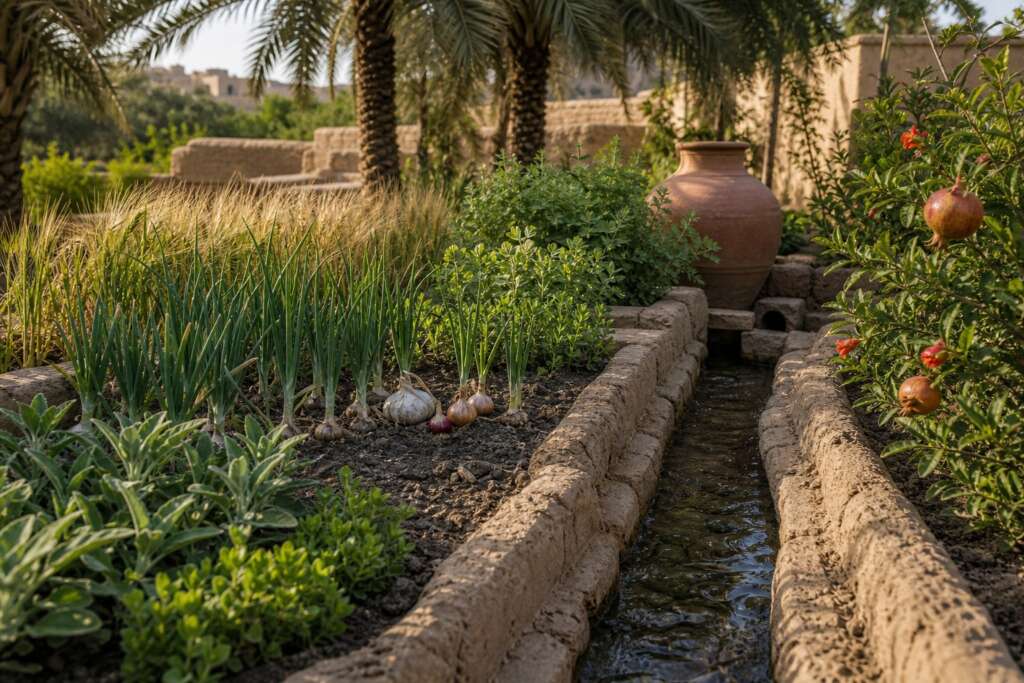
Plant remains give us local snapshots rather than a universal planting plan. At the Early Bronze Age site of Kani Shaie in what is now Iraqi Kurdistan, researchers identified barley, emmer wheat, lentil, chickpea, and pea among the charred remains.5 Written and archaeological syntheses for southern Mesopotamia add date palm, onions, garlic, and other vegetables to the picture.6 The assemblage at one northern settlement should not be projected across every southern city or every period.
These plants also need qualifications in a modern garden. Barley is relatively tolerant of saline soil, but planting it does not remove accumulated salts.7 A date palm can endure formidable summer heat, yet good fruit production requires a long, hot, comparatively dry season, and cold can damage leaves and flowers.8 It also becomes a large tree. Neither plant is a universal symbol to insert regardless of climate, space, or purpose.
Translate the logic, not the plant list
Begin with the site you actually have. Note summer sun, winter cold, wind, soil depth, drainage, water quality, and the mature width of every woody plant. Then choose a locally suitable tree or tall shrub for structure and partial shade. Date palm may fit a large, frost-light garden; elsewhere a climate-appropriate fruit tree can perform the design role more responsibly. Check local invasive-plant guidance before choosing any substitute.
Place plants in hydrozones: species with similar water needs share a valve, line, or basin. Utah State University’s water-wise guidance recommends this grouping because it lets irrigation match the plants and season rather than soaking the whole garden equally.9 Keep plants that demand sharp drainage on the higher edge. Put crops needing steadier moisture within reach of drip emitters, a shallow basin, or the slow release of porous-clay olla irrigation.
A small interpretation might combine one well-spaced structural tree, a pomegranate where winters and summer heat suit it, a short cool-season strip of barley, and edible alliums. Pomegranate tolerates drought once established, but regular water improves establishment and fruiting, while poorly drained soil remains a problem.10 In a cold or humid climate, change the species rather than forcing the historical association. Edible crops should also be identified with certainty and grown in clean soil; an ornamental look-alike is not automatically food.
Give water somewhere to leave
Dry-climate gardens can fail from excess water as readily as from shortage. Test a basin by filling it and watching how long it drains. Direct overflow away from foundations and neighboring property. Irrigate the root zone deeply enough to encourage useful rooting, then adjust timing for soil texture, weather, and the plant’s stage of establishment rather than following a fixed calendar.
Also watch for salts where rainfall is too scant to wash them down or irrigation water is mineral-rich. A pale crust on the soil is a warning, not a diagnosis. Utah State University notes that leaching only works when water can carry salts below the root zone and the soil has adequate drainage; a high water table or compacted layer can make extra irrigation counterproductive.7 If salinity is suspected, test the soil and water before reaching for an additive.
Mulch can reduce evaporation and soften temperature swings, but keep it clear of trunks and crowns that rot when buried. Inspect emitters, clear channels, and revise the layout as plants grow. That maintenance is not a failure of the design. It is the most faithful Mesopotamian lesson here: a productive dry garden is an observed and continually managed relationship with water.
References
- Identifying the preserved network of irrigation canals in the Eridu region, southern Mesopotamia. Antiquity, 2025.
- The Hanging Gardens of Nineveh. Stephanie Dalley, Iraq, 2004.
- Les jardins suspendus. Archéologie de Babylone, Ministère de la Culture.
- Sennacherib’s Aqueduct at Jerwan. Thorkild Jacobsen and Seton Lloyd, Institute for the Study of Ancient Cultures.
- Plant commodification in Northern Mesopotamia: evidence from the Early Bronze Age site of Kani Shaie, Iraqi Kurdistan. Frontiers in Environmental Archaeology, 2025.
- The Sumerians: Their History, Culture, and Character. Samuel Noah Kramer, University of Chicago Press, 1963.
- Managing Saline and Sodic Soils. Utah State University Extension.
- Climatic Requirements of Date Palm. Food and Agriculture Organization of the United Nations.
- Principles of Water-Wise Landscaping. Utah State University Extension.
- Pomegranate Production. University of Georgia Cooperative Extension.