
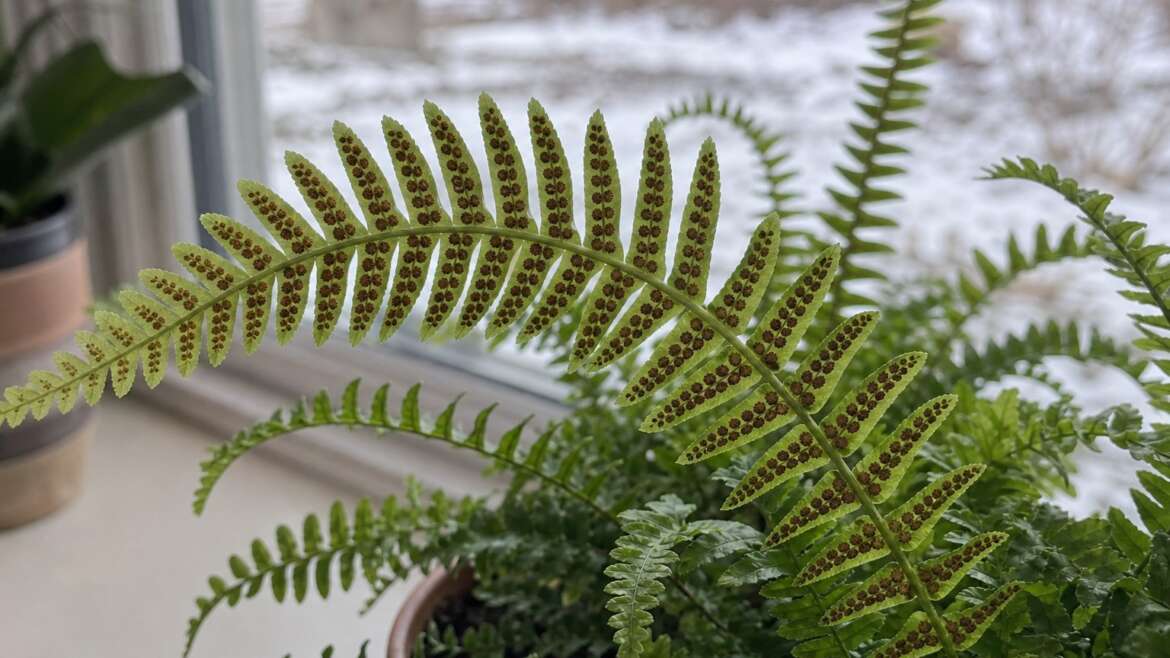
On a January windowsill, a fern can look like the most innocent plant in the house. Green fronds, soft shadows, a pot that asks mostly for humidity and restraint. Then you turn one frond over and find rows of brown dots underneath.
They can look alarming if you were not expecting them. The dots may be round, rusty, tan, black, or cinnamon brown. They may sit in tidy lines along each little leaflet, or gather near the edges like punctuation. To a gardener already suspicious of scale insects, mites, mildew, or mysterious houseplant decline, the underside of a fertile fern frond can look like evidence.
Most of the time, it is not a problem at all. Those brown dots are sori, the spore-producing structures of the fern. They are not eggs. They are not scale. They are not a fungus eating the leaf. They are one of the reasons ferns are ferns.
That small correction changes the plant. A fern stops being just a soft green filler for shade and becomes a living reminder that not every garden plant follows the flowering-plant script. No petals. No seeds. No fruit. Just fronds, spores, water, and an older way of making another generation.
The underside is doing quiet work
Fern leaves are usually called fronds. Many are divided into smaller leaflets, or pinnae, arranged along a central stalk. The top side does the familiar green work of catching light. The underside often carries the more surprising evidence of reproduction.
Mississippi State University Extension explains that the small brown dots or lines on the underside of fern leaves are usually sori, clusters of spore cases, rather than insect eggs or disease.1 Iowa State University Extension makes the same practical point for worried houseplant owners: fern spores are commonly arranged in regular patterns, while scale insects tend to be more irregular and may appear on stems as well as leaves.2
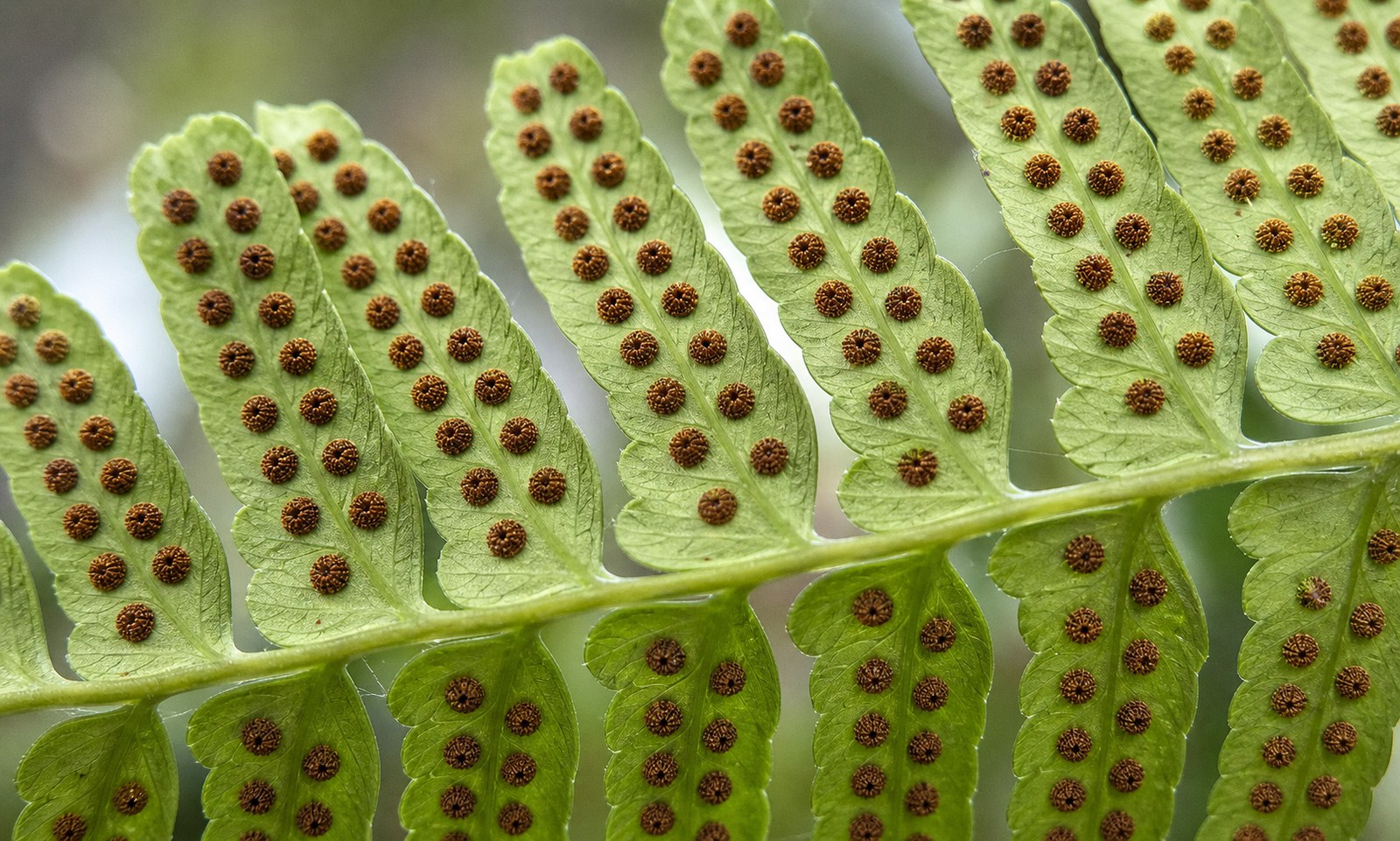
That regularity is the first clue. Sori often repeat with botanical neatness. They may trace a line along the veins, sit as paired rows, form dots near the margins, or appear as long brown streaks depending on the fern species. The pattern belongs to the frond. It is not a colony deciding where to invade.
Some ferns carry sori openly. Others cover them with a thin flap of tissue called an indusium. Some tuck spores under curled leaf margins. This is why one fern may show obvious brown circles while another hides its reproductive work more discreetly. The gardener sees dots, stripes, patches, or almost nothing, but the underlying job is the same: making spores.
A sorus is a cluster, not a single speck
One brown dot is not one spore. It is more like a little factory. A sorus is a cluster of sporangia, and each sporangium is a tiny capsule that produces spores. When the spores mature, the sporangia dry and open, releasing a fine dust that can look like brown powder on a windowsill, paper towel, or the soil surface below the plant.
That powder can cause its own misunderstanding. It may look as if the plant is shedding dirt or rust. In a healthy fertile frond, it is simply the fern doing what it evolved to do. The USDA Forest Service notes that ferns reproduce by spores rather than by flowers and seeds, with spores often produced in sori on the undersides of leaves.3
Spores are much smaller and simpler than seeds. A seed carries a plant embryo with a food supply and a protective coat. A fern spore is more stripped down. It does not contain a miniature fern with a packed lunch. It is a starting point for a completely different, easily missed stage of the fern’s life.
The fern has a hidden second plant
When a fern spore lands somewhere suitable, it does not immediately grow into the feathery plant we recognize. It germinates into a tiny, flat, green gametophyte, often called a prothallus. This little body may be only a few millimeters across. It looks more like a green scale, tiny liverwort, or speck of living film than a fern.
The University of California Museum of Paleontology describes the fern life cycle as an alternation between the familiar spore-producing fern and a small gametophyte that produces eggs and sperm.4 Water matters because fern sperm need a film of moisture to swim to the egg. That is one reason ferns feel so tied to damp woods, shaded stone, greenhouse benches, and humid rooms, even though different species tolerate very different conditions.
Only after fertilization does the new fern plant, the sporophyte, begin to grow. That is the fern we usually notice: roots, rhizome, fiddleheads, fronds, and eventually sori of its own. The brown dots under a frond are therefore not a minor stain on the plant. They are the visible edge of a two-generation life cycle.
How to tell sori from scale insects
The confusion with scale insects is understandable. Scale can also appear as small brown bumps attached to leaves or stems, and some scale insects are excellent at looking like part of the plant. The difference is pattern, placement, and side effects.
Sori are usually restricted to fertile fronds and arranged according to fern anatomy. They appear on the underside, often in repeated rows or shapes. They do not wander onto the pot, petioles, windowsill, or neighboring plant. They do not make sticky honeydew. They do not usually coincide with yellowing patches, wilting, or a general collapse of vigor.
Scale insects are less polite. They may cluster along stems, midribs, and leaf undersides in uneven groups. Some can be scraped off as individual bodies. Many produce honeydew, which leaves surfaces sticky and can lead to sooty mold. Iowa State University Extension advises that fern spores usually appear in uniform patterns, while scale insects are more random and may appear on both leaves and stems.2
If you are unsure, look at the whole plant before reacting. A fern with neat rows of dots under otherwise healthy fronds is probably fertile, not infested. A plant with sticky leaves, random bumps, yellowing, and pests on stems deserves closer attention. The underside of a fern rewards patience more often than panic.
Why some fronds have dots and others do not
Not every frond on a fern has to be fertile. Some species produce similar-looking fertile and sterile fronds, with sori appearing only when the frond is mature enough. Other species make fertile fronds that look noticeably different from the sterile ones. Sensitive fern, ostrich fern, and cinnamon fern, for example, can produce specialized fertile structures that do not look like ordinary leafy fronds at all.
Age matters. A young frond may be clean underneath because it has not yet formed mature sori. Later it may develop pale green, yellow, tan, or brown structures as the spore cases ripen. The color can change over time. A fern that looked spotless in summer may carry brown dots in winter simply because the fronds have matured.
Species matters even more. Maidenhair ferns tuck sori near the edges. Boston ferns often show tidy brown dots. Hart’s tongue fern can carry long, dark lines. Staghorn ferns form large spore patches that look like brown felt. Once you know this, the fern collection becomes less like a row of green textures and more like a shelf of reproductive signatures.
Collecting spores is possible, but slow
If the dots have turned brown and begin to shed dust, you can collect spores. This is not the fastest way to make more ferns, and it is not always the easiest. Division is usually simpler for garden ferns that naturally make crowns or rhizomes. But spore growing is wonderfully instructive because it lets you see the fern’s life cycle instead of only reading about it.
Brooklyn Botanic Garden recommends collecting a fertile frond when the sori are mature, placing it spore-side down on clean paper, and letting the spores fall out as a fine dust.5 The Hardy Fern Foundation gives similar guidance and emphasizes cleanliness, patience, and the difference between true spores and bits of chaff from the sporangia.6
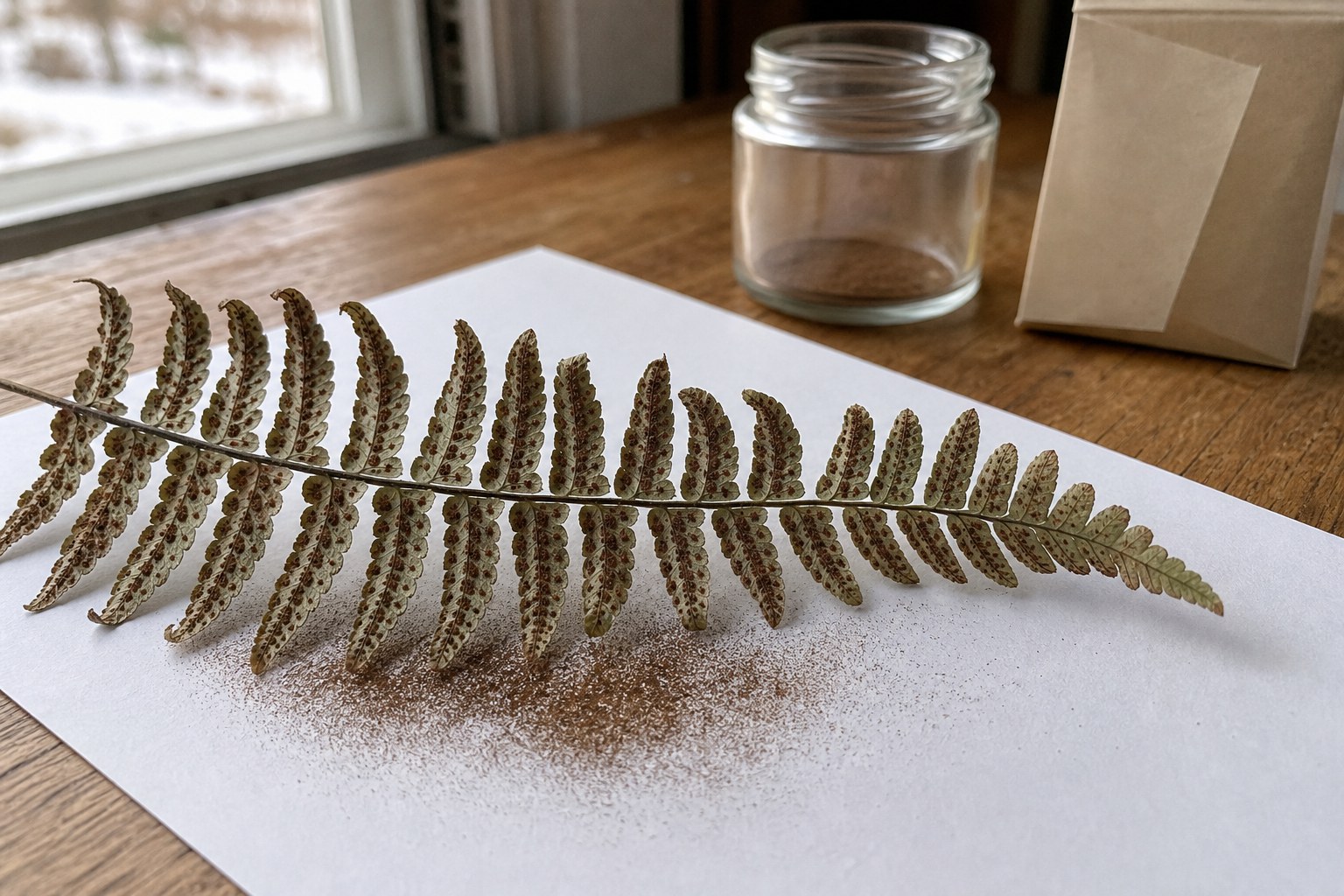
Sowing fern spores is closer to starting a tiny mossy culture than planting ordinary seeds. The spores are dust-fine and should not be buried. They need a clean, moist, covered environment and patience. First comes the green film of gametophytes. Later, if moisture and fertilization cooperate, tiny fern plants begin to appear. The process can take months, and contamination can outrun you if the setup is careless.
That slowness is not a flaw. It is the point. Growing ferns from spores forces a gardener to notice scale, humidity, hygiene, and time. It makes the adult fern feel less like a finished object and more like one stage in a longer, stranger cycle.
What to do with fertile fronds
For ordinary care, do almost nothing special. A fertile fern frond does not need to be removed because it has sori. The dots are not draining the plant in some emergency way, and cutting every fertile frond only deprives the fern of working leaf surface.
Remove fronds when they are dead, badly damaged, diseased, or in the way. Leave healthy fertile fronds alone unless you are collecting spores or tidying a display. If brown spore dust bothers you indoors, place the fern where a little shedding is easy to wipe up, or remove one mature frond after it has done most of its work. That is housekeeping, not treatment.
Outdoor ferns can be even easier. Old fronds often protect crowns, shelter small garden life, and mark the plant’s place through winter. Cut them back when new growth begins if they are collapsed and untidy, or leave them longer in a looser woodland planting. The sori themselves are not the reason to prune.
A small underside lesson
The brown dots under a fern frond are a useful antidote to the habit of diagnosing every mark as damage. Gardens are full of symptoms, but they are also full of structures. Bud scales, lenticels, root nodules, leaf glands, nectaries, and sori can all look suspicious until you know what they are.
So turn the frond over before you reach for soap, alcohol, scissors, or alarm. Look for pattern. Look for placement. Look for whether the plant is otherwise healthy. If the dots are neat, repeated, and built into the underside of a mature frond, you are probably looking at reproduction, not trouble.
A fern does not announce itself with a flower. It writes its next generation in brown script on the back of a leaf. Once you learn to read it, the underside of the frond becomes one of the most interesting pages in the winter garden.
References
- Mississippi State University Extension: Fern Spores
- Iowa State University Extension: Fern Spores vs Scale Insects
- USDA Forest Service: Fern Structure
- University of California Museum of Paleontology: The Life Cycle of a Fern
- Brooklyn Botanic Garden: Growing Ferns from Spores
- Hardy Fern Foundation: Propagation