
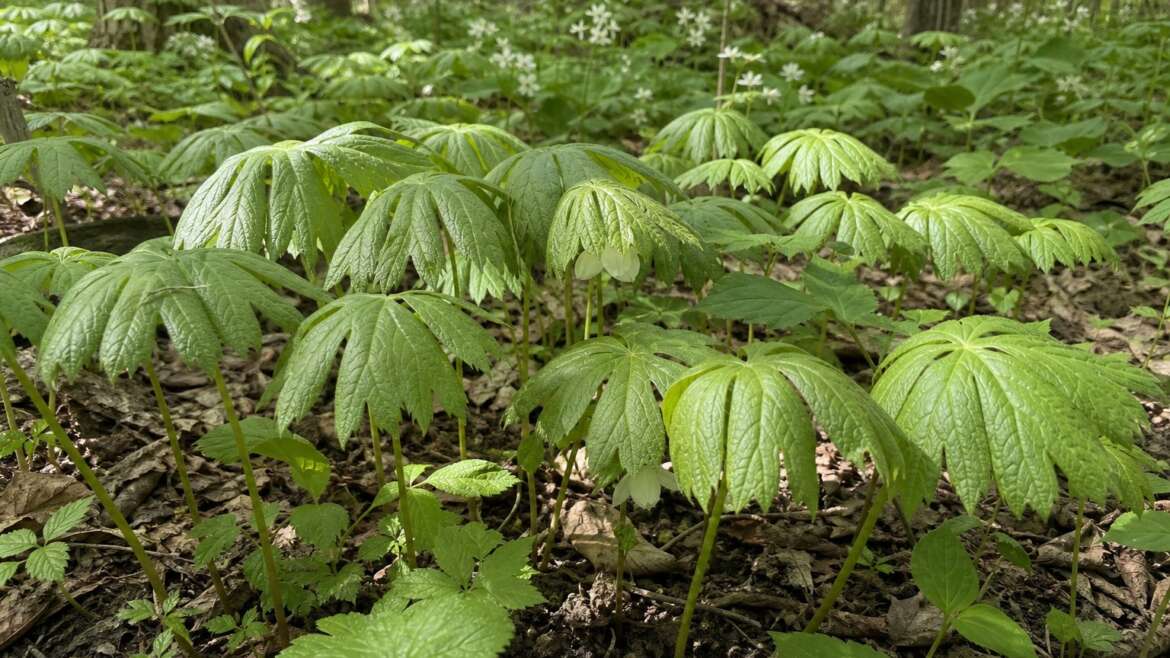
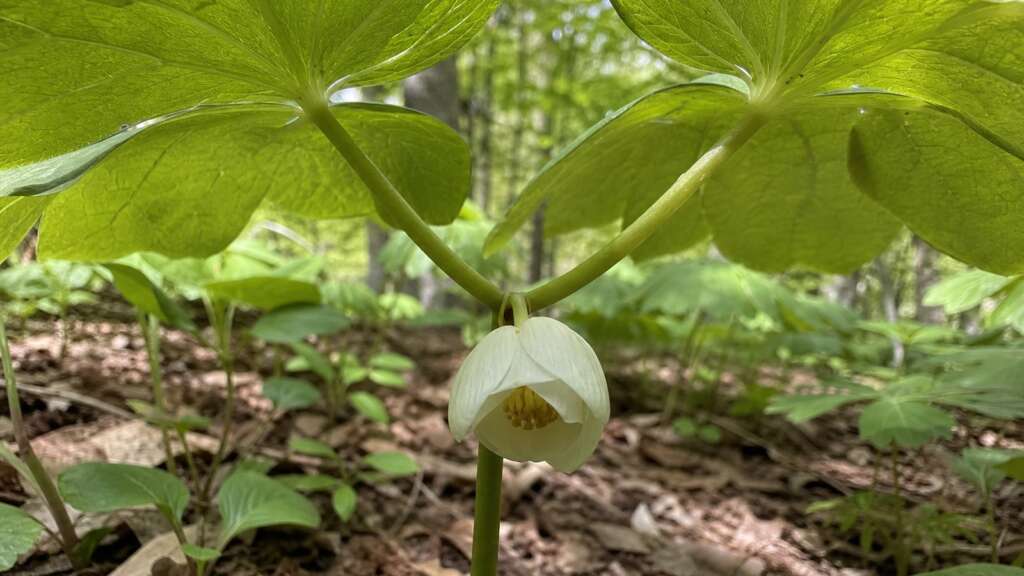
By early May, a mayapple patch can look less like a group of wildflowers and more like a small green weather event. Smooth stems rise from the leaf litter, each one holding a pale, lobed leaf like an umbrella that has just opened after rain. The effect is so architectural that it is easy to miss the plant’s real trick: the flower is not displayed above the leaves. It hangs underneath them.
That hidden flower is the reason mayapple deserves a closer look in the shade garden. Podophyllum peltatum is a native woodland perennial of eastern North America, common in rich deciduous woods, bottomlands, shaded roadsides, and woodland edges.16 It is familiar to hikers, useful to gardeners, interesting to pollinators, and slightly dangerous in the way many old medicinal plants are dangerous: beautiful, chemically defended, and easy to misunderstand.
The umbrella is a leaf with its stem in the middle
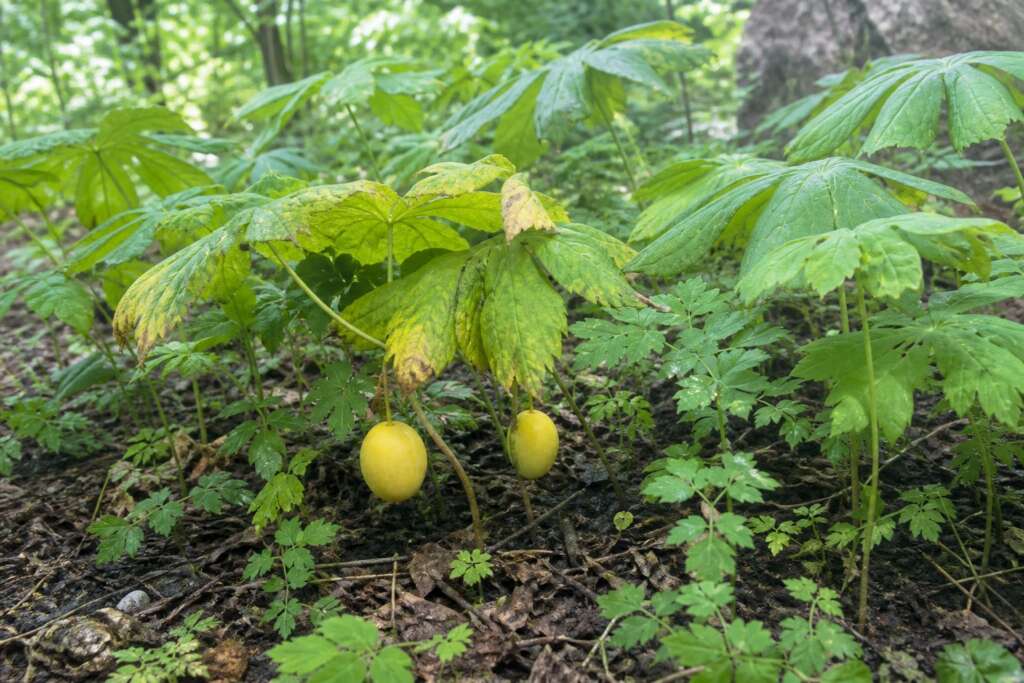
The mayapple leaf is peltate, which means the stalk attaches near the center of the leaf blade rather than at the edge. This is what gives the plant its umbrella look. A mature leaf spreads into five to nine lobes, often nearly a foot across, with the veins radiating from a central point like the ribs of a parasol.2
Not every umbrella is doing the same job. Young or weaker shoots usually carry one leaf and do not flower. Stronger shoots carry two leaves, and the flower forms at the fork between them.1 If you look at a patch from above, you see a colony of green disks. If you get low and look underneath, you can read the plant’s internal economy: single-leaved shoots are mostly feeding the rhizome, while two-leaved shoots have enough stored energy to attempt reproduction.
This is one reason a mayapple colony feels so different from a bed of annuals. It is not resetting from seed every spring. It is returning from an underground system of rhizomes, carrying last year’s stored energy into a brief season of light before the tree canopy closes.
A patch can be one plant repeated many times
Mayapple is colonial. In good conditions, a single plant can spread outward by rhizomes until the colony looks like many separate plants standing shoulder to shoulder. Wisconsin Horticulture describes mayapple as growing from a shallow, creeping, branched underground rhizome, with each terminal bud producing a shoot.2 To a gardener, that means two things at once: mayapple is excellent for naturalizing in a woodland corner, and it is not a polite little accent plant.
The colony is part of its charm. One mayapple is curious. Twenty mayapples become a miniature canopy, repeating the same shape in slightly different sizes and angles. The leaves intercept spring light above the soil surface while the real body of the plant slowly claims space below. In a naturalistic shade garden, that can be exactly the effect you want. In a narrow formal border, it can feel like a plant ignoring the floor plan.
The name mayapple comes from timing and fruit, not from a close relationship to apples. The plant usually flowers in April or May, then, if pollination succeeds, forms an oval berry that ripens from green toward yellow later in summer.3 The apple is low, hidden, and botanical rather than orchard-like. It is the sort of fruit you find by kneeling, not by reaching.
The flower makes pollination surprisingly uncertain
A hidden flower is not automatically a failed advertisement. Many woodland plants bloom low, where spring bees are moving through a complicated floor of leaves, trunks, and early flowers. But mayapple adds a complication: its flowers are not generous nectar stations. A classic study of mayapple pollination described the flowers as nectarless and dependent on infrequent visits by queen bumble bees that were searching for nectar.4
That makes mayapple a good reminder that pollination is not only about a flower and an insect. It is about the neighborhood. In the same study, mayapple colonies near flowering lousewort, a nectar-producing native wildflower, had better fruit and seed set than colonies farther away. When the lousewort flowers were removed, that advantage disappeared.4 The nearby nectar plant appeared to function as a kind of pollinator magnet, increasing bee movement through the area and giving mayapple more chances to be visited.
For a gardener, the lesson is practical. A woodland planting built from one dramatic species may look clean in April, but a mixed spring community often works better. Bloodroot, Virginia bluebells, woodland phlox, foamflower, violets, golden ragwort, native sedges, and other early plants create overlapping signals and resources. Some feed bees directly. Some shelter the soil. Some appear and vanish quickly. Together, they make the garden more legible to the insects that have to find food in a short spring window.
Mayapple does not need to be the whole show. It is better as one of the strong repeating notes in a woodland composition.
The fruit is real, but it is not casual food
When a pollinated flower succeeds, the developing fruit hangs under the leaves like a small green egg. Later it can turn golden yellow, sometimes with a faint blush. Missouri Botanical Garden notes that the ripe fruit has been used for preserves and jellies, while the leaves and roots are poisonous.1 North Carolina Extension is more explicit: only ripe, yellow, soft fruit is considered edible in limited quantity, while roots, seeds, and leaves are poisonous and should not be eaten.3
That distinction matters. Mayapple is not a snack plant for children, pets, or casual foraging. It is a plant to admire first, and to treat with restraint if you know exactly what you are doing. The unripe fruit, seeds, leaves, and roots are not edible garden curiosities. They are chemically defended plant parts.
Those defenses are part of the plant’s story. USDA Agricultural Research Service has described mayapple as a source of podophyllotoxin, a compound used as a starting point for making certain cancer-fighting chemicals, and notes that the plant appears to use podophyllotoxins as protection from insects and other herbivores.5 That does not make the plant a home remedy. It makes it a good example of how a garden plant can sit at the boundary between ecology, medicine, and caution.
Wildlife knows the fruit differently
Gardeners tend to notice mayapple in spring, when the leaves are fresh and theatrical. Wildlife may notice it later. North Carolina Extension lists squirrels and box turtles among the wildlife that eat the fruits.3 Wisconsin Horticulture also notes that box turtles and other wildlife may eat the fruit and disperse seeds.2
This is where the plant’s hidden design begins to make ecological sense. The flower sits low. The fruit hangs low. The colony lives at the level of leaf litter, turtle paths, small mammals, beetles, slugs, fungal threads, and the cool air near the soil. Mayapple is not trying to be a tall border flower. It is a plant of the forest floor, and the forest floor is a whole layer of life.
How to grow mayapple without misusing it
Mayapple is best used where it can behave like itself: under deciduous trees, along a shaded path, at the back of a woodland bed, or in a naturalized native planting where summer gaps are not a failure. It prefers part shade to full shade and rich, humusy, well-drained soil with steady spring moisture.1 It can tolerate some dry woodland conditions once established, but hot sun and drought tend to hurry it toward dormancy.
The summer dormancy is the planning detail people forget. As with many spring wildflowers, mayapple emerges before trees fully leaf out and then declines by mid-summer.2 This is not necessarily a sign that the plant has died. It is often the normal end of its aboveground season. In a designed bed, however, the disappearing foliage leaves space. Plant it with companions that can carry the later season: ferns, sedges, wild ginger, woodland asters, heuchera, foamflower, Solomon’s seal, or other shade plants suited to your region and soil.
Because the plant spreads by rhizomes, give it a place where a colony is welcome. Do not tuck it between delicate neighbors that need sharp boundaries. Do not plant it at the front edge of a formal walkway if you expect constant neatness through August. Use it the way the plant wants to be used: as a spring carpet, a colony, a repeating native shape.
Buy nursery-propagated plants from reputable native-plant growers rather than digging from wild colonies. A mayapple patch in the woods may look abundant, but it is part of a larger community. Removing rhizomes can disturb soil, fungi, invertebrates, and the slow geometry of a colony that took years to build. In the garden, division is possible, and seed is possible, but patience is part of the arrangement. A plant that spreads confidently once established may still take time to settle.
How to read a mayapple patch
A good mayapple patch has a spring rhythm. Shoots emerge furled, then lift, then open. Single-leaved stems make a green ceiling. Two-leaved stems hide flowers below. If fruit forms, it swells in the shade while the leaves gradually age. By summer, the foliage may yellow, soften, and vanish. The rhizome remains.
If a patch collapses very early, look at moisture, heat, and competition. Too much sun can shorten the show. Dry, compacted soil can make the leaves smaller and the season brief. Heavy foot traffic can damage the shallow rhizomes. Thick mulch piled over the crown can bury new shoots too deeply or keep the surface wetter than the plant wants. A woodland plant wants leaf litter and humus, not a suffocating mound of bark.
If the patch grows leaves but no flowers, do not assume something is wrong. Many shoots are single-leaved. Flowering depends on maturity and stored energy. Over time, as the rhizome strengthens and the colony settles into good light and soil, more two-leaved stems may appear. In a young planting, foliage is progress.
If flowers appear but fruits are scarce, remember the pollination problem. Mayapple can make a beautiful flower and still fail to set much fruit. The answer is not to fuss over the mayapple alone. It is to improve the whole spring neighborhood: more early flowers, less pesticide pressure, more undisturbed leaf litter, and a garden that lets queen bumble bees find enough reason to keep searching.
A plant that asks you to kneel
Mayapple is not subtle from a distance, but its best details are hidden. The leaf is obvious. The flower asks you to crouch. The fruit asks you to remember that ripeness and safety are not the same thing. The colony asks you to think below ground, where one plant may be repeating itself through a network of stored energy.
That is why it belongs in a curious garden. It turns shade into architecture for a few weeks, then withdraws before summer has fully taken over. It feeds a larger story about bees, turtles, rhizomes, chemical defenses, and the spring light that reaches the forest floor before the canopy closes. A mayapple patch looks like a crowd of umbrellas, but the real lesson is underneath.
References
- Missouri Botanical Garden Plant Finder: Podophyllum peltatum
- Wisconsin Horticulture: Mayapple, Podophyllum peltatum
- North Carolina Extension Gardener Plant Toolbox: Podophyllum peltatum
- Laverty, T. M. Plant interactions for pollinator visits: a test of the magnet species effect. Oecologia 89, 502-508 (1992)
- USDA Agricultural Research Service: Mayapple’s cancer-fighting precursor
- Flora of the Southeastern United States: Podophyllum peltatum