
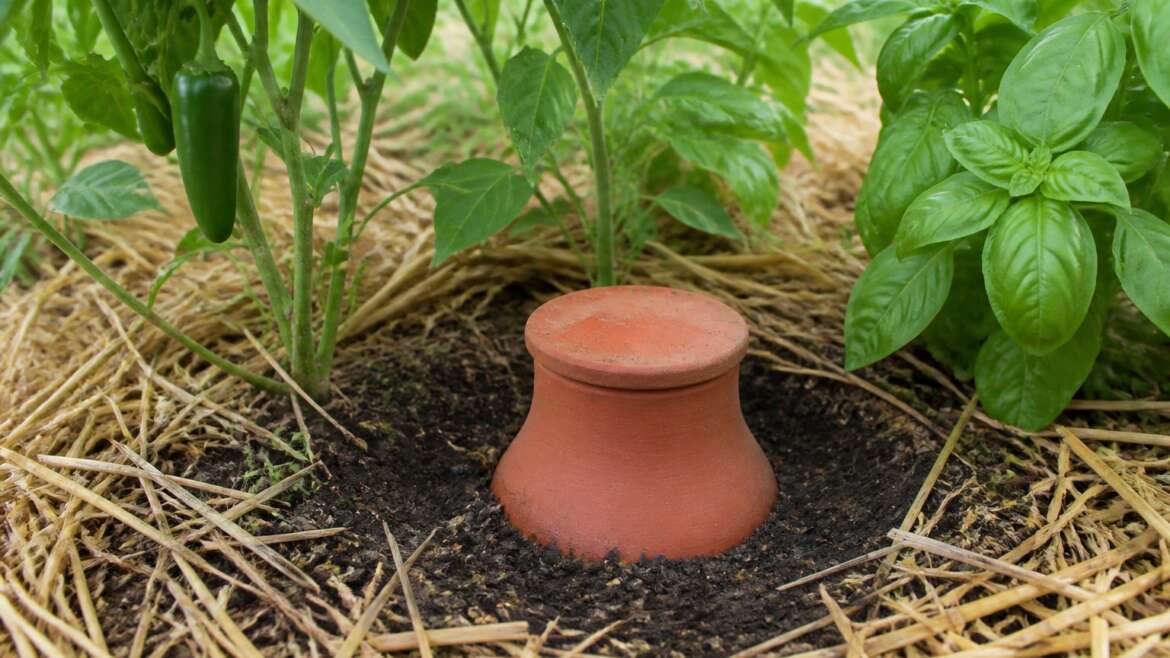
Olla irrigation looks almost too simple to explain. A clay pot is buried in the soil, filled with water, and covered. The garden seems to water itself. But the quietness is the point. The system works because porous clay, soil moisture, and plant roots create a local gradient that changes as the soil dries and wets.
University of Arizona Cooperative Extension explains that an unglazed clay wall is porous enough for water to seep into the surrounding soil, and that soil-moisture tension helps drive movement from the wetter reservoir toward drier ground.1 That is the heart of the system. The pot is not leaking randomly, but it is not reading the garden like an electronic sensor either. Its behavior comes from water, ceramic, and soil acting on one another.
The wall is a resistor, not a tap
An irrigation olla needs a porous, unglazed wall. Glaze closes the route through the ceramic; a crack opens a route that is far too large. Experiments with porous ceramic emitters—not household ollas, but a related wall-flow system—show that discharge depends on the water head and the ceramic’s hydraulic conductivity.2 A broad belly offers more working wall than a narrow one, but size alone does not predict how quickly two pots will empty.
A peer-reviewed paper on buried clay-pot irrigation reaches the practical conclusion gardeners need: pot surface area and porosity must be matched to the crop, climate, and soil, and field trials are still needed for local decisions.3 This is why a spacing number printed on a product card is a starting point, not a law of nature. Two vessels of similar size can still release water at different rates.
As nearby soil becomes wetter, the difference across the wall becomes smaller and release can slow. When roots remove water and the soil dries again, the gradient can increase. That feedback is useful, but “self-regulating” should not be mistaken for “cannot overwater.” Water can still travel below shallow roots, a very porous pot can empty quickly, and a cracked seal in a homemade vessel can create a hidden puddle. Test a new olla above ground for obvious leaks before burying it.
Soil writes the shape of the wet zone
The damp area around an olla is not a neat sphere. New Mexico State University notes that water in sandier soil tends to move downward more readily than sideways, while heavier clay can allow more lateral spread but can also remain oversaturated.4 Real beds add roots, worm channels, old planting holes, compacted layers, stones, and bands of amended soil. Each can bend the wetting pattern away from the tidy circle in a diagram.
Contact at the wall matters. UC Agriculture and Natural Resources advises gently packing soil around an installed olla so air pockets do not interrupt water movement or root growth.5 Backfill in stages, firming without crushing soil into a brick, then water the bed from above once to settle the backfill. If a void opens beside the pot, water must bridge that gap before it can enter the root zone predictably.
Roots respond after the water moves
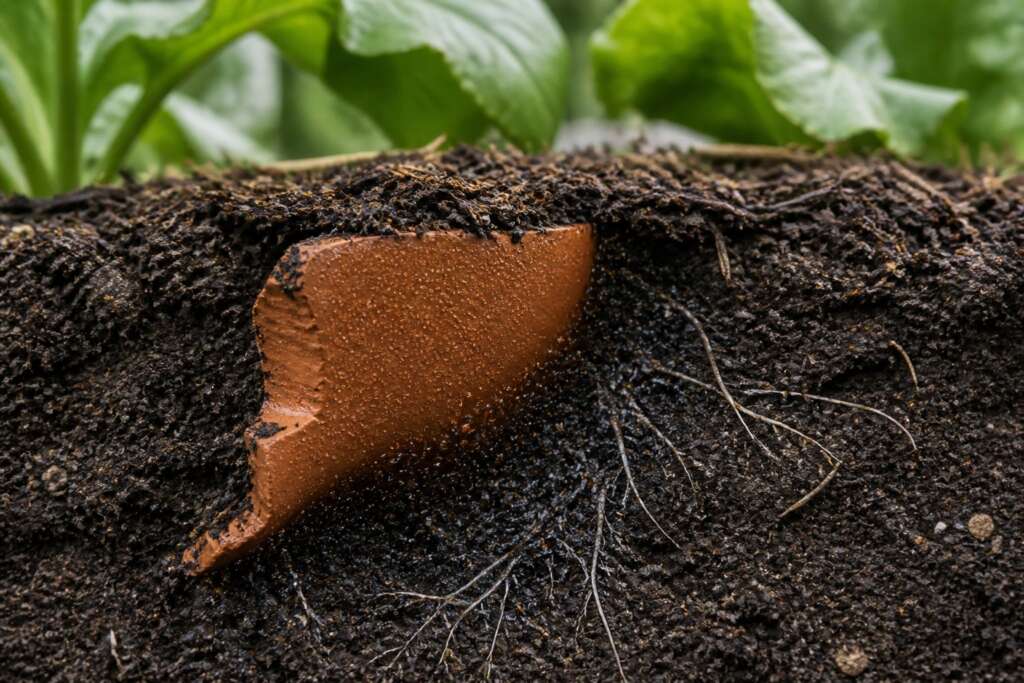
Roots do not switch the olla on. Their water uptake dries part of the surrounding soil and helps maintain the difference that draws more water through the wall. Over time, roots may proliferate in the reliably moist zone and even gather against the ceramic. The visible plant and buried reservoir therefore become coupled through the soil between them, not through a magical one-to-one signal.
Seeds and young transplants begin outside that system. Arizona Extension warns that they need supplemental water until roots reach the olla’s moist zone, while UC ANR recommends surface watering when the top layer is not staying damp enough for germination.15 A buried reservoir can support established roots while the seedbed above it remains dry. Water the actual life stage, not the irrigation idea.
Plant architecture matters as well. Closely spaced seedlings may require more vessels than the bed can sensibly hold, while a large woody root can eventually stress or break a pot.15 Ollas are usually easier to match with clusters of herbaceous vegetables, herbs, or flowers than with an entire mixed border. That is a design limit, not a failure of the physics.
Measure the bed instead of inheriting a radius
Start with one vessel before committing a whole bed. Fill it to the same level, replace the lid, and note the time. After a day or two, check moisture at several distances and depths with a narrow trowel, keeping roots and the pot wall safe. Repeat after a cool spell, hot wind, and rain. The useful radius is the zone that stays moist enough for your plants without remaining airless, not the largest dark patch you can find.
Keep the opening capped so insects and debris stay out and evaporation from the reservoir is reduced.4 A falling water level then becomes a better clue, though never a perfect measurement of plant use. Seepage below the sampled depth, a leaking repair, and evaporation through an imperfect cover can all empty the pot. For installation, placement, and refilling as a routine rather than an experiment, see olla irrigation from clay pot to garden habit.
Salts, cracks, and cold change the experiment
The wall does not keep the same permeability forever. Arizona Extension notes that salts can accumulate and clog its pores.1 A pale deposit is evidence that dissolved minerals have moved with the water, although appearance alone cannot tell you how much flow has changed; the article on white crust on terracotta explains that movement in detail. If refill intervals lengthen unexpectedly while plants are drying, inspect the vessel rather than assuming the roots suddenly became frugal.
The opposite change—an olla emptying much faster than before—can indicate a crack or failed seal, though hotter weather and larger plants can also increase demand. UC ANR recommends lifting ollas before hard freezes because trapped water and freezing conditions can crack buried clay.5 Local winter practice should follow the vessel maker’s guidance and the severity of freezing at its buried depth.
What the gradient cannot decide
An olla cannot know whether a plant is appropriate for the site, whether the root zone is deep enough, or whether the gardener has forgotten to refill it. It cannot replace drought planning or guarantee a universal water-saving figure. Published performance varies with soil, crop, weather, pot construction, spacing, and the irrigation method used for comparison.3
An olla is a small lesson in gradients. It does not force water across the garden. It waits for a difference between wet ceramic and drying soil, while roots and weather keep changing that difference. That is why the method feels so elegant when tested at the right scale, and so disappointing when expected to do the work of a complete irrigation plan.