
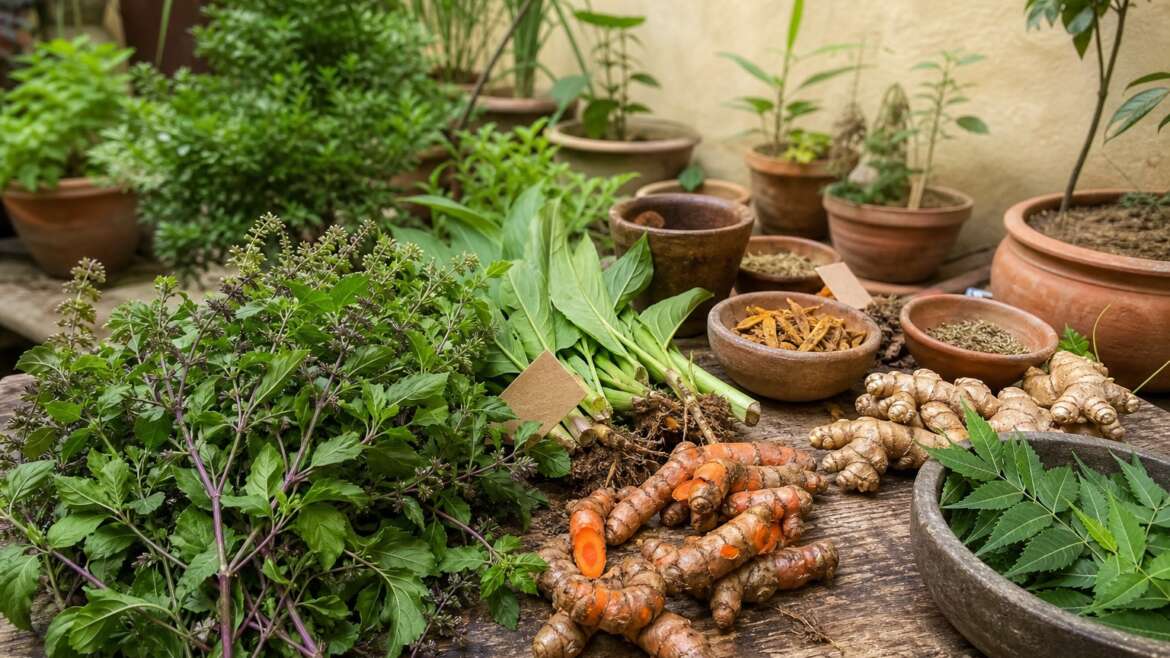
A garden of Indian healing plants can hold several kinds of history at once. Tulsi leaves release a clove-like scent when brushed. Turmeric disappears below the soil and returns at harvest as a startling orange rhizome. Ashwagandha finishes the season as a small, grey-green shrub rather than the anonymous powder seen on a shop shelf. Growing these plants makes their differences tangible.
It does not, by itself, make the gardener a practitioner of Ayurveda. A plant may be culturally important, useful in food, described in a medical text, studied in a laboratory, and sold as a concentrated supplement; those facts are related, but they are not interchangeable. The most respectful garden keeps the history visible and the claims precise.
The old texts were systems, not seed catalogues
Classical Indian medicine was not built from one timeless list of miracle herbs. Historian Dominik Wujastyk describes the Carakasaṃhitā as the earliest surviving Sanskrit encyclopedia of medicine and dates its earliest version tentatively between the second century BCE and the first century CE. The work itself records several editorial layers, associated with Agniveśa, Caraka, and the later editor Dṛḍhabala.1 “Ancient” is therefore a useful period marker, not a promise that every modern claim has one simple origin.
The same source translates a passage in which successful treatment depends on the medicine and its application, but also on place, time, strength, body, diet, suitability, constitution, and stage of life.1 That is a more demanding picture than the internet formula “old plant equals proven cure.” It also reminds a gardener that a historical medical preparation cannot be reconstructed merely by picking a familiar-looking leaf.
Ayurveda remains a living traditional medical system. The U.S. National Center for Complementary and Integrative Health describes it as combining products—mostly plant-derived, though some include animal, metal, or mineral materials—with diet, exercise, and lifestyle. It also notes that evidence differs by intervention and that some Ayurvedic preparations have contained toxic amounts of lead, mercury, or arsenic.2 Respect for a tradition and scrutiny of a particular product can occupy the same sentence.
Begin with the exact plant and exact part
For medicinal plant materials, the World Health Organization treats identity, purity, and content as separate quality questions and provides macroscopic and microscopic methods for checking raw material.3 A home gardener does not need a laboratory, but the principle scales down well. Record the botanical name, seed or nursery source, date, and plant part. Keep the label with the harvest. Discard material that is moldy, contaminated, or no longer identifiable.
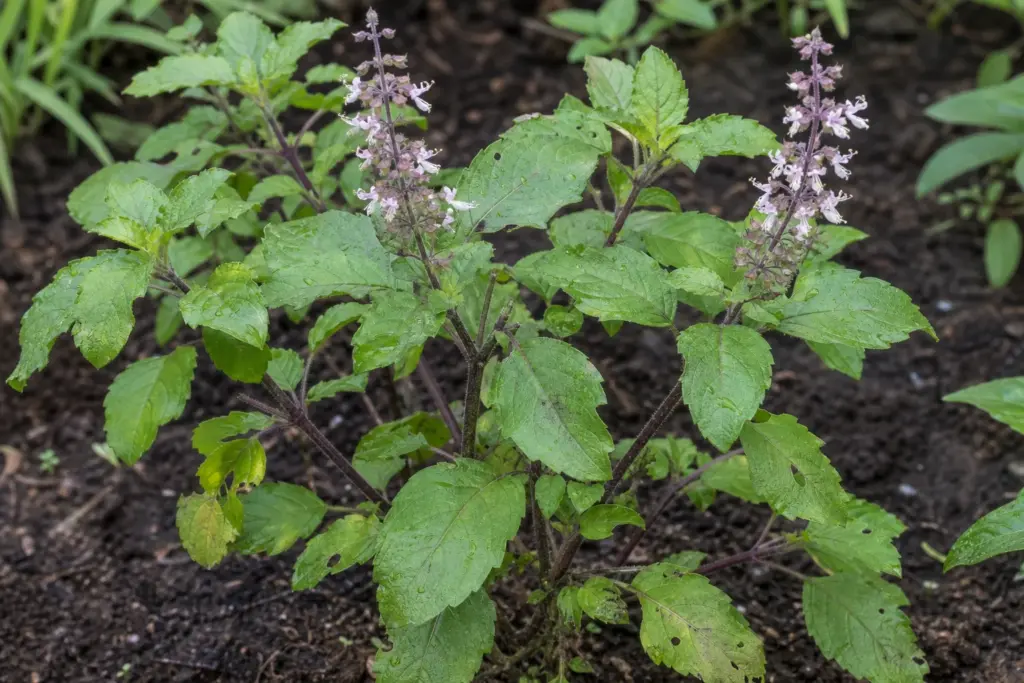
Tulsi is a good plant on which to practise looking. Ocimum tenuiflorum, also sold under the older name O. sanctum, has paired leaves on hairy, square stems and small pale flowers in terminal clusters. NC State Extension describes it as an aromatic annual, short-lived perennial, or subshrub that likes sun and moist but well-drained soil; it performs poorly in waterlogged ground and may seed aggressively outside its native range.4 Those details matter more than a packet printed only with “holy basil.”
Three plants ask for three different garden conditions
Turmeric, Curcuma longa, is a tropical perennial grown for an underground stem, or rhizome—not a true root. Penn State Extension recommends rich, slightly acidic soil, frequent water during active growth, and morning sun with afternoon shade. In a cold climate, a broad container makes it easier to provide warmth and bring the dormant rhizomes under cover. Harvest when the foliage yellows and dries, then reserve firm pieces with a sound bud for replanting.5 Our guide to harvesting and storing homegrown spices explains why cleaning and drying should follow the needs of the plant part rather than one universal herb routine.
Ashwagandha, Withania somnifera, belongs in a different moisture zone. Oregon State University’s work with medicinal-herb producers in the Pacific Northwest treats it as an annual crop with a deep root, grown in well-drained sandy or rocky soil and watered sparingly once established.6 That regional profile is not a prescription for every climate, but it exposes the problem with a decorative “healing bed”: turmeric that is kept evenly moist and ashwagandha that resents wet soil should not share one irrigation schedule.
Tulsi can occupy the sunnier, regularly watered edge; turmeric can have a warm, humus-rich container; ashwagandha can take the freer-draining position. Check local hardiness, invasive-plant guidance, and nursery provenance before planting. A history-themed collection is still a real garden, subject to drainage, frost, pests, mature size, and the ecology beyond its fence.
The preparation changes the claim
A slice of turmeric cooked into food is not equivalent to a capsule engineered to increase curcumin absorption. NCCIH says the evidence is not yet strong enough to conclude that turmeric or curcumin benefits any health purpose, and reports liver injury in some people using highly bioavailable formulations. Oral turmeric may also cause digestive effects, and supplements may be unsafe during pregnancy.7 None of that makes a turmeric plant dangerous to admire or the spice useless in a kitchen. It means form, amount, and purpose cannot be erased.
Ashwagandha makes the same point. Trials have used different preparations, often with small samples. NCCIH finds some evidence for particular preparations in stress or insomnia, not a blanket result for the garden plant or every product. It also records rare cases of liver injury, advises against use during pregnancy and breastfeeding, and lists potential interactions with thyroid, blood-pressure, diabetes, sedative, anticonvulsant, and immunosuppressant medicines.8
For a gardener, the clean boundary is simple: cultivate for observation, scent, food where the species and plant part are established culinary ingredients, or a documented historical collection. Do not turn a home harvest into treatment advice. If someone wants to use a plant medicinally—especially during pregnancy, before surgery, with a chronic condition, or alongside medication—the next step is a qualified clinician and, where relevant, a properly trained practitioner. Our broader guide to planning a medicinal herb garden without medical promises develops that boundary.
Design the bed as a record, not a pharmacy
- Separate moisture zones. Group plants by the conditions their roots need, even when a historical theme connects them.
- Use durable labels. Include the botanical name and accession source. A common name alone may cover more than one species or a mixed seed strain.
- Keep harvests traceable. Use clean tools and separate containers; note the plant part and date before drying anything. Never collect a plant that has been treated with a pesticide not labelled for that intended use; pesticide labels define where, how, how much, and how often a product may be applied.9
- Protect casual visitors. Do not place culturally or medicinally significant plants in a children’s snack bed. Explain that “used traditionally” describes a history; it does not certify every part for unsupervised eating.
The result can still be sensuous: tulsi buzzing with small pollinators, turmeric leaves catching rain, the earthy smell of an ashwagandha root lifted after frost. The honesty is part of the design. Each label tells us what the plant is, each bed shows what it needs, and each careful citation leaves room for both cultural history and better evidence.
References
- Dominik Wujastyk, “The Evidence for Hospitals in Early India”. History of Science in South Asia, 2022.
- Ayurvedic Medicine: In Depth. National Center for Complementary and Integrative Health.
- Quality Control Methods for Medicinal Plant Materials. World Health Organization.
- Ocimum tenuiflorum plant profile. NC State Extension Gardener Plant Toolbox.
- 2026 Herb of the Year: Turmeric. Penn State Extension.
- Medicinal Herb Production in the Pacific Northwest. Oregon State University Extension Service.
- Turmeric: Usefulness and Safety. National Center for Complementary and Integrative Health.
- Ashwagandha: Usefulness and Safety. National Center for Complementary and Integrative Health.
- Introduction to Pesticide Labels. U.S. Environmental Protection Agency.