

April Fools’ Day belongs to whoopee cushions, fake announcements, and suspiciously confident advice from people who should know better. The garden does not need any of that. It has been running its own jokes for millions of years, and some of the best ones are flowers.
Not joke flowers in the novelty sense. Real flowers. Carefully built flowers. Flowers that look like insects, smell like fungi, promise food they do not provide, warm themselves like a body, or briefly hold visitors in a chamber long enough to dust them with pollen. They are not being silly. They are solving one of the central problems of plant life: how to move pollen when you cannot walk.
For an April Fools post, then, the honest thing is not to invent an absurd plant. It is to look at the absurdity that botany has already made true.
The basic trick
Most flowering plants are not pranksters. They advertise honestly enough. A flower advertises with color, form, or scent and may reward a visitor with nectar, pollen, warmth, shelter, or another benefit. A bee, fly, beetle, moth, wasp, or bird visits. Pollen sticks to the visitor. With luck, the visitor carries it to another flower of the same species. The whole arrangement can be messy, but it is built around exchange.
Deceptive flowers bend that arrangement. They use the signals without always paying the bill. In orchids, deception is especially well developed. A review in Biological Reviews describes several mechanisms, including generalized food deception, food-deceptive mimicry, brood-site imitation, shelter imitation, and sexual deception.1 That is a polite scientific way of saying that some flowers have become very good at exploiting what insects are already looking for.
This does not make insects foolish in any simple sense. A pollinator has limited time, limited energy, and a world full of signals. A flower that closely matches a reliable cue can sometimes borrow the insect’s attention. The joke works because the insect’s behavior is reasonable most of the time.
The bee orchid and the bad date
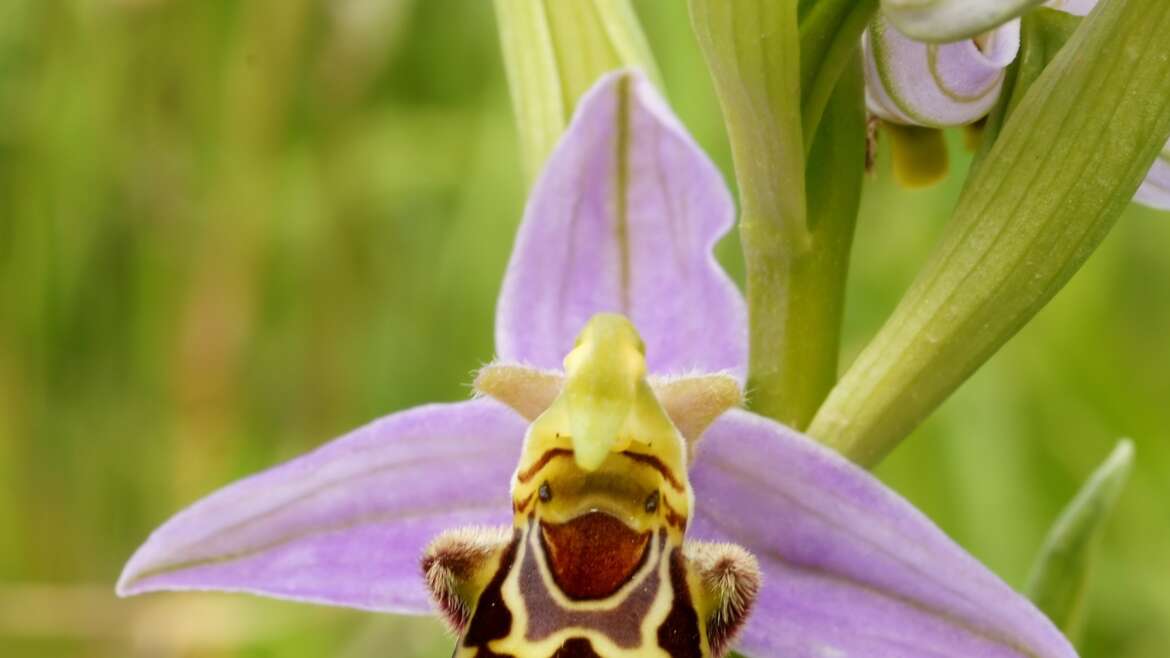
The bee orchid, Ophrys apifera, is the classic floral April Fool. Its lip, called the labellum, has a rounded, patterned, slightly furry look that suggests a bee resting on the flower. The Natural History Museum describes bee orchids as mimicking the shape and scent of bees, drawing males into attempted mating while pollen is transferred.2
The visual resemblance is only part of the story in many sexually deceptive orchids. Scent matters deeply. Some orchids imitate chemical signals used by female insects, and males arrive already primed for a very specific mistake. The flower does not have to look convincing to a human. It has to press the right buttons for a wasp or bee at the right moment in spring.
There is a small twist to the bee orchid, which makes it even better for April Fools’ Day. The Museum also notes that bee orchids self-pollinate, transferring pollen from the male to the female parts of the same plant.2 The costume remains, but the actor may not need to fool an audience every time. Evolution is practical, not theatrical.
The empty buffet
Not every trick is romantic. Some flowers look like a meal and then provide almost nothing. Rewardless orchids may advertise with bright color, shape, fragrance, or timing while offering little or no nectar. A bee that has recently found good food in similar flowers may investigate the mimic, and that investigation may be enough for pollination.
This is a risky strategy. Pollinators can learn to avoid unrewarding flowers. Deception may work best when the cheat is uncommon enough that visitors do not quickly learn the association, or when it resembles a rewarding flower nearby.1 A fake cafe sign is more convincing on a street where real cafes exist.
For gardeners, this is a useful reminder. A flower is not beautiful for our benefit alone. Color and scent are part of a communication system with other animals. Sometimes the message is a fair invitation. Sometimes it is a nudge, a shortcut, or a fraud with petals.
When a flower smells like bad news
Human gardeners often divide flowers into fragrant and not fragrant, as if sweetness were the point. Flies and beetles disagree. To an insect that feeds or lays eggs on decaying matter, the smell of rot is not disgusting. It is information.
The titan arum, Amorphophallus titanum, is famous for this. A recent study describes its rotting-flesh odor as an attractant for carrion beetles and flies.3 The inflorescence also generates heat during bloom; that heat is thought to help volatilize and spread its odor.3
That trick appears again and again in plant life. Rafflesia, some stapelias, several arums, and other carrion-scented flowers borrow the smell-world of decay. To us, the flower may seem to have made a terrible social choice. To the plant, it has found the right audience.
This is why a garden built only around human fragrance can miss part of what flowers are doing. Lavender and roses speak beautifully to people and bees. A stinkier plant may be speaking to flies, beetles, or other visitors whose work is easy to overlook because it does not come with a honeybee’s public relations campaign.
The temporary trap
Some floral tricks are not only about attraction. They are also about timing. The plant needs a visitor to enter at the right stage, contact the female parts, stay or move in a controlled way, then leave carrying pollen from the male parts.
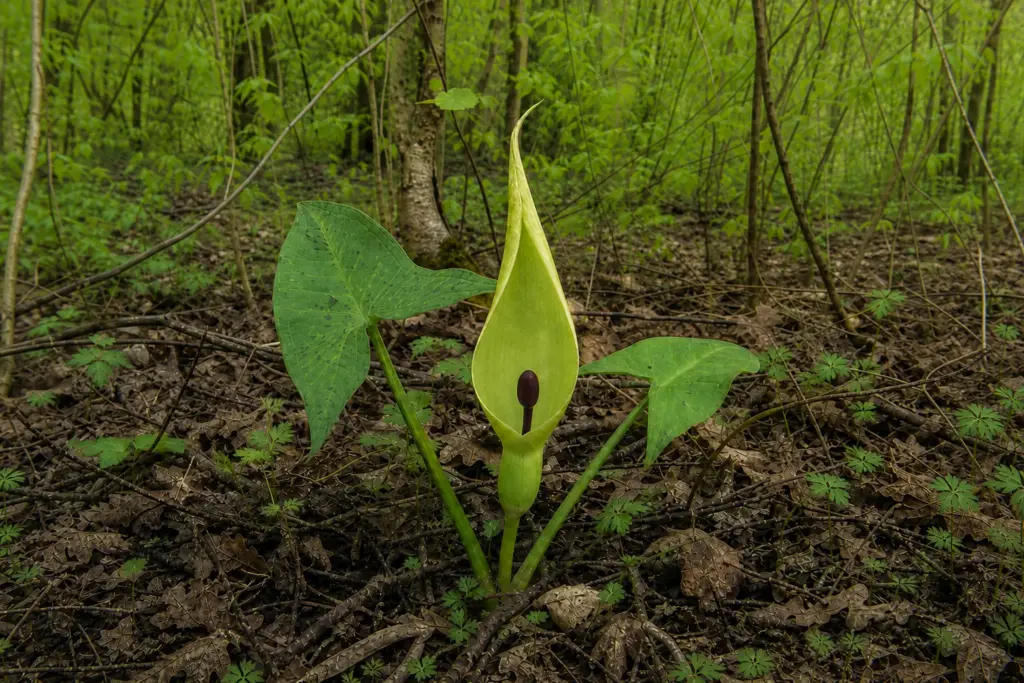
Several arums use this kind of choreography. Research on Arum maculatum describes a pitfall-trap inflorescence that attracts psychodid moth flies during the female stage.4 The insects are not eaten like prey in a sundew or Venus flytrap. They are temporarily managed as pollination workers. The difference matters: a carnivorous plant wants nutrients from the insect; a pollination trap wants pollen delivered.
In regions where arums and their jack-in-the-pulpit relatives emerge in spring, it is worth looking at the structure with this in mind. The spathe forms a hood around the spadix, while the fertile flowers stay hidden at the base: a compact piece of pollination architecture.
Why the insects keep falling for it
The obvious question is why pollinators do not simply stop visiting deceptive flowers. Sometimes they do. Insects can learn, and a bad flower visit has an energy cost. But deception persists because the world is not a tidy classroom. New insects emerge. Weather changes. Honest flowers come and go. Scent plumes drift. A signal that is usually useful can still be exploited sometimes.
Many deceptive systems are also very specific. They may depend on a short seasonal overlap, a narrow group of insects, or a cue that is powerful because it is tied to mating or egg-laying rather than casual curiosity. A male insect does not inspect a possible mate with the same patience a gardener brings to a seed catalog.
The plant is not clever in a human sense. It has no private joke. Natural selection keeps forms, scents, colors, and timings that move pollen more successfully than their alternatives. The result can look mischievous because it touches the same human nerve as a prank: someone expected one thing and got another.
What this means in a real garden
Most home gardeners are not going to build a border around sexually deceptive orchids or corpse-scented giants. Many of these plants are specialized, protected, difficult to cultivate, or simply not suited to ordinary gardens. The practical lesson is not to turn the yard into a botanical prank shop.
The lesson is to pay attention to floral signals. Some flowers are built for bees. Some for flies. Some for moths. Some are generous. Some are selective. Some are trickier than they look. If your goal is to support pollinators, the garden should not be one long April Fools joke. University of Maryland Extension recommends flowers with varied shapes and bloom periods through the growing season, along with water and places to shelter and reproduce; it also advises against using pesticides in the yard.5
That means mixing bloom times, flower shapes, and plant families. It means letting a few less glamorous insects matter. It means choosing plants for accessible pollen and nectar, rather than assuming every ornate cultivar serves visitors well. It also means accepting that a pollinator garden can be a little untidy: leaving some perennial stems and leaf litter in place, retaining bare patches for ground-nesting bees, and growing flowers that do not all perform for humans first.
The joke is on certainty
April Fools’ Day is usually about making someone briefly wrong. Plants do that to us all the time. We think a flower is an ornament, and it turns out to be a contract. We think fragrance means sweetness, and it turns out to mean fungus, dung, or decay. We think a petal is simply pretty, and it turns out to be a costume, a landing platform, a scent machine, or a trapdoor.
That is one of the pleasures of gardening with any seriousness. The garden keeps embarrassing our first explanations. A flower can be beautiful and manipulative. A fly can be a pollinator. A weed can be a teacher. A prank can be a strategy old enough to have outlived entire forests.
So on April 1, give the fake gardening advice a rest. Do not plant spaghetti trees. Do not water with soda. Do not believe the seed packet that promises blue tomatoes by Thursday. The real jokes are better. Somewhere, a flower is dressed like a bee, smelling like a mushroom, warming itself like meat, or holding a fly overnight, and it is doing so with a seriousness no prankster can match.
References
- Jersáková, Johnson, and Kindlmann: Mechanisms and evolution of deceptive pollination in orchids
- Natural History Museum: Sneaky orchids manipulate bees for pollination
- Zulfiqar et al., PNAS Nexus: Molecular basis for thermogenesis and volatile production in the titan arum
- Gfrerer et al., Scientific Reports: Antennae of psychodid and sphaerocerid flies respond to a high variety of floral scent compounds of deceptive Arum maculatum
- University of Maryland Extension: Pollinator gardens
- Featured image by Hans Hillewaert via Wikimedia Commons, cropped from the original and used under CC BY-SA 3.0

.jpg)