
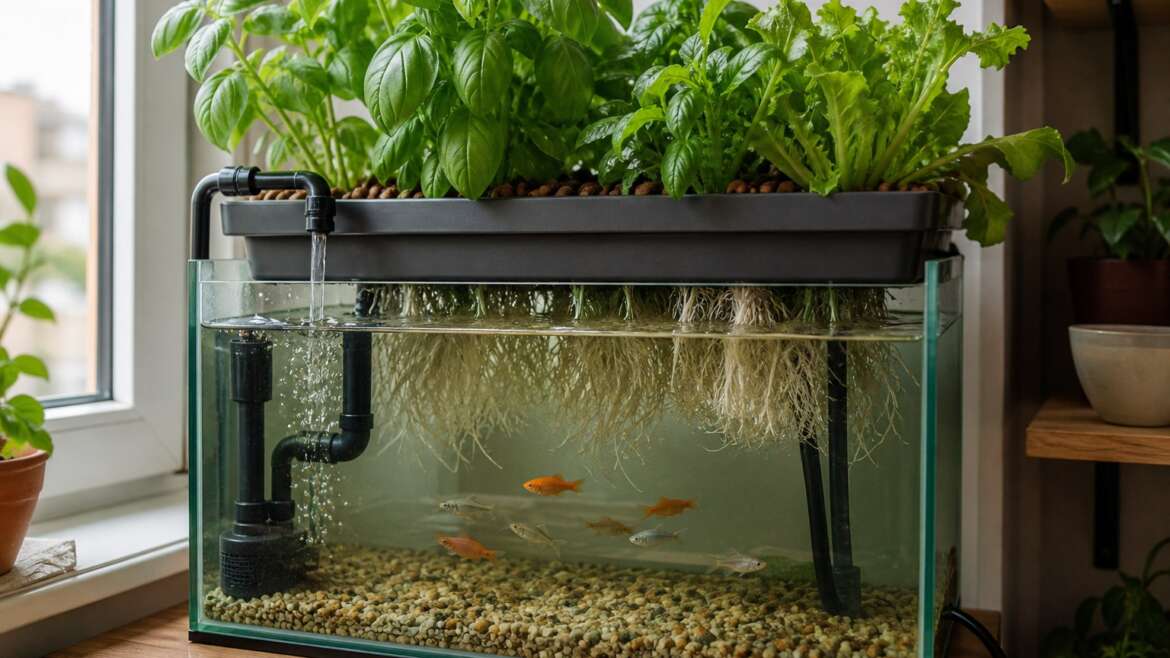
Apartment aquaponics sounds tidy: fish feed plants, plants clean water, dinner grows beside the window. The real system is more interesting and less effortless. It is a small ecosystem with fish, plants, nitrifying bacteria, pumps, oxygen, water chemistry, light, and the person who notices when one part drifts.
USDA’s National Agricultural Library describes aquaponics as a system that combines aquaculture with hydroponic plant growing.1 That definition is useful because it keeps both halves in view. The fish are not decoration beneath a planter, and the greens are not ordinary houseplants with a novelty tank below them.
The third crop is bacteria
Fish waste does not leap straight into lettuce leaves. Nitrifying bacteria convert toxic ammonia first to nitrite and then to nitrate, a form plants can use more readily. New Mexico State University Extension explains that ammonia and nitrite can harm fish and that nitrification is central to aquaponic water quality.2 In practical terms, you are growing a bacterial filter as carefully as you are growing basil.
That is why new systems need patience. A tank that looks clean may not yet have a stable biofilter. Add fish slowly. Feed lightly. Test water. Do not scrub every surface sterile when the system is trying to colonize. The invisible part of aquaponics is often the part keeping the visible part alive.
Source water matters too. Municipal water is often treated with chlorine or chloramines, which must be removed before it enters a live aquaponic system.2 A small bottle of dechlorinator, a water test kit, and a written log are not accessories. They are part of the garden.
Apartments make small mistakes bigger
A backyard system has more room for tanks, filters, overflow, and weather. An apartment system has weight limits, power cords, neighbors, floor finishes, and limited water volume. Small volumes warm, cool, and change chemistry quickly. A missed pump problem can matter in hours.
FAO’s small-scale aquaponics guide describes the relationship among fish, plants, and bacteria as a balance that must be managed through design and operation.3 Start with a sturdy stand, a waterproof mat, a reliable pump, and a tank you can actually reach into. The romance of the system depends on very ordinary maintenance.
If you are still choosing the hardware, keep the first system modest. A media bed is forgiving because the grow media can also host bacteria and trap some solids, while NFT channels and raft systems can be elegant but less forgiving when flow, oxygen, or filtration is off. I go deeper into those tradeoffs in choosing an apartment aquaponics system without overbuilding it.
Plants still need light
Aquaponics does not remove plant biology. Basil, lettuce, and leafy greens still need enough light to grow strongly. A dim window may keep the system alive without producing much food. If you add grow lights, keep cords and water separated, use a timer, and avoid warming the tank beyond the fish’s comfort zone.
What it can realistically grow
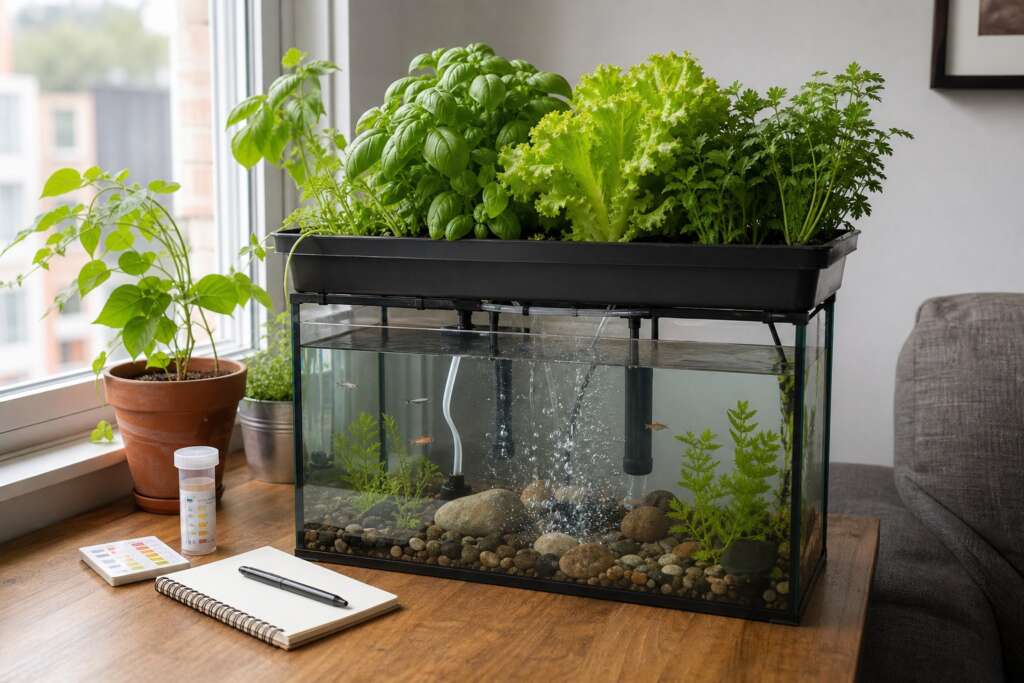
For a first apartment system, think herbs and leaves rather than pantry replacement. Oklahoma State University Extension notes that culinary herbs and leafy greens are strong beginner choices because they have lower nutrient demands than fruiting crops such as tomatoes, peppers, and cucumbers.4 Lettuce, basil, watercress, Swiss chard, pak choi, and mint-sized ambitions make more sense than promising yourself a year-round tomato wall.
Fish can be part of the yield in larger, legal, properly stocked systems, but a small apartment unit is usually better treated as a learning loop that happens to grow fresh leaves. Choose fish for welfare and water temperature before you choose them for novelty. In many apartments, ornamental fish in a lightly stocked system are more sensible than trying to raise dinner.
Maintenance is the hobby
The system will ask for small regular acts: check the pump, watch fish behavior, remove trapped solids, top up evaporated water, rinse mechanical filters in dechlorinated water, and test pH, ammonia, nitrite, and nitrate. Indoor pests can still arrive on transplants or houseplants, and many garden sprays are unsafe around fish, so prevention and mechanical controls matter more than heroic rescue treatments.
Once the loop is running, stability is the real skill. The companion article on keeping an aquaponic system stable before it becomes a crisis is the practical next step because most aquaponic failures begin as small changes nobody wrote down.
Begin for learning, not harvest volume
A first aquaponic setup should teach you water before it tries to feed you. Basil, lettuce, and leafy greens can be satisfying, but the true harvest is understanding how quickly a living loop responds. When the fish are active, the plants are growing, the water tests make sense, and the pump is reliably dull, the apartment has earned its small ecosystem.