
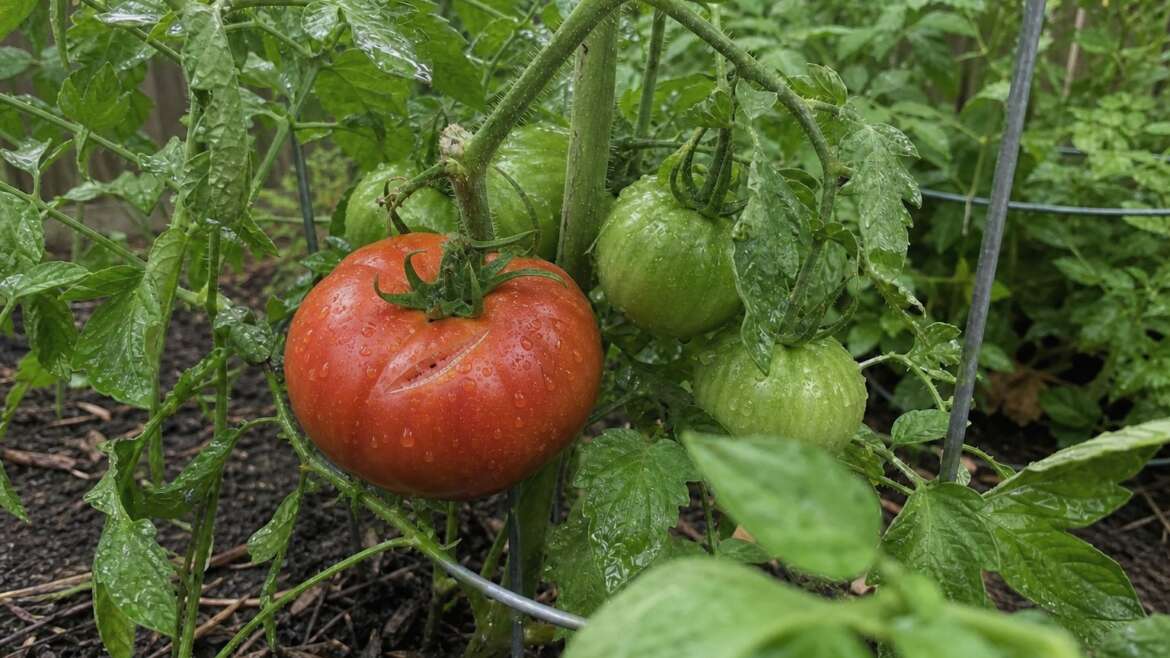
A split tomato has a disappointing kind of drama. Yesterday it was almost perfect, heavy on the vine and beginning to color. Then a night of rain passes through, the garden smells rich and washed, and the tomato is suddenly open along one side, its skin pulled apart like a seam that could not hold.
It can feel like rot, disease, or bad luck, but cracking is usually a water story. The fruit is alive, expanding, and held inside a skin that has only so much give. When water arrives too quickly after a dry spell, the inside of the tomato can swell faster than the outer skin can stretch. The skin fails, and the fruit records the weather in a line.
This is one of the useful frustrations of summer gardening. A cracked tomato can still be useful evidence: its seam records soil moisture, heat, variety, harvest timing, and the gardener’s watering habits.
The fruit grows faster than the skin
Tomatoes crack when expansion outpaces flexibility. NC State Extension describes heavy rain, especially after dry weather, as the leading cause of tomato cracking and splitting. Rapid shifts in soil moisture cause fruits to expand faster than the skin can grow.1 The plant is not trying to ruin the harvest. It is doing what roots do after water returns: taking up moisture and moving it through the system.
The fruit, however, is not a balloon with endless stretch. As a tomato ripens, the skin naturally becomes weaker, which makes late-stage fruit more vulnerable when internal pressure rises.2 That is why splitting often appears just when a gardener has been patiently waiting for color.
Purdue’s Vegetable Crops Hotline notes that cracking is often seen after a dry period followed by heavy rain, when the shift from low to high soil moisture reduces skin strength while the fruit expands quickly.3 Heat can add pressure by warming the fruit and changing how firm the skin remains. A tomato can be under stress from both inside and outside at once.
Two ways a tomato opens
Most cracking falls into two visible patterns. Radial cracks run outward from the stem end, sometimes traveling down the shoulder or side of the fruit. Concentric cracks form rings around the stem end, like shallow circles drawn into the top of the tomato. Iowa State University Extension describes both patterns and ties them to wide fluctuations in soil moisture.4
Radial cracks are usually more serious because they can extend deeply into the fruit. NC State notes that radially cracked tomatoes may rot quickly if they remain on the vine.1 Concentric cracks circle the stem end; either pattern can expose tissue to secondary decay.
Pattern alone does not reveal exact timing. Susceptibility changes with cultivar, maturity, temperature, light, humidity, and how abruptly water availability shifts.3 The useful reading is not a precise weather diary but evidence that fruit growth and skin strength fell out of step.
Why rain after drought is risky
The worst sequence is not simply rain. It is drying, then sudden abundance. When soil dries, roots slow, leaves conserve, and fruit development changes pace. Then a deep watering or heavy rain arrives. The plant takes up water rapidly, and the fruit receives a pulse it cannot always absorb gracefully.
Iowa State puts the prevention plainly: supply tomatoes with consistent moisture during summer, water thoroughly during dry periods, mulch around plants, and choose varieties with good crack resistance when possible.4 Consistency matters more than heroic rescue watering. A tomato bed that swings between dust and saturation is more likely to write those swings into the fruit.
Penn State Extension notes that harvesting fruit at the breaker-to-pink stage rather than waiting for full vine ripeness can reduce cracking late in development.2 Before a soaking storm after a dry spell, fruit that has already begun to color is therefore a sensible candidate to move indoors. This is not cheating the vine. It is reading the forecast as part of the harvest.
Not all tomato troubles are cracks
Cracking is easy to confuse with other tomato disorders because summer fruit can carry several problems at once. Blossom-end rot, for example, is not a split. It usually appears as a dry, dark, leathery area near the blossom end of the fruit. Mississippi State Extension explains that blossom-end rot is a physiological disorder tied to inadequate calcium in developing fruit, often because drought limits water movement and therefore calcium movement into the fruit.5
The overlap is water. Uneven moisture can contribute to both cracking and blossom-end rot, but the symptoms differ. A split tomato has a break in the skin, usually near the stem or along the side. A tomato with blossom-end rot has a dark collapsed patch at the bottom. Adding calcium after the fact will not close a split skin, and a cracked tomato is not automatically calcium deficient.
Sunscald is different again: it appears as a white or yellowish spot on the side of fruit facing the sun, especially when mature foliage has been removed. Catfacing produces misshapen, severely deformed fruit, often after cold conditions interfere with pollination while flowers develop.6 The guide to when full sun becomes too much looks more closely at protecting exposed fruit without turning a tomato bed into deep shade. A summer tomato can be a whole notebook of stresses. The useful habit is to name the mark before trying to fix it.
What to do with a split tomato
If a tomato splits, harvest it. Leaving it on the vine rarely improves the situation, especially if the crack is deep and the weather is warm. NC State Extension recommends harvesting cracked fruit immediately before rot begins, and notes that fruit with a sour smell or oozing should go to the compost pile.1 Use your senses. A clean fresh split on an otherwise sound tomato is very different from a soft, leaking, moldy one.
Freshly cracked ripe tomatoes that are otherwise sound are best used quickly, but a split deserves more caution than an intact skin. The FDA notes that microorganisms can enter tomatoes through cracks, cuts, or bruises.7 Discard fruit that is soft, leaking, moldy, rotten, or sour-smelling. If you choose to use a very fresh shallow split, wash the fruit under running potable water before cutting, trim away damaged tissue, inspect the interior, and favor a thoroughly cooked sauce, soup, or pan dish. People at higher risk from foodborne illness may reasonably discard cracked fruit. Refrigerate any cut remainder at 41°F (5°C) or below.7
Do not use cracked or otherwise damaged tomatoes for home canning. Colorado State University Extension lists cracks among the kinds of damage that can reduce tomato acidity and advises against home-canning damaged or decayed fruit.8 Nearly ripe tomatoes with shallow cracks can sometimes finish indoors if they are otherwise sound, but check them daily. A crack turns a storage tomato into a short-term tomato.
The case for picking before perfect red
Gardeners love the idea of a tomato ripened completely on the vine, warm from the sun. That is a real pleasure, but it is not the only honest harvest. Colorado State University Extension explains that tomatoes starting to show a pink blush have reached the breaker stage and can ripen off the vine without loss of flavor.9
That matters before a storm. If a tomato has begun to turn, especially a large slicing tomato, it has already crossed an important threshold. Picking it before a heavy rain can save it from splitting, birds, heat damage, or the simple problem of being missed for one day too long.2 Let it finish on the counter, out of direct sun, where you can watch it closely.
This does not mean stripping every green fruit at the first cloud. A matte, immature green tomato is a different thing from a shiny mature green tomato or a fruit with a blush at the blossom end. Learn the variety. Some turn yellow, orange, purple, or striped instead of red. The goal is not early harvest for its own sake. The goal is to stop asking a ripe fruit to survive unnecessary weather.
How to reduce cracking next time
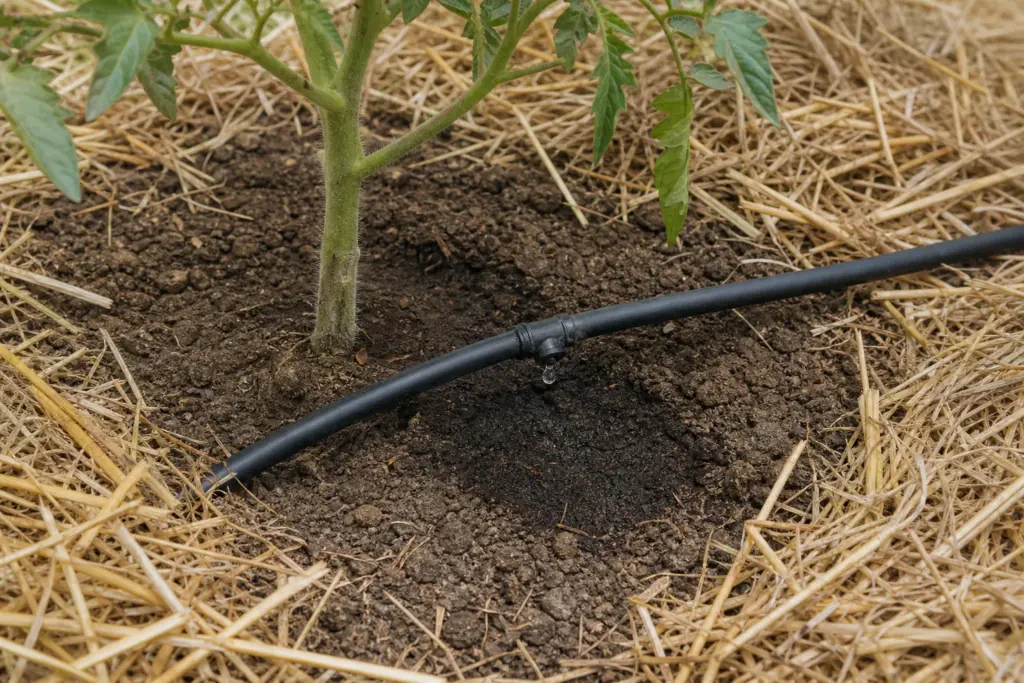
Start with the soil, not the fruit. Mulch tomatoes after the soil has warmed, using straw, shredded leaves, compost, or another clean organic mulch. Mulch slows evaporation, softens the effect of hot afternoons, and reduces the wild swing between dry surface and soaked root zone. It also keeps soil from splashing onto lower leaves and fruit.
Water deeply and regularly instead of giving the bed shallow apologies. NC State offers about one inch of water per week as a general vegetable-garden benchmark and notes that soaker hoses or drip irrigation apply water directly to the soil while keeping leaves dry.1 Heat, soil texture, wind, root depth, containers, and recent rain all change the actual need. A rain gauge helps you know whether the sky delivered useful water, and a check beneath the mulch tells you whether moisture reached the root zone.
Choose varieties with some crack resistance if cracking is a yearly problem. Iowa State names several crack-resistant options, and many seed catalogs now include similar notes in variety descriptions.4 Small-fruited tomatoes often tolerate moisture swings better than large beefsteaks, though no tomato is immune when dry soil is followed by heavy rain.3
Finally, maintain healthy leaf cover. Excessive pruning can expose fruit to direct sun and larger temperature swings.2 Support vines so you can see and pick tomatoes before they overstay. A tomato plant does not need fussing every hour. It needs steadiness.
Useful tomato-watering supplies
- AcuRite magnifying rain gauge: helpful for knowing whether a storm delivered a useful soaking or only made the leaves look wet.
- XLUX soil moisture meter: a simple probe for checking whether soil is dry below the surface, especially in containers and raised beds.
- KINGLAKE tomato vine clips: useful for keeping vines supported, fruit visible, and harvest checks less chaotic after rain.
Final thoughts
A split tomato is frustrating because it arrives at the edge of reward. The fruit did nearly everything right. It flowered, set, swelled, colored, and sweetened. Then the weather changed faster than its skin could answer.
The lesson is not to fear rain. A garden needs rain. The lesson is to soften the extremes: mulch before drought, water before plants wilt, harvest nearly ripe fruit before a soaking storm, and choose varieties that forgive a little weather. Tomatoes will always keep some of their drama. The gardener’s work is to keep that drama out of the skin.
References
- NC State Extension: What causes tomatoes to crack?
- Penn State Extension: Why are my tomatoes cracking and what can I do about it?
- Purdue University Vegetable Crops Hotline: Cracking tomatoes
- Iowa State University Extension: Why are my tomatoes cracking?
- Mississippi State University Extension: Tomato troubles
- Rutgers New Jersey Agricultural Experiment Station: Growing tomatoes in the home garden
- U.S. Food and Drug Administration: Storage and handling of tomatoes
- Colorado State University Extension: A guide to canning tomatoes and tomato products
- Colorado State University Extension: Ripening tomatoes indoors