
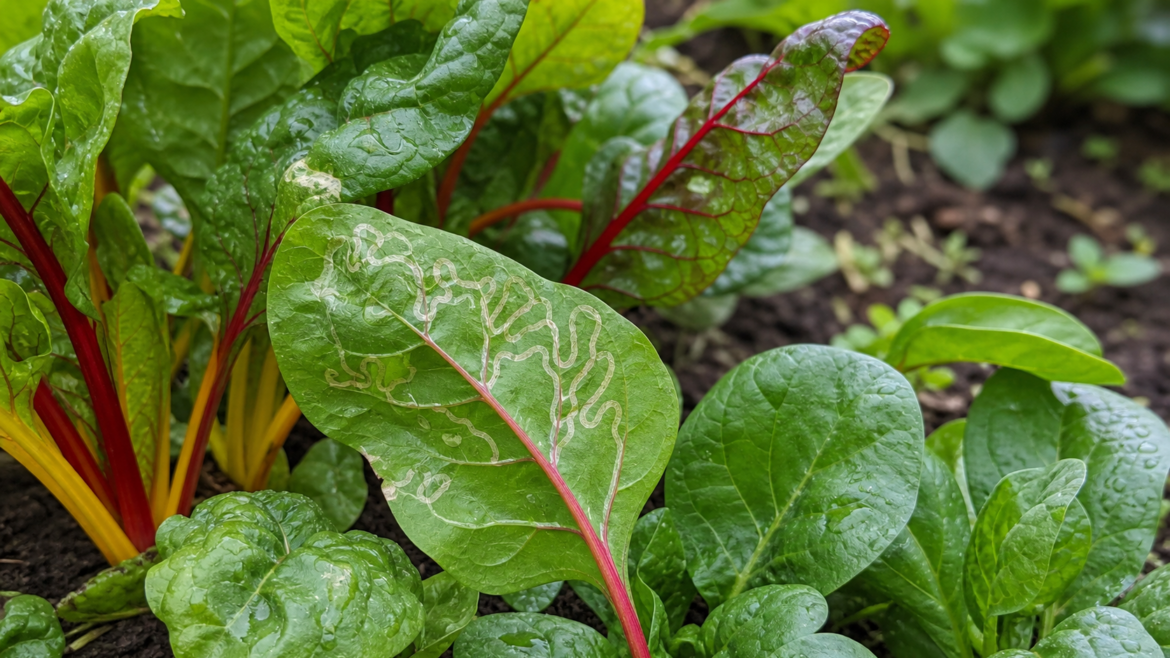
By June, a spinach leaf can begin to look as if something has been writing inside it. The surface is still mostly green, still cool from morning watering, but pale lines wander through the tissue in loose loops and narrow bends. They are too clean to be slug damage, too internal to be chewing, and too deliberate-looking to feel random.
These silver trails are leaf mines. A tiny larva is feeding between the upper and lower surfaces of the leaf, leaving a tunnel of damaged tissue behind it. To a gardener, the pattern can look like a warning sign. To the insect, it is a sheltered dining room.
Leaf miners are not one single insect. The phrase describes a way of living. In vegetable gardens, the most familiar leaf miners are small flies whose larvae feed inside leaves. University of Maryland Extension describes leaf miners as insects that feed between leaf surfaces during the larval stage, producing white, gray, or pale trails, tunnels, mines, or blotches just under the surface of leaves and soft stems.1
That hidden feeding is why leaf-miner damage feels so odd. The pest is not sitting openly on the leaf like a caterpillar. It is inside the leaf, using the plant itself as shelter.
A tunnel, not a bite
Most garden feeding damage is easy to understand at a glance. A beetle chews a hole. A caterpillar removes an edge. A deer makes a rough absence where a hosta used to be. If the marks are tiny round holes rather than pale tissue, compare them with the shot-hole pattern made by flea beetles. Leaf miners make a different kind of mark because they do not eat from the outside inward. They hatch on or in the leaf, enter the tissue, and feed in the thin green layer between the two skins of the leaf.
Wisconsin Horticulture describes spinach-leafminer damage as narrow early mines that can merge into larger pale blotches as larvae grow.2 The names are useful because the damage often tells you as much as the insect itself. A serpentine mine wanders like a pale line on a map. A blotch mine spreads into a larger papery window.
Look closely and the mine often changes along its length. The line may begin narrow, then widen as the larva grows. It may darken with frass, the insect’s waste, or turn from translucent silver to tan or brown as the damaged tissue dries. Sometimes the larva is still visible at the end of the tunnel as a tiny pale body. Sometimes the mine is empty, because the larva has already dropped into the soil to pupate.
This is useful information. A fresh mine with a living larva is still part of the current problem. An old empty mine is only history written on a leaf.
Why leafy greens show it most
Leaf miners can feed on many plants, but gardeners notice them most on crops we grow for leaves. A mined beet leaf is annoying if you wanted beetroot. A mined spinach leaf is the harvest itself. The damage has not merely marked the plant. It has marked the part you planned to eat.
The damage threshold is crop- and site-specific. Wisconsin Horticulture notes that mined spinach leaves may become unmarketable, while Utah State reports mainly cosmetic injury in many Utah vegetables but warns that damage can be more severe in warm regions and greenhouse production.27 A tomato plant with a few leaf-miner trails may keep growing and fruiting as if nothing important has happened. A row of young spinach, however, can become unappealing quickly because every marked leaf matters.
Spinach, Swiss chard, beets, lambsquarter, lettuce, onions, garlic, beans, peas, cucumbers, squash, tomatoes, and many ornamentals can all be involved depending on the species. Illinois Extension separates two common vegetable-garden patterns: spinach leafminers feed on crops including spinach and Swiss chard, while vegetable leafminers range across beans, peas, nightshades, cucurbits, beets, onions, and lettuce.3
This is one reason lambsquarter matters in and around a vegetable garden. It may look like an incidental plant at the bed edge, but to a leaf-miner fly it can also be a nearby host. If you grow chard and spinach every year and leave closely related weeds beside the bed, you may be keeping the table set.
The life cycle under the pattern
The visible trail is only one chapter. Adult flies emerge, mate, and lay eggs on leaves. The egg hatches. The larva feeds inside the leaf, protected from many predators and from a gardener’s casual glance. After feeding, it pupates, often in the soil, then a new adult emerges to start the cycle again.
Maryland Extension describes the cycle plainly: female flies puncture leaves and insert eggs, larvae tunnel through and feed inside leaves or soft stems, then pupae form in soil or plant parts before adults emerge.1 Illinois Extension gives the practical timing for spinach leafminer: adults appear from mid-April into May after overwintering as pupae, and several generations can occur in a year.3
That timing explains why the first serious signs often appear in spring and early summer. It also explains why succession planting can keep the issue alive. A bed of spring spinach, followed by summer chard, followed by fall beets, may be excellent kitchen planning. If leaf miners are established, it can also be a continuous invitation.
The solution is not to stop growing greens. It is to stop thinking of the mark as a mysterious disease and start thinking in generations, host plants, and timing.
What to do when you find the first lines
The first response should be small and physical. Pick off the damaged leaves while the mines are fresh. Do not drop them beside the bed, because larvae in removed leaves may be able to finish developing. Colorado State University Extension recommends picking and destroying leaves with actively growing larvae, warning that leaving picked leaves on the ground allows larvae to complete development.4
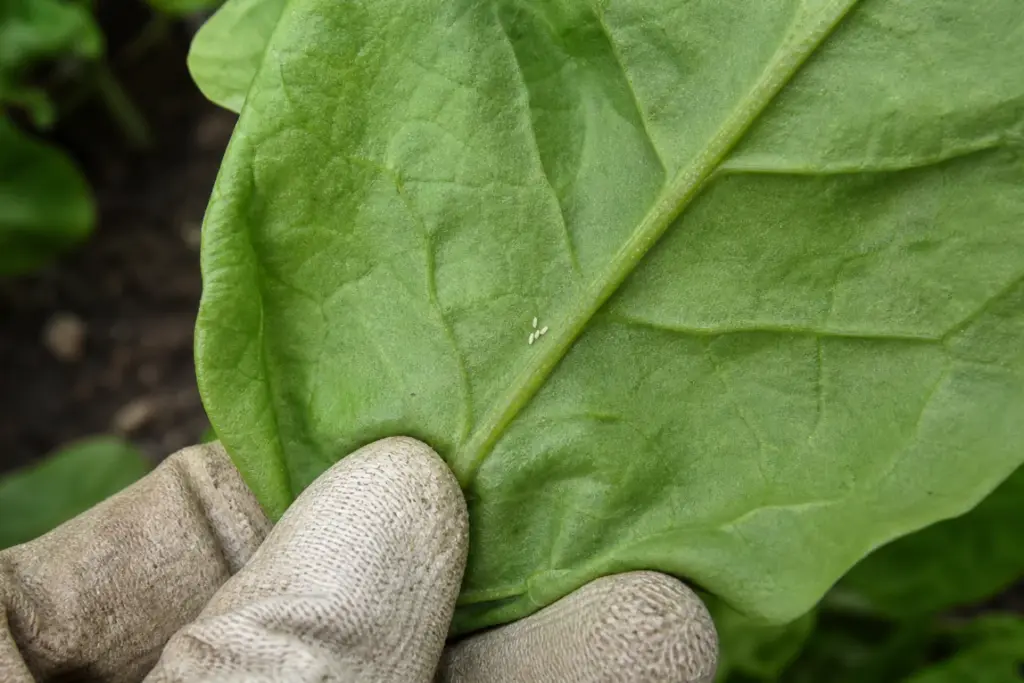
If you see the small white egg clusters on the undersides of spinach, beet, or chard leaves, crush them or remove that portion of the leaf.3 This is not glamorous work, but it is direct. It reaches the pest before it becomes a tunnel.
For leafy greens, harvest assertively. If a few outer chard leaves are mined, remove them and let clean inner leaves continue growing. If a young spinach planting is heavily marked, it may be better to harvest usable leaves, pull the rest, and replant in a different bed rather than nursing a declining patch that is also producing the next generation.
The goal is not perfect foliage. The goal is to keep the population from turning every new leaf into a nursery.
Why spraying often disappoints
Leaf miners are frustrating because contact sprays remain on the outside of a leaf while the larva feeds inside it. Once a tunnel is visible, a contact treatment cannot reach that hidden larva. Wisconsin Horticulture notes that pesticides do not control maggots after they burrow into leaves, and recommends conserving natural enemies by minimizing broad-spectrum insecticide use.2
Colorado State University Extension is even more blunt about vegetable leafminers: many insecticides work poorly against them, and applications can make problems worse by killing the natural enemies that normally help hold leaf miners in check.4 This is a useful warning for gardeners who are tempted to respond to every pale line with a broad spray.
In a home garden, restraint is often more effective than escalation. Remove infested leaves early. Rotate susceptible crops. Keep related weeds down. Use row covers before the adults arrive. Save sprays for situations where identification is clear, timing is right, the crop is listed on the label, and the benefit is worth the risk to beneficial insects.
Row cover works before the flies arrive
Physical barriers are one of the best tools for leaf miners because they solve the problem at the egg-laying stage. If the adult fly cannot reach the leaf, the larva cannot begin its hidden meal. Utah State University Extension describes row covers as a transparent or semitransparent material used over crops and, in integrated pest management, as a physical barrier that prevents pests from reaching host plants.5
There is a catch, and it matters. Row cover only works if you are not trapping the pest inside with the crop. Utah State recommends securing the edges and says exclusion is effective only on a site not previously infested with leaf-miner pupae; it also lists crop rotation and host-plant removal among the cultural controls.7
This means the best covered spinach bed is often a clean new bed, not last year’s problem bed under fabric. Cover at planting. Seal the edges. Leave enough slack for growth. Remove covers from crops that need insect pollination when they begin flowering, though spinach, beets, and chard do not ask for pollinator access to make leaves.
Wisconsin Horticulture notes that floating row cover remains permeable to light, water, and air while excluding pests, and that edges must be buried completely when the cover is being used for pest exclusion.6 A loose sheet fluttering over a bed may look protective, but a tiny fly only needs one open door.
A calmer way to read the damage
Leaf-miner trails can make a garden look less tidy, but they are also unusually readable. Their shape tells you where the larva fed. Their freshness tells you whether the problem is active. Their host plant tells you where to look next. Their timing tells you whether spring adults, summer generations, or overwintering pupae are the likely source.
For ornamental plants, a few mines may be worth ignoring. Columbine leaves, nasturtium leaves, citrus leaves, and many shrubs can carry some mines without serious harm. For leafy vegetables, your threshold will be lower because the leaf is the crop. The same insect behavior can be cosmetic on one plant and a harvest problem on another.
Sanitation is most useful when it interrupts the life cycle rather than merely tidying the bed. Remove actively mined leaves while larvae are still inside, and keep the infested material out of the planting area; leaves dropped beside the crop can let larvae finish developing.4 Local waste and composting rules vary, so use a permitted disposal route that does not return active larvae to the bed.
Useful leaf-miner supplies
- Agfabric floating row cover: useful for covering spinach, chard, beets, and other leafy greens before adult flies reach the crop.5
- Faicuk yellow sticky traps: useful for detecting adult leaf-miner flies when paired with regular leaf inspection, rather than treated as a stand-alone control.7
- Carson MicroBrite Plus pocket microscope: useful for checking eggs, larvae, and other tiny signs when you want to know whether damage is fresh or old.
Final thoughts
A leaf-miner trail is damage, but it is also a small cross-section of garden life. The line is not on the leaf. It is in the leaf. It records a larva’s movement, a fly’s timing, the crop rotation from last year, the weeds at the edge of the bed, and whether the gardener noticed early or late.
That is what makes the pattern useful. The silver marks do not ask for panic. They ask for reading. Remove the fresh mines. Check the undersides of leaves. Rotate the greens. Cover clean beds before the flies arrive. Let natural enemies do their quiet work where damage is minor. A garden does not become healthy because every leaf is flawless. It becomes healthier when we learn which marks matter, and when to answer them with the smallest effective move.
References
- University of Maryland Extension: Leafminers on Vegetables
- Wisconsin Horticulture: Growing Salad Greens in Wisconsin
- University of Illinois Extension: Leafminer
- Colorado State University Extension: Leafmining Insects
- Utah State University Extension: Row Covers
- Wisconsin Horticulture: Floating Row Cover
- Utah State University Extension: Leafminers of Vegetable Crops