
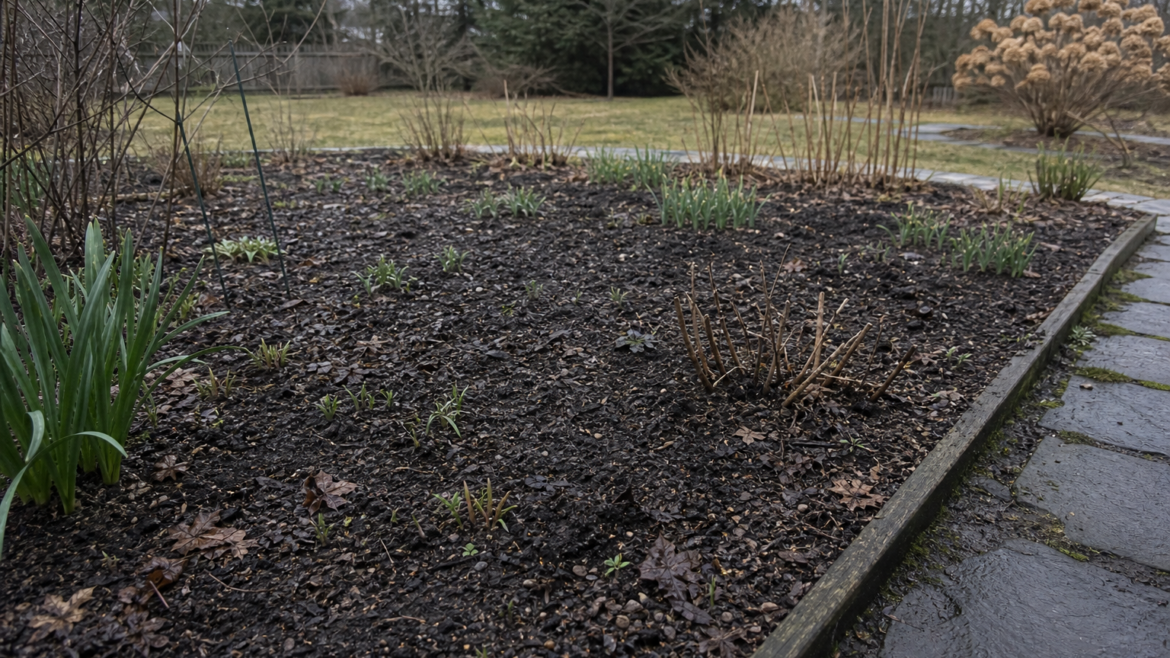
In early March, the garden can look almost ready if you stand far enough away. The beds are no longer frozen. The days have lengthened. Seed packets are stacked on the table, and the first green points are testing the surface. Then you step into the bed and the soil answers with a slow, glossy squelch.
This is one of spring’s most ordinary traps. The gardener is ready before the soil is. A fork seems harmless. A quick turning of the bed seems efficient. A few minutes of tidying feels like momentum. But wet spring soil is not just inconvenient soil. It is vulnerable soil. Work it too soon, and you can press a living, porous structure into clods that follow you through the whole season.
Purdue Extension puts the warning plainly: resist the urge to work wet soil, because doing so can destroy soil structure and leave the garden with clods that are hard to correct later.1 That may sound severe for a few minutes with a spade. It is not. Soil remembers pressure, especially when it is wet enough to smear.
The restraint is frustrating because it looks like doing nothing. In reality, waiting is one of the first soil-care jobs of spring.
Good soil is not just dirt
A garden bed is easy to flatten in the imagination. We call it soil, see a brown surface, and treat it as a material to dig, rake, amend, and arrange. But a healthy soil is not a solid block. It is a structure made of mineral particles, organic matter, roots, fungal threads, living organisms, water, and air. The spaces between particles matter as much as the particles themselves.
Oregon State University Extension describes soil as a living landscape with mineral particles, organic matter, water, air, and organisms all working together, and notes that pore spaces allow air and water to move through the soil.2 Those pores are not decorative. Roots need them for oxygen. Water needs them for infiltration and drainage. Soil organisms need them as habitat and pathways. Seeds need a surface that can hold moisture without becoming a sealed crust.
When soil is at the right moisture, it can be opened, shaped, or planted with relatively little harm. Aggregates hold together. Pores remain. The soil crumbles instead of smearing. When soil is too wet, the same action behaves differently. The particles slide and pack. The pore spaces collapse. A footprint, wheelbarrow tire, tiller pass, or enthusiastic fork can do more damage than its size suggests.
Wet soil compacts easily
Water changes how soil responds to pressure. A slightly moist soil may crumble into small pieces when squeezed. A saturated one can press into a ribbon, smear against a shovel, and hold the shape of a boot sole. That is the warning sign. The soil is not ready to be handled as a crumbly growing medium. It is behaving more like clay in a potter’s hand.
Oregon State’s guide to wet spring soils describes saturated soils as especially prone to ponding, plugging, and pugging, with compaction reducing pore space and making it harder for air and water to move.3 The term pugging comes from pastures trampled by animals, but gardeners know the small-scale version: a bed that turns to lumpy paste under a boot or tool, then dries into hard shapes that refuse to rake out neatly.
This matters because compaction is not only about whether the soil looks neat. Roots do not grow well through a dense, airless mass. Water may run across the surface instead of soaking in; unlike the dry, water-repellent conditions described in soil that seems to forget how to drink, the bottleneck here is crushed pore space. Seedlings may emerge unevenly. Fine roots may sit in a wet layer after rain and a hard layer after drying. A gardener who works wet soil in March may spend May wondering why the bed dries like concrete on top and stays sticky beneath.
The damage is often worst in clay-rich soils, but sandy or loamy beds are not immune. Any soil can lose structure if it is walked, tilled, or dug when the pore spaces are full of water and the particles can be pressed tightly together. Heavy soil simply complains more obviously.
The squeeze test is simple and humbling
The old garden test is still useful because it makes you touch the soil before you make plans for it. Take a handful from planting depth, not just a dry crust from the surface. Squeeze it gently. Then open your hand and prod the lump with a finger.
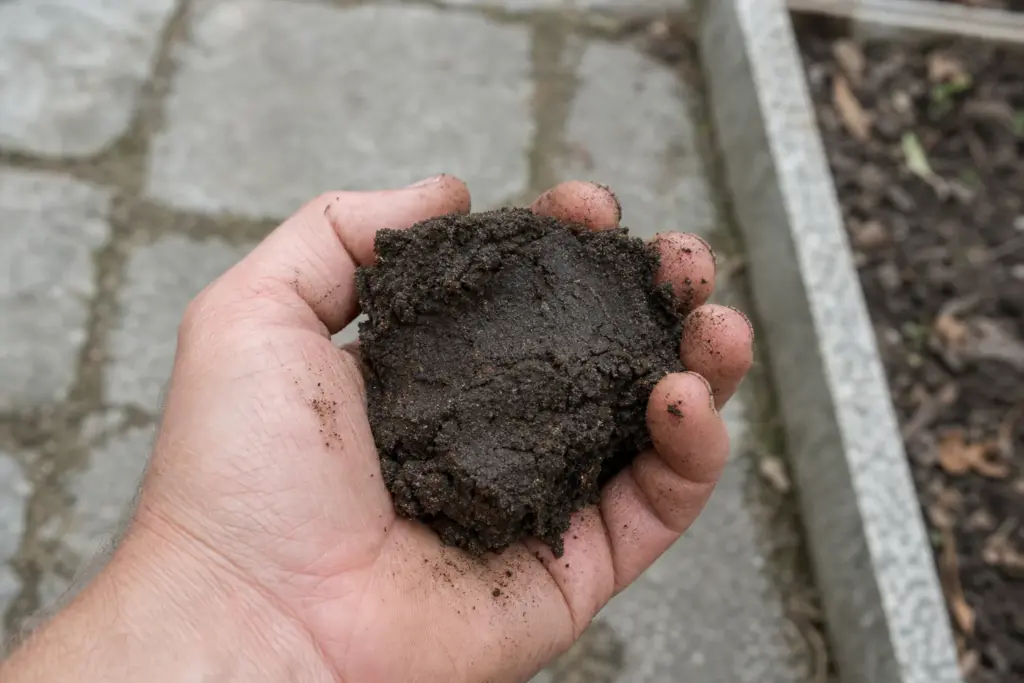
If it falls apart into loose crumbs, the bed is much closer to workable. If it holds a shiny ball, smears, or forms a ribbon when pressed between your fingers, wait. Purdue’s wet-soil guidance uses this same practical distinction: soil should crumble rather than form a ball before you work it.1 Colorado State Extension adds a drop test: if the squeezed ball shatters when dropped or gently tossed, the soil may be dry enough; if it stays intact, wait.4
The surface can lie. A windy afternoon may dry the top half inch while the root zone remains saturated. Raised beds may be ready before in-ground beds. A south-facing sandy bed may pass the test while a shaded clay corner fails it for another week. This is why the handful matters. It tells you about the soil the roots will actually use.
There is no shame in waiting after the calendar says spring. The soil is responding to temperature, rainfall, texture, drainage, and exposure. It is not late because a seed packet says March. It is wet because water has not yet moved, evaporated, or been used by active roots.
Clods are not just ugly
A wet-dug bed can look promising for a moment. The soil turns dark and rich. The gardener sees progress. Then the exposed lumps begin to dry. What was soft becomes hard. Large clods form plates and chunks with slick faces where the shovel smeared them. Seeds fall into cracks or sit on ridges. Water follows the easiest channels. Tiny roots meet walls.
Breaking those clods later is not the same as never making them. Raking, chopping, and re-tilling can make the pieces smaller, but it does not instantly rebuild the natural arrangement of pore spaces, organic glues, roots, and living threads that made the soil workable in the first place. This is why the first mistake of the season can feel strangely durable.
Wet working also encourages crusting on the surface. Fine particles can settle and seal after rain, especially where soil has been pulverized or compacted. A sealed surface sheds water and makes seedling emergence harder. The bed may have been worked in the name of giving seeds a good start, then left with a surface that asks them to push through a lid.
Roots need air too
Gardeners talk about water constantly, for good reason. Seedlings dry out. Summer beds need irrigation. Mulch saves moisture. But roots also need oxygen. A soil can contain plenty of water and still be a poor place for roots if the air spaces have been squeezed out or filled for too long.
Oregon State’s soil guide explains that pore spaces provide room for air and water movement, and that the balance between water and air is part of what makes soil a functioning habitat.2 In a wet, compacted bed, that balance is poor. Roots may be slow, shallow, or reluctant to branch. Soil life shifts toward organisms that tolerate low oxygen. Nutrient cycling can slow or change form. The garden may look planted, but below the surface it is holding its breath.
This is especially important in early spring because plants are being asked to establish roots in cool conditions. A lettuce seed, pea seedling, onion transplant, or new perennial crown does not need a perfect spa. It does need contact with moist soil, access to air, and a structure roots can enter. Wet compaction takes away two of those gifts at once.
What to do while the bed waits
Waiting does not have to mean losing the season. There are useful March tasks that do not ask the wet bed to carry your weight. Sharpen tools. Wash seed trays. Start transplants indoors. Mark paths so you know where feet belong later. Pull light debris from the surface if you can reach from the edge. Spread compost on top of a bed without turning it in, if you can do so without stepping into the soil. Let rain, worms, roots, and time begin the mixing.
If a bed is only slightly wet at the surface and you need to sow, think carefully about access. A board laid across a path or bed edge can distribute weight better than a boot heel. Permanent paths protect growing areas from repeated traffic. Oregon State’s vegetable gardening guide recommends raised beds and defined paths partly because they improve drainage and keep foot traffic out of the growing zone.5
Containers and raised beds can also buy time. A potting mix in a container may be ready while the ground is not. A raised bed with loose, amended soil may warm and drain earlier than the surrounding garden. That does not make raised beds immune to wet damage, but it can make spring work more flexible if you still respect the squeeze test.
Build soil that forgives spring
The long-term answer is not to find a better way to force wet soil. It is to build soil that drains, aggregates, and recovers better. Organic matter is central to that work. Oregon State Extension notes that adding organic matter can improve garden soils by helping with structure, water movement, and biological activity.6 Compost is not magic, but it gives soil life more material to work with and helps mineral particles gather into more stable crumbs.
Mulch helps too, not because it makes wet soil instantly workable, but because it protects the surface from pounding rain, moderates drying, and feeds the upper layer as it breaks down. Cover crops can add roots that open channels and organic residues that support aggregation. Perennial plantings do a quieter version of the same thing by keeping living roots in the ground for more of the year.
Paths are part of soil care. It is easy to think of paths as a design feature and beds as the growing feature. In a wet spring, paths are also a promise: this is where the weight goes. The growing soil is spared. A garden with clear paths can be visited earlier without being worked earlier.
The patience is practical
There is a particular kind of restraint that only gardeners know. It is not laziness. It is the discipline of not doing the satisfying thing when the timing is wrong. Wet spring soil tests that discipline because the garden looks close enough to touch.
The bed will not always be mud. A few dry days, a little wind, more plant growth, and a warmer sun can change the feel under your hand. When the soil crumbles, it will tell you. Until then, let it drain. Let it breathe. Let the structure remain intact for the roots that will need it later.
March gardening often rewards the person who starts early. Wet soil is the exception. The best first move is sometimes to put the fork down, step back onto the path, and let the garden become ready in its own body.
References
- Purdue Extension, “Resist the urge to work wet soil”.
- Oregon State University Extension, “Soil: The dirty secrets of a living landscape”.
- Oregon State University Extension, “Ponding, plugging, and pugging: How to care for wet spring soils”.
- Colorado State University Extension, CO-Horts, “Patience is a virtue when it comes to wet soil”.
- Oregon State University Extension, “An educator’s guide to vegetable gardening”.
- Oregon State University Extension, “Improving garden soils with organic matter”.