
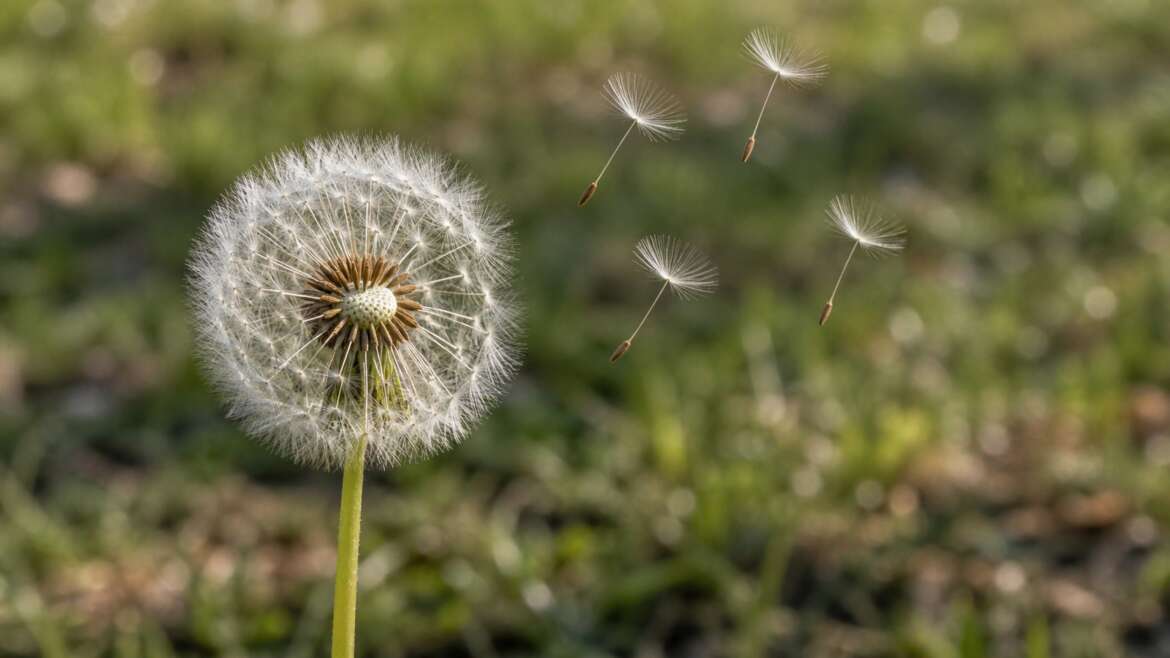
On a dry April afternoon, a dandelion clock looks ready to leave all at once. The white globe is full, every fine parachute is spread, and a breath sends several fruits across the lawn. Visit after mist or rain, however, and the same head may look narrowed and untidy. Its parachutes have changed shape, and many hold on.
That difference is not just wet fluff sticking together. A ripe dandelion is a collection of tiny flying units, each built with a porous parachute, a moisture-responsive hinge and an attachment that breaks more readily when pulled one way than another. Together, those parts influence whether a fruit departs, how steadily it falls and which gusts get the chance to carry it.
The familiar “clock” is therefore less like a bag of loose seed and more like a weather-sensitive launch field. It cannot forecast rain or choose a destination. Yet its dead tissues still respond to water, its bristles organize the air into an unusual vortex, and its attachment geometry biases which pulls can pry a fruit loose.
One yellow flower is really a crowd
The change begins with a correction to what the eye sees. A dandelion does not carry one large yellow flower. It carries a capitulum: a head commonly containing about 100–300 small florets on a shared receptacle. Each yellow “petal” is the strap-shaped corolla of one floret, complete with its own reproductive structures and ovary.12
After flowering, the head closes while the fruits mature. The scape—the hollow, leafless stalk—may lie lower, then return upright as the pale fruiting head opens. What appears to be one flower transforming into a ball of fluff is actually a packed community of florets becoming a spherical array of separate dispersal units.2
The name “common dandelion” hides another crowd. Taraxacum is taxonomically difficult, with sexual and asexual lineages and large numbers of closely related microspecies. Researchers often write Taraxacum officinale agg.—the T. officinale aggregate—rather than pretending that every lawn dandelion belongs to one simple, uniform species.13
The “seed” is a fruit with a parachute
Gardeners reasonably call each flying unit a seed, but the visible brown body is a one-seeded dry fruit. Dandelion papers often call it an achene; stricter botanical accounts use cypsela for the fruit of the daisy family. A slender beak extends from that fruit to the white tuft above it.110
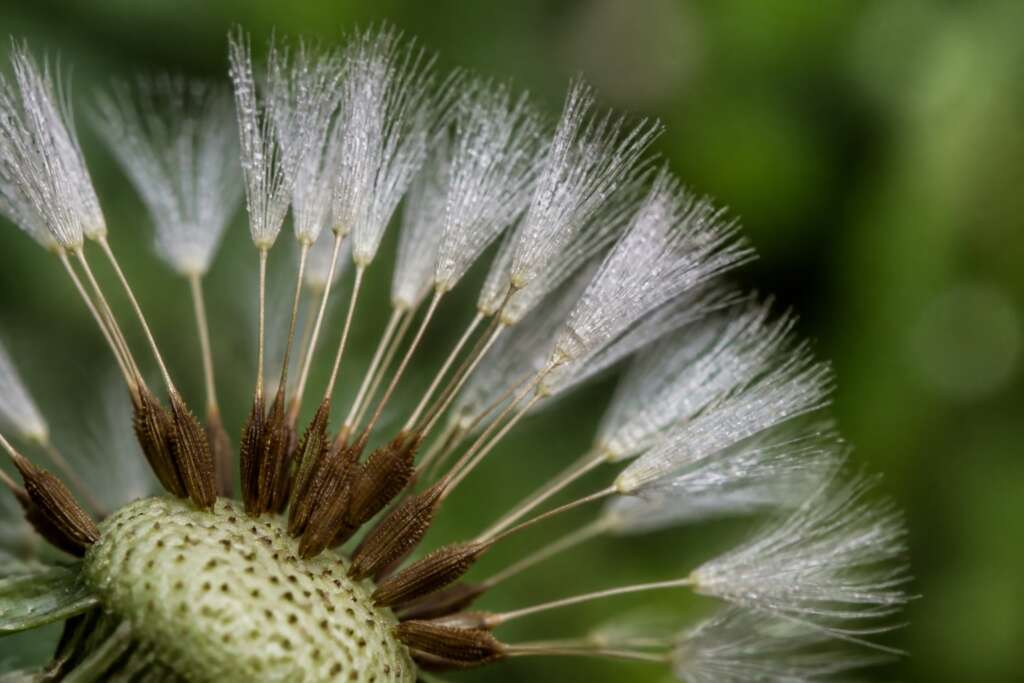
The tuft is the pappus, a modified remnant of the flower’s calyx. It is not cotton and it is not a miniature fabric canopy. It is a disk of extremely fine, radiating bristles. Fruit, beak and pappus travel together as a diaspore—the complete unit the plant disperses.15
This distinction matters because almost all the apparent parachute is empty space. The holes are not a cheap imitation of a solid umbrella. At dandelion scale, they are central to how the structure works.
A parachute made mostly of holes
In a 2018 study, X-ray microtomography and microscopy showed an average of about 100 pappus filaments in the sampled dandelions. The filaments averaged 7.41 millimeters long and only 16.3 micrometers in diameter. Measured in projection, the pappus was about 91.6 percent empty space.5
Those exact measurements, and the linked 2022 morphing experiments, came from greenhouse descendants of one apomictic lineage collected in Edinburgh. They establish mechanisms in that lineage, not the amount of variation across the common-dandelion aggregate or the whole genus.567
That sparse disk slowed the study fruits to a mean terminal falling speed of roughly 39 centimeters per second. Its neighboring bristles did not behave as a hundred isolated hairs. Their boundary layers interacted, restricting flow enough for the whole pappus to act somewhat like a permeable membrane. Relative to the tiny projected area actually occupied by its bristles, it produced more than four times the drag per unit area of the solid disk used for comparison.5
Smoke visualization in a vertical wind tunnel revealed the most surprising part: a torus of recirculating air formed downstream of the pappus. Unlike a vortex attached to a solid disk or one shed and carried away, this separated vortex ring remained detached from the pappus while holding a steady position in its wake. The pappus’s disk-like shape and high but carefully spaced porosity stabilized that flow.5
The ring helps create the drag-dominated, steady descent that gives horizontal air and, especially, rising air more time to move the fruit. Calling the pappus a parachute is useful. Calling it a tiny umbrella misses the part that the air passes through.
The hinge works after its cells are dead
A dry pappus spreads into a broad disk. As humidity rises and the structure becomes wet, its bristles lift and draw together, making a narrower cone. The movement does not require muscles, nerves or living motor cells. It is hygroscopic: cell walls absorb water and change dimensions.
The actuator sits in the apical plate at the bristles’ base. Researchers found swellable cortex arranged around less-expansive vascular bundles and a central cavity, with several tissue regions differing in wall composition and geometry. When hydrated, the cortex expands around the resisting framework. Radial displacement rotates the attachment sites and coordinates the movement of roughly 100 hairs at once.6
In hydration experiments, pappus angle typically changed by 40–100 degrees and reached a steady state over about 30–60 minutes, depending on how water was added. Removing nearly all the bristles did not stop the remaining pair from moving, which showed that the response was not simply neighboring wet hairs adhering to one another. Blocking the lower part of the apical plate nearly stopped closure.6
The cells in this hinge are non-living at dispersal. Their patterned walls are enough. Like the scales of a pine cone, the dandelion’s flight hardware can keep responding to weather after the living flower has finished its work.
Closing changes two odds at once
A closed pappus is a poorer parachute. In drop tests, strong wetting that reduced pappus angle made diaspores fall two to three times faster. The projected area shrank, the vortex became smaller and moved closer to the pappus, and the drag coefficient fell.7
If that were the whole story, moisture-responsive closure would merely shorten a wet fruit’s trip. But closure also made fruits less likely to depart. In one wind-tunnel treatment at the highest tested speed, 9.8 meters per second, 24 percent of dry diaspores remained attached compared with 50 percent of wet ones. Moisture changed the launch threshold as well as the flight that followed.7
The researchers combined those measurements with weather data in a dispersal model. Compared with an imaginary pappus that stayed open in all weather, morphing raised modeled median dispersal from 3.9 to 4.8 meters, a 23 percent increase. The modeled fraction traveling beyond 100 meters rose from 26.7 to 28.5 percent—1.8 percentage points, or roughly 6 percent relative. Those are model outcomes, not universal field distances. Their value is the counterintuitive mechanism: holding on during damp, often calmer periods can outweigh the worse flight of the occasional fruit that leaves while closed.7
This is sometimes called “informed dispersal,” but the phrase does not imply thought or a forecast. The dead hinge responds directly to present moisture. In the weather records used for the study, wetter hours tended to have lower horizontal wind speeds. That relationship let a simple moisture response bias modeled release toward windier conditions.7
Each fruit sits on a directionally biased joint
Moisture is not the only gate. A 2025 study pulled individual dandelion fruits from different directions while measuring the force required. Pulling straight out from the receptacle required a median 45 millinewtons in the experiment. Pulling sideways toward the scape required 1.3 millinewtons; pulling in the opposite direction, toward the head’s apex, required just 0.26 millinewtons.8
Microscopy showed why direction matters. A thin, porous vascular connection called the pedicle attaches each fruit to a raised site on the receptacle. Tissue supports that connection on one side in a horseshoe-like shape but leaves the other side relatively open. A force from the less-supported direction bends and breaks the pedicle readily; a force from the supported direction distributes stress through more tissue.8
This asymmetry offers a mechanism for the reported windward-before-leeward release and for easier release under updrafts than downdrafts. In the pulling experiment, force angled toward the head’s apex released a fruit most readily, force toward the scape required more, and a pull straight out from the receptacle required by far the most. The authors’ mechanical model reproduced the force ratios to the correct order of magnitude, but they also called for further tests linking individual tissue dimensions and material properties to release. It is a strong mechanism, not a finished account of every dandelion in every gust.8
The longest trips begin with rising air
Horizontal wind is easy to see when a clock breaks apart, but long-distance dispersal depends heavily on vertical motion. Modeling published in 2003 found that ordinary variation in horizontal wind speed mattered far less than whether a fruit entered an updraft. Rising air increases time aloft; horizontal air then supplies distance.9
That does not mean every dandelion from one lawn travels a kilometer. A summary of the 2003 modeling reports that about 99.5 percent landed within 10 meters under its assumptions, while very small fractions exceeded 100 meters or one kilometer. Its long-distance tail is dramatically thinner than the 2022 model’s. The studies used different release assumptions, weather inputs and trajectory assumptions; their percentages are scenario outputs, not rival counts of fruits tracked in the field. The contrast is a reason not to treat either distance distribution as universal. Rare journeys matter to range expansion, but the ordinary outcome is local.279
Landing is not establishment either. A fruit may catch in grass, be eaten, dry out or reach a place where no seedling survives. If it reaches suitable bare soil, it joins the larger story of the garden’s seed bank. The pappus improves a chance; it does not issue a guarantee.
Some dandelions make clonal seed without fertilization
Dispersal is only half the dandelion’s reproductive surprise. Many polyploid lineages in the common-dandelion aggregate produce seed by apomixis. They bypass the usual chromosome reduction, begin an embryo without fertilization and form endosperm autonomously. The resulting offspring are largely clonal copies of the maternal line.34
In 2022, researchers identified a dominant PARTHENOGENESIS allele expressed in egg cells of apomictic dandelion. Expressing the dandelion PAR gene activity in sexual lettuce could trigger unfertilized egg cells to divide. That did not turn lettuce into a complete apomict: clonal seed production also needs the other components of apomixis. It did trace one component of the dandelion system to a gene.3
“Dandelions do not need pollinators” is still too broad. The genus also contains sexual lineages, and the familiar heads provide accessible pollen and nectar to visiting insects. The careful conclusion is narrower: pollination and fertilization are not required to initiate embryo or endosperm development in a fully autonomous apomictic lineage, even though the same flower head may still feed bees and flies.134
How to watch a clock—and when to remove it
Choose two ripe heads on the same dry day. Look across one from the side with a hand lens: the pappi should form broad, porous disks, each connected by a beak to a brown fruit. Mist the second lightly and revisit it over the next hour. Its bristles should draw upward and the visible disk should narrow. A soaked, collapsed tuft is less informative because large droplets can also pull hairs together through surface tension.
To observe release, shelter a ripe head until it is dry, then take it outside in a gentle breeze and watch which side lets go first. Do not expect a clean laboratory sequence: head age, turbulence, previous wetting and damage all alter detachment. A phone video against a dark background can reveal the fruit hanging below each pale pappus and the slow settling that the naked eye misses.
If the goal is control rather than observation, remove flower heads before the white sphere opens. Mowing before seed dispersal reduces new arrivals but does not kill the established perennial crown and taproot. Hand removal works best when as much root as practical is lifted, while mulch can reduce establishment from seed in beds. Management should fit the place; one clock in a mixed lawn and a seed-producing patch beside a nursery bed are different problems.10
A globe with gates
The childhood clock invites one decisive breath, but the plant has built several filters before that moment. A head assembles scores of fruits. Each fruit carries a mostly empty parachute whose hairs cooperate to hold a vortex. A dead hinge narrows that parachute with moisture. An asymmetric joint favors some pulling directions over others, and the atmosphere decides whether a released fruit finds rising air.
None of those parts knows where the fruit will land. Together, however, they change the odds of departure, which force directions most readily trigger it, and time aloft. The dandelion clock does not tell time and it does not read tomorrow’s sky. It turns the weather happening now into a better-timed chance to leave.
Image note: The images accompanying this article are AI-generated photorealistic editorial reconstructions. They were reviewed for the visible arrangement of fruit, beak and pappus, but they are not microscopy images or records of the cited experiments.
References
- Royal Botanic Gardens, Kew: Taraxacum genus description; Kew: Taraxacum sect. Taraxacum profile; Kew: Asteraceae botanical glossary
- Cornell University Weed Science: Dandelion biology and management profile
- Underwood et al., 2022: A PARTHENOGENESIS allele from apomictic dandelion can induce egg-cell division without fertilization in lettuce
- Van Dijk et al., 2020: Genetic dissection of apomixis in dandelions
- Cummins et al., 2018: A separated vortex ring underlies the flight of the dandelion
- Seale et al., 2022: Dandelion pappus morphing is actuated by radially patterned material swelling
- Seale et al., 2022: Environmental morphing enables informed dispersal of the dandelion diaspore
- Shields et al., 2025: Letting go with the flow—directional abscission of dandelion seeds
- Tackenberg, Poschlod and Kahmen, 2003: Dandelion seed dispersal—the horizontal wind speed does not matter for long-distance dispersal; it is updraft
- University of Minnesota Extension: Dandelion identification and management