
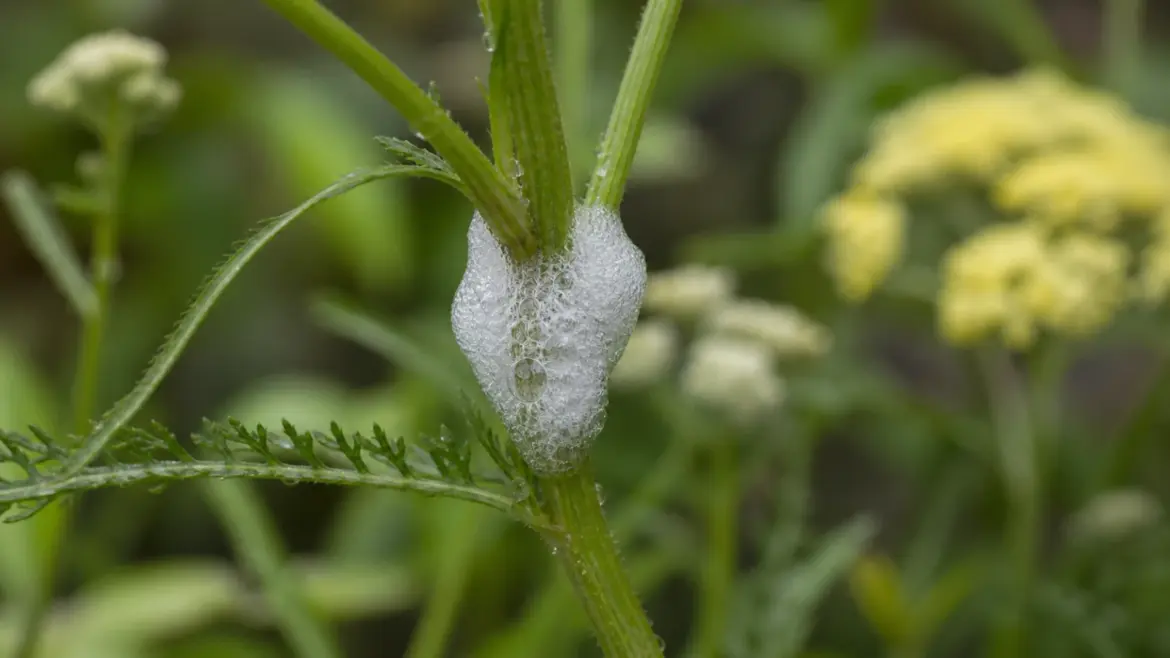
On a June morning, a garden can seem to have developed a strange habit. White froth appears around a lavender stem, in the fold of a strawberry leaf, or where a blade of grass meets its sheath. It looks freshly blown. Rain does not wash it into streaks, and no snail trail explains how it arrived halfway up a plant.
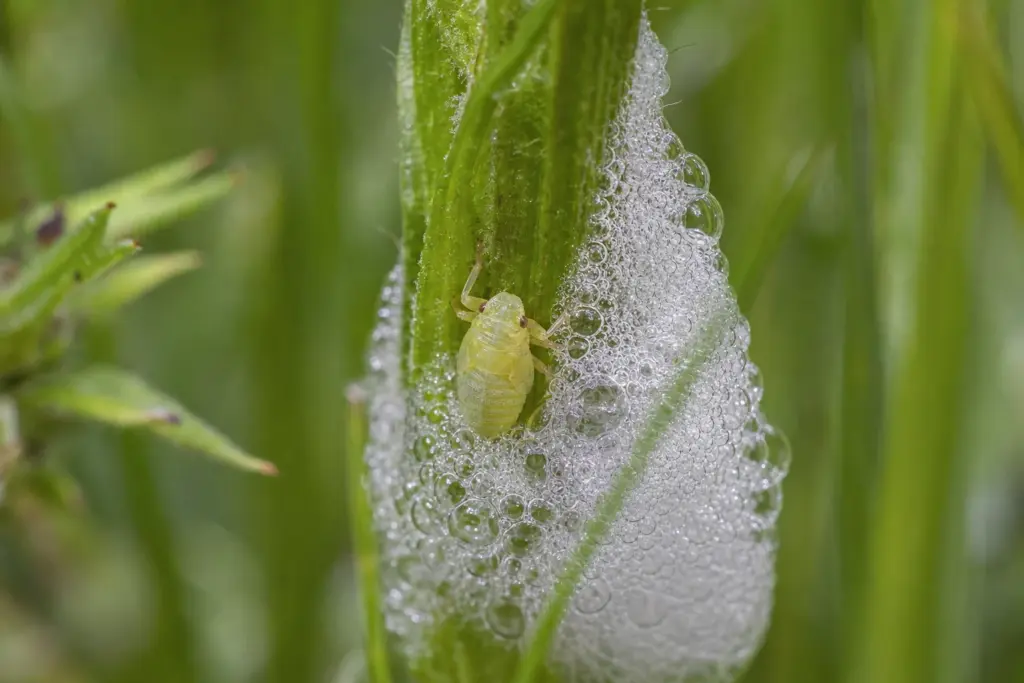
Touch the mass with a grass stem and the bubbles part. Inside is a soft, pale insect only a few millimetres long, often yellow-green with conspicuous eyes. It is a spittlebug nymph, and the foam is neither spit nor a plant disease. It is a nursery the insect has made around its own body.
That small discovery changes the question. Instead of asking what has infected the plant, you can ask why an insect that will one day leap through the garden is spending its youth inside a house of bubbles.
The foam is a room, not a symptom
Spittlebugs take their common name from the froth, which is also called cuckoo spit in Britain and parts of Europe. Neither name is anatomically accurate. The mass has not come from the insect’s mouth, and the cuckoo had nothing to do with it. One or sometimes several nymphs sit inside, feeding with piercing mouthparts while continuously maintaining the wet shelter around them.16
Foam is useful identification because plants do not normally produce a persistent cluster of fine bubbles around a feeding point. It should not be confused with the water beads leaves push out at dawn. Guttation forms clear droplets at leaf tips or margins when root pressure moves water through special pores. Spittle is an aerated mass wrapped around an insect on a stem, leaf, bud, or crown.
If you open it, look for a stout nymph rather than an aphid colony, a caterpillar, or a clutch of eggs. Depending on species and age, spittlebug nymphs may be cream, orange, yellow, green, brown, or nearly black. The familiar meadow spittlebug, Philaenus spumarius, changes in appearance as it develops and is only one member of a large group. A foam mass is enough for a useful garden diagnosis, but not usually enough for a confident species name.
The insect drinks from the plant’s water pipes
Spittlebugs are true bugs related to leafhoppers and cicadas. Their mouthparts form a narrow beak that taps the xylem, the plant tissue carrying water and dissolved minerals upward from the roots. Xylem fluid is abundant but nutritionally dilute. To obtain enough of what it needs, a nymph processes a great deal of liquid and has a great deal left over.3
That excess does not simply fall away. The nymph releases fluid at the rear of its body, adds surface-active material that helps bubbles persist, and draws in air through a channel beneath the abdomen. Repeated abdominal movements work air into the fluid until the insect is surrounded. A 2024 study of alder spittlebugs, Aphrophora alni, described the result plainly as foam made from anal excrement fluid—a remarkably economical reuse of a feeding by-product.1
The chemistry is not one universal spittlebug recipe. Proteins, carbohydrates, fatty acids, and other compounds have been found in foams from particular species and host plants, but their proportions vary. The safe generalization is simpler: liquid derived from feeding is stabilized by insect-produced surfactants and filled with air. What looks like a blob of soap is a living structure being repaired as bubbles drain or burst.
A bubble nest solves several small problems
A soft-bodied nymph on an exposed stem would face sun, moving air, and hungry animals. Foam changes the immediate world around it. It keeps the body in a humid pocket and makes a predator work through wet bubbles before reaching it. The shelter is not an impenetrable or poisonous force field—spiders, predatory bugs, and other enemies still eat spittlebugs—but it can make a slippery meal harder to reach and handle.
Its physical properties change as it ages. In laboratory tests, freshly collected Aphrophora alni foam wetted both glass and animal surfaces. As the liquid dried, it became more adhesive. Small attackers contacting the material could therefore find their mouthparts or legs fouled by a residue that grew stickier, adding another layer to the shelter’s defence.1
Foam can also moderate temperature, although this is a place to keep the species name attached to the claim. Experiments with the sugarcane root spittlebug Mahanarva fimbriolata found that its foam held a more stable daytime temperature than the surrounding air and resembled the thermal conditions of soil. The researchers proposed that the bubble nest functions as a manufactured microhabitat.2 That does not prove every white mass in every climate behaves identically. It shows how much work a seemingly flimsy material can do.
The nursery disappears when the jumper grows wings
A spittlebug develops from egg to nymph to adult without a pupal stage. The nymph passes through five instars, shedding its skin between each one. It may move to a better feeding site and build another mass as the plant changes. In the meadow spittlebug’s usual temperate cycle, eggs survive winter on vegetation, nymphs feed in spring and early summer, and one generation reaches adulthood each year. Timing and generation number differ with species, latitude, and climate.35
The adult no longer lives in foam. It is a compact, roof-winged insect often mottled brown, grey, or straw-coloured, with powerful hind legs. The adult’s jumping ability gives the group its other common name, froghoppers. Research on the meadow spittlebug measured leaps as high as 70 centimetres—about 115 times its body length—powered by a catapult mechanism that stores energy in the thorax and releases it through the hind legs.4
That change from hidden nymph to airborne adult belongs to the same broad insect branch as the empty shells cicadas leave on summer bark. Spittlebugs do not leave a large, memorable shell on a tree trunk, but their foam is another temporary trace of an immature life. When the froth stops appearing, the insect has not necessarily vanished; it may simply have exchanged its bubble room for wings and a catapult.
Most foam is more spectacle than emergency
Meadow spittlebugs alone have been recorded from hundreds of host plants, and garden species turn up on grasses, herbs, strawberries, roses, chrysanthemums, shrubs, and trees. Such a broad menu makes the foam conspicuous. It does not make every occupied plant endangered.
A few nymphs usually cause no noticeable injury to a healthy garden plant. University of Minnesota Extension describes feeding injury on annuals and perennials as uncommon, while the University of California’s integrated pest management guidance says the obvious masses do not seriously harm established woody landscape plants.56 The froth is often more alarming than the feeding beneath it.
Large populations are different. Sustained feeding can distort tender growth, slow an herbaceous plant, or contribute to problems in susceptible turf and pasture crops. Judge the plant as well as the bubbles. Is new growth misshapen? Are stems weakening? Are dozens of masses appearing on a small plant rather than two or three in a border? As with the silver tunnels inside leaves, a dramatic trace tells you where an insect has been; the amount of injury tells you whether intervention is justified.
Xylella is the important exception—and it needs context
Some xylem-feeding insects can transmit the bacterium Xylella fastidiosa after feeding on an infected plant. In Europe, the meadow spittlebug is currently the main insect vector. The bacterium can cause serious diseases in olives, grapevines, almonds, and other hosts, and official controls apply in outbreak areas.37
Two qualifications prevent that fact from turning every foam mass into a false alarm. First, spittle is not a symptom of Xylella; it only shows that a nymph is feeding. A vector must acquire the bacterium from an infected plant before it can transmit it. Second, “spittlebug” describes many species, not a declaration that the individual in front of you is a proven vector in your region.
Garden advice therefore depends on geography. Outside a known outbreak or regulated area, isolated foam on an otherwise healthy plant is normally an insect-management question, not evidence of disease. Within an official demarcated area—or when a plant shows suspicious scorch or dieback—follow the monitoring and control instructions of the local plant-health authority rather than relying on a general home-garden remedy. Disease surveillance needs a location, a host, symptoms, and testing; bubbles alone cannot supply them.
What to do when a stem is foaming
Begin by parting one mass and confirming that a nymph is inside. If the plant is growing normally and only a few are present, doing nothing is a reasonable form of pest management. The foam lasts for a limited juvenile stage, and garden predators may find some of its occupants.
If the sight bothers you, a valued shoot is crowded, or tender growth is becoming distorted, wipe off the foam and nymph with a gloved hand or dislodge both with a firm stream of water. Check stem forks and leaf undersides again after several days because a surviving nymph can move and rebuild. On edible leaves, ordinary washing removes the visible residue before harvest.
A broad insecticide is rarely a good answer to scattered spittle. The wet shelter makes contact sprays difficult to deliver to the nymph, while the spray can reach unrelated insects that were never inside it. Both Minnesota and California extension guidance favour tolerance or physical removal for home landscapes.56 Reserve larger control programmes for places where a crop pest or regulated disease vector has actually been identified and local guidance calls for one.
A garden clue made from air and sap
The white mass on a June stem invites the wrong story at first. It resembles infection, carelessness, or something left behind by a larger animal. Open it and the scale changes. A nymph has turned the excess from a dilute meal into walls, humidity, shelter, and sometimes a steadier temperature. It lives inside its own waste stream without wasting it.
Soon the bubbles collapse. The pale resident darkens, grows wings, and leaves as a jumper you may never notice. The foam remains valuable precisely because it is temporary: a readable sign that lets a gardener identify the maker, measure the actual harm, and decide that curiosity is often a better first response than control.
References
- Hoch, H., Pingel, M., Voigt, D., Wyss, U. & Gorb, S. Adhesive properties of Aphrophoridae spittlebug foam. Journal of the Royal Society Interface 21, 20230521 (2024)
- Tonelli, M. et al. Spittlebugs produce foam as a thermoregulatory adaptation. Scientific Reports 8, 4729 (2018)
- Cornara, D., Bosco, D. & Fereres, A. Philaenus spumarius: when an old acquaintance becomes a new threat to European agriculture. Journal of Pest Science 91, 957–972 (2018)
- Burrows, M. Jumping performance of froghopper insects. Journal of Experimental Biology 209, 4607–4621 (2006)
- University of Minnesota Extension: Spittlebugs in home gardens (reviewed 2026)
- University of California Statewide Integrated Pest Management Program: Spittlebugs
- European Food Safety Authority: Xylella fastidiosa (reviewed 6 May 2026)