
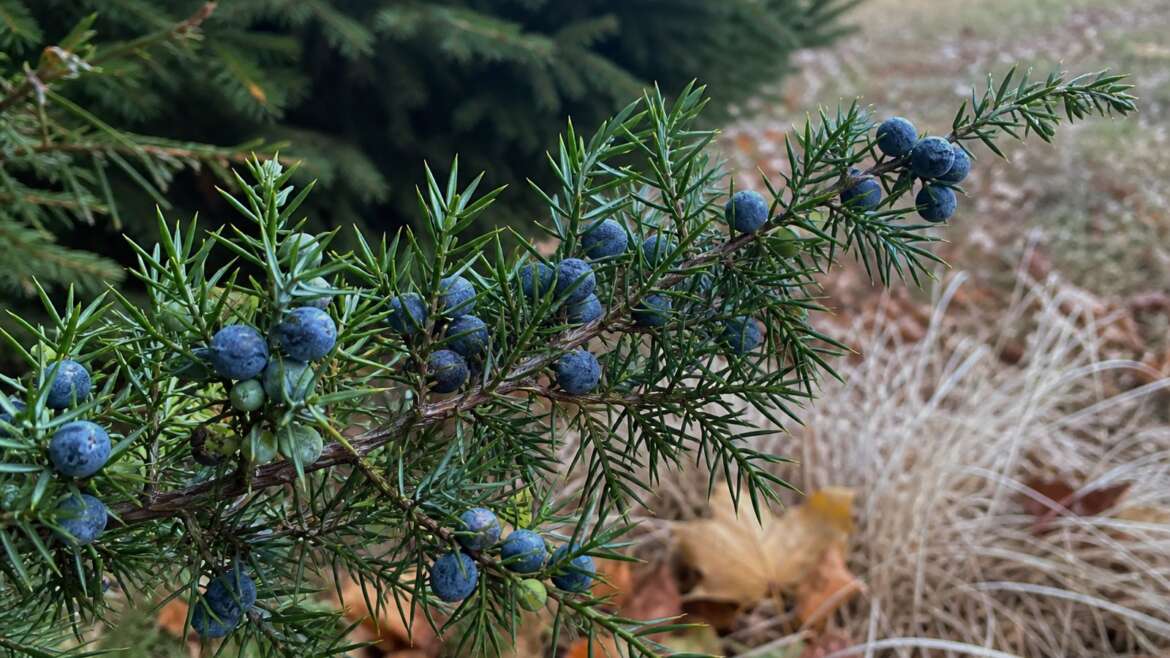
In early October, a juniper can make a liar out of ordinary words. The shrub looks evergreen in the most literal way: prickly, resinous, and built for weather. Then you notice the blue beads tucked along the twigs, as round and matte as tiny blueberries. They look like fruit. They are usually called berries. They even turn up in kitchens under that name.
Botanically, though, a juniper berry is not a berry at all. It is a cone that has learned to look edible.
That small correction is more than vocabulary. It changes how you read the plant. A juniper is not making flowers, petals, ovaries, or true fruits the way an apple, tomato, rose, or blueberry does. It is a conifer, and the blue object is part of the same broad reproductive world as pine cones and cedar cones, only softened, rounded, and disguised enough that birds, cooks, and gardeners have all agreed to call it something else.
A cone pretending to be a fruit
Common juniper, Juniperus communis, is a coniferous evergreen shrub or small tree. NC State Extension describes it as a plant that does not bear flowers, with female plants producing fleshy, fruit-like seed cones commonly referred to as juniper berries.1 That phrasing is useful because it keeps both truths in the same hand: the garden name is berry, the plant part is cone.
The difference sits in the architecture. A true berry develops from the ovary of a flower. Its seeds are enclosed within fruit tissue. A juniper cone belongs to the gymnosperms, a group whose seeds are not sealed inside a flower’s ovary. The American Conifer Society describes juniper seed cones as structures made from fleshy, fruit-like scales that fuse into a berry-like body around hard-shelled seeds.2 In other words, the juniper has not made a miniature blueberry. It has made a cone that stopped looking like our idea of a cone.
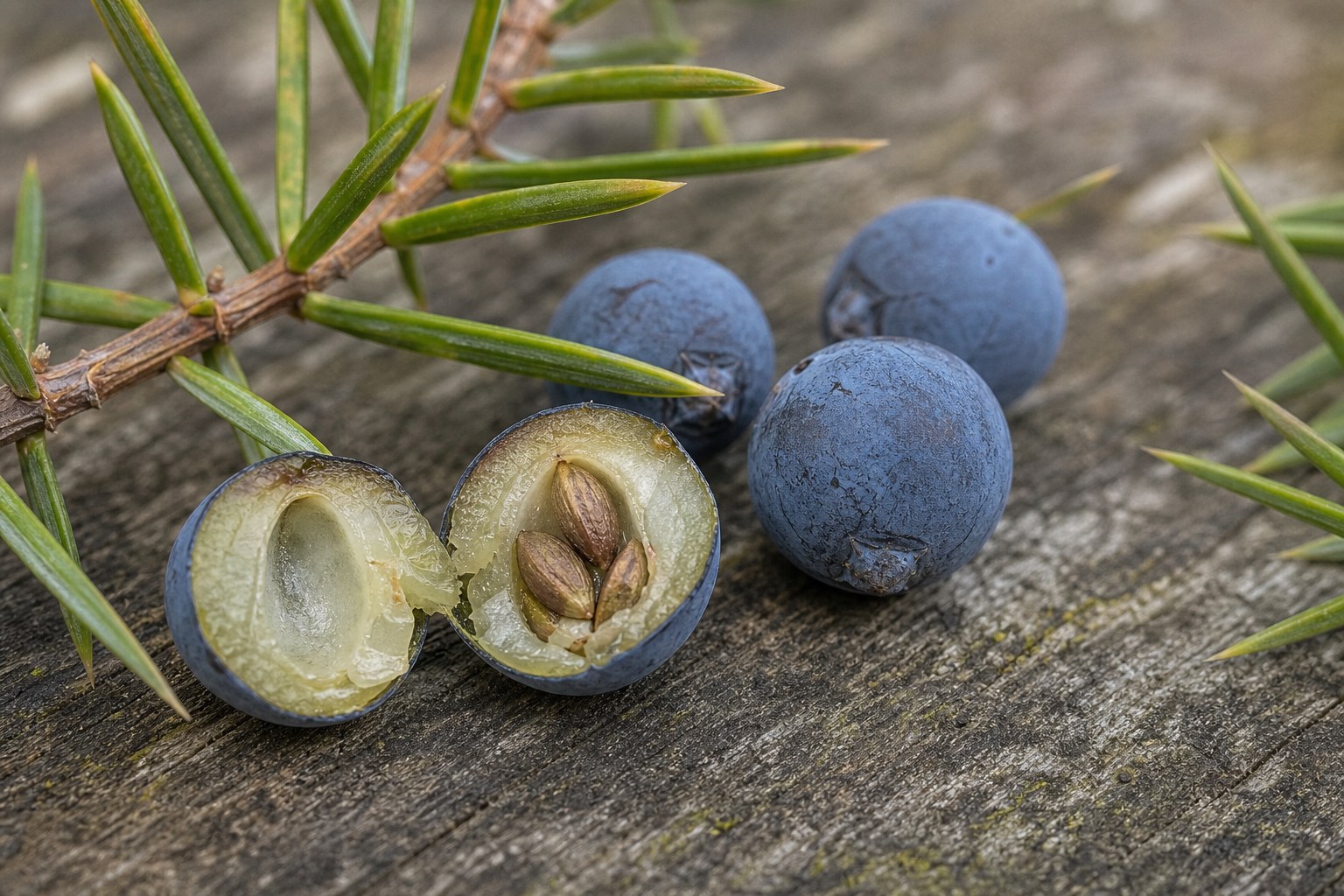
This is why the word berry should be treated as a useful nickname rather than a botanical diagnosis. Gardeners do this constantly. We call strawberry seeds seeds, though they are achenes. We call tomato vegetables vegetables, though they are fruits in the botanical sense. Juniper berries belong in the same friendly mess. The common name is not useless. It simply carries kitchen history and field habit more than plant anatomy.
Why the blue looks dusty
The best juniper cones are not shiny blue. They are blue with a powdery, almost smoky surface, as if someone has breathed cold air onto them. Rub one between your fingers and that bloom can dull or smear. Underneath, the cone may look darker, greener, blacker, or more purple than it did on the branch.
That bloom is a waxy surface layer. It helps protect plant surfaces from water loss and wetting, but it also changes what we see. A 2024 paper in Science Advances investigated dark fruits with wax blooms, including juniper cones, and found that their blue appearance can be produced by structural color in the wax rather than by blue pigment in the tissue itself.3 The cone is not full of blue juice. Its surface is scattering light in a way that makes blue visible to us, and likely conspicuous to birds that see parts of the spectrum differently than we do.
This explains a small kitchen disappointment and a good garden lesson. Crush a juniper cone and it will not stain like a blueberry. The blue is mostly a surface event. The garden often works this way: color is not always a substance. Sometimes it is a structure, a film, a skin, a tiny arrangement of wax and air catching light at the right scale.
Several seasons on one twig
A juniper branch can look as if it is unsure what year it is. Green cones and blue cones may sit near each other, with small pollen cones or new growth elsewhere on the same plant. This is not confusion. It is a slow calendar.
NC State Extension notes that common juniper’s berry-like cones emerge green, gradually ripen to waxy dark blue or black by fall, usually contain two or three seeds, and ripen in the second or third year.1 That long ripening time is why one plant can carry multiple ages at once. The green cones are not necessarily failed blue ones. They may simply be younger.
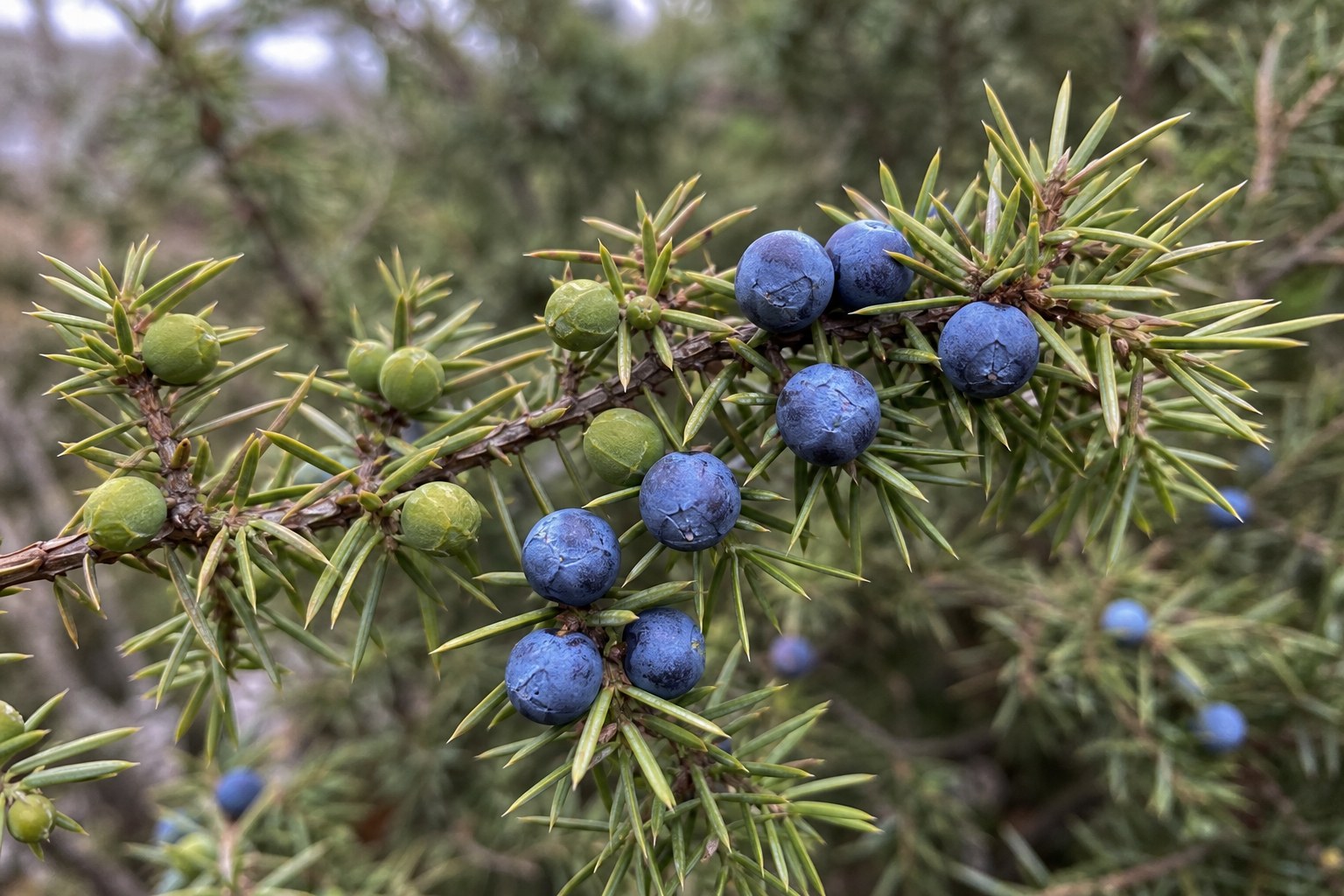
For gardeners, this makes juniper more interesting in autumn than it first appears. The plant is not merely sitting there as evergreen background. It is holding a staggered reproductive record. This year’s small cones, last year’s swelling cones, and older blue cones may all be present in the same close view. A quick look becomes a timeline.
Male plants, female plants, and the missing berries
If your juniper never makes blue cones, the first explanation may be simple: it may be male. Many junipers are dioecious, meaning male and female reproductive structures are produced on separate plants. Common juniper follows that pattern, with male and female cones on separate plants.1 A male plant can be perfectly healthy, beautifully shaped, and completely unwilling to decorate itself with blue berries.
Male cones tend to be small and less showy. In spring, they may release pollen in brief yellowish clouds when the branch is tapped. Female plants are the ones that carry the rounded cones gardeners notice later. If you want the blue display, buy a cultivar known to set cones or inspect plants in season before choosing. If you need a clean, formal evergreen with no berry-like litter, a male selection may suit you better.
There is a catch, as usual. A female juniper still needs compatible pollen nearby if the cones are to develop fully. In a neighborhood with many junipers and redcedars, that may happen without any planning. In a more isolated garden, cone production can be lighter. The absence of berries is not always a care problem, and adding fertilizer will not turn a male plant female.
How to place juniper so it behaves like itself
Junipers are often treated as default shrubs, the kind of thing installed beside driveways, banks, foundations, and hot corners when nobody wants to think too hard. That reputation is unfair to the plant and sometimes unfair to the site. Junipers are tough, but they are not indifferent.
The University of Georgia Extension advises planting junipers in open, sunny locations with well-drained soil, noting that they dislike wet or poorly drained sites and can suffer from overwatering once established.5 That single sentence explains many sad junipers. They are often placed where soil stays damp against a foundation, where irrigation sprays them daily, or where shade makes the interior thin and disease-prone. A juniper wants light, air, and drainage more than pampering.
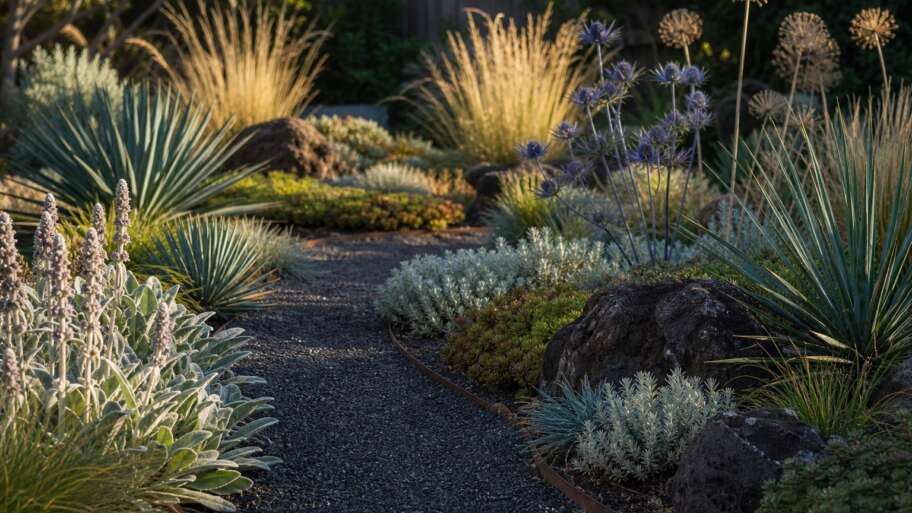
Give it those things and it becomes a useful structural plant. Low forms can hold a dry slope. Upright forms can mark an entrance or give a winter border a vertical note. Blue-toned selections can echo the color of the cones even when no cones are present. In mixed planting, juniper often looks best when it is allowed to be textural rather than forced into a hard green blob. Pair it with grasses, small bulbs, drought-tolerant perennials, or rough stone, and its scale-like or needle-like foliage suddenly has context.
Pruning should be modest. Many junipers do not break well from old bare wood, so cutting hard into the brown interior can leave holes that never refill politely. Tip pruning and selective thinning are safer than shearing the plant into a shape that ignores its growth habit. The best pruning decision is usually made at planting time: choose the mature size you actually have room for.
Bird food, spice, and sensible caution
The blue cones are not made for gardeners alone. NC State Extension lists common juniper as wildlife friendly and notes that birds feed on the berries.1 That makes sense. A berry-like cone is a seed package with advertising. The fleshy exterior invites attention. The hard seeds can move away from the parent plant after an animal meal. In a winter garden, that matters. A juniper with cones is not just an evergreen shape. It is a small pantry.
Humans enter the story through flavor. Juniper berries are best known as the seasoning behind gin, but they are also used in small amounts with game, cabbage, marinades, and fermented foods. The taste is resinous, sharp, slightly citrusy, and forest-like in a way that can become too much very quickly. This is seasoning territory, not handful territory.
Do not treat every landscape juniper as a snack. Oregon State University Extension notes that some western junipers have edible berries and needles, but also advises staying away from ornamentals when you do not know whether they have been sprayed.4 That caution is worth widening. Identify the plant confidently, avoid chemically treated shrubs, use culinary juniper in small amounts, and do not use juniper medicinally because a garden article made it sound ancient and intriguing. NC State also flags low toxicity and warns that large doses of the fruit can cause renal damage.1 The spice rack is a safer model than the medicine cabinet.
The apple-tree complication
Juniper has one more garden relationship worth knowing, especially if you grow apples, crabapples, hawthorns, serviceberries, or related plants. Several rust fungi move between junipers or redcedars and members of the rose family. University of Minnesota Extension explains that cedar-apple rust and related rust diseases require one host from the cypress family, such as red cedar or juniper, and another from the rose family, such as crabapple, hawthorn, or serviceberry.6
This does not mean every gardener with an apple tree must declare war on every juniper in sight. Spores can travel, and in many neighborhoods the alternate hosts are already everywhere. Removing one shrub may not solve the regional spore problem. It does mean you should recognize the relationship. If your apple leaves develop orange spots and nearby junipers carry brown galls that sprout orange, gelatinous horns in wet spring weather, you are not looking at two unrelated oddities. You are seeing different stages of one fungal life cycle.
For a small home garden, the practical answer is often resistant apple or crabapple cultivars, good airflow, sanitation where useful, and realistic expectations. Juniper is not a villain. It is a host in a cycle. That distinction keeps the gardener from solving a landscape problem with a grudge.
A better way to look in October
The next time you pass a juniper in autumn, slow down and look at the blue. Look for green cones beside mature ones. Look for the dusty bloom and the places where it has been rubbed away. Notice whether the foliage is awl-like and prickly or scale-like and tight. Check whether birds have been working the branch tips. If you grow apples, remember the rust connection without letting it flatten the plant into a problem.
A juniper berry is a useful little fraud. It looks like a fruit, functions partly like a fruit, tastes like a forest spice, feeds birds like a fruit, and still remains a cone. That is the pleasure of it. The garden is full of structures that refuse our tidy categories. Sometimes the most ordinary shrub by the path is carrying a conifer lesson in blue.
References
- NC State Extension Gardener Plant Toolbox: Juniperus communis var. communis
- American Conifer Society Conifer Database: Juniperus
- Middleton et al., Self-assembled, disordered structural color from fruit wax bloom, Science Advances
- Oregon State University Extension: Edible juniper?
- University of Georgia Extension: Junipers
- University of Minnesota Extension: Cedar-apple rust and related rust diseases