
By October, the visible garden starts behaving as if the year is almost filed away. Leaves thin out. Annuals lose their nerve. The tomato vines look tired, the border gets looser at the edges, and the first serious leaf rake begins to sound reasonable.
But the garden has a poor sense of human endings. Above ground, many plants are slowing down. Below ground, especially around newly planted trees and shrubs, October can still be a working month. Roots do not care that the flowers are gone. They care whether the soil is moist, unfrozen, and warm enough to keep building contact with the ground around them.
That hidden work is why fall planting can succeed, why new shrubs still need water when the air feels chilly, and why a mulch ring in October is not just a tidy finishing touch. It is also why a plant can look quiet and still be busy where you cannot see it.
The visible garden slows first
Leaves respond to shorter days, cooler nights, and the plant’s own seasonal chemistry. A tree can begin withdrawing resources from its leaves while its roots are still exploring soil. The air may feel like late autumn, but soil usually gives up summer more slowly than the air does.
UNH Extension notes that fall planting can work because root growth may continue until soil temperatures drop below about 40 degrees Fahrenheit, and recommends giving plants roughly six weeks of mild weather for root growth before freezing conditions arrive.1 That is the useful hinge: the top of the plant may be entering dormancy while the root zone still has enough warmth to matter.
This is especially important for woody plants. A newly planted shrub is not established just because it is standing upright. Most of its absorbing roots are still close to the nursery root ball. The plant has to grow into the surrounding soil before it can behave like it belongs there.
Why fall planting can be kinder than it looks
A spring planting has obvious optimism: swelling buds, longer days, warming light. It also has a problem. The plant is being asked to grow shoots, leaves, flowers, and roots at once, often just as weather begins to swing toward heat. A fall planting asks for less performance from the top of the plant. The leaves are fading or gone. The sun is lower. Evaporation is weaker. The plant can put more of its limited recovery into roots.
University of Idaho Extension gives the practical version of this idea: early spring and early fall are often the best planting times because shoot growth is minimal and roots have time to become established after planting.2 That does not make autumn magical. It makes autumn less demanding, provided the soil is workable and there is enough mild weather left.
The same logic explains why fall planting gets risky when gardeners wait too long. The plant still needs time. A shrub dropped into cold, wet, nearly frozen soil is not enjoying a secret advantage. It is simply being stored outdoors with injured roots and no chance to repair the damage before winter.
The root ball is not the whole root system
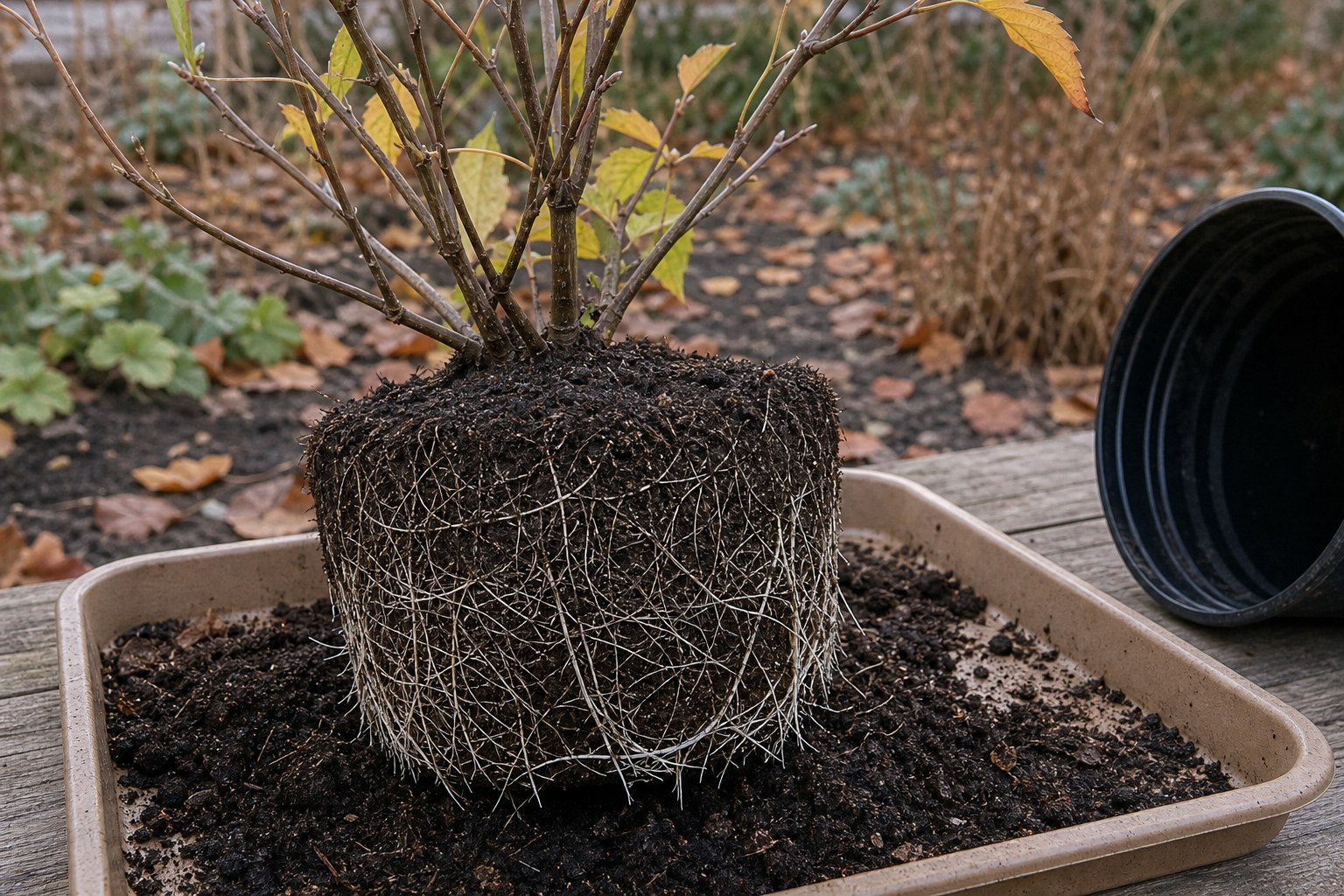
Container and balled-and-burlapped plants arrive with a concentrated root system, but that root system is not yet a garden root system. It is a root system shaped by production, transport, and a limited volume of growing medium. The planting job is to help roots cross the boundary between that original root ball and the native soil.
University of Maryland Extension recommends planting trees and shrubs when soil is not frozen and stresses proper planting depth, with the root flare at or slightly above the soil surface.3 That root flare is not a decorative detail. It is where trunk becomes root. Bury it, and the plant begins its life in the garden with bark in the wrong environment and roots arranged too deeply.
A deep hole is not generous. A narrow hole is not efficient. New roots need oxygen, moisture, and loosened soil where they are actually going to grow, which is mostly outward. The planting hole should encourage that sideways movement rather than turn the root ball into a buried pot.
Water is the October fertilizer
Fall planting advice often spends too much energy on the hole and not enough on the weeks after the hole is filled. A newly planted tree or shrub can fail in perfectly decent soil if the root ball dries out before roots have moved outward. It can also suffer if the surrounding soil stays dry while the root ball is damp, because roots do not want to grow into a dry wall.
University of Minnesota Extension puts it plainly: newly planted trees and shrubs need regular, consistent watering until their root systems establish, and root systems continue expanding until they become much wider than the above-ground part of the plant.4 In October, this can feel unintuitive. The weather is cool. The plant looks quiet. But quiet is not the same as established.
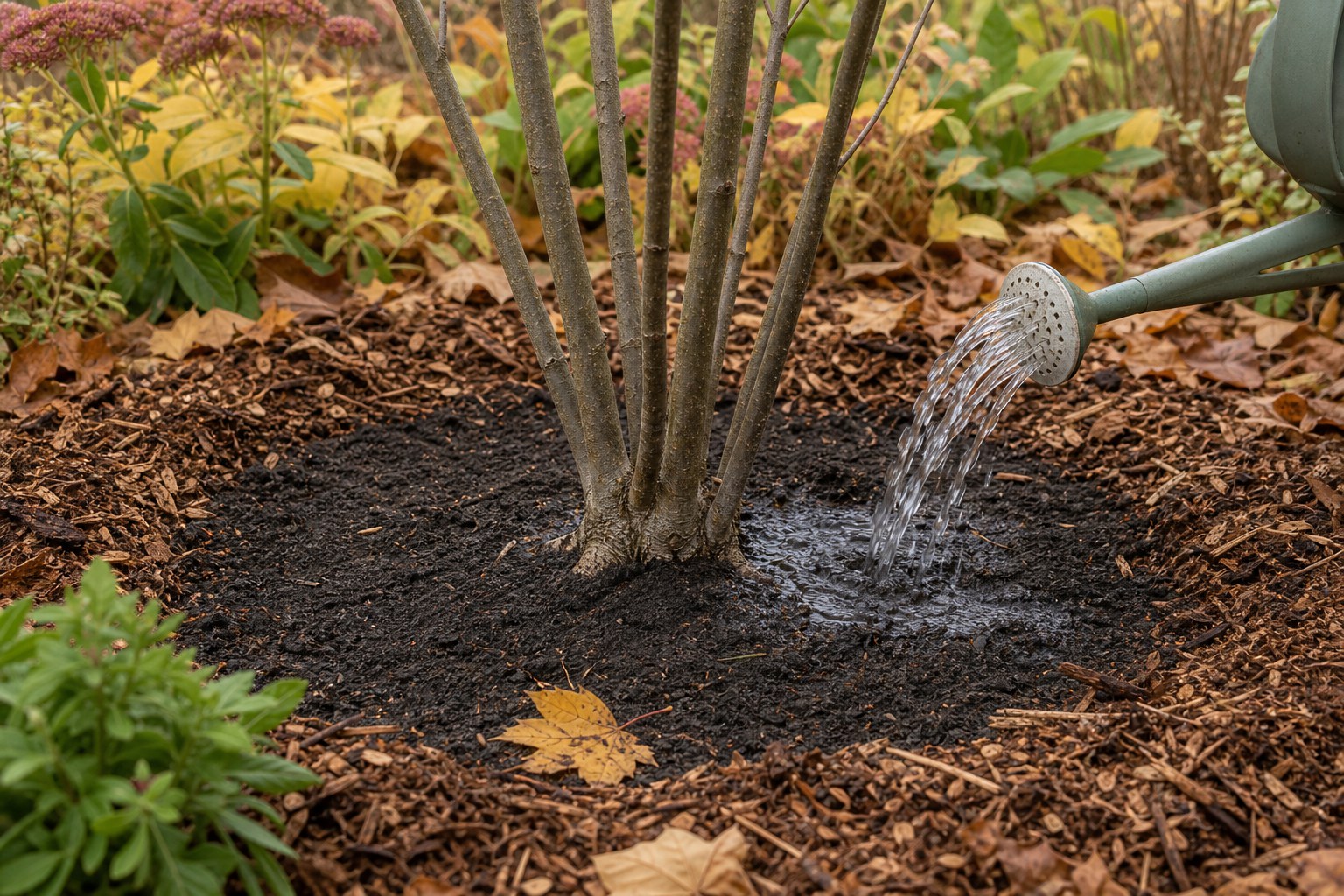
Illinois Extension recommends continuing to water trees and shrubs during dry fall weather until the ground freezes, especially newly planted trees and evergreens.5 That does not mean making mud. Roots need air as well as water. It means checking the soil, watering slowly, and aiming for an evenly moist root zone before winter shuts the door.
The watering target is wider than the stem. Water against the trunk and you may wet bark while missing the roots that need encouragement. Water the root ball and the surrounding soil. If the root ball is dry, it can shed water at first, especially if it was peat-heavy in the pot. Slow watering gives the water time to enter rather than skid away.
Mulch is a thermostat, not a scarf
Mulch is one of the best fall planting tools because it moderates the root zone. It slows evaporation, buffers soil temperature swings, reduces weed competition, and keeps mowers and string trimmers farther from tender bark. Used badly, it can also make a plant worse.
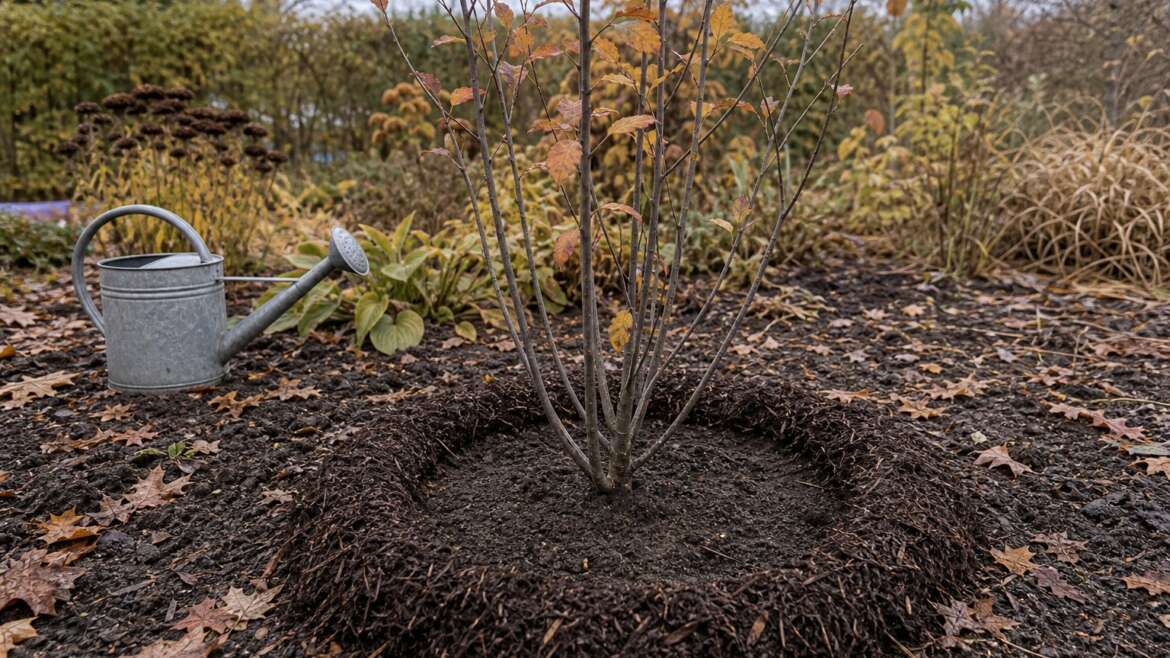
Minnesota Extension recommends mulching newly planted trees and shrubs and notes that proper mulching helps regulate soil moisture and temperature.4 Illinois Extension gives the shape most gardeners should remember: a doughnut of mulch, not a mound against the trunk.5
The difference matters. A mulch volcano keeps bark damp, hides the root flare, and can encourage circling roots near the stem. A mulch doughnut leaves the trunk exposed while protecting the soil where roots are meant to grow. The plant does not need a scarf. It needs a steadier floor.
Not every plant wants the same October
The phrase “fall planting” can sound too universal. It is not. Region, plant type, soil drainage, exposure, and winter severity all change the answer. In mild climates, October may be a comfortable beginning. In cold inland gardens, early October may already be the end of the sensible planting window for many woody plants.
UNH Extension cautions that some plants are higher-risk fall candidates, including many broadleaf evergreens and certain species that tend to establish better when planted in spring.1 University of Maryland Extension similarly notes that some trees with fleshy roots are better planted or transplanted in spring.3
This is not a reason to fear fall planting. It is a reason to stop treating the calendar as a universal instruction sheet. A red-twig dogwood planted in early October in workable soil may settle in beautifully. A broadleaf evergreen planted late in a windy exposed site may spend winter losing water from leaves faster than cold roots can replace it. The plant’s biology has to be part of the decision.
The quiet test after planting
A successful October planting does not announce itself with dramatic top growth. That is the point. If a newly planted shrub suddenly pushes a flush of tender shoots in late autumn, that is not necessarily good news. The better sign is boring: leaves drop normally, stems stay firm, buds remain sound, and the root zone stays evenly moist without sourness.
Use your hands rather than hope. Pull back the mulch and feel the soil a few inches down. Check the root ball as well as the surrounding soil, because they can dry at different rates. Notice whether water is soaking in or running away. If the soil is sticky and saturated, stop. If it is dusty or pulling away from the root ball, water slowly.
By late autumn, the goal is not to push growth. Avoid late nitrogen fertilizer, hard pruning, and anything that tells the top of the plant to make soft new tissue. The October job is quieter: settle the soil, keep roots moist, protect the root zone, and let the plant spend the remaining mild days making contact with its new place.
Reading your own root season
The most useful October question is not “Can I still plant-” It is “What is my soil still offering-” If your soil is workable, moist, and not close to freezing, roots may still have time. If the bed is cold mud, the answer changes. If you garden in a warm region, root season may stretch deep into winter. If you garden where early freezes arrive hard, it may be short and unforgiving.
A soil thermometer is not required, but it can be clarifying. So can memory. Which beds thaw first in spring- Which stay wet- Which are sheltered from wind- Which dry out under thirsty trees- The same garden that has frost pockets and warm wall pockets also has root-season pockets.
There is also a design lesson here. A garden is not only flowers and foliage. It is timing, soil temperature, moisture movement, root architecture, and patience. The plant you install in October is not just an object placed in a bed. It is a negotiation between a root ball and a living soil.
Final thoughts
October root growth is easy to miss because it asks for trust. Nothing showy happens. A new shrub may stand there looking almost unchanged while the useful work happens in the dark. That can feel unsatisfying in a garden culture trained to reward bloom, height, and instant fullness.
But this is one of the places where gardening becomes more interesting than decorating. Plant at the right depth. Keep the root flare visible. Water slowly before the ground freezes. Mulch like you understand the trunk is alive. Then let the plant do what October quietly allows: grow where spring will later need it most.
References
- UNH Extension: Is fall a good time to plant trees and shrubs-
- University of Idaho Extension: Trees, shrubs and vines
- University of Maryland Extension: Planting a Tree or Shrub
- University of Minnesota Extension: Watering newly planted trees and shrubs
- Illinois Extension: Watering trees, shrubs in the fall and winter is a balancing act