
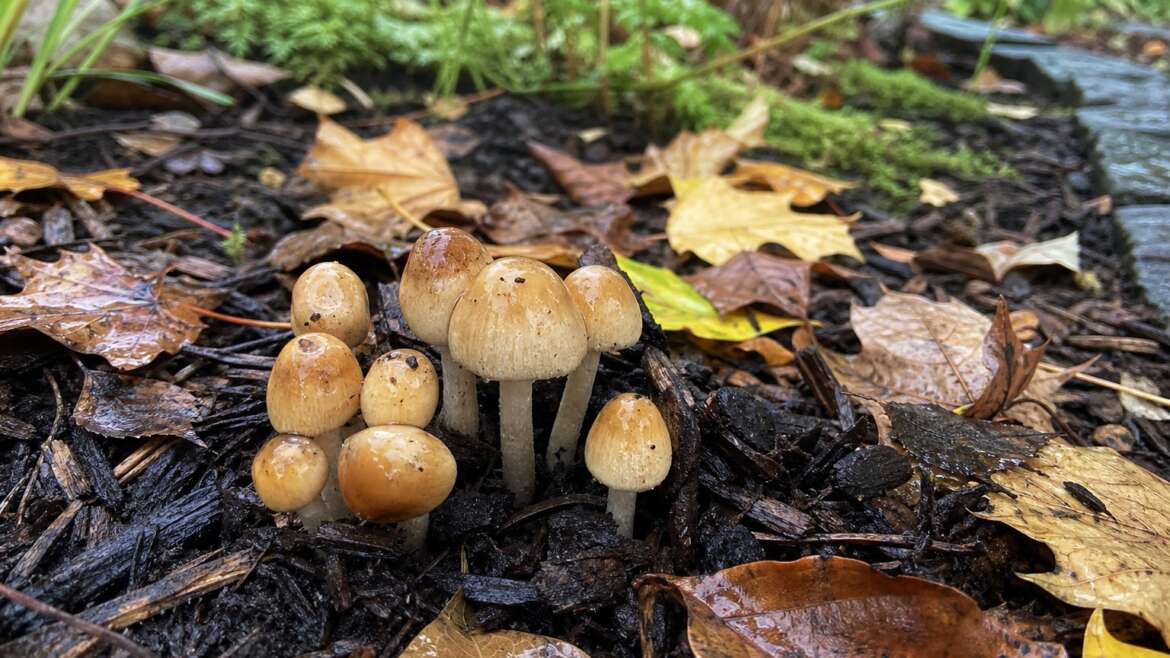
After a night of October rain, a garden bed can look as if someone has quietly moved in furniture. Yesterday there was only dark mulch under the asters, a few yellow leaves, and the damp edge of the path. This morning, a cluster of pale caps is standing there on thin stems, glossy with rain, arranged with the confidence of something that has always belonged.
Mushrooms have a talent for making gardeners feel late to the meeting. They seem to arrive in a single night, fully formed and faintly theatrical. One day the lawn is ordinary. The next day it has buttons, umbrellas, puffballs, or a ring that looks suspiciously intentional. The speed is real, but the surprise is mostly ours. The mushroom is not the whole organism. It is the part that finally became visible.
Clemson Extension describes mushrooms as the above-ground fruiting bodies of fungi that live in the soil and feed on decaying organic matter such as old roots, stumps, and thatch. Under wet weather, those fruiting bodies can seem to sprout overnight.1 That is the first useful correction: the mushroom did not begin when you noticed it. It is the temporary flower of a hidden body that may have been working in the bed for months or years.
The mushroom was not sudden
Most of the fungus is below the surface, not above it. University of New Hampshire Extension makes this point plainly: the vast majority of fungal mass is underground, where it goes unseen until mushrooms emerge. Many of these fungi are beneficial decomposers, breaking down dead roots, leaves, wood, and other organic matter in soil and mulch.2
That hidden body is built from hyphae, tiny threadlike filaments that explore whatever they are growing through. A mass of hyphae is called mycelium. UC IPM describes how fungal spores germinate into hyphae, how those hyphae may form visible mycelium under bark or in soil, and how the fungus can persist for years before producing fruiting bodies when conditions are favorable.3
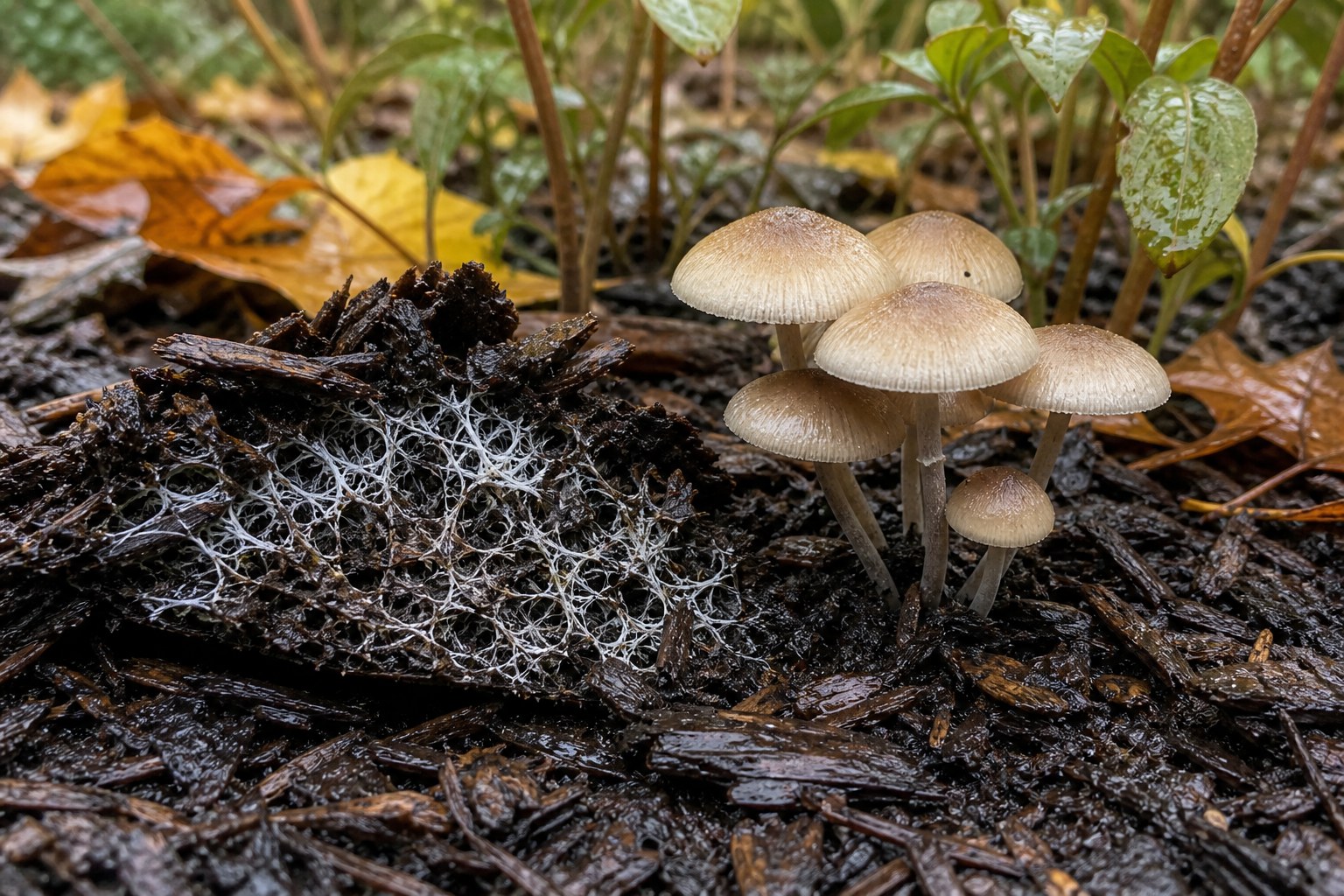
This is why pulling up the caps can feel satisfying but rarely solves anything. It removes the part that was about to release spores, not the fungus that made it. In a vegetable bed, a shrub border, or a mulched path, the living network remains threaded through the material it is digesting. Once conditions dry or cool, the caps collapse and vanish, but the mycelium stays on the job.
Why rain makes the hidden work visible
Rain changes the rules at the soil surface. It softens mulch, raises humidity, wets old roots and wood chips, and gives fungal tissue the water it needs to inflate delicate structures quickly. A mushroom cap is not built like a woody stem. It is mostly water, expanded from tissue that can develop fast when the fungus has enough stored energy and the air is moist enough to keep the young fruiting body from drying out.
That is why mushrooms often follow a stretch of damp weather rather than a single splash from the watering can. UNH Extension notes that prolonged wet, humid conditions cause fungi to send up fruiting structures, and that mushrooms disappear once weather dries even though the mycelium continues below ground.2 A cool October rain is especially persuasive because evaporation slows, nights are longer, and leaf litter holds moisture close to the soil.
Temperature matters too, but not in the simple way gardeners sometimes imagine. Mushrooms are not proof that the soil is too cold or too warm. Different fungi fruit at different seasonal thresholds. Some prefer summer heat after thunderstorms. Others appear in cool autumn weather. The useful pattern is not the exact date. It is the combination of moisture, food, and a fungus that has already reached the stage where reproduction is worth the effort.
What the fungus is eating
In most ordinary garden situations, the food source is not mysterious. Mushrooms in bark mulch are often feeding on the mulch itself, especially where it stays damp and has begun to break down. Mushrooms in a lawn may be working on old roots, buried wood, thatch, or organic debris left from a tree that was removed years ago. Mushrooms beside a stump are not making a moral argument about your maintenance. They are reading the menu.
Missouri Botanical Garden notes that mushrooms in lawns are common during rainy weather, live on decaying organic matter in the soil, and are usually not harmful to the lawn. The same guide points to decaying tree roots, logs, lumber, and other buried organic material as common fuel for fairy rings.4 That makes many mushroom flushes less like a disease outbreak and more like a receipt for organic matter you cannot see.
This is one reason wood-based mulch can produce mushrooms in autumn. Fresh chips and bark are not sterile decorations. They are carbon-rich habitat. Fungi help turn that coarse material into humus-like fragments that soil animals and microbes can work with. If the mulch is not piled against plant crowns or tree trunks, and if the bed is not staying sour and waterlogged, a few mushrooms are usually a sign that decomposition is happening, not that the bed has gone wrong.
There is a difference between a living process and a cultural problem. A three-inch layer of airy mulch breaking down slowly is useful. A wet mat of wood chips pressed against stems can invite rot. A lawn with occasional mushrooms after rain is normal. A lawn with thick thatch, poor drainage, and circles of drought-stressed turf is asking for different attention. The mushroom is a clue, but it is not the whole diagnosis.
When a ring appears in the grass
Fairy rings are the garden’s most dramatic fungal handwriting. A ring or arc of mushrooms appears in turf, sometimes with a greener band of grass, sometimes with a dry or weakened band, and sometimes with no mushrooms at all until rain makes the edge visible. It looks deliberate because it is organized, but the organizer is growth.
Clemson Extension explains that fungi can grow from a central point outward, expanding the circle each year. The dark green grass sometimes associated with fairy rings comes from nutrients released as fungi break down organic matter. In problem cases, dense mycelium can make soil repel water, creating localized drought stress.1 Missouri Botanical Garden describes the same outward growth pattern and notes that mushrooms or puffballs may appear under wet conditions in the ring.4
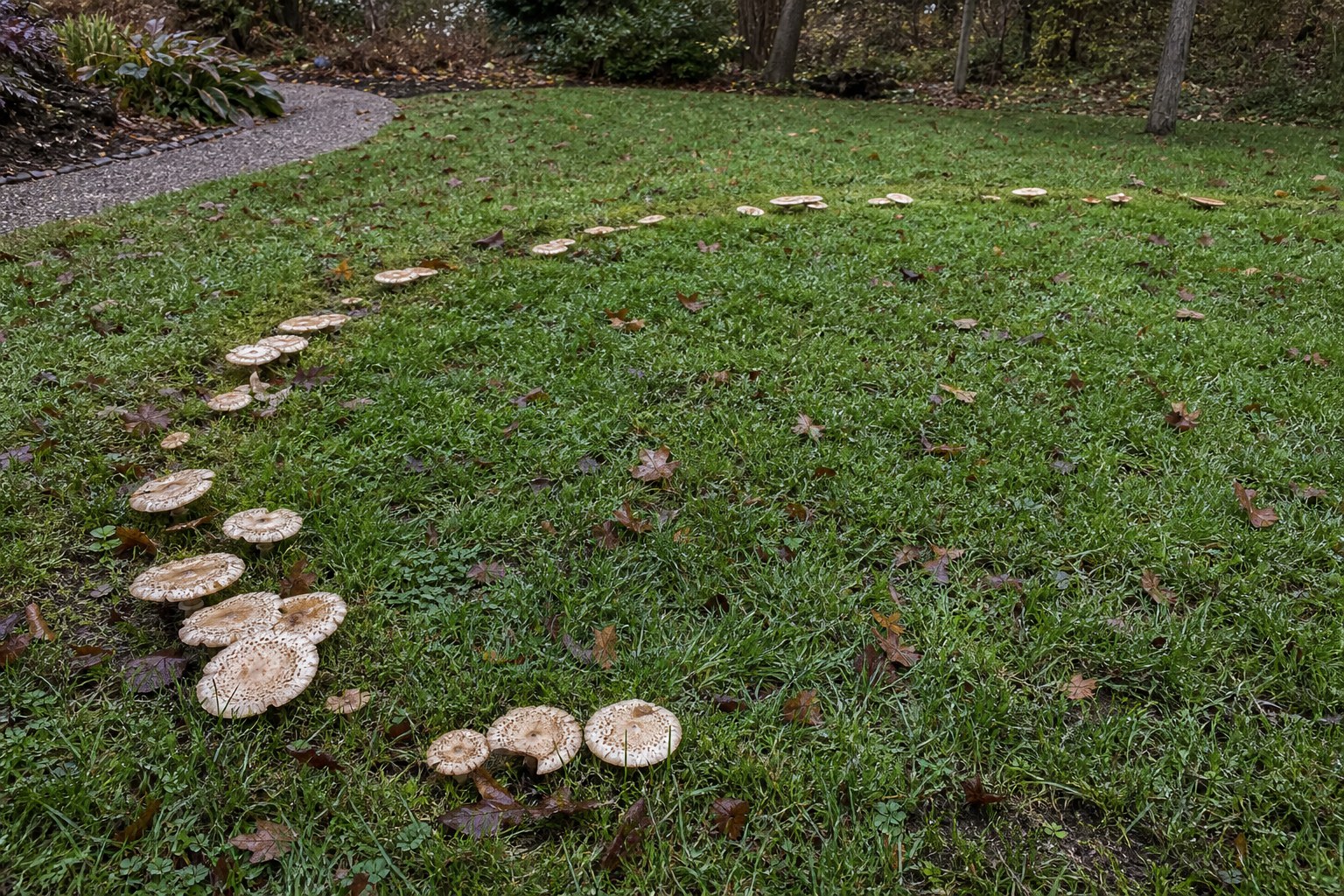
If the grass is healthy and the ring is only visible as mushrooms after rain, there may be nothing useful to do beyond observation. If the ring includes dry, brown, or water-repellent turf, treat the soil problem rather than declaring war on the mushrooms. Core aeration, deep watering that actually wets the resistant zone, and managing thatch can help water reach roots again. Replacing soil is sometimes suggested for severe cases, but for a home lawn it is usually more disruption than the ring deserves.
What to do, and what not to do
The most sensible response to garden mushrooms is often restraint. The Royal Horticultural Society notes that there is no precise distinction between the words toadstool and mushroom, and that most garden fruiting bodies are harmless or beneficial, though a few fungi can cause plant problems.5 The name is less important than the context: where it is growing, what it is growing from, and whether nearby plants are actually declining.
If mushrooms are only an aesthetic nuisance, leave them. They will usually age, dry, and collapse. If children or pets use the area, remove them promptly and throw them away. Missouri Botanical Garden warns that mushrooms should never be collected and eaten unless identified by an expert, because poisonous species can resemble edible ones.4 Iowa State Extension gives similarly cautious advice and does not advise on edibility for yard mushrooms.6
Removing the caps does not kill the underground fungus, but it can reduce the immediate chance of accidental eating and may reduce local spore release. UC IPM makes the same practical distinction: picking fruiting bodies soon after they appear might limit some spore spread, but it does not remove the mycelium below.3 UNH Extension adds that fungicides are generally not recommended for yard mushrooms because they are largely ineffective and the mushrooms are not usually damaging.2
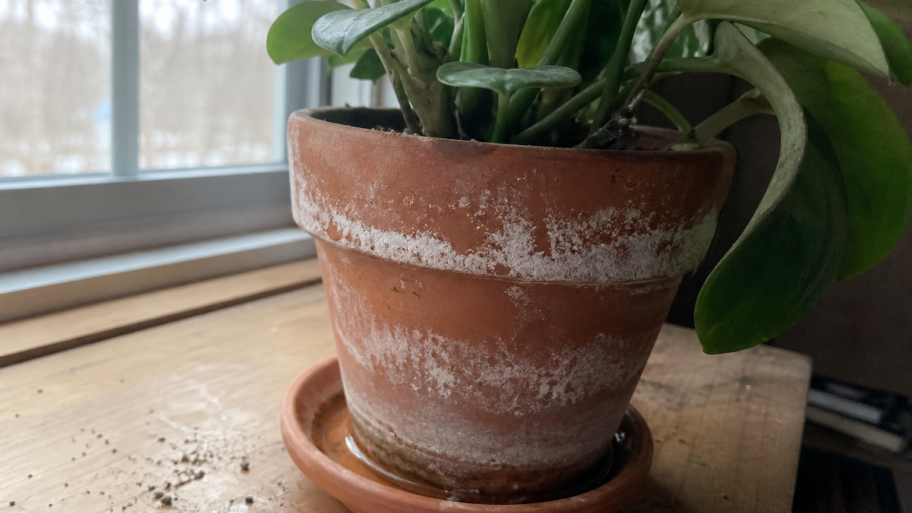
Where mushrooms are constant in a bed, look for the conditions that keep inviting them. Pull mulch back from stems and crowns. Keep woody mulch loose rather than matted. Improve drainage in places that stay wet for days after rain. In lawns, reduce excessive thatch, avoid shallow daily irrigation, and aerate compacted soil where water runs off instead of soaking in. In containers, a mushroom or two usually means the potting mix contains decomposing bark or compost and has stayed moist. That is not automatically a crisis, but it is a reason to check that the plant itself is not sitting in a saturated pot.
The useful warning near trees
Most small mushrooms in mulch or turf are not attacking living plants. Brackets, conks, or clusters at the base of a living tree deserve more respect. Iowa State Extension notes that some mushrooms associated with living or declining trees can be signs of wood decay, heartwood rot, or root and butt rot, and that a trained arborist may be needed to evaluate whether a tree remains structurally sound.6
That does not mean every fungus on wood is an emergency. A log used as a bed edge will grow fungi because dead wood is fungal food. A stump will soften, fruit, crumble, and return to soil. But a fresh shelf fungus on the trunk of a tree that shades the house, or honey-colored clusters at the base of a declining tree, is not the same kind of casual autumn appearance as little caps in mulch. In that situation, the right question is not whether the mushroom is pretty. It is what the fungus might be saying about wood strength.
Final thoughts
A mushroom after rain is easy to treat as an intrusion because it arrives on its own schedule and leaves without asking. But in most gardens it is part of the soil’s ordinary economy. Leaves fall. Roots die. Mulch softens. Wood disappears by slow degrees. Fungi do much of the work of turning those leftovers into something the next season can use.
So when mushrooms rise overnight in October, read them before you remove them. They may be pointing to buried wood, a damp pocket, a lawn ring, a mulch layer doing its work, or simply a week when the weather finally matched the hidden calendar below the surface. The caps will not last. The lesson should.
References
- Clemson Cooperative Extension: Mushrooms in Lawns
- University of New Hampshire Extension: Why are there so many mushrooms coming up in my yard and garden?
- UC IPM: Mushrooms and Other Nuisance Fungi in Lawns
- Missouri Botanical Garden: Lawn Mushrooms and Fairy Rings
- Royal Horticultural Society: Toadstools in Gardens
- Iowa State University Extension: Mushroom Questions Answered