
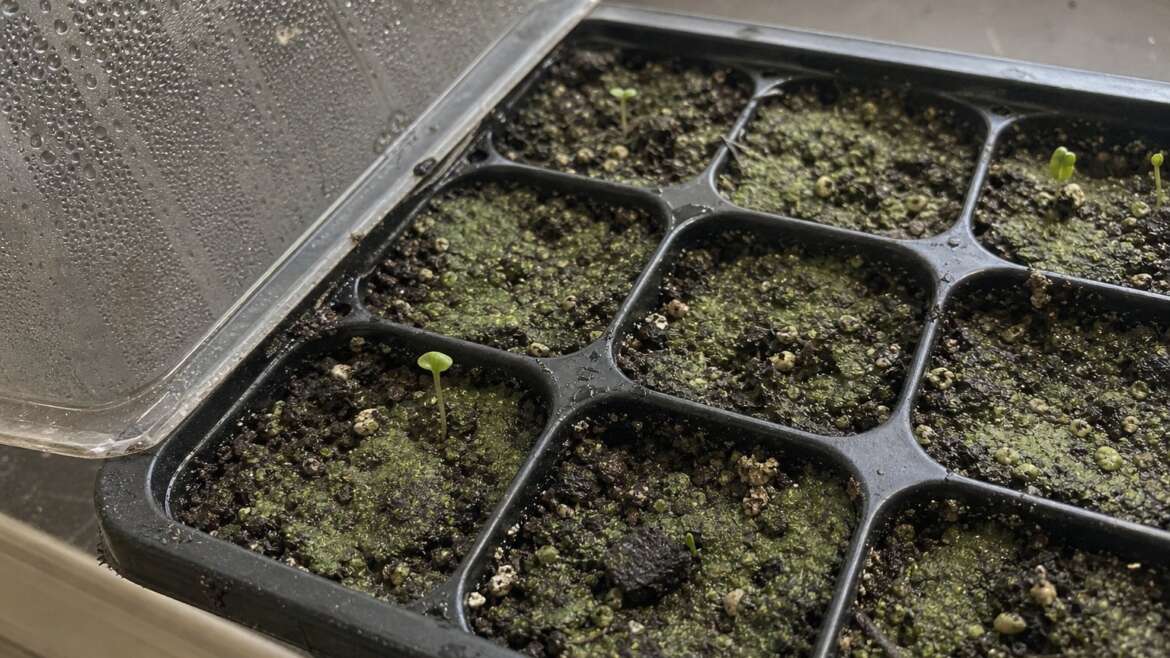
A February seed tray can look too small to have its own ecosystem, until it does. You fill the cells with seed-starting mix, press in tomatoes or basil or snapdragons, mist the surface, set the clear dome over the tray, and wait for the first signs of spring. Then, before many seedlings have done anything impressive, the soil surface begins to turn green.
At first it may look almost pretty: a faint wash of color between perlite flecks, like moss beginning on a stone. A few days later it can become a thin green skin. The mix looks slick. The dome is beaded with condensation. The seedlings are still standing, but the tray has started to feel less like a nursery and more like a damp little pond.
That green film is usually algae, sometimes joined by mosses or liverworts if conditions stay wet long enough. It is not the same as damping-off disease, and it is not usually attacking the seedlings directly. But it is a very good witness. It tells you the tray has been giving light, moisture, nutrients, and still air to organisms that know exactly what to do with them.
Algae are evidence, not the first crime
Algae are simple photosynthetic organisms. They do not need a flower, a seed packet, or a deep root system to make use of a bright wet surface. In seed-starting trays, they often arrive as spores or cells already present in water, dust, reused trays, old potting mix, or the surrounding room.
Utah State University Extension notes that algae on the surface of planting medium does not directly hurt tomato seedlings, but it signals that the medium is staying too moist and can encourage other complications.1 That distinction matters. The green surface is not always the villain. It is often the visible clue that the seedling climate is out of balance.
A few green patches are usually less serious than a tray of collapsing stems. Still, they are worth noticing early because the same conditions that favor algae also favor problems seedlings do not handle well: soggy roots, low oxygen around the root zone, fungus gnats, and disease organisms that thrive in crowded, humid spaces.
The humidity dome bargain
A clear dome is useful before germination because it slows evaporation. Seeds need steady moisture while they are swelling and waking. The dome helps create that protected atmosphere, especially in a dry house with winter heat running.
But a dome is a temporary tool, not a miniature greenhouse to leave sealed indefinitely. Iowa State University Extension recommends removing plastic coverings as soon as seedlings emerge and then placing the seedlings under bright light.2 Once leaves appear, the tray needs air movement and a surface that is not permanently wet.
Algae understand the sealed-dome stage very well. They are small enough to use the moisture before your seedlings have made much root. They sit on the surface where light reaches easily. They do not mind condensation. If the dome stays on after germination, the tray becomes an algae-friendly room with free lighting.
Water is the real invitation
Most seedling trouble begins with a reasonable fear: letting seeds dry out. A dry surface can stop germination, so gardeners mist, check, mist again, and keep the dome snug. The trouble is that seed-starting mix can look dry on top while remaining wet below, or look evenly damp while the bottom of the cell has become airless.
The University of Connecticut IPM program describes algae as thriving where water, light, fertilizer, and warm temperatures are present, and notes that it can grow on media, floors, benches, and pots in greenhouse settings.3 A seed tray on a windowsill or under lights is only a tiny version of that environment, but the same ingredients are there.
That is why a green film often appears first in trays that are watered from the top every day, kept under domes too long, or placed where water has no chance to move through and out. Algae do not need deep soil. They need a damp lit surface.
When the green skin becomes a problem
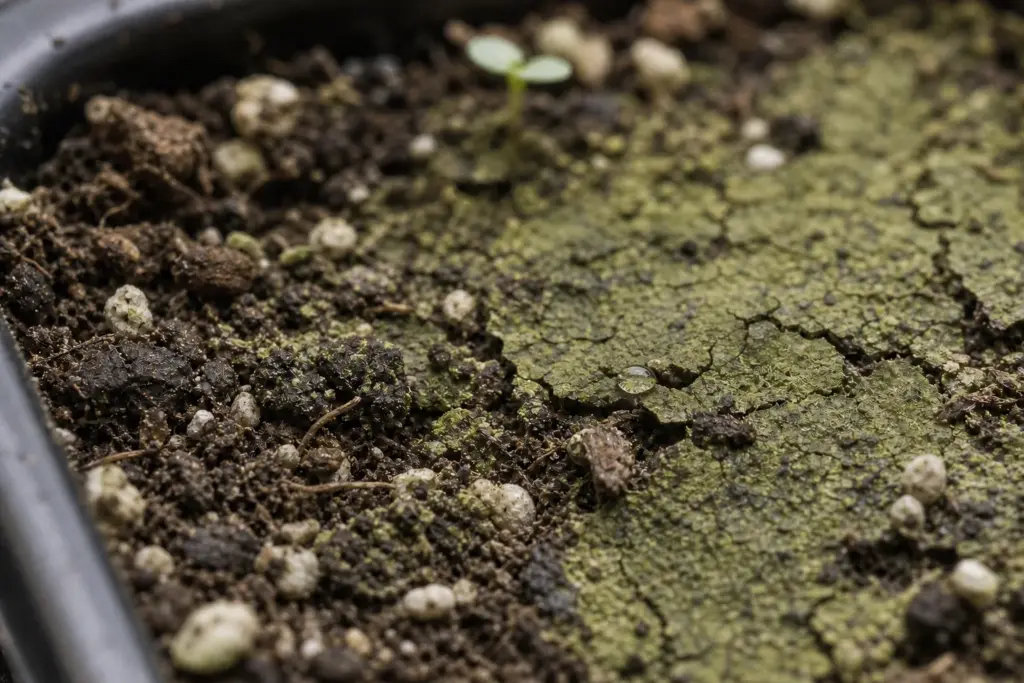
A thin algae film may be mostly cosmetic, but a thicker mat can change the surface of the tray. It can seal the mix, slow drying, shed water sideways, or make tiny seedlings push through a tougher crust than they were built for. It can also keep the surface wet longer, extending the very conditions that allowed it to form.
University of Maryland Extension explains that excessive algae or fungal growth can form a thick, dry crust on container media that interferes with water absorption and infiltration.4 In a home seed tray, the scale is smaller, but the principle is the same: a living film on the surface changes how the surface behaves.
The green film also makes moisture harder to judge. A shiny surface can look wet even when the root zone is drying, while a crusted surface can repel a light watering that never reaches roots. The tray starts lying by appearance.
Algae and damping-off are different warnings
Damping-off is the name gardeners use when young seedlings rot at the soil line, collapse, or fail before they have a chance to become sturdy. It is caused by disease organisms, not by algae. Still, the two problems often share the same room.
Iowa State University Extension lists poorly drained potting mix, overcrowding, excessive watering, and contaminated containers or media among factors associated with damping-off in seedlings.5 Those are also the kinds of conditions that make a tray hospitable to algae. So the green skin should not be treated as a diagnosis of damping-off, but as a prompt to improve the tray’s climate before more serious trouble has an opening.
If seedlings are upright, stems are firm, and the green is only on the mix, you probably have time to adjust. If stems are pinched, brown, translucent, or falling over at the soil line, the tray needs faster intervention, and affected seedlings may not recover.
How to turn the tray back toward seedlings
Start by changing the atmosphere. Remove the dome once germination has begun, or at least vent it more aggressively during the transition. Move seedlings into brighter light so they grow sturdier and the surface does not stay damp from weak, slow growth. Add gentle air movement if the room is still.
Then change the watering. Water deeply enough to moisten the root zone, but less often. Let the surface begin to dry between waterings once seedlings are established enough to tolerate it. Bottom watering can help if it is done carefully, but do not leave trays sitting in water. The goal is moisture through the cell, not a permanent bath below it.
RHS guidance on algae, liverworts, and mosses in greenhouses points to moist, humid, and enclosed environments as conditions that let these growths spread on compost surfaces, including seed trays.6 That is the whole correction in one idea: make the tray less enclosed and less constantly wet.
If the film is light, rough up the surface gently with a toothpick, plant label, or fork tip without disturbing the seedling roots. A very thin top-dressing of dry seed-starting mix, fine vermiculite, or horticultural sand can shade the algae and improve the surface texture. Do not bury small seedlings. Think of it as dusting the surface, not mulching a shrub.
Prevention starts before the packet opens
The easiest algae problem is the one that never gets a head start. Use fresh seed-starting mix rather than old outdoor soil. Wash reusable trays before sowing. Avoid letting old plant debris sit in the cells. Seeds contain enough stored food for the first stage of growth, so fertilizer is usually unnecessary until seedlings have true leaves.
Spacing helps too. A tray sown so thickly that every surface is shaded and wet becomes harder to manage. Seedlings need light and air around them. So does the surface of the mix. The tray is not only a place to germinate seeds. It is a small climate to manage for a few weeks.
The green skin on a seed tray is annoying, but it is also mercifully visible. Root stress hides below the surface. Damping-off can seem to happen overnight. Algae announces the moisture pattern before the seedlings have fully paid for it.
When you see that green film, do not panic. Open the dome. Let the surface breathe. Water with more attention and less habit. The tray is simply telling you that something besides your seedlings has found spring.
References
- Utah State University Extension: Starting Vegetable Seeds Indoors — Seedling Culture and Transplanting
- Iowa State University Extension: How to Successfully Start Seed Indoors
- University of Connecticut IPM: Managing Algae in the Greenhouse
- University of Maryland Extension: Algae and Fungal Growth on the Soil of Indoor Plants
- Iowa State University Extension: Addressing Issues with Starting Seeds Indoors
- RHS: Algae and Moss in Greenhouses