
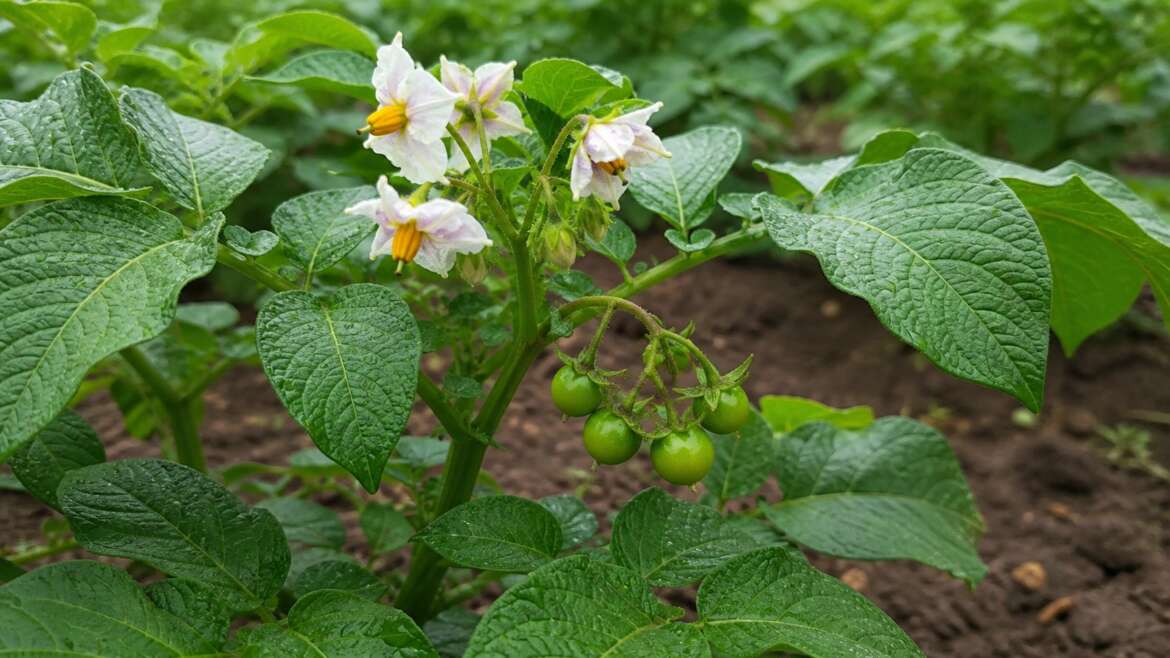
In a potato row in late July, the flowers may be gone but something round is still hanging from their stalks. It is green, smooth, and about the size of a marble. At first glance it looks exactly like a cherry tomato that has wandered onto the wrong plant.
It is not a tomato cross, a gall, or a potato trying to grow above ground. It is the potato plant’s own fruit: a true botanical berry that develops from a flower ovary, usually after pollination and fertilization. It may contain true seeds—although some potato berries are seedless—even though the “seed potato” planted in spring was a tuber, not a seed at all.
That little green sphere reveals something the harvest usually hides. When a berry contains viable seed, a potato plant can package two reproductive futures at once—clonal daughter tubers below ground and genetically reshuffled offspring in seeds above it. Only one of those structures belongs in the kitchen.
The fruit and the tuber are different organs
Potato, Solanum tuberosum, belongs to the nightshade family alongside tomato, eggplant, pepper, and petunia. The family resemblance is especially clear in the flowers: potato blossoms have a white, pink, blue, or purple corolla surrounding a cone of yellow anthers. After fertilization, the ovary at the center of a flower can swell into a round or slightly oval berry.12
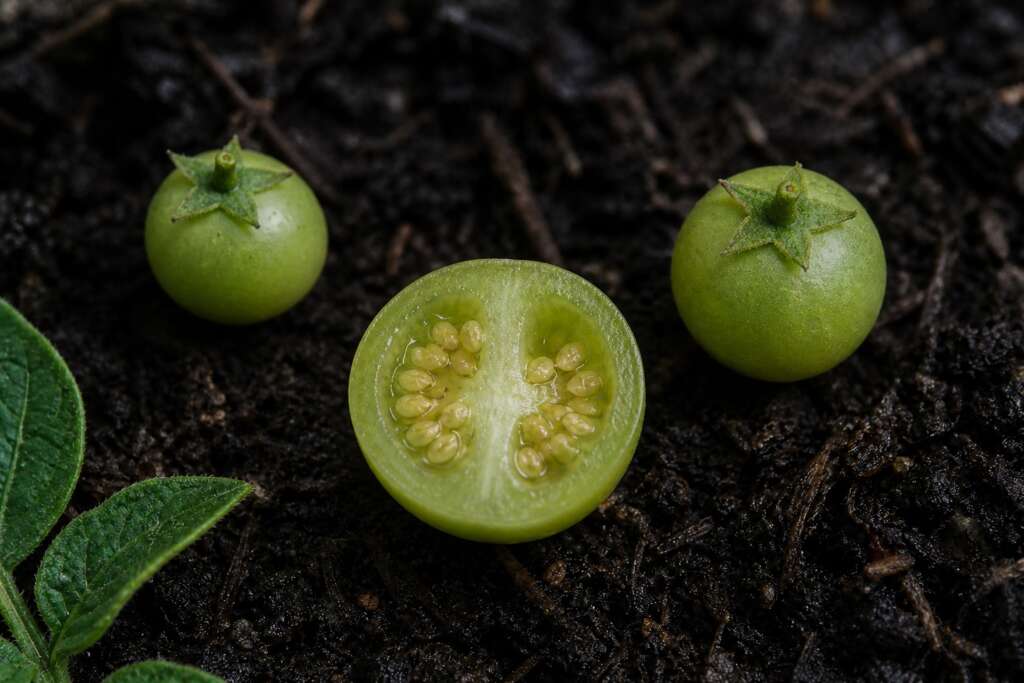
The berry is commonly 1–4 centimeters across. It may stay green even when mature, sometimes with pale or purple markings, and may contain no seed or several hundred flattened seeds roughly 2 millimeters long.12 Its likeness to a small tomato comes from shared ancestry. It is not evidence that pollen crossed the garden from a tomato plant.
The edible potato develops by another route. Underground shoots called stolons extend from the lower stems, and their tips enlarge into storage organs. A tuber is therefore a modified stem, not the plant’s fruit and not a swollen root. Its “eyes” are buds. The berry grew from a flower ovary; the tuber grew from a stolon. They share a parent plant but have entirely different jobs.1
A flower has to pass several gates before it becomes a berry
Potato flowers do not offer nectar. Their reward is pollen held inside long anthers that open through small pores at their tips. Bumblebees and other bees able to vibrate their flight muscles can shake this pollen loose—a form of buzz pollination also used on tomato flowers. Pollinators can help make potato seed, but the underground tuber crop does not require a pollinated flower.3
Many blossoms never reach the next stage. A cultivar may drop its buds, release little viable pollen, carry a form of male sterility, or fail to set seed even after a flower opens. Light, temperature, water, and nutrition also influence flowering and fertility. High temperatures around flowering often suppress reproductive success, but there is no universal weather formula that guarantees berries.14
Even a successful pollination does not produce a marble overnight. Fertilization is reported roughly 24–72 hours after pollination, and mature, viable seed generally needs about five to six weeks to develop.14 A berry found in late July is the slow outcome of an earlier flower, not a sudden response to yesterday’s rain.
A seed potato is a clone, not a botanical seed
The name “seed potato” is wonderfully practical and botanically confusing. It means a small tuber, or a piece of one, planted for its living eyes. When those buds resume growth—the process described in why seed potatoes wake before spring—vegetative propagation preserves the cultivar’s genotype and characteristic traits.1
The tiny structures inside a seed-bearing berry are “true potato seed” or TPS: seed made by sexual reproduction. Conventional tetraploid potato is generally self-compatible, so pollen may come from the same plant or another potato. Either route reshuffles gene variants in the embryos; it cannot alter the genome of tubers already forming on the mother plant. Vegetative propagation preserves a selected line, but it can also carry diseases through generations of saved tubers.1
Seeds from a familiar cultivar do not copy the label
Most conventional commercial S. tuberosum cultivars are highly heterozygous and carry four sets of chromosomes. Their many gene variants do not sort into seed offspring neatly. Sow ordinary seed from a garden berry and the seedlings may differ from the mother and from one another in vigor, maturity, flower color, tuber shape, skin, flesh, yield, disease response, and cooking quality.1
This does not mean every seed is automatically a new cultivar. Each sexually produced seedling is genetically distinct, but a candidate intended for release as a dependable food cultivar is normally tested across seasons and sites for agronomic performance, defects, cooking quality, and total glycoalkaloid concentration. A selected plant is then multiplied clonally so its genotype stays together. The berry is the beginning of that process, not its certificate.1
For a gardener who wants another reliable row of the same potato next year, a random berry is therefore the wrong shortcut. Iowa State University Extension puts the distinction plainly: potato fruit does not reproduce a cultivar true from seed.5 For a curious breeder, however, that unpredictability is the point.
Breeders see a lottery where gardeners see a marble
Conventional potato breeding begins by choosing parents, making crosses, and raising large populations from true seed. Researchers inspect the resulting plants, keep a small number with useful combinations, and replant their tubers as clones. Those clones then pass through years of trials. Sexual reproduction creates variation; tubers preserve a successful result.1
Researchers are also developing hybrid true potato seed from inbred diploid parents, which carry two chromosome sets rather than the usual four. The aim is different from sowing an unknown garden berry: crosses between sufficiently uniform parents can produce a much more consistent first-generation seed lot. Botanical seed is light to store and transport and reduces many tuber-borne disease risks, though it is not guaranteed pathogen-free.1015
The approach has begun to cross into formal variety registration. On May 21, 2026, the Netherlands added SOLHY019 to its National List and Variety Register; the company behind it describes the release as the country’s first registered diploid hybrid potato variety grown from hybrid true seed.13
This emerging system has not made the seed tuber obsolete. A 2025 synthesis of 20 field experiments found direct sowing of hybrid true seed promising but strongly dependent on seed quality, treatment, soil structure, moisture, weather, and management; weak establishment remains a practical hurdle.11 The odd fruit in a home garden contains the same reproductive route, not a ready-made replacement for next spring’s certified tubers.
The berry is not a tiny tomato for the kitchen
Steroidal glycoalkaloids occur throughout the potato plant and contribute to chemical defense. In cultivated potato, the principal compounds are α-solanine and α-chaconine, but concentrations vary greatly by tissue, cultivar, and growing or storage conditions. Sound tubers of established food cultivars are the food organ; potato berries are not food.67
Potato berries generally contain far more total glycoalkaloid than commercial tubers. EFSA summarizes the difference as about tenfold, while individual cultivars and analyses vary substantially.67 Acute potato-glycoalkaloid poisoning can cause nausea, vomiting, abdominal pain, and diarrhea, with more serious effects possible at higher exposures.6
There is no responsible “safe number of berries” to offer. Fruit size, chemistry, and body mass vary, and the human evidence does not support berry-count arithmetic. Do not taste one, turn it into a preserve, or assume cooking will make it acceptable. A berry that softens or changes shade is still not an edible potato.67
Green, badly sprouted, damaged, or markedly bitter tubers can also contain unsuitable glycoalkaloid levels; “tuber” does not mean every specimen is safe. If anyone swallows potato fruit, contact a local poison center promptly for case-specific advice; do not induce vomiting or wait for symptoms. Call emergency services for severe symptoms such as collapse, seizure, trouble breathing, severe confusion, or repeated vomiting. If an animal eats it, contact a veterinarian or animal poison service. Keep a photograph or specimen for identification, sealed away from food and children.14
Fruit is not a harvest clock
Flowering, berry growth, and tuber development can overlap, but one is not a gauge for the other. Cultivars differ in flowering time and fruit set, while temperature and other conditions can interrupt the reproductive sequence without stopping tuber growth. A plant with no flowers may still make potatoes; a plant loaded with berries does not reveal how large its tubers are.112
For “new” potatoes, elapsed time and a careful test dig are better guides. For a mature storage crop, wait for the tops to yellow and die back and for the skins to set, following the timing for the cultivar and local climate.12 In midsummer, keeping developing tubers covered from light and watering steadily during dry weather matters more than reading the berries as signals.
Should you remove the flowers or fruit?
It is easy to reason that every gram invested in flowers must be stolen from the tubers, but field results are not consistent enough to turn that idea into a universal garden rule. One experiment found a yield response to flower removal in one clone and year but not across three entries the following year.8 Another trial, using four cultivars under Ethiopian field conditions, found that allowing fruit to develop reduced total and marketable tuber mass.9 Genotype, environment, fruit load, and experimental treatment all matter.
For a home row, routine flower pinching is not a dependable yield trick. Leaving the flowers also lets pollen-collecting bees use them. The practical reason to remove the berries is access: if young children, pets, or livestock might sample the tomato-like fruit, snip it off after flowering and place it in household waste according to local rules. Do not leave removed berries where they remain tempting.
If access is controlled, no plant-health emergency requires removal. You can leave the fruit attached and observe it without tasting it. Its presence is evidence of successful reproductive development, not a diagnosis.
How to read the surprise safely
First, trace the stalk. A potato berry hangs from a branched flower cluster in the upper canopy, often with a small five-lobed calyx still clasping its base. Nearby leaves should be pinnate, with large leaflets alternating with smaller ones. The fruit is usually green, smooth, and modest in size rather than a full-sized tomato.12
Next, look for the sequence rather than opening the fruit. Photograph a flower, mark its stalk, and revisit it weekly. You may see the corolla fall, the ovary begin to swell, and the cluster gain weight. Other flowers on the same plant may yellow and drop without setting anything. That contrast is a small lesson in how selective reproduction can be.
If you deliberately explore potato breeding, use an established TPS protocol and check applicable plant-health rules before moving or sharing seed. Label the mother plant and treat open-pollinated seed as having an unknown pollen history: individual seeds may be selfed or crossed. Keep berry material away from food-preparation areas. Treat the resulting seedling tubers as unassessed breeding material, not automatically as food; professional programs screen new clones for total glycoalkaloids before release, and appearance alone is not a safety test.1
One plant, two futures
At harvest, the fork goes under the plant and the familiar future appears: a cluster of tubers, each carrying buds that can repeat the same genetic individual next season. Above them, a seed-bearing berry has been holding the opposite possibility—small seeds in which the parental genes have been dealt into new hands.
The green marble is easy to mistake because the potato’s clonal life is the one gardeners cultivate and eat. Yet the flower has not forgotten the older machinery of fruit and seed. A potato plant can preserve a successful identity below ground while experimenting above it. The tubers keep the name; a seed-bearing berry asks what might come next.
References
- Canadian Food Inspection Agency: The Biology of Solanum tuberosum (Potatoes)
- Royal Botanic Gardens, Kew: Solanum tuberosum species profile
- Buchanan et al., 2017: Bee community of commercial potato fields and Bombus impatiens visitation
- Bethke and Jansky, 2021: Genetic and environmental factors contributing to reproductive success and failure in potato
- Iowa State University Extension: Tomato-like fruit on potato plants
- EFSA CONTAM Panel, 2020: Risk assessment of glycoalkaloids in feed and food
- Bueno da Silva et al., 2024: Potato berries as a valuable source of compounds potentially applicable in crop protection and pharmaceutical sectors
- Jansky and Thompson, 1990: The effect of flower removal on potato tuber yield
- Tekalign and Hammes, 2005: Growth and productivity of potato as influenced by cultivar and reproductive growth: II. Growth analysis, tuber yield and quality
- Lindqvist-Kreuze et al., 2023: Potato and sweetpotato breeding at the International Potato Center
- van Dijk et al., 2025: Is field-sowing of hybrid true potato seeds feasible?
- University of Minnesota Extension: Growing potatoes in home gardens
- Dutch Board for Plant Varieties, 2026: Registration of SOLHY019; Solynta’s variety announcement
- MedlinePlus: Potato plant poisoning
- Northern Ireland DAERA: Potato spindle tuber viroid