

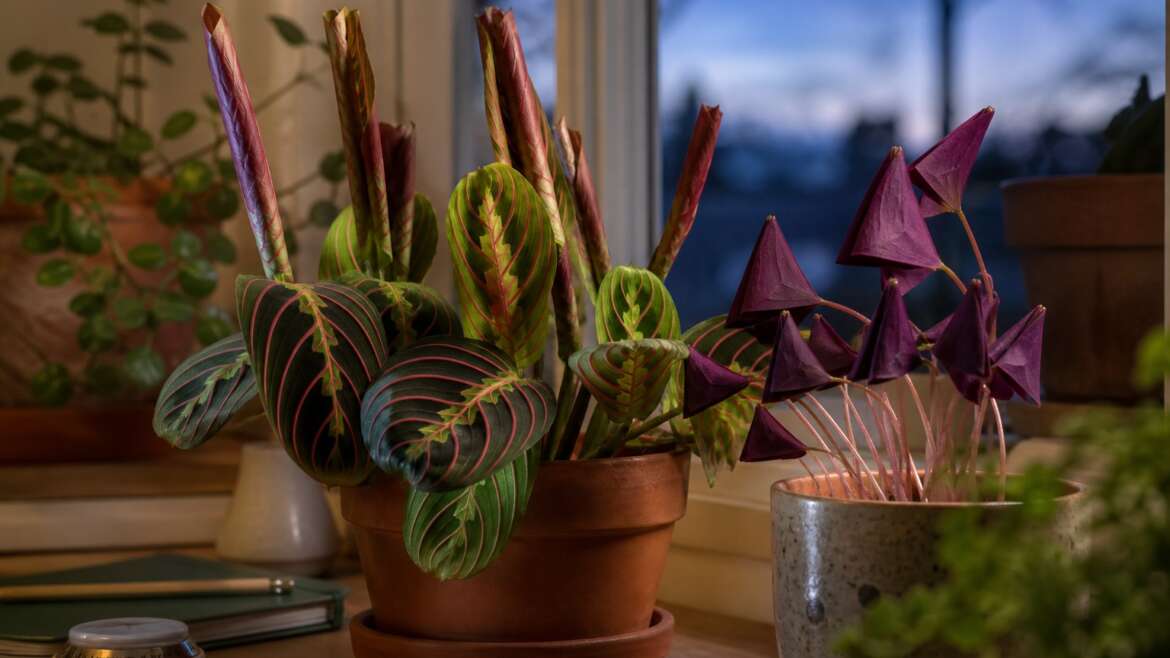
At dusk, some plants begin to rearrange themselves. A prayer plant lifts its patterned leaves until they stand like hands held together. Purple oxalis folds its triangular leaflets into little tents. Clover pulls its leaflets close, and some flowers that looked cheerful at lunchtime quietly close the shop.
It is tempting to call this sleep, and gardeners have been doing that for centuries. The word is charming, but the habit is not just charm. Leaf and flower movements are part of a wider plant sense of time. Cambridge University Botanic Garden explains that plants respond to daily and seasonal cycles both through direct environmental cues and through internal circadian clocks that help them anticipate day and night.1
For the home gardener, plant sleep turns an ordinary windowsill or border into a small observatory. You do not need laboratory equipment. You need a few responsive plants, a regular light-dark rhythm, and the patience to look at the same leaf twice in one day.
What plant sleep really means
The technical word for many of these repeating day-night movements is nyctinasty. It is a nastic response: the organ’s structure determines the direction, rather than the direction of the cue. In foliar nyctinasty, blades or leaflets usually move from a more horizontal daytime position toward a more vertical night position. That differs from touch-directed growth that lets a vine curl around a support over several days. Environmental cues entrain the rhythm, while an internal circadian clock can help sustain and anticipate it; the balance differs among species.12
This idea has a long gardening history. In Philosophia Botanica (1751), Carl Linnaeus grouped flowers by the hours they opened and closed and described a floral clock, or horologium florae. The Linnean Society cautions that he probably never planted such a clock himself. It also notes that he distinguished between flowers whose timing shifted with weather or day length and those with more fixed daily opening and closing times.3
A planted clock is never as punctual as a clock on the wall. Latitude, day length, and weather all matter; a cold, wet morning may keep a flower closed beyond its usual hour.3 Still, the old observation is valuable: a garden is not just arranged in space. It is arranged in time.
The little hinge inside a moving leaf
Many of the best-known leaf-sleep plants move from a small swollen joint called a pulvinus. Think of it as a living hinge at the base of a leaf, leaflet, or leaf stalk. In legumes, it contains opposing flexor and extensor motor tissues.4
That movement is hydraulic rather than muscular. Through ion-linked water flux, the motor cells change volume; the difference in turgor bends the pulvinus, while cell-wall properties help make the deformation reversible. A 2022 review in the International Journal of Molecular Sciences describes how osmotic pressure, water movement, and the mechanical behavior of the cell wall work together in this living hinge.4
Not every daily plant movement uses the same machinery. A legume pulvinus bends through reversible changes in motor cells, while the daily sweep of a young sunflower is driven by unequal growth on opposite sides of its stem.45 Flower movements vary too: depending on the species, temperature and light can act as cues, while opening and closure can involve changes in cell water relations or differential growth.6 Similar-looking gestures can arise from different tissues and processes.
Why a plant would fold itself
The honest answer is that no single demonstrated benefit explains every species. A review of foliar nyctinasty evaluates ideas involving temperature, removal of surface water, moonlight and photoperiod, and insect herbivory, while emphasizing that support varies and any advantage is likely context-dependent.2 In domesticated sunflower, the circadian clock coordinates late-stage floret development into daily rings. A 2023 field study found that delaying the rhythm delayed pollen release and morning pollinator visits, while disrupting it erased the ring pattern and sharply reduced visits.7

That does not mean your prayer plant is attracting bees in the living room. It means timing is a real biological tool. Plants use time because they cannot walk away from noon glare, a cold night, or an empty pollinator hour. They have to meet those changes in place.
There is also a more practical reason to care: rhythmic movement tells you that the plant is alive in a way that is easy to overlook. A leaf that changes position between breakfast and bedtime is a reminder that houseplants are not green decor. They are organisms keeping appointments with light.
Plants you can grow and watch
The classic indoor choice is the prayer plant, Maranta leuconeura. NC State Extension describes it as an evergreen tropical houseplant with leaves that fold at night to resemble praying hands, and recommends bright indirect light, evenly moist soil during the growing season, and high humidity.8 It is one of the most satisfying plants for this topic because the movement is large enough to notice without a time-lapse camera.
Prayer plants also show stress visibly. Too much direct sun can bleach or scorch their leaves, and NC State lists low humidity, low temperatures, and cold drafts among conditions they do not tolerate.8 Nightly lifting followed by daytime reopening is expected. Persistent daytime curling, fading, or collapse warrants checking light, soil moisture and drainage, temperature, humidity, roots, and pests; no single symptom identifies the cause.
Purple oxalis, Oxalis triangularis, is another fine windowsill plant for watching movement. NC State Extension notes that its leaves close at night or when disturbed, and that its flowers also close at night. It prefers a well-drained loamy mix, can grow in full sun to partial shade, and may go dormant if conditions become too hot or too dry.9 The same profile rates human poison severity as low but notes toxic potential with large ingestions and flags the plant for cats, dogs, and horses, so keep it away from children or pets that chew foliage.9
Outdoors, you can look for smaller versions of the same drama in the pea family—including clovers, beans, and peas—and in wood sorrels.2 A child can sow a few beans in a pot, mark one leaflet with a loose paper tag on the stake beside it, and check its angle in morning and evening. That simple habit teaches more plant physiology than a page of definitions.
Flowers add another layer. The Linnaean floral-clock idea invites time-based observation, but species do not all open and close for the same reason or keep the same hours in different places.36 If you are designing a garden that wakes after dusk or trying a floral-clock bed, treat timing as an experiment rather than a promise. Choose plants that suit your climate first, then record the hours they actually keep in your garden.
How to make a small plant clock
Start with one responsive houseplant on a windowsill where light is steady but not harsh. Because light helps reset a plant’s circadian clock, changing late-evening lighting schedules can shift or mask the rhythm you are trying to compare.1 If you use a grow light in winter, put it on a timer so the plant receives a repeatable day length.
For one week, look at the plant at three times: soon after waking, late afternoon, and before bed. Do not overcomplicate it. Write a few words, or take a photo from the same angle each time. The pattern will become obvious. Prayer plant leaves that lie flatter by day may lift at dusk. Oxalis leaflets may spread like open umbrellas in good light and fold down as evening arrives.
Once you know the normal rhythm, change only one thing if you are curious. Move the plant a foot farther from the window. Add a timer-controlled grow light. Raise humidity. Water more carefully. A single change gives you a real observation. Five changes give you a mystery.
The outdoor version is just as satisfying. Choose two or three plants known for daily flower or leaf movement and plant them where you pass often. A kitchen path, herb bed, patio step, or balcony rail is better than a distant border. The best observational gardens are placed where daily life naturally crosses them.
When movement becomes a care clue
Normal nightly folding should not be mistaken for wilting. A prayer plant that raises its leaves at dusk is not asking for emergency water, and an oxalis that folds after sunset is not dying.89 Check the growing medium and the plant’s daytime condition instead of using one evening pose as a watering signal.
Look for rhythm, not a single pose. A healthy plant of a nyctinastic species normally repeats a range that depends on the species and conditions, so compare this plant with its own familiar daily range: does it change, then return? Trouble is more likely when leaves stay limp through the day, remain tightly curled after light returns, yellow quickly, or develop scorched margins. Then the questions are ordinary but important. Is the soil staying wet too long? Is the plant in direct afternoon sun? Is a winter window too cold at night? Is the room too dry?
Oxalis adds one more twist: dormancy. If it fades after heat, dryness, or seasonal change, it may be retreating into its rhizomes rather than failing completely. Reduce watering, let the resting plant sit quietly, and wait for new growth before returning to normal care.9 A plant clock sometimes includes a nap measured in weeks.
Useful plant-rhythm supplies
- UBeesize Phone Tripod Pro S (affiliate link): a flexible holder for repeatable stills or time-lapse without shading the plant.
- BN-LINK BND-60/U47 24-hour mechanical outlet timer (affiliate link): a simple way to give a compatible grow light a repeatable schedule.
- SANSI 36-watt full-spectrum grow light bulb (affiliate link): one option for a repeatable photoperiod where daylight is insufficient; follow the maker’s distance guidance and watch leaves for heat or bleaching.
- Govee H5075 Bluetooth hygrometer-thermometer (affiliate link): records temperature and humidity near the plant so you can compare conditions with its movement, without treating one reading as a diagnosis.
Final thoughts
A sleepy plant is not asleep the way we are. It is more interesting than that. It is measuring light, moving water through cells, adjusting its shape, and keeping time with a world that changes every hour. The gesture is small, but the lesson is large: plants are rooted, not passive.
Put a prayer plant on a bright shelf, grow oxalis in a pot, or sow beans with a child and watch the leaflets in the evening. The garden will begin to look less like a still life and more like a slow performance. You do not have to catch every movement. It is enough to notice that the plants were keeping time before you looked.
References
- Cambridge University Botanic Garden: rhythms in plants
- Minorsky: The functions of foliar nyctinasty—a review and hypothesis
- The Linnean Society: Linnaeus’ floral clock
- Nakata and Takahara: mechanics of reversible deformation during leaf movement
- Brooks, Atamian, and Harmer: multiple light-signaling pathways control solar tracking in sunflowers
- van Doorn and van Meeteren: flower opening and closure—a review
- Marshall et al.: The circadian clock controls temporal and spatial patterns of floral development in sunflower
- NC State Extension Gardener Plant Toolbox: Maranta leuconeura
- NC State Extension Gardener Plant Toolbox: Oxalis triangularis