
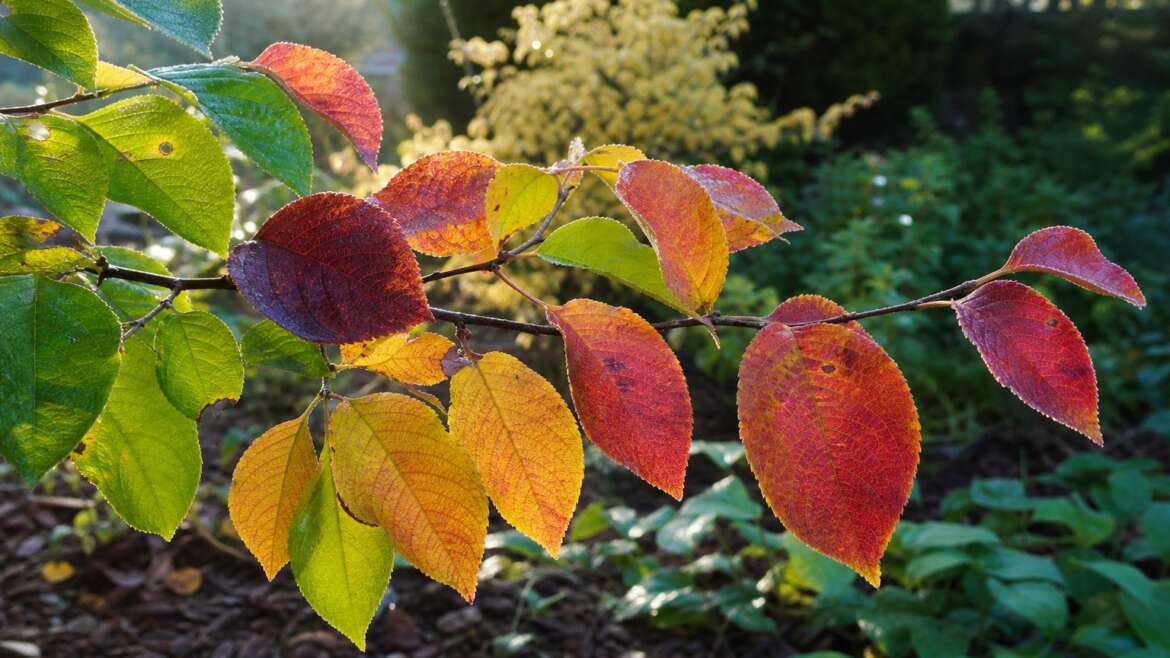
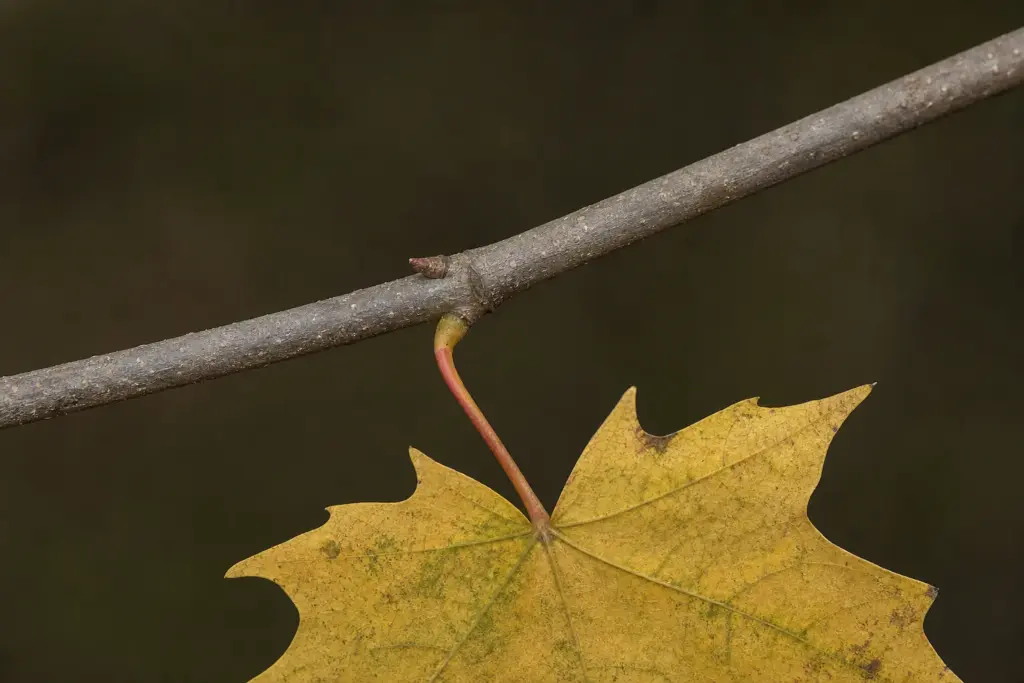
By late September, the garden begins to keep two calendars at once. Tomatoes may still be ripening. Dahlias may still be loud. But above them, a serviceberry starts to ember at the edges, a dogwood darkens toward wine, and a maple holds green, yellow, and red on the same branch as if it has not yet decided what season it belongs to.
Autumn color can look like decoration, but it is closer to accounting. A leaf that turns yellow or red is not simply dying in a pretty way. It is being dismantled. Useful materials are being pulled back into the woody plant. Pigments that were hidden or newly made become visible while the leaf is still alive enough to finish its work. Then the tree lets go.
That is why a good autumn border is not only a color scheme. It is a visible lesson in timing, chemistry, weather, and plant health. Once you understand what the colors mean, September becomes easier to read.
Green is expensive
During the growing season, green is the color of work. Chlorophyll absorbs light energy and helps power photosynthesis, but it is not a permanent paint. It is made, damaged, repaired, and replaced while the leaf is active. As days shorten and temperatures change, many deciduous trees and shrubs begin the orderly process of senescence.
Wisconsin Horticulture describes this autumn process as the disassembly of a leaf’s photosynthetic components, with nutrients such as nitrogen and phosphorus moved into stems and roots for storage and reuse the following year.1 The visible color is the late part of a process that has already begun inside the leaf.
This matters to gardeners because leaves are not disposable scraps until the plant has finished reclaiming what it can. A shrub that colors early every year may simply be genetically early. A shrub that colors early only after drought, root damage, poor drainage, or transplant stress may be sending a warning. Autumn color is beautiful, but it is also a report.
Yellow was there all along
When chlorophyll fades, yellow and orange pigments can finally show through. Autumn foliage does not fit neatly into three pigment buckets: chlorophyll supplies green, carotenoids account mainly for yellow and orange, anthocyanins make many reds and purples, and late brown usually accompanies cell death and oxidation, with tannins and residual pigments also contributing.2
Carotenoids are not autumn guests arriving late to the party. They are present in leaves through the growing season, helping with light capture and protection inside the photosynthetic machinery. Chlorophyll usually masks them. As chlorophyll breaks down in autumn, birches glow yellow, hickories turn bronze-gold, ginkgo leaves become clear butter, and many hostas fade through chartreuse before collapsing.
Because carotenoids are already present, yellow and orange displays are often more consistent from year to year than reds that depend on late-season anthocyanin production. They are not guaranteed: genetics, drought, disease, heat, frost, and early leaf drop still affect what the gardener sees.1
Red is made late
The red of a maple leaf is not just the uncovering of something hidden beneath green. In many species, anthocyanins are synthesized during senescence. One proposed job is photoprotection: screening excess light while aging photosynthetic systems are vulnerable. In experiments with ordinary and anthocyanin-deficient forms of red-osier dogwood, Elliott’s blueberry, and Sargent viburnum, anthocyanins reduced high-light photoinhibition during senescence and, in some comparisons, improved nutrient resorption.3 That result supports the mechanism in those plants and conditions; it does not make every red leaf a universal gauge of nutrient recovery.
This is one of the loveliest details in plant science. A leaf near the end of its life may still invest in protection. Bright autumn sun can become damaging when low temperatures and dismantled photosynthetic machinery limit how a leaf uses that energy. In some species, red pigment can screen vulnerable tissues while nutrients are retrieved. Other functions have been proposed, and the adaptive meaning of autumn red remains debated.2
University of Illinois Extension describes senescence as a process in which leaves break complex molecules into smaller soluble compounds that the tree can resorb for spring, while an abscission layer forms at the base of the leaf stalk.4 The color show is therefore not separate from the leaf’s departure. It is part of the departure.
Weather edits the show
Genetics sets much of a plant’s potential palette, while weather, soil moisture, exposure, and plant condition influence timing, intensity, and how long the leaves remain. The classic recipe for strong reds is sunny days followed by cool but not freezing nights, with adequate moisture before the display. The National Weather Service notes that warm sunny days and cool nights favor brilliant color, while hard frosts can wither leaves and make them drop before they color well.5
In a garden, this explains why the same plant can look different from year to year. A calm autumn with enough soil moisture, clear days, and cool nights may give you a slow burn. A hot, dry late summer can push some plants into early color or early drop. A windy rainstorm can end the display before it has properly opened. A hard freeze can damage leaves and curtail the display.
It also helps explain the patchwork on a single shrub. Sun-exposed leaves may redden more strongly than shaded leaves, and outer branches can color differently from the canopy interior. A low spot may meet frost earlier than a nearby slope. Species, leaf age, soil moisture, and exposure overlap, so use the pattern as a map of questions rather than a diagnosis.
Designing with a disappearing color
Fall color is different from summer flower color because it is brief, mobile, and weather-sensitive. You cannot design it with the same certainty as a row of zinnias. You can, however, give it structure.
Use evergreens, grasses, seed heads, bark, and dark-leaved shrubs as the frame. Then let deciduous color move through that frame. A red maple without a quieter neighbor can become a flare with no shadow. A gold witch hazel beside yew, holly, or blue-green conifer reads more clearly. A serviceberry earns its space twice, once in spring flower and again in orange-red fall leaves.
Wisconsin Horticulture’s guide to selecting woody landscape plants for fall color points gardeners toward a wide range of trees and shrubs with autumn foliage value.6 The useful principle is not to chase one spectacular tree. It is to plant a sequence: something that colors early, something that holds gold, something that turns red, something that finishes with russet or bark.
For small gardens, shrubs can bring fall color close to paths and windows without the canopy spread of a large tree. Fothergilla, oakleaf hydrangea, chokeberry, blueberry, viburnum, Virginia sweetspire, serviceberry, a compact witch hazel cultivar, and many dogwoods can do the work. Choose plants for your soil, light, mature size, local ecology, and climate first. Fall color is best when it is the reward for a well-sited plant, not the only reason a plant was squeezed into the wrong place.
When early color is a warning
Not every red leaf is a cause for concern, but timing and comparison matter. A young tree that colors several weeks before healthy plants of the same species on a similar site may be under stress from drought, trunk injury, root loss, compaction, deep planting, or stem-girdling roots. Illinois Extension describes premature color as a symptom rather than a diagnosis and recommends reviewing recent site changes and inspecting the trunk base and root flare.7
The gardener’s job is not to panic at every early leaf. Compare neighboring plants of the same kind. Use a hand trowel to check soil about six inches down in several places beneath the canopy rather than judging the dusty surface. Look for a visible root flare, bark wounds, circling roots, mower damage, or recent digging and construction in the root zone. A branch that changes far ahead of the rest deserves inspection for localized injury or decline, but color alone cannot tell you the cause. Newly planted trees need consistent moisture during establishment, but not saturated soil.8
Do not fertilize in response to early color. Fertilizer cannot correct drought, compaction, trunk injury, or damaged roots and can aggravate stress; use it only when a soil or tissue test identifies a nutrient need.9 During dry weather, water the broad root area deeply enough to moisten the soil without keeping it saturated, and keep a broad layer of mulch away from direct contact with the trunk.8 Ask a qualified arborist to assess a large tree with serious wounds, dieback, or structural concerns.
Useful autumn color supplies
A few modest tools make it easier to read fall color as plant information rather than just scenery.
- Carson MicroBrite Plus pocket microscope for looking closely at veins, pigment boundaries, and the surface of a suspicious spot; a magnified view is useful evidence, not a disease diagnosis by itself.
- XLUX soil moisture meter for a quick spot-check in accessible soil around small shrubs. Test several places and confirm by digging, because one short probe cannot represent an entire tree root zone.
- Fiskars 6-inch pruning scissors for clipping a single leaf sample or soft petiole; use correctly sized bypass pruners or a saw for woody branches.
Let the garden finish its sentence
Autumn can tempt gardeners into tidying too fast. The border looks tired, the lawn collects leaves, and the old summer urgency returns in a different form. But some of the most interesting plant work of the year is happening while the garden appears to be shutting down.
A red leaf may be shading its own dismantling machinery. A yellow leaf may be revealing pigments that worked all summer under green cover. A brown oak leaf may still be hanging after nearby maples are bare. Fallen leaves return organic matter and mineral nutrients as they decay; move thick mats off turf and paths, then use clean leaves in beds, compost, or leaf mold—the practical choices described in the quiet work of fallen leaves.
So look slowly in late September. Notice which plants color first, which ones color cleanly, which ones drop without ceremony, and which ones hold a last lamp of gold after the rest of the garden has gone quiet. Autumn color is not an ending painted on the surface. It is the plant moving value from one season into the next.
References
- Wisconsin Horticulture: Leaf color change in autumn
- Archetti et al.: Unravelling the evolution of autumn colours—an interdisciplinary approach
- Plant Physiology: Anthocyanins facilitate nutrient recovery in autumn by shielding leaves from potentially damaging light levels
- University of Illinois Extension: Why do tree leaves change color in autumn?
- National Weather Service: Fall colors report
- Wisconsin Horticulture: Selecting woody landscape plants for fall color
- University of Illinois Extension: Early fall color
- University of Maryland Extension: Watering trees and shrubs
- University of Maryland Extension: Fertilizing trees and shrubs and nutrient deficiency symptoms