
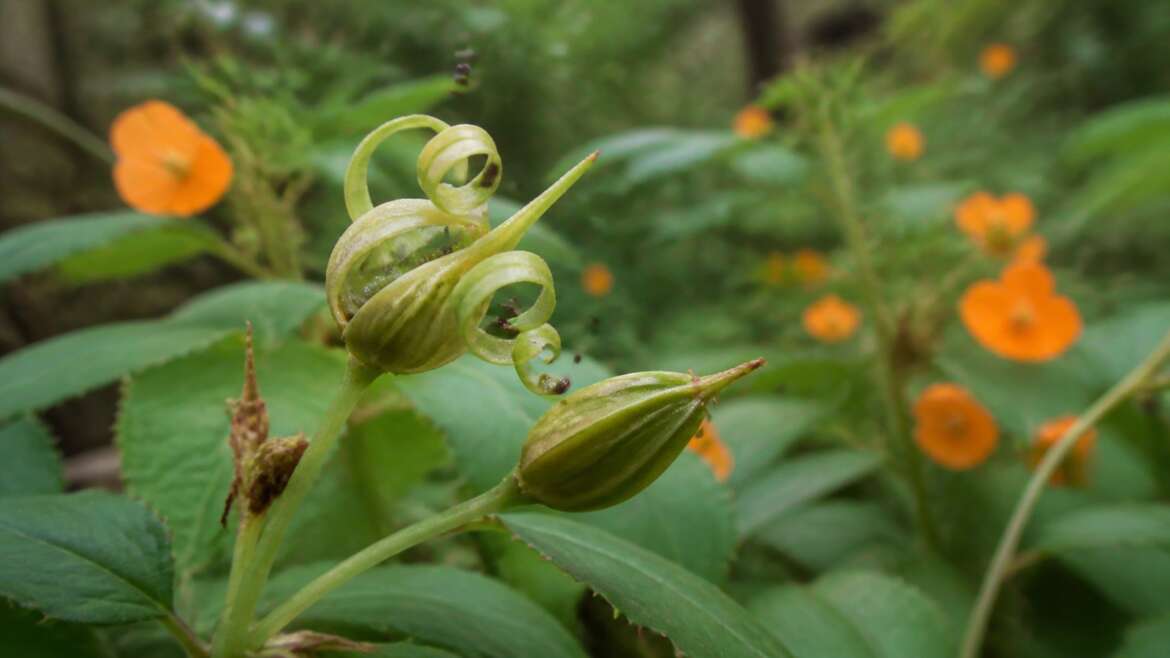
September is when the garden begins to sound different. The bees are still working the late flowers, the tomatoes are softening faster than anyone can use them, and some seed pods have become so tense with readiness that a fingertip can make them spring apart. Touch a ripe jewelweed pod and it does not simply open. It startles.
The little green capsule twists back on itself, the seeds flick outward, and the plant has done in a blink what a gardener might have done with an envelope, a label, and a careful hand. It has moved the next generation away from the parent plant.
This is explosive seed dispersal, and it is one of the garden’s best reminders that plants are not passive. They do not walk, but they solve the problem of distance in other ways. Some hitchhike on fur. Some float. Some drill themselves into the soil as their awns twist with changing humidity. Some are carried by ants, birds, or water. Some build a spring-loaded fruit and wait for the right moment to let it go.
A seed pod with a trigger
Jewelweed is the classic plant for seeing this up close. NC State Extension describes Impatiens capensis as an annual native wildflower of moist woods, thickets, bogs, and stream edges in much of North America. Its fruit is a capsule that pops open at maturity, dispersing seed, and the genus name Impatiens refers to that impatient release of ripe seed.1
The plant’s other common name, touch-me-not, is unusually honest. A ripe capsule can sit quietly on the stem until it is touched by a hand, brushed by an animal, shaken by rain, or simply reaches the point where its stored tension wins. Then the pod walls curl suddenly and fling the seeds away.
That curl is the clue. The seed pod is not opening like a door. It is releasing energy that has been stored in its tissues. Researchers studying orange jewelweed found that the valves of the fruit coil quickly as they open, and that this coiling drives seed ejection.2 To a gardener, it looks playful. To the plant, it is distribution.
The physics under the green skin
The simple version is that a pod grows into tension. Different tissues in the fruit wall behave differently as the seed matures. Some parts want to shorten, curve, dry, swell, or resist. The pod stays together until a weak line gives way, and then the fruit wall moves faster than ordinary plant growth can explain. It is less like a flower opening and more like a bent ruler snapping straight.
Not every exploding pod uses exactly the same mechanism. In popping cress, Cardamine hirsuta, scientists at the Max Planck Institute for Plant Breeding Research found that the pods do not simply wait to dry before exploding. Their report explains that a hydrated fruit wall can store elastic energy through growth and expansion, then rapidly release it at the right stage of development.3
The underlying paper in Cell describes explosive dispersal in Cardamine hirsuta as a coordinated result of turgor pressure, cell geometry, wall properties, tissue tension, and a fruit wall that coils when released.4 That is the part worth holding onto. A seed pod is not just a container. It is a little machine grown from living tissue.
Why throwing seed helps
A seed that falls straight down lands in the shadow of its parent, among the same roots, in the same crowd, under the same disease pressure, and near the same hungry seed-eaters. Distance gives a seed a chance at a different patch of light, moisture, and luck. Explosive dispersal does not carry seed across a continent, but it can move it far enough to matter.
In a moist shade garden, that is why jewelweed can appear in loose colonies. The parent plant lives one season, sets seed, and the next year’s plants rise from the scattered result. NC State notes that jewelweed can self-seed aggressively under suitable conditions, even while being valuable in native, moist shade, bog, pond-edge, and stream-margin plantings.1
The same habit explains why some small weeds seem to leap around the garden. Hairy bittercress, shotweed, and other popping cresses can be almost comically efficient at escaping a gardener’s hand. Pull them after the pods are ripe and you may help them sow the path. Pull them young, before flowering or while seed pods are still green and immature, and the story changes.
How to collect seeds from impatient plants
Seed saving asks for timing, and explosive seed pods make that timing more interesting. Harvest too early and the seed may not be mature. Wait too long and the plant may save itself without you. The trick is to watch the pod rather than the calendar. A ripe pod often looks swollen, slightly paler or more translucent, and ready to split along its seams.
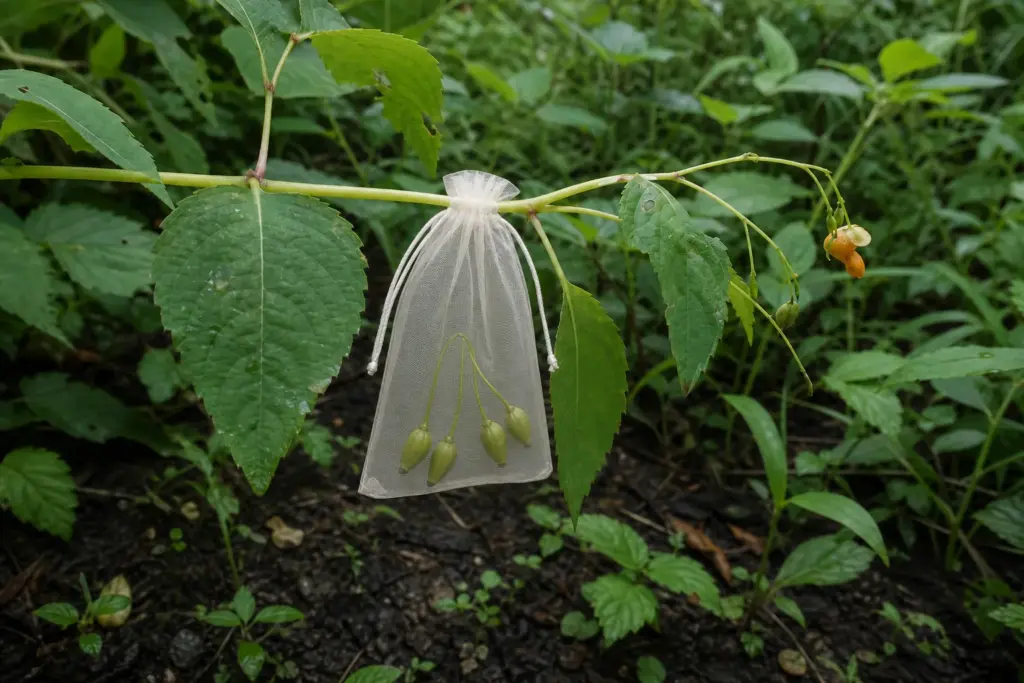
For plants that throw seed, use the gentlest possible container. Hold a paper bag, bowl, or envelope around the pod before touching it. If it is ready, it will often release into the container. If you are saving seed from a plant that ripens gradually, tie a small breathable organza bag around a few developing pods. The bag catches seed while allowing air movement, which matters because trapped moisture invites mold. Keep collected jewelweed pods and seed away from children and pets. NC State classifies the fruit’s poison severity as low but notes that ingestion can cause mild to moderate gastric irritation.1
Illinois Extension’s seed-saving guidance is a good anchor here: collect mature seed, let it dry completely before storage, and keep it in a cool, dry place once dry.5 Oregon State University Extension adds another principle for vegetables: save from open-pollinated or heirloom varieties when you want offspring with the same traits, and collect from the healthiest plants.6 That advice is written for crops, but the habit of selecting healthy parent plants is just as useful with flowers.
How to manage self-sowers without losing the charm
Explosive seed dispersal can be either delightful or annoying, depending on the plant and the place. A few jewelweed seedlings along a damp, shaded edge may be welcome. A mat of bittercress in a nursery bed is less charming. The question is not whether self-sowing is good or bad. The question is whether the plant is in the right habitat, at the right density, and behaving well in your region. Regional status matters too. Spotted jewelweed is native across much of central and eastern North America but introduced in some western areas; NC State notes that Washington listed it as a noxious weed in 2018.1
For welcome self-sowers, leave a few seed heads and edit the seedlings later. For plants you want to contain, cut or bag pods before they ripen fully. For weeds with spring-loaded seed capsules, do not shake mature plants over bare soil. Pull them young, move slowly, and carry them away in a bucket rather than waving them through the beds.
It also helps to leave less open ground. Mulch, living groundcovers, dense planting, and timely cultivation reduce the bare, receptive surfaces where thrown seeds can settle easily. A seed may be launched with remarkable speed, but it still needs a place to land and survive.
Where to watch for it
Look first in damp shade. Jewelweed often grows where soil stays moist and light is filtered: stream edges, woodland margins, rain garden edges, low corners, and the cool side of shrubs. The orange flowers are easy to notice, but the pods are subtler: green, narrow, and held on tender stems.
In the vegetable garden and paths, watch small brassica weeds such as bittercress. In ornamental beds, notice which annuals and perennials return in surprising places. Not all self-sowers explode, but many reveal their strategy if you let a few seed structures mature and observe them closely. September is a good month for this kind of attention. The garden is not only declining. It is distributing itself.
Useful seed-catching supplies
- Resealable kraft seed envelopes: useful for labeling and storing small batches of dry seed by plant, date, and garden location.
- Small white organza drawstring bags: handy for tying over ripening pods so seeds are caught before they launch.
- Carson TriView folding loupe: a compact magnifier for checking pod seams, seed maturity, and tiny structures without guessing.
Final thoughts
A ripe seed pod is easy to overlook because it is not as showy as a flower. But in September, the pod may be where the real performance is happening. It has grown quietly, changed its geometry, held its tension, and waited until the seed inside was ready for a future beyond the parent stem.
There is a useful gardening lesson in that. Some plants need our help to save seed. Some need us to intervene before they sow too freely. And some simply invite us to stand close enough to witness the moment when a green capsule becomes a catapult.
Let a few pods ripen where they are welcome. Bag a few if you want to save them. Remove the ones that would make next spring harder. The garden is always moving, even when rooted in place. Sometimes it moves by throwing a seed into the next story.
References
- NC State Extension Gardener Plant Toolbox: Impatiens capensis
- Journal of Experimental Botany: The mechanics of explosive seed dispersal in orange jewelweed
- Max Planck Institute for Plant Breeding Research: Exploding myths about seed dispersal
- Cell: Morphomechanical innovation drives explosive seed dispersal
- Illinois Extension: The ABC of seed saving
- Oregon State University Extension: Save seeds now for next year’s garden