
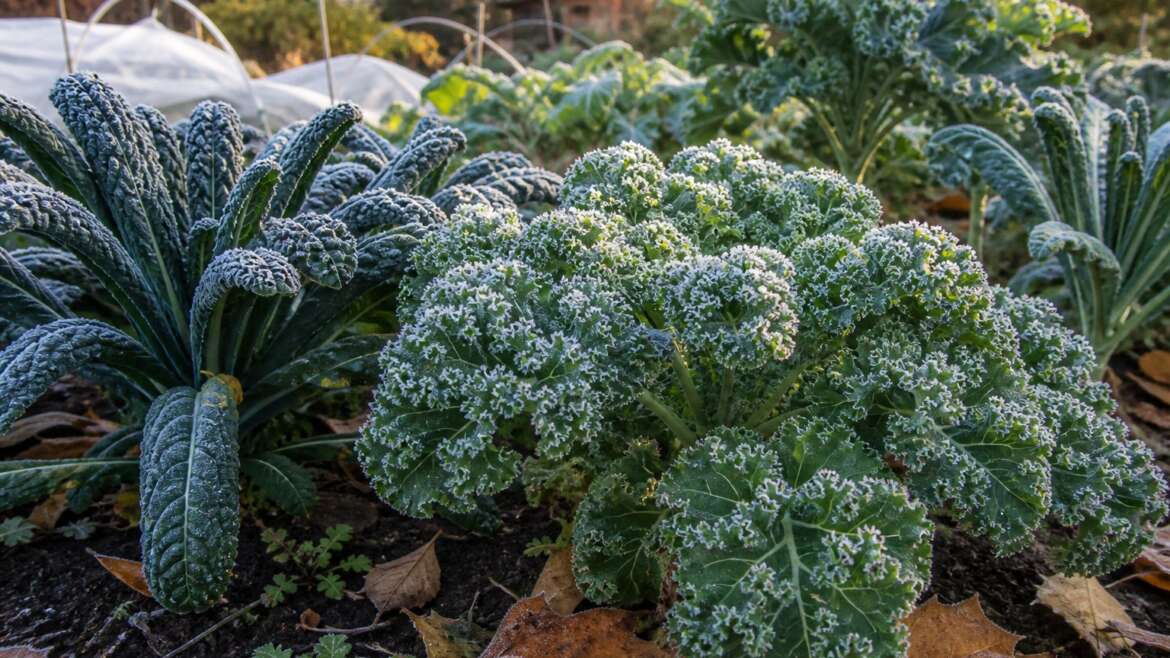
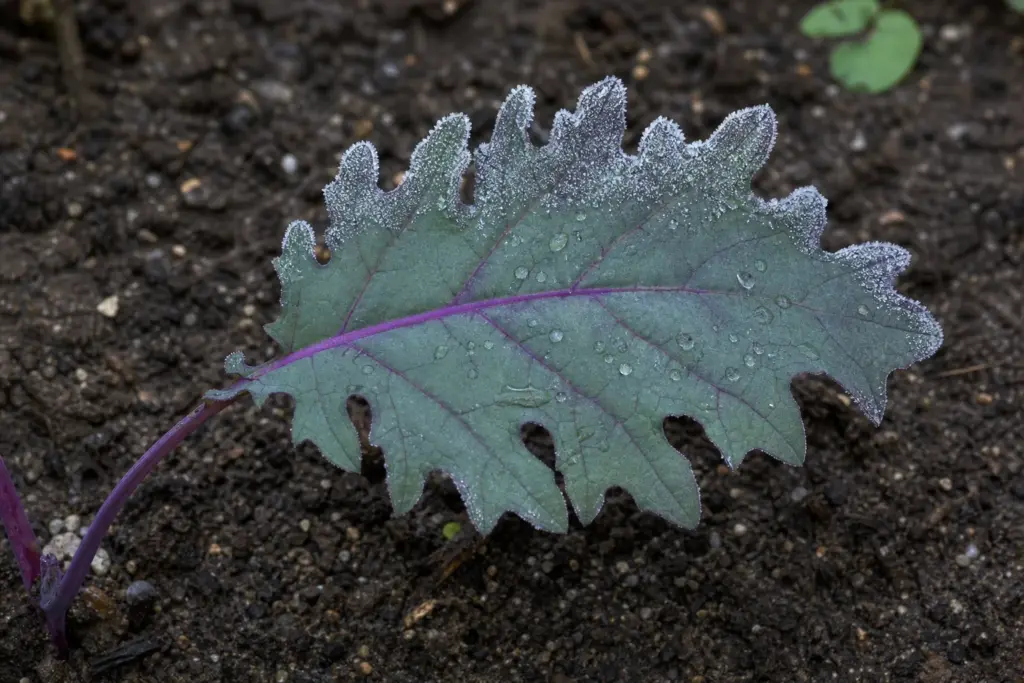
Kale looks almost theatrical after the first real frost. The leaves are darker than they were in September, their ruffled edges traced with white, their surfaces stiffened just enough to catch the low morning light. A gardener who does not know the plant might think the crop has been damaged. A gardener who has eaten from the bed before and after frost knows better.
Cold does not make every vegetable better. Basil collapses. Beans blacken. A tomato vine that was generous yesterday can look exhausted by breakfast. Kale belongs to a different group of plants, one that can treat autumn cold less like an ending and more like a change in chemistry. The result is one of the quiet pleasures of the late garden: leaves that taste rounder, sweeter, and less sharp after the weather has turned.
The old phrase is that frost sweetens kale. It is useful, but a little too simple. Frost is not seasoning the leaf from outside. The plant is responding to cold from within, shifting water, sugars, protective compounds, growth rate, and texture. When we harvest after that shift, we taste the plant’s winter preparation.
Kale is built for the cool end of the year
Kale and collards are cool-season brassicas, close relatives of cabbage, broccoli, Brussels sprouts, cauliflower, and kohlrabi. Iowa State University Extension includes kale among leafy greens that tolerate light freezes and remain harvestable while plants stay green and healthy, but advises waiting for frozen leaves to thaw and rehydrate before cutting them.1 That does not mean kale is invincible. It means its ordinary range of comfort reaches much farther into autumn than a pepper or cucumber would tolerate.
This is one reason spring and fall kale often tastes better than kale pushed through hot weather. Utah State University Extension says kale grows best at 75 degrees Fahrenheit or below and that high summer temperatures reduce growth and quality and can produce bitter or off flavors.8 Cool weather is useful, but the plant still needs steady growth rather than drought, nutrient stress, or severe crowding.
Frost, then, is not a magic switch so much as the visible moment in a longer cool-weather story. Cold acclimatisation is a process, not one white morning: the controlled kale research discussed below treated it as a distinct period after the plants’ original growth conditions.3 A sudden hard freeze after warm weather can exceed protections that gradually chilled tissue has had time to develop.
What cold asks a leaf to solve
A leaf is mostly water, and water becomes dangerous when it freezes in the wrong place. Ice forming outside living cells can draw water out and dehydrate them; ice within cells is more destructive, and cold also challenges membrane stability.2 Plants that survive cold weather have to manage those risks. They cannot put on a coat. They alter their chemistry.
One important response is the accumulation of soluble sugars and other small protective molecules. An article in Frontiers in Plant Science describes soluble sugars as having multiple roles in cold tolerance, from helping stabilize membranes to participating in stress signaling.2 In garden language, sugar is not only sweetness. It is part of the plant’s cold-weather toolkit.
Kale research points in the same direction. In a controlled Food Chemistry experiment, cold acclimatisation increased soluble sugars and could thereby improve taste; it also changed glucosinolates and fatty acids, so sugar is part of the flavor story rather than the whole of it.3 That helps explain the kitchen memory: the leaf that tasted a little stern in September can become gentler after October nights.
The story is not simply “more frost, more sugar.” Cool conditions and cold acclimation can improve flavor; a severe freeze can damage tissue instead. Once thawed leaves remain water-soaked, slimy, or collapsed, the crop has passed from a useful flavor change into injury. The best harvest window is after enough cool weather to change the leaf but before winter breaks it down.
Bitterness also changes
Sweetness is only one side of kale’s flavor. The other side is bitterness and pungency, much of it connected to sulfur-containing compounds called glucosinolates. These are characteristic of brassicas. They help explain why cabbage, mustard, radish, arugula, broccoli, and kale all seem to belong to the same culinary family even when their shapes are completely different.
Glucosinolates are part of the plant’s defense chemistry, and their breakdown products contribute the sharpness that makes brassicas interesting. Cold changes this chemistry in complicated ways. In one controlled study using kale seed from a single Croatian source, seven days at 8 degrees Celsius and a subsequent one-hour exposure to −8 degrees Celsius changed different glucosinolate groups in different directions.4 That result describes one source of plant material under defined conditions, not every kale in every garden.
A later Horticulturae experiment exposed curly ‘Frostara’, lacinato ‘Palmizio’, and a feral kale type to 2 degrees Celsius. Their glucosinolate responses differed by type and duration.5 The study did not include a sensory panel, so it cannot tell a gardener exactly how each leaf will taste after frost. It does show why “kale” should not be treated as one chemical response.
For the gardener, the lesson is practical. If you want mild leaves for salads, grow more than one type and taste the same plants through the season. Cold does not erase differences among varieties, and a laboratory measurement of one compound cannot substitute for tasting the harvest.
Light frost, hard freeze, and the gardener’s judgment
Not all cold nights are equal. Frost is a surface event, so a leaf can fall below freezing even when the reported air temperature remains above 32 degrees Fahrenheit; our guide to why frost can appear above freezing explains the role of radiative cooling and garden microclimates. A moderate freeze can be survivable for hardy brassicas. A hard freeze, especially with wind or dry soil, is a different event.
South Dakota State University Extension places kale among the hardier cole crops that can tolerate moderate freezes, roughly 24 to 28 degrees Fahrenheit, and notes that some crops improve in flavor with cooler temperatures.6 North Carolina Extension gives similar practical reassurance, listing kale among cool-season crops that can survive temperatures below 26 degrees Fahrenheit for an extended period.7
Those numbers are useful guideposts, not guarantees. Cultivar, plant age, previous acclimation, the actual temperature and its duration, wind, exposure, and soil moisture all affect the outcome. A sheltered bed beside a wall may sail through a night that injures an exposed allotment row, while moist soil retains more daytime heat than dry soil.7
The most reliable habit is to check the plant after it thaws naturally. Iowa State advises waiting for frozen leafy greens to thaw and rehydrate before harvesting.1 If the leaves stand back up, feel firm, and smell fresh, they remain useful. If they stay translucent, slimy, or collapsed, discard those damaged leaves.
How to grow for the sweet spot
The sweetest autumn kale usually starts weeks before frost. Sow or transplant early enough that the plant has real leaf mass by the time nights cool. A tiny seedling does not have much to offer the first frost. A well-rooted plant with a crown of mature leaves can keep producing through short days.
Utah State University Extension notes that kale tastes best when plants grow rapidly and mature before summer heat or after fall frosts, and recommends avoiding water or fertilizer stress during growth.8 That advice is easy to underestimate. Cold can improve flavor, but it cannot fully rescue a neglected plant. Drought stress, poor soil, and insect-chewed leaves all carry forward into the harvest.
Give kale fertile, well-drained soil with steady moisture. Keep the bed mulched lightly enough that the soil does not swing between baked and flooded. Remove yellowing lower leaves before they invite decay. If cabbageworms or aphids are active in your area, use insect netting earlier in the season rather than waiting for the plant to become a battleground. By October, you want leaves that are mature, healthy, and ready for cold, not leaves recovering from a summer of insults.
Spacing also matters. Crowded kale makes smaller, more humid, more disease-prone leaves. A bit of air between plants helps them dry after cold rain and makes it easier to harvest from the outside without tearing the center.
Using cover without stealing the cold
A row cover can feel like cheating, but it is really a way of editing the weather. The goal is not to keep kale warm like a houseplant. The goal is to soften extremes: wind, sudden drops, heavy frost, and freeze-thaw cycles that break tissue down before you can harvest it.
Wisconsin Horticulture notes that light frost can make crops such as spinach, Swiss chard, broccoli, Brussels sprouts, kale, and collards sweeter, and suggests using small hoops with clear plastic or protective coverings to extend harvest into winter for a time.9 The phrase “for a time” is important. A simple low tunnel is not a greenhouse. It buys days or weeks, sometimes more, depending on climate.
Fabric frost cover and plastic low tunnels offer different levels of protection, so check the material’s rating rather than assuming every cover is equal. Plastic can work over hoops, but it needs daytime monitoring and ventilation; Iowa State advises venting low tunnels on sunny days above 40 degrees Fahrenheit to release excess heat and moisture.10 If you use plastic, think of it as a movable roof, not a sealed jar.
Use the cover according to its protection rating and the forecast, secure its edges against wind, and keep plastic from resting directly on leaves. Vent or remove it when daytime temperatures climb. The aim is to soften a damaging extreme without creating a hot, wet tunnel.
Harvesting after frost
Harvest from the outside of the plant, taking older leaves and leaving the central growing point intact. That lets the plant keep making smaller new leaves as long as light and temperature allow. For salads, choose young leaves or the tender inner parts of larger leaves. For cooking, the bigger outer leaves are excellent once the midrib is removed or sliced finely.
Do not cut leaves while they are frozen solid. Iowa State warns that frozen vegetables become limp when harvested and recommends waiting for them to thaw and rehydrate.1 Once the leaves feel firm again and their surfaces are dry, cut them cleanly and cool them promptly. A clean basket and sharp snips are better than yanking a stiff leaf until the stem tears.
The flavor difference is easiest to notice if you taste the same plant repeatedly. Pick one leaf before frost and one leaf after a few cold nights. Chew them raw if they are clean and tender, or steam them side by side with no seasoning. The comparison is more useful than any gardening proverb. Some plants become honeyed and mild. Some mostly become less bitter. Some are still sturdy, cabbagey, and better in soup than salad.
Other crops that share the trick
Kale is the famous example, but it is not alone. Extension guidance also describes improved flavor after cool weather or light frost in crops including Brussels sprouts, collards, spinach, Swiss chard, broccoli, carrots, parsnips, rutabagas, and turnips.6, 9 The response and useful harvest window vary by crop. A carrot stores reserves in a root, a Brussels sprout is a tight bud on a stalk, and kale is a leaf still working in thin autumn light.
This is why an edible garden should not be thought of only as a summer machine. October has flavors July cannot make. The cold garden is slower, but not empty. It gives you leaves that have been through weather and changed because of it.
Useful cold-season kale supplies
- Agfabric 2.0 oz floating row cover: a heavier frost cloth for protecting mature kale during sharper cold snaps while still letting some light through.
- Fiberglass garden tunnel hoops: simple hoops make it much easier to keep row cover or plastic from resting directly on frosted leaves.
- Fiskars 6-inch pruning snips: useful for cleanly harvesting individual kale leaves without tearing the stem or disturbing the growing crown.
- Luster Leaf digital soil thermometer: helpful for planning fall sowings and understanding how quickly a bed is cooling under mulch or cover.
Final thoughts
Frost-sweetened kale is one of those garden experiences that sounds like folklore until you taste it carefully. The observation opens a doorway into plant physiology: cold challenges cells, can increase soluble sugars, shifts defense chemistry, and alters texture. Whether the result is a better leaf still depends on the variety, the weather, the plant’s condition, and the moment of harvest.
The trick is to grow plants healthy enough to meet the cold well. Plant in time. Keep them watered. Protect them from insects before the season turns. Let cool nights do their work, then cover when the weather threatens to become destructive rather than useful. Harvest with attention.
A summer tomato is generous because it tastes like heat. October kale is generous for the opposite reason. It tastes like a plant that has listened to the cold and answered with sweetness.
References
- Iowa State University Extension: Late-season harvest in the vegetable garden
- Frontiers in Plant Science: Cold tolerance triggered by soluble sugars
- Food Chemistry: Effects of photoperiod, growth temperature and cold acclimatisation on glucosinolates, sugars and fatty acids in kale
- Plants: Chilling and freezing temperature stress differently influence glucosinolates content in kale
- Horticulturae: Glucosinolate levels in kale cultivars are differently influenced by cold temperatures
- South Dakota State University Extension: Fall frost tolerance of common vegetables
- North Carolina Extension: Frost and freeze protection for vegetables
- Utah State University Extension: Kale in the garden
- Wisconsin Horticulture: Preparing the vegetable garden for winter
- Iowa State University Extension: Using low tunnels to extend the season