
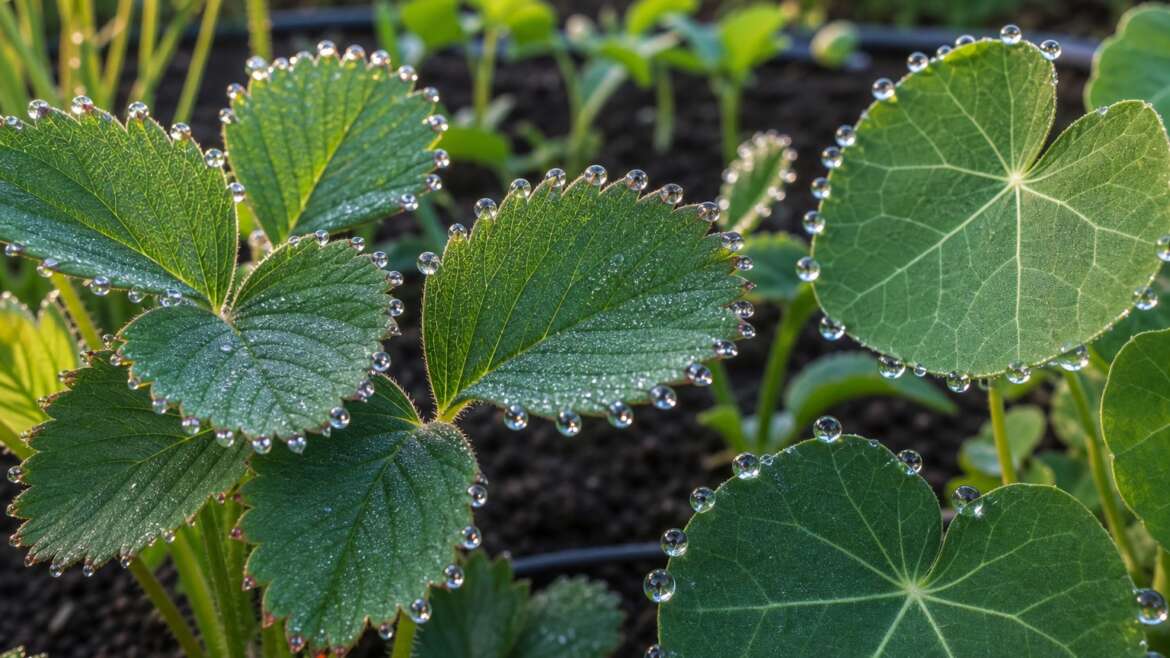
Some mornings, a garden looks as if it has been arranged by someone with a jeweler’s patience. Tiny droplets sit on the teeth of strawberry leaves. Beans carry clear beads at the very tips of their young leaflets. Grass blades hold a bright point of water where each blade narrows to a tip. The pattern is too neat to be rain, and often too regular to be ordinary dew.
What you are seeing may be guttation. It is one of those plant phenomena that looks decorative before it looks scientific: a row of pearls on a leaf edge, made by the plant itself. Missouri Integrated Pest Management describes guttation as the exuding of water from hydathodes, specialized structures on leaf margins or tips, when internal water pressure builds under certain conditions.1
For gardeners, guttation is worth knowing because it sits at the meeting point of beauty and diagnosis. It can be entirely normal. It can also tell you that soil is wet, humidity is high, transpiration is slow, or a houseplant has been watered more generously than it needed.
The difference between dew and guttation
Dew forms when water vapor from the air condenses on a cool surface. It can appear on leaves, roofs, tools, chairs, and the rim of a cold watering can. Guttation is different. The liquid starts inside the plant and exits through small openings called hydathodes, often at the end of veins near the leaf margin.
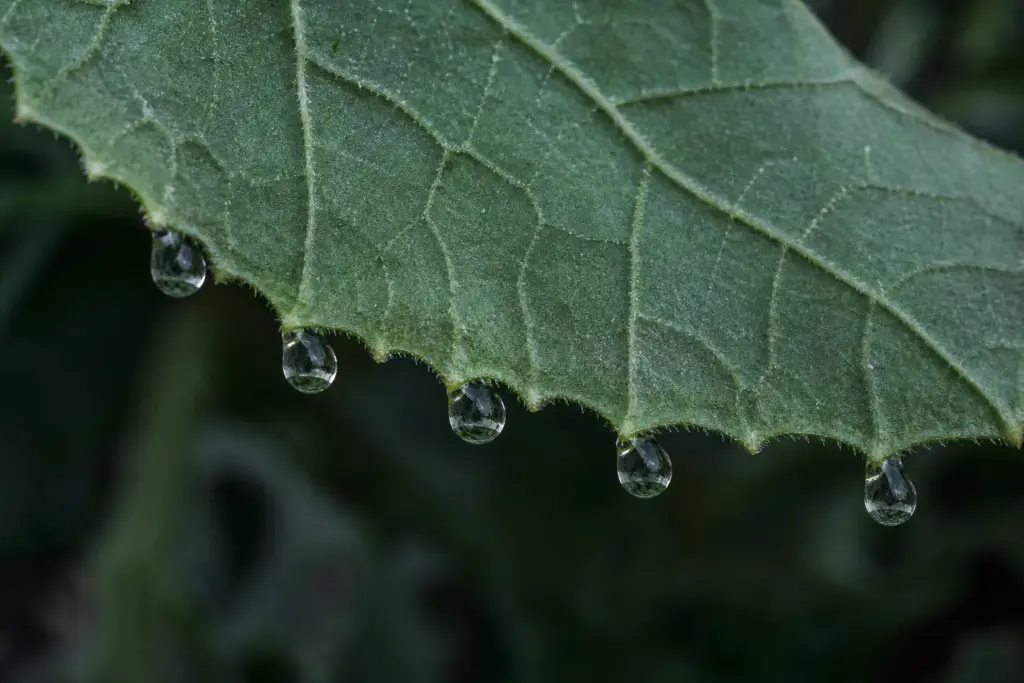
That is why the pattern can look so deliberate. Purdue’s Vegetable Crops Hotline explains that the droplets on a cucurbit leaf were evenly arranged around the edge because they came from hydathodes at the points where veins ended. In that case, high plant water pressure forced liquid out through those pores.2
A quick field clue is placement. Dew tends to speckle whatever cool surfaces are exposed. Guttation tends to bead along leaf tips, serrations, margins, and vein endings. Dew can coat an entire leaf surface. Guttation often looks like the plant has placed droplets at measured intervals.
How a plant pushes water out
During the day, plants move enormous amounts of water from roots to leaves. Much of it leaves through stomata, the adjustable pores involved in gas exchange and transpiration. Missouri IPM notes that transpiration helps cool leaves and pulls minerals from the soil into the plant, even though much of the water absorbed by plants is ultimately lost to the atmosphere.1
At night, the situation changes. Stomata are often closed or less active. If the soil is moist, roots may continue taking up water, especially when humidity is high and leaves are not losing water quickly. The plant still has water moving upward, but the usual daytime exit route has slowed. Root pressure rises, and the excess can be pushed out through hydathodes.
Hydathodes are not just poetic little vents. A PLOS ONE study on leaf apical hydathodes describes them as plant organs responsible for guttation in vascular plants, with water release occurring at leaf margins or surfaces.3 They are part of the plant’s plumbing, located where veins can deliver xylem sap close to the outside world.
The result is quiet pressure made visible. The droplet is not a tear, not in any emotional sense. It is a small overflow from a living hydraulic system.
Where gardeners are most likely to see it
Guttation is easiest to notice on soft, fast-growing plants with clear leaf margins: strawberries, grasses, beans, cucurbits, nasturtiums, tomatoes, young brassicas, hydrangeas, and many houseplants. It is especially common after a night with moist soil, warm roots, cool air, and high humidity. A greenhouse bench, a seedling tray under a humidity dome, or a well-watered summer vegetable bed can all create the right conditions.
Houseplants add another version of the story. The University of Arkansas Cooperative Extension notes that ficus plants can produce sticky droplets through guttation, particularly when there are changes in moisture and humidity, and that the plant may lose extra water from leaf tips.4 A dripping ficus may not be diseased, but it should still be inspected, because sticky residues can also come from scale insects or mealybugs.
That distinction matters indoors. Clear beads at leaf tips after watering are one thing. Sticky floors, black sooty mold, visible scale, cottony mealybugs, or leaves that feel tacky all over are another. Guttation can be normal; pests can mimic part of the symptom.
When it is harmless and when to adjust
A little guttation on a healthy plant is usually not a problem. It is often just a sign that the plant had more water pressure than it needed during the night. By midmorning, the droplets may evaporate, leaving nothing behind. Sometimes, however, the dried droplets leave pale specks because guttation fluid can contain dissolved minerals, sugars, and other compounds. Colorado State University’s CO-Horts blog notes that evaporated guttation droplets can leave white deposits on leaf margins.5
In houseplants, repeated heavy guttation may be a nudge to review watering habits. Is the pot sitting in a saucer of water? Is the mix staying wet for days? Is the plant in a cool room where evaporation is slow? A soil moisture meter is not a substitute for judgment, but it can help you learn the difference between a surface that looks dry and a root zone that is still wet.
In vegetable beds, guttation is less about immediate plant stress and more about conditions. Wet leaves, humid air, and crowded growth can favor disease spread. Purdue notes that hydathodes may also serve as entry points for bacterial pathogens, and that guttation droplets containing bacteria can be moved by people, equipment, animals, wind, or rain.2
The practical response is not panic. It is timing and spacing. Water soil rather than foliage when you can. Give vegetables enough air movement. Avoid brushing through wet plants first thing in the morning, especially if bacterial disease is already present in the crop. Let leaves dry before harvesting, tying, pruning, or staking whenever possible.
How to use guttation as a morning check
Guttation makes a useful garden habit because it asks you to look before the day gets loud. Walk the beds early, before sun and wind erase the evidence. Look at the same plants over several mornings. One row of droplets after a wet night is normal. Daily heavy droplets on seedlings in a closed tray may tell you to vent the lid. A houseplant that drips after every watering may be asking for a longer dry interval.
Use the pattern, not a single droplet, as your clue. Droplets at the edge of a strawberry leaf after a humid night are a beautiful bit of physiology. Droplets plus yellowing leaves, sour-smelling soil, fungus gnats, and a pot that never dries are a care problem. Droplets on cucurbit margins when angular leaf spot is moving through the patch deserve more caution than droplets on a vigorous, clean leaf.
If you grow children along with plants, guttation is one of the easiest living science lessons in the garden. Compare a strawberry leaf with a metal trowel on a dewy morning. The trowel may be wet from condensation. The leaf edge may carry regularly spaced guttation beads. One came from the air. One came from inside the plant.
Useful guttation-watching supplies
- 10x lighted jeweler’s loupe: useful for seeing whether droplets are sitting at vein endings, serrations, or leaf tips.
- XLUX soil moisture meter: helpful for learning whether a dripping houseplant or seedling tray is staying wetter than it appears.
- Govee thermometer-hygrometer: useful for tracking the high-humidity, low-transpiration conditions that make guttation more likely indoors.
- Luster Leaf soil thermometer: useful for comparing warm soil and cool morning air, a combination that can help make root pressure visible.
Final thoughts
Guttation is a small phenomenon with a generous lesson. It shows that plants are not simply drinking from below and drying from above. They are balancing pressure, humidity, temperature, roots, veins, pores, and time of day. A row of beads on a strawberry leaf is not decoration added to the garden. It is the garden briefly showing its plumbing.
Notice it, enjoy it, and then ask the practical questions. Is the plant healthy? Is the soil too wet? Are leaves drying quickly enough? Are pests or disease also present? Most mornings, the answer will be simple: the plant had extra water, and the dawn made it visible. That is enough reason to kneel down and look.
References
- Missouri Integrated Pest Management: guttation, a pressure relief for plants
- Purdue Vegetable Crops Hotline: guttation droplets and hydathodes
- PLOS ONE: anatomy of leaf apical hydathodes in four monocotyledon plants
- University of Arkansas Cooperative Extension: ficus and guttation
- Colorado State University Extension CO-Horts: guttation, just a curious plant thing?