
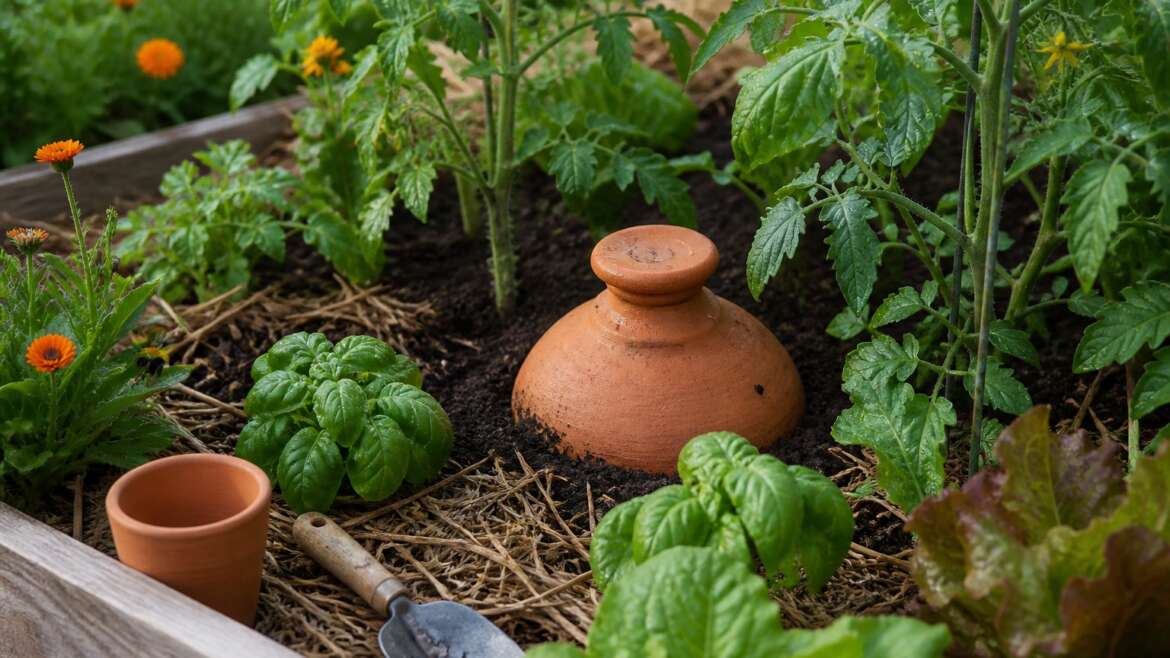
An olla is one of the quietest irrigation tools a gardener can use. It has no timer, no spray pattern, no little plastic emitters to unclog. It is simply an unglazed clay pot, buried in the soil and filled with water, asking the ground around it a patient question: are you thirsty yet?
When the surrounding soil dries, water moves through the porous clay and into a local part of the root zone. As the difference in water potential across the wall narrows, the flow generally slows. Reservoir depth, clay porosity, soil texture, weather, and root uptake all affect the rate, so an olla is responsive without being a perfect on-off valve.12
Olla irrigation is old enough to feel almost obvious. Colorado State University Extension describes it as an ancient technique using unglazed clay vessels buried near plants so water can seep slowly into the soil.3 In a small edible garden, that old idea can feel surprisingly modern: low-pressure, low-tech, and attentive to where water is delivered.
How the pot responds to drying soil
The olla does not truly know anything, of course. Its apparent intelligence is physical. Low-fired, unglazed clay contains connected pores. A filled vessel places water on one side of that porous wall and unsaturated soil on the other. The resulting hydraulic gradient moves water outward; soil drying and plant water uptake can strengthen the gradient, while rain or irrigation outside the pot can weaken it.2
The University of Arizona Cooperative Extension describes this in terms of soil-moisture tension: dry soil draws water through porous clay, moistening the soil around the vessel.1 This is why an olla behaves more like a buried reservoir than a miniature sprinkler. It creates a moist zone around itself and gives nearby roots a dependable place to explore.
The system is not identical in every bed. Research with porous clay pipe—a related but differently shaped emitter—found greater horizontal spread in finer-textured soils.4 In coarse soil, an olla’s useful lateral zone can be narrower; clay-rich or layered soil may spread and hold moisture differently, while compaction or poor drainage can keep a bed too wet. Pot dimensions and firing, initial soil moisture, reservoir head, root density, and evaporative demand all change how quickly an olla empties.12
Where ollas make the most sense
Ollas are most practical in concentrated planting areas where several roots can reach one reservoir. Think tomatoes or peppers in a raised bed, squash beside a well-placed vessel, or a large container that dries quickly. They are less practical for broad lawns, dense rows that require even surface coverage, or woody plants whose expanding roots may eventually crack the pot.1
The Native Seeds/SEARCH guide recommends burying the vessel with only an inch or two of its neck above the soil, packing soil against the clay to avoid air gaps, and covering the opening.5 The exposed neck lets you refill without disturbing roots. The cover limits direct evaporation from the reservoir and keeps debris and mosquitoes out.
Because delivery happens below the surface, an olla can reduce the area of bare soil wetted and exposed to direct evaporation or runoff. That can be useful in a hot, dry garden, but it does not eliminate plant transpiration, guarantee a particular water-saving percentage, or compensate for an empty pot. Soil, crop, weather, vessel design, and the irrigation method used for comparison all matter.62
Choosing or making an olla
A purpose-made olla is usually a rounded terracotta vessel with a narrow neck and a lid. The broad body provides reservoir volume and porous surface area, while the neck leaves a small fill point aboveground. A commercial vessel is the simplest choice if its capacity and recommended coverage suit the bed.
A homemade version can use one unglazed terracotta flowerpot with its drainage hole sealed and a saucer for a lid. Another common design joins two unglazed pots rim to rim, sealing one drain hole and leaving the other as the fill opening.31 Use an adhesive or sealant whose manufacturer explicitly approves the intended water and outdoor use, and allow it to cure fully. Glazed ceramic and plastic do not provide the porous wall this method requires.
Test any vessel before relying on it. With a homemade olla, fill it over a tray or bucket and look for a fast water-level drop, a dripping seam, or a failed plug; those are leaks, not controlled seepage. The terracotta itself may darken as it wets. Do not treat an open-air test as a prediction of refill intervals, because water delivery changes once the pot is surrounded by soil.2
Spacing is a garden experiment
Most spacing advice is a starting point rather than a promise. Research on ideal placement remains limited, and the useful wetting zone depends on soil, vessel size and shape, crop demand, and climate.1 A small olla may serve only a tight cluster; a larger one may reach farther, but size alone cannot tell you how moisture is moving underground.
Begin with one olla near a group of plants and inspect the soil. Use a finger, narrow trowel, or soil probe at several distances and depths, taking care not to gouge the vessel. Compare the pattern in cool weather and during a hot spell. If plants wilt while the olla still holds water, roots may not yet reach its moist zone, but also check for temporary heat wilt, root injury, salinity, disease, or oxygen-poor saturated soil. If the bed remains saturated or smells sour, investigate drainage rather than assuming the olla will regulate every condition.
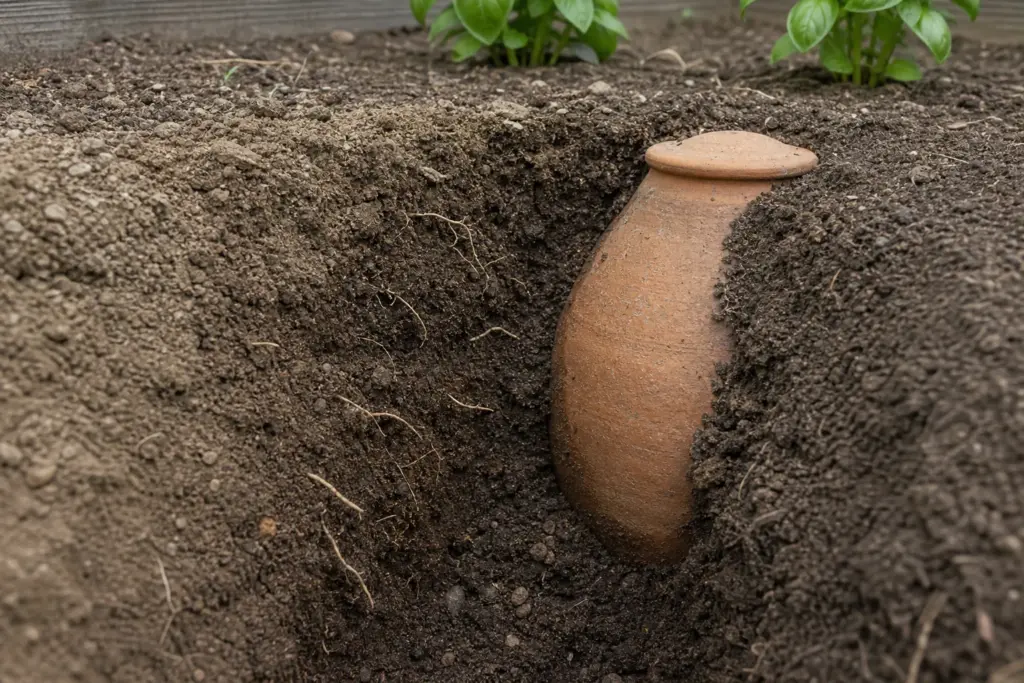
Roots often proliferate where water is reliably available, and University of Arizona photographs show roots encircling an excavated olla.1 Frequent shallow watering can concentrate active roots near the surface, although rooting depth still depends on species, soil, oxygen, and irrigation history.7 New transplants need ordinary surface watering until roots establish near the vessel; Extension guidance warns that this can take several weeks.31
What to plant around one
Fruiting vegetables with spreading root systems—tomatoes, peppers, squash, melons, and cucumbers—are common candidates when the vessel is sized and placed well.5 Herbs and leafy vegetables can work too, but a deep, round olla may put much of its moist zone below shallow roots. Match the vessel shape to the crop instead of assuming one pot suits every planting.
Ollas are not sufficient by themselves for seeds that need consistent moisture near the surface. If you sow carrots, lettuce, cilantro, or flowers directly into the bed, water the seedbed conventionally through germination and early establishment. The olla becomes useful later, once roots begin exploring its zone.5
Mulch still earns its place. A moderate layer shades the soil and reduces surface evaporation, but keep loose material out of the fill opening and leave the neck visible. The olla is one part of irrigation management, alongside suitable soil structure, drainage, crop spacing, and direct observation.
Care, cleaning, and seasonal caution
Cover the opening and check the level frequently at first. Refill intervals can range from every other day to a week or more because soil, weather, vessel capacity, and plant density vary.5 A lid also prevents leaves from falling in and blocks mosquitoes from reaching standing water.
Dissolved minerals can accumulate in and on porous clay. If flow slows or you notice the white crust that can form on terracotta, lift the olla at the end of the season, let it dry, and brush soil, roots, and loose deposits away. Follow the maker’s cleaning instructions for a commercial vessel. Do not pour household cleaners or acid into an installed olla beside active roots.
In climates with hard freezes, remove the vessel before winter if water could remain in it. Wet porous clay can crack as water freezes and expands. Empty it, dry it thoroughly, and store it under cover; both Native Seeds/SEARCH and Colorado State Extension recommend lifting ollas in freezing regions.35
A small tool, not a universal result
Field evidence can show what buried clay pots do under defined conditions, not what every backyard olla will save. In a 2023 cabbage trial in Rwanda, a buried-clay-pot treatment used less irrigation water and produced greater water productivity than that study’s drip treatment.6 The result belongs to its crop, soil, pot design, climate, and irrigation schedule; it is not a percentage to promise in another garden.
A two-year experiment at the Indian Institute of Technology Delhi likewise found that flow from buried clay pitchers varied with hydraulic head, atmospheric moisture deficit, and soil-water tension.2 A backyard olla is a modest application of that physics. Its best lesson may be practical: check the root zone instead of watering only because the surface looks dry.
Useful olla supplies
- The Olla Company Classic watering pot (affiliate link): a purpose-made buried clay reservoir with a lid; check its capacity and stated coverage against the bed before buying.
- XLUX soil moisture meter (affiliate link): useful for relative spot checks at several distances from the olla, interpreted alongside soil feel rather than as a laboratory reading.
Final thoughts
An olla disappears into the bed, leaves only a small clay neck at the surface, and lets water move through a porous wall in response to changing conditions around it. The device is simple. The soil-plant system it joins is not.
Try one where the experiment is easy to observe: a tomato and basil corner, a large container, or a raised bed that dries quickly. Fill it, cover it, water new roots from the surface, and map the damp zone before trusting it. Good irrigation is not always about adding more water. Often, it is about learning where the water actually goes.
References
- University of Arizona Cooperative Extension: Irrigating with Ollas
- Journal of Scientific and Industrial Research: Buried Clay Pot Irrigation for Efficient and Controlled Water Delivery
- Colorado State University Extension, Pueblo County: Olla Pots, an Ancient Irrigation Technique
- Agricultural Water Management: Measured and Simulated Soil Wetting Patterns under Porous Clay Pipe Sub-Surface Irrigation
- Native Seeds/SEARCH: How to Use Olla Irrigation
- African Journal of Food, Agriculture, Nutrition and Development: Water Saving and Water Productivity under Buried Clay Pot and Drip Irrigation Systems for Cabbage in Rwanda
- Oregon State University Extension: Growing Your Own—A Practical Guide to Gardening in Oregon