
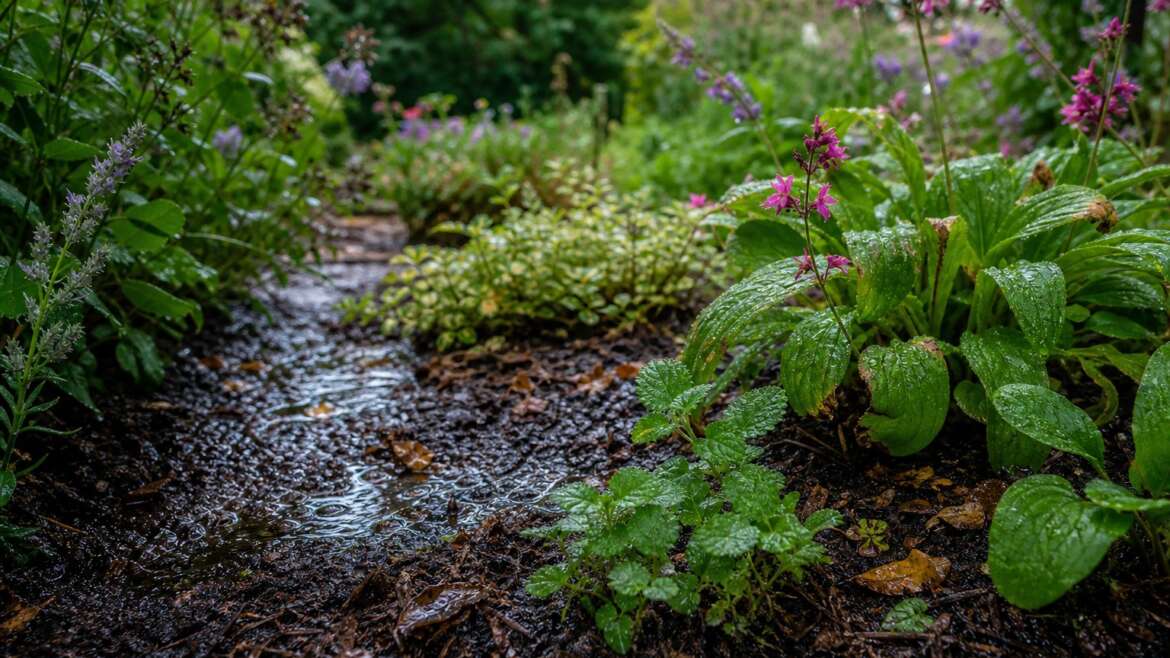
The first rain after a dry spell changes a garden before the soil is visibly wet. A smell rises from the path, the mulched beds, the cracks between paving stones, and the dark places under shrubs. It is clean and earthy at once, familiar enough to feel emotional, but not vague at all. The garden is releasing chemistry.
Gardeners often treat that scent as weather poetry, and it is. But it can also prompt useful questions about the soil surface, microbial volatiles, mulch, and drainage. Smell alone cannot tell you whether a bed is healthy or waterlogged; paired with what you see and feel, it becomes one more way of reading the garden.
The first rain has a name
The word most often used for the smell of rain on dry ground is petrichor. Isabel Joy Bear and Richard Thomas introduced the term while studying what was then called argillaceous odour, the smell associated with dry clays, soils, and weathered mineral surfaces after wetting.1 CSIRO, where the researchers worked, describes how they recovered a yellowish oil from rocks exposed to warm, dry conditions and found that moisture released it from rock and soil surfaces.2
That old research matters because the smell of a wet garden is not one thing. It is a small chorus. Mineral surfaces, plant residues and oils, microbial volatiles, and water can all contribute. During a dry period, compounds can accumulate on exposed surfaces. When moisture returns, some of what the garden has been holding moves into the air.
This helps explain why the first summer shower after a dry spell can smell more dramatic than another day of steady drizzle. The contrast matters: dry surfaces have had time to collect material, then new moisture releases it. The effect varies with the surface and the rain, but the familiar sequence is real.
The molecule that smells like earth
If petrichor is the whole atmosphere, geosmin is one of its most recognizable notes. Geosmin is one compound behind the deep earthy odour of damp soil. In the garden, much of that story leads to soil bacteria, especially Streptomyces.
A 2020 study in Nature Microbiology found that Streptomyces bacteria emit geosmin and 2-methylisoborneol as their colonies sporulate, and that both compounds attract springtails. The springtails graze on the colonies and disperse spores on their bodies and in faecal pellets.3 In other words, an earthy odour can be part of a tiny ecological exchange between microbes and soil animals.
That is a good Soil Sages kind of fact: ordinary, beautiful, and slightly humbling. A gardener kneels to pull a weed, notices the smell of clean damp soil, and catches a trace of chemistry that also matters to a soil animal. The scent does not prove that every soil process is working well, but it is a reminder that soil is habitat, not an inert rooting medium.
Our noses are unusually good at noticing geosmin. The John Innes Centre, summarizing the same springtail research, notes that humans can detect geosmin at extremely low concentrations, around one hundred parts per trillion.4 That sensitivity is why a small shower can seem to perfume an entire path.
How a raindrop carries scent
The smell does not simply float out of the soil like steam from a kettle. Raindrops help launch it. Researchers studying droplets hitting porous surfaces found that raindrop impact can trap tiny air bubbles. Those bubbles rise through the drop and burst, releasing fine aerosols that can carry material from the surface into the air.5
The laboratory results also put useful limits around a familiar observation. The researchers produced aerosols under conditions comparable to light and moderate rain on clay and sandy-clay surfaces, but not on sand or under the tested heavy-rain conditions.5 That does not mean every gentle shower will smell stronger than every downpour, but it shows why drop speed and the surface beneath it matter.
A leaf-mulched path, a gravel path, and a bare vegetable bed present different materials to the rain, so it is reasonable that they do not smell alike. But the nose is not measuring soil texture or infiltration. To read structure, pair scent with evidence you can see: whether water pools or runs off, whether the surface has capped, and whether a handful of soil breaks into stable crumbs.
What an earthy smell can tell you
A clean earthy smell can be reassuring, but it should not be romanticized into a soil test. It does not tell you the pH, nitrogen level, organic matter percentage, or whether your tomatoes need calcium. It tells you, more modestly, that detectable volatile compounds were released as the surface became damp.
Smell is most useful as a prompt to inspect. Iowa State University Extension explains that wood mulch stored in overly large or saturated piles can turn sour under low-oxygen conditions and develop a strong vinegar or silage odour.6 That is a specific storage problem, not a diagnosis for every smelly bed. In a planted bed, a persistent sulfurous or swampy odour should send you looking for prolonged saturation, blocked drainage, buried fresh material, or an overdeep, matted mulch layer.
Containers make this especially clear. An earthy smell after watering may be normal; a swampy odour plus a mix that remains saturated for days deserves a closer look unless the plant is adapted to boggy conditions. Make sure existing drainage holes are open, check moisture below the surface, use a mix suited to the plant, and adjust watering to light, temperature, container size, and season. Roots need both water and oxygen, but smell is the warning to investigate rather than the diagnosis itself.7
Building soil that smells alive
You cannot manufacture petrichor by pouring fragrance onto a garden, and you should not try. The better approach is to build the kind of surface that receives rain well: covered, porous, biologically active, and not compacted into a crust.
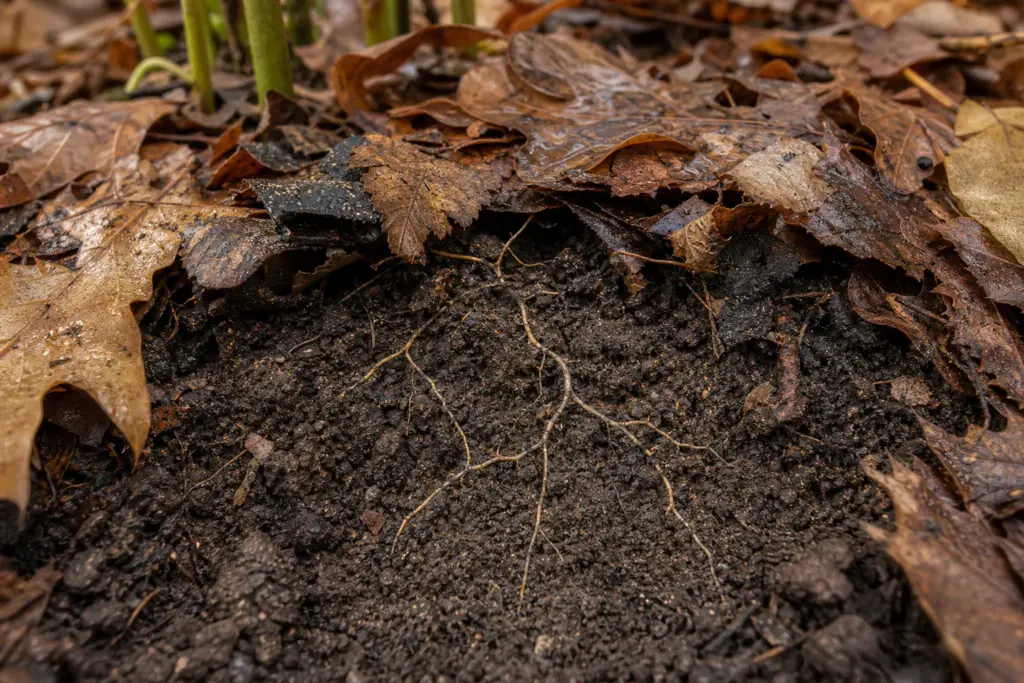
Organic matter is central. Oregon State University Extension explains that as fresh organic materials decompose, sticky substances produced by soil organisms help bind soil particles together and improve structure.7 Structure is not glamorous, but it is one reason water can enter the soil instead of skating across it, and why some pores refill with air after rain.
Mulch helps from above. Oregon State University Extension notes that organic mulch protects soil structure from compaction, promotes infiltration, and can stimulate microbial activity as it increases soil moisture.8 In practical terms, mulch turns the soil surface into a quieter place. Raindrops hit leaves, straw, bark, or compost first, reducing direct impact, crusting, and splash.
The best mulch for this purpose is not a decorative cap that never changes. It is a slowly weathering layer that joins the soil over time. Shredded leaves, composted bark, fine wood chips, straw around vegetables, and leaf mold in shade all have different scents after rain. Each one creates a different little weather system at ground level.
Designing for the rain-scent moment
Some of the most memorable garden experiences happen at the edge of weather. You can design for that without turning the garden into a theme. Think about where you stand when rain begins or ends: a back step, a porch, a narrow path beside herbs, a bench under a tree, the gate you pass through after work.
Place scent-rich, rain-responsive materials near those pauses. A path mulched with shredded leaves beneath shrubs will smell different after rain than bare concrete. A thyme edge, a rosemary pot, or a patch of mint near a door can release plant oils when brushed while the air is damp. A compost-rich vegetable bed near a path gives you that dark, living soil smell just when you are likely to lean in and check it.
There is a balance to keep. The goal is not to trap water everywhere; it is to manage it for the soil, slope, plants, and rainfall. A rain garden is a shallow basin designed to receive runoff and drain, while a swale can slow or convey water along a contour. Mulched beds and permeable paths do different work again. None should leave ordinary garden roots saturated indefinitely unless the planting is chosen for that condition.
If you water by hand during dry weather, you can borrow the same principle. A hard jet from a hose pounds the surface and often runs away before it sinks. A rose on a watering can or a gentle rain wand gives water time to land softly. Water the soil, pause, then water again. If the first pass still beads or runs off, this guide to helping resistant soil take up water again explains how to distinguish a dry water-repellent surface from crusting and compaction.
A small way to listen after rain
After the next dry spell breaks, walk the garden slowly before you do any work. Smell the open path, then the mulched bed, then a container, then the shaded soil under a shrub. Notice where the scent is cleanest and where it is flat, sour, or absent. Look down while you do it. Is the soil capped and shiny? Are earthworm castings visible? Is mulch matted into a wet blanket, or loose enough for air?
This is not a mystical exercise. It is practical observation with one more sense included. Gardeners already read leaf color, stem angle, bud timing, insect damage, and soil moisture by touch. Smell belongs in the same toolkit. It will not replace a soil test or a moisture check, but it can send you toward the right question.
The loveliest thing about petrichor is that it makes careful gardening feel less separate from wonder. The scent that pulls you to the doorway after rain is made from surfaces, microbes, plant residues, water, and air. It is science, but it still feels like the garden taking a breath.
Useful rain-reading supplies
- AcuRite 5-inch magnifying rain gauge: a simple way to compare what the garden received with how wet the soil actually feels afterward.
- XLUX soil moisture meter: useful for checking containers and deeper potting mix when the surface looks dry but the lower root zone may still be wet.
- Dramm One Touch rain wand: a gentle shower pattern helps water soak in without blasting mulch, seedlings, or loose soil.
- Luster Leaf Rapitest soil test kit: a basic at-home check for pH and major nutrients when a bed needs more than a smell-and-touch diagnosis.
Final thoughts
The smell after rain is not just atmosphere. It is the garden making contact with water in a way our bodies can notice. Dry surfaces release stored compounds. Soil bacteria add their own earthy signature. Raindrops lift scent into the air. Mulch, leaf litter, and crumbly soil shape the whole event.
So enjoy the moment, then let it prompt observation. A clean earthy smell tells you that rain has released compounds your nose can detect; drainage, surface structure, and plant response tell you what the bed is doing with the water. A persistent sour or sulfurous odour is a reason to investigate, not a diagnosis by itself. The garden is always giving information. Sometimes it does it with flowers. Sometimes it does it with the scent of wet earth rising from the path.
References
- Nature: Nature of Argillaceous Odour
- CSIRO: The smell of rain, how our scientists invented a new word
- Nature Microbiology: Developmentally regulated volatiles geosmin and 2-methylisoborneol attract a soil arthropod to Streptomyces bacteria promoting spore dispersal
- John Innes Centre: Research unearths the science behind the smell of spring
- Nature Communications: Aerosol generation by raindrop impact on soil
- Iowa State University Extension: Using mulch in the garden
- Oregon State University Extension: Improving garden soils with organic matter
- Oregon State University Extension: Mulching woody ornamentals with organic materials