
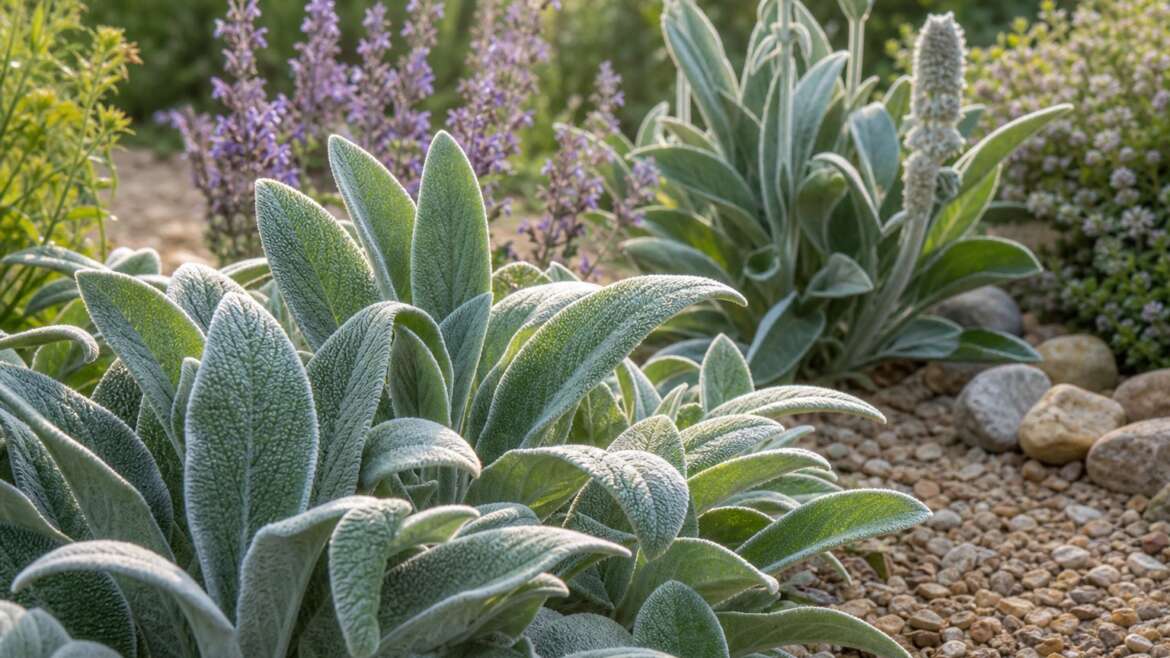
Brush your fingers across lamb’s ear on an August morning and the leaf seems almost animal. It is cool, pale, and impossibly soft, like the plant has grown its own weatherproof coat. That softness is not a decorative accident. It is architecture.
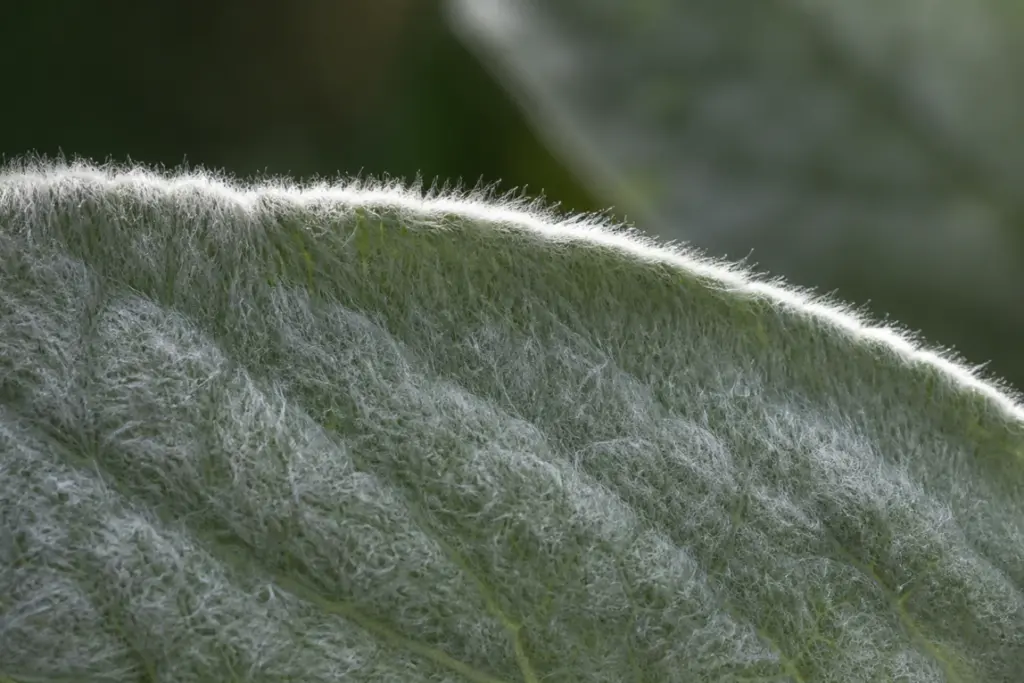
The velvet on a leaf is made of trichomes: tiny outgrowths from the plant’s surface. Some are simple hairs. Some are branched, star-shaped, hooked, sticky, or glandular. In different species, trichomes can scatter light, change how water sits on the surface, or complicate an insect’s route to the leaf. A fuzzy leaf is a clue, not a verdict: the same surface texture has evolved for different jobs, and fuzzy plants do not all share one habitat or care recipe.
Silver foliage is often treated as a color choice, something to cool down hot flowers or brighten a path at dusk. It can do that beautifully. But the silver is also a working surface, one of the most visible ways a plant negotiates with a difficult day.
A leaf wearing a little weather
A smooth leaf presents its epidermis directly to sun, rain, and moving air. A fuzzy leaf complicates that contact. Trichomes can create a rougher surface, scatter light before it reaches the green tissue below, and change how droplets spread or linger. In a review of leaf trichomes, plant ecophysiologist Christopher Bickford describes effects on radiation absorption, heat balance, photon interception, and gas exchange. He also found little support for a strong, general trichome effect on boundary-layer resistance and transpiration—a useful reminder that the mechanism depends on the species, the kind of hair, and which side of the leaf bears it.1
That is a lot of work for something a gardener may describe simply as “fuzzy.” On a hot, bright site, dense pale hairs can act like a soft screen. They do not replace water, roots, or suitable soil, but they can reduce the energy load on a leaf. The plant is not trying to be silver for our border plan. It is altering the small climate around its own skin.
Many familiar dry-border examples fit this pattern: lamb’s ear, mullein, silver sage, horehound, artemisia, lavender cotton, and the grayest forms of culinary sage. They are not identical in their needs, but this particular group often points toward sun, drainage, and restraint with irrigation. The texture alone, however, is not permission to treat an unidentified plant as drought-proof.
Silver is a kind of shade
The most intuitive job of pale leaf hairs is reflection. In the desert shrub Encelia farinosa, classic work by John Ehleringer and Harold Mooney found that leaf hairs reduced absorbed radiation, lowered leaf temperatures, and lowered transpiration rates compared with less pubescent leaves.2 The lesson for the garden is not that every silver plant is a desert plant, but that whiteness and woolliness can be part of a heat strategy.
In a two-month greenhouse experiment on Shepherdia ×utahensis, plants grown with less available water developed denser trichomes and more reflective leaves. The researchers connected those changes with leaf-temperature regulation, but the stressed plants also grew less and produced more visibly wilted foliage.3 That is acclimation observed in one hybrid under controlled conditions, not a recipe for withholding water from a garden shrub.
There is a tradeoff hidden here. A leaf that reflects more light may protect itself from overheating, but it may also intercept less light for photosynthesis. Plants are always balancing accounts. Silver foliage is not a magical drought shield. It is one entry in a larger ledger that includes root depth, leaf size, stomata, soil moisture, wind exposure, and the plant’s native rhythm of growth and rest.
The velvet can also be a border guard
Tomato stems provide a different kind of fuzz. Cultivated tomato bears several glandular and non-glandular trichome types, and type VI glands are a major site of terpene production. In a study comparing ordinary plants with a hairless mutant, distorted trichomes and changes in surface chemistry were associated with weaker resistance to Manduca sexta caterpillars.4 The resinous scent left on your hands after tying a tomato row is therefore part of a chemically active surface, though the trichome mix and chemistry vary among tomatoes.
Some plant hairs are mechanical obstacles. Some are chemical workshops. Some are both. A hairy surface can interfere with feeding or movement by certain small herbivores, while glands can store compounds involved in defense. The effect depends on the plant, the trichome, and the insect; fuzzy foliage is not pest-proof.4
For gardeners, that means texture is more than a visual layer. A planting that mixes smooth, glossy, waxy, aromatic, and woolly leaves creates different surfaces for sun, rain, and insects to encounter. It also creates a richer border for the human eye. A silver leaf beside a dark green leaf makes both more legible.
Where fuzzy leaves belong
For lamb’s ear, an easy starting place is the front edge of a sunny border where the soil drains quickly. It can soften a path, while silver sage can anchor a dry corner for a season or two. Around herbs, gray foliage is especially effective because it echoes the Mediterranean character of rosemary, thyme, sage, oregano, and lavender—but each plant still needs to be matched to the site’s climate, winter wet, soil, and mature spread.
The best companions are often plants with contrasting leaves rather than simply contrasting flowers. Pair woolly lamb’s ear with the narrow green needles of rosemary where both are hardy and the drainage suits them. Put silver sage near the round leaves of calendula or the deep purple of basil. Let an artemisia suited to your region thread between upright grasses. The pale layer also stays legible after saturated flower colors fade, an effect that can anchor a garden designed for dusk.
Missouri Botanical Garden describes lamb’s ear as a plant for dry to medium, well-drained soil in full sun, with light afternoon shade useful in hot-summer climates. It notes the plant’s drought tolerance as well as its vulnerability to rot and leaf spots where moisture lingers on the woolly foliage.5 Treat that as a lamb’s-ear prescription, not a universal rule for every hairy leaf.
When velvet becomes trouble
On lamb’s ear, the same dense hairs that catch light can also hold moisture after rain or overhead irrigation. In a humid garden, that can turn a strength into a weakness. A woolly leaf that dries quickly in a breezy gravel bed may rot in still shade beside a wall. The plant has not changed its mind. The site has changed the meaning of its surface.
University of Wisconsin Horticulture gives similar advice for ‘Cotton Boll’ lamb’s ear: too much shade slows drying, moist foliage can become susceptible to rot and leaf spots, and excessive moisture may cause crown meltout.6 This helps explain why lamb’s ear can look magnificent in May and tired by late summer if the bed is rich, crowded, or frequently watered from above.
Good culture is simple but not casual. Plant lamb’s ear where air can move. Keep mulch from packing tightly into the crown. Water the soil rather than routinely wetting the leaves, especially in the evening. Remove collapsed leaves before they become a damp mat. If a patch opens in the center, lift healthy rooted pieces from the edges and replant them into freer-draining ground. Rich soil can also encourage aggressive spread, so do not fertilize by habit; feed only when the plant or a soil test gives you a reason.5
A small summer experiment
Choose a bright morning and compare three living leaves in the garden: one woolly, one glossy, and one thin and matte. A fingertip is not a thermometer, so do not treat a difference in touch as proof of leaf temperature. Instead, tilt each leaf toward the sun and watch how its surface handles glare. Then look underneath, where trichomes may be denser or differently shaped. Compare plants without detaching or damaging the leaves.
A hand lens turns this into a miniature forest. Lamb’s ear looks like a tangle of pale fibers. Tomato stems look bristly and glandular. Sage leaves show a softer gray nap. Mullein can look almost frosted. Once you see these surfaces closely, the garden becomes less flat. Every leaf has a weather report written on it.
There is also a wildlife footnote worth noticing. UF/IFAS describes female European wool carder bees scraping trichomes from lamb’s ear and other fuzzy plants, gathering the fibers into a ball, and using them to line a brood cell.7 The same source notes that Anthidium manicatum is native to Europe, western Asia, and northern Africa but has been introduced widely, and that males defend flower patches. It is an intriguing behavior to observe, not a reason to treat this introduced bee as a local conservation target.
Useful fuzzy-leaf supplies
A few simple tools make it easier to study and care for woolly foliage without overcomplicating the bed.
- Carson MicroBrite Plus pocket microscope for seeing trichomes, glands, and leaf texture up close.
- Fiskars micro-tip pruning scissors for removing tired lamb’s ear leaves or small flower stems cleanly.
- Gilmour flat soaker hose for watering the soil beneath fuzzy-leaved plants while keeping foliage drier.
Reading the leaf before choosing the place
A garden becomes more forgiving when you learn to read surfaces. Thick, glossy leaves tell one story. Fine, ferny leaves tell another. Fuzzy silver leaves deserve particular attention because their beauty is also their biology. For lamb’s ear and many familiar dry-border silver plants, the surface can point toward sun, drainage, moving air, and careful irrigation. For another species, read the label, its habitat, and local growing guidance before reading the texture alone.
Plant each species where its small weather makes sense. Let silver leaves catch the low light along a path. Let them cool the look of a hot planting without hiding it. Let children and curious adults touch a leaf and ask why it feels the way it does. The answer is not just texture. It is adaptation made visible.
References
- Christopher P. Bickford: Ecophysiology of leaf trichomes
- John R. Ehleringer and Harold A. Mooney: Leaf hairs, effects on physiological activity and adaptive value to a desert shrub
- Frontiers in Plant Science: Effects of water availability on leaf trichome density and plant growth and development of Shepherdia ×utahensis
- Journal of Experimental Botany: Distortion of trichome morphology by the hairless mutation of tomato affects leaf surface chemistry
- Missouri Botanical Garden Plant Finder: Stachys byzantina
- University of Wisconsin Horticulture: Lamb’s ear, Stachys byzantina, ‘Cotton Boll’
- UF/IFAS: European wool carder bee, Anthidium manicatum