
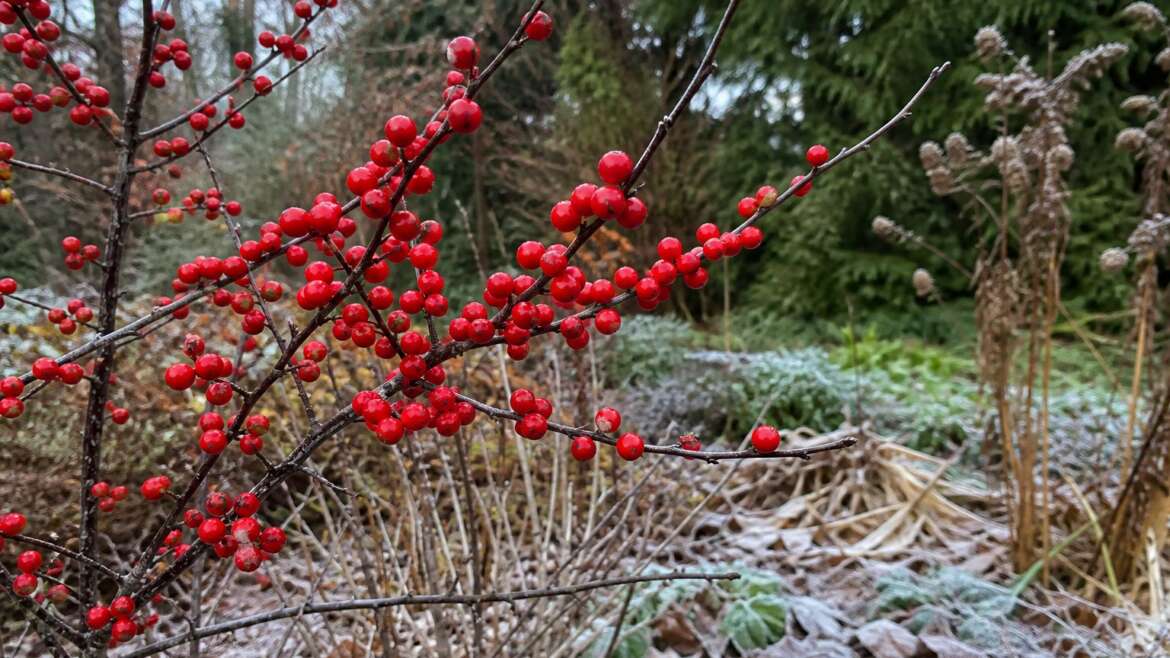
By early December, most shrubs have stopped trying to impress anyone. Their leaves have dropped, their flowers are old news, and their summer shape has been reduced to twigs. Then winterberry comes into view as if the garden has been saving a secret. The leaves fall away, and the stems are left strung with red fruit.
It is a strange kind of brilliance because almost nothing is added. The show begins with subtraction. Green leaves that hid the fruit all summer are gone. The background turns brown, gray, straw, and evergreen-dark. Against that quieter world, winterberry’s berries look sharper than they ever did in August.
Winterberry holly, Ilex verticillata, is a holly that does something many people do not expect from hollies: it drops its leaves. That deciduous habit is not a flaw in the plant’s winter display. It is the reason the display works. The shrub becomes mostly line and color, a loose drawing of dark stems with red beads held at the nodes.
A holly without winter leaves
The North Carolina Extension Gardener Plant Toolbox describes winterberry holly as a slow-growing, woody, deciduous shrub or small tree native to eastern North America, with red berries that mature in fall and provide winter interest as well as food for birds and small mammals.1 That single description explains much of its appeal. Winterberry is not trying to behave like English holly, with glossy evergreen leaves and prickled edges. It has its own winter strategy.
In summer, winterberry can be pleasant but easy to overlook. The leaves are green and ordinary from a distance. The flowers are small, pale, and not theatrical. The plant earns its place quietly, especially in wetter corners where many more glamorous shrubs sulk. Then, after the leaves fall, the fruit becomes the whole sentence.
The effect is strongest when the plant is allowed to be a shrub, not clipped into an anxious shape. Winterberry wants a little room for its upright, spreading stems. It looks best where winter light can pass through it, where the berries can be seen against snow, pale grasses, dark conifers, stone, or the muted brown of a sleeping border.
The berries were decided in spring
A heavy crop of winter berries is not made in December. It is made months earlier, in the brief, easily missed period when winterberry flowers are open and insects are moving pollen. This is where the plant surprises gardeners who buy one beautiful berried shrub in winter, plant it, and then wonder why future years look bare.
Winterberry is dioecious, meaning male and female flowers are carried on separate plants. University of Maryland Extension notes that only female plants produce berries, and they need pollen from a male plant of the same species. Bloom timing matters too: early-blooming female cultivars need an early male nearby, while late-blooming females need a late male.2
That is the practical key. A female winterberry can be healthy, well-watered, and beautifully placed, but without compatible pollen it will not set a proper crop. The male plant does not need to be the star of the border. It can be tucked into a less visible spot, as long as it blooms at the right time and grows close enough for pollinators to do the work.
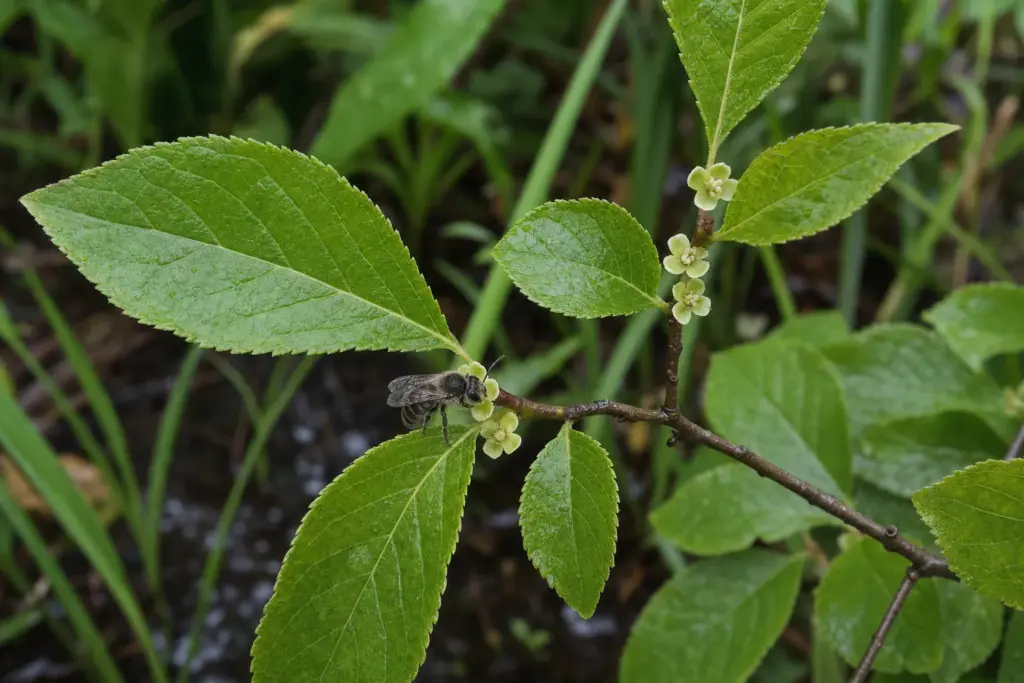
This makes winterberry a useful reminder that ornamental effects often depend on invisible timing. December color may depend on June flowers. The winter border may depend on a modest male shrub most visitors never notice. Gardens are full of these backstage arrangements.
Why birds do not always eat them at once
Winterberry’s fruit looks urgent to us because red is loud in a bare garden. Birds read it differently. Some shrubs are stripped early. Some hold fruit for weeks. Winterberry often keeps its berries long enough to become part of the winter architecture, then loses them suddenly when robins, cedar waxwings, bluebirds, mockingbirds, or other fruit-eating birds move through.
University of Maine Cooperative Extension notes that winterberry berries are eaten by 49 species of birds and are often taken late in winter because they are relatively low in fat compared with some other fruits.3 That is one reason the shrub can look ornamental for so long. The fruit is valuable, but not always the first choice while richer foods remain available.
For the gardener, this delay extends the display through weeks when flowers are absent and seedheads are weathering down. For wildlife, fruit that persists can become useful later, after some other foods have been eaten, buried, spoiled, or covered. The timing varies from plant to plant and winter to winter, so treat the berries as one part of a diverse food garden rather than a guaranteed reserve.
NC State Extension reports that winterberry fruit is eaten by more than 48 bird species, including cedar waxwings, and also by small mammals.1 That is the better way to think about it in a garden plan. A single shrub can be useful, but a layered winter habitat can offer fruit alongside persistent seedheads, locally appropriate evergreen cover, and clean water where practical. Choose the other plants for the site and region rather than treating any one wildlife-garden list as universal.
The best place for winterberry
Winterberry is especially useful in places that are seasonally moist. University of Maine describes it as a good choice for sites that flood in spring and become dry in summer once the plant is established, and lists wet-soil tolerance among its strengths.3 That makes it a natural candidate for rain gardens, pond edges, swales, low borders, and the back of mixed plantings where soil does not stay evenly polite.
University of Maine lists sun or part shade, while NC State warns that dry soil may abort fruit set and that neutral to alkaline soils can cause chlorosis or even plant death.13 Moist, acidic soil is the safer baseline. If leaves become chlorotic, growth is thin, or berries are sparse despite compatible pollination, check soil moisture and pH as well as bloom timing.
Placement is as much design as culture. Put a female winterberry where you will see it from a window, path, driveway, or winter seating spot. Give it a dark or quiet background. Let late grasses, sedges, or evergreen shrubs make a frame. The berries do not need elaborate companions, but they do benefit from contrast.
A note on cutting and safety
It is understandable to want a few stems indoors. A vase of winterberry branches can look like a small weather report from the garden. But if the shrub is young or the crop is light, cut sparingly. Each stem you take is also a stem birds cannot use later, and a stem that will not carry its full display outdoors.
There is also a safety line worth keeping clear. NC State Extension classifies winterberry as a low-severity poison and says ingesting the fruits or leaves may cause vomiting, diarrhea, or other illness in people; USDA NRCS also warns that the fruit is poisonous to humans.14 Treat the berries as wildlife food, not food for people. If you bring cut branches indoors, keep berries beyond the reach of young children and sweep up fallen fruit promptly. If a pet may have eaten berries or leaves, seek species-specific advice from a veterinarian or animal poison-control service rather than assuming a wildlife food is safe for household animals.
In the garden, pruning should be modest and deliberate. Winterberry’s beauty depends on the rhythm of its stems and the crop those stems carry. Heavy shaping can turn a loose winter drawing into a stiff object and may remove the very branches you were waiting all year to see.
Final thoughts
Winterberry is not subtle in December, but the reasons behind its brightness are subtle. It blooms quietly. It depends on a partner plant. It feeds insects before it feeds birds. It grows best where the soil is often damp. It waits until the garden has emptied itself of easier color, then lets the leaves fall away from the fruit.
That is why it looks brighter after the leaves are gone. The shrub has not suddenly become more colorful. The garden has become more honest. With the foliage removed, with summer distractions gone, winterberry shows the architecture of a plant that planned its red season months earlier.
In a good winter garden, color is not pasted on at the end. It is grown into the year. Winterberry proves it one red cluster at a time.