

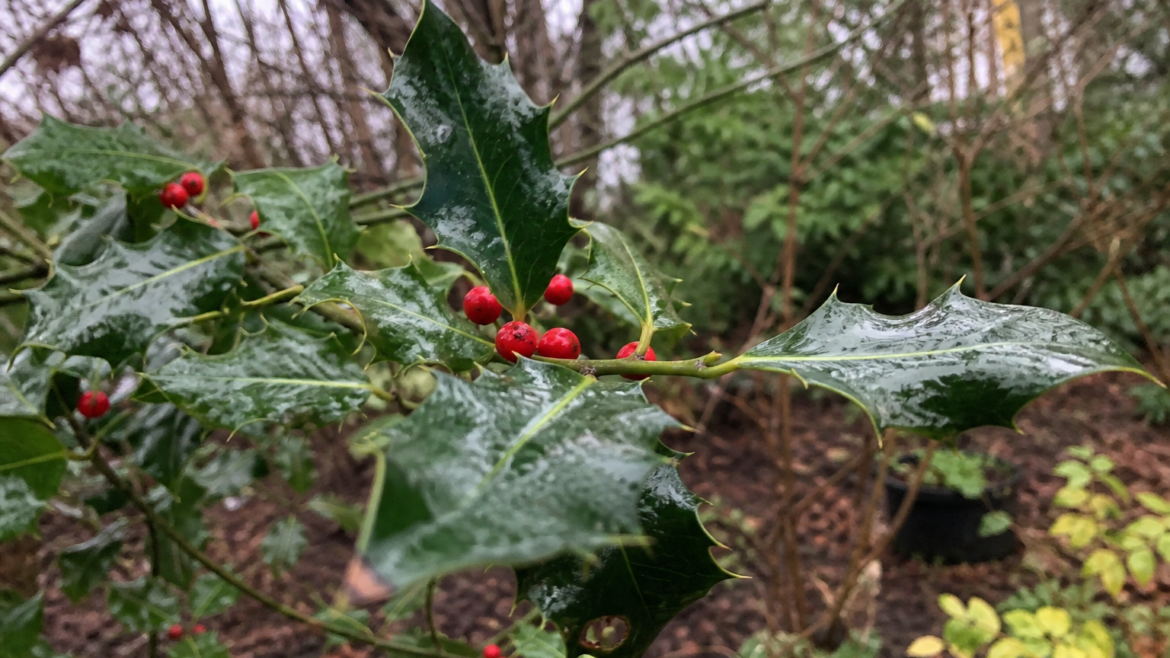
A holly branch in December seems, at first, to be one of the garden’s simplest statements. Dark glossy leaves. Red berries. A shape sharp enough to belong to winter. Then you look more closely and the certainty begins to loosen. One leaf has a dramatic ring of points. Another, only a few inches away, is almost smooth. A third looks undecided, with a few prickles near the tip and softer curves along the sides.
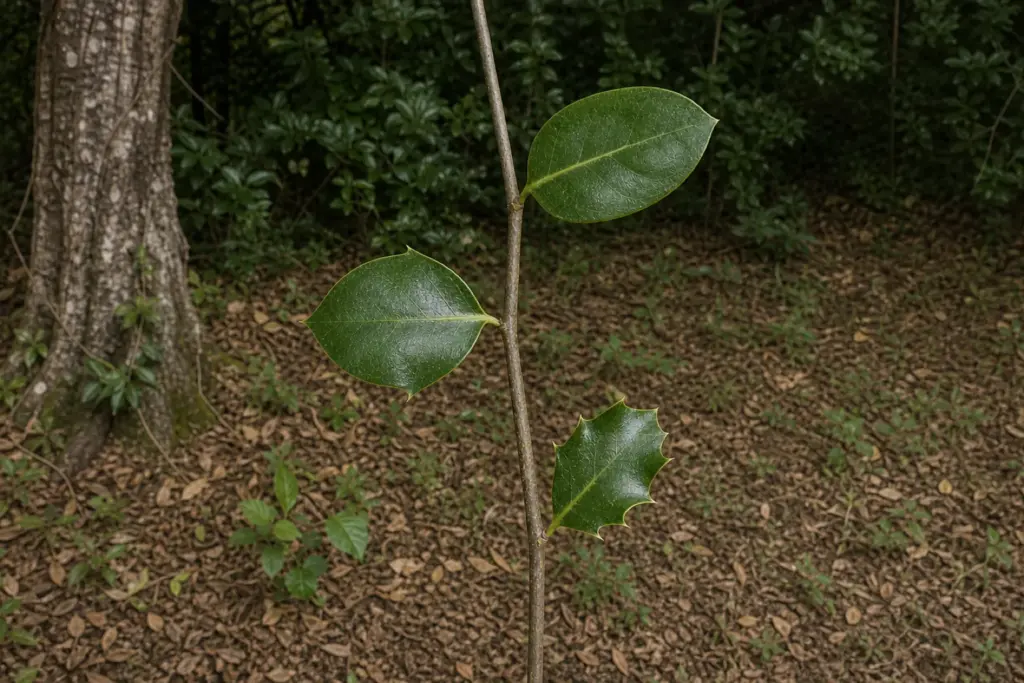
This is not the plant being careless. Holly is one of those shrubs that keeps more than one answer on the same branch. The prickles are real, but they are not equally distributed. Some hollies make leaves that vary by age, height, cultivar, species, and damage history. In European holly, the difference can even reflect where browsing animals have been reaching.
That makes the winter holly more than a decoration. Its margins can look like a record of where and how the plant has grown. The red fruits catch the eye, but the leaf edges may be telling the more interesting story.
A sharp edge is not the whole plant
Holly is not one plant but a large genus, Ilex, with hundreds of species and many garden cultivars. North Carolina Extension describes hollies as woody shrubs and trees found in temperate and tropical forests, with evergreen and deciduous members, glossy or leathery leaves, and fruits that can feed birds in fall and winter.1 Some hollies have the classic spiny leaf. Some have very small smooth leaves. Some drop their leaves entirely and keep only berries on bare stems.
The Christmas-card holly most people imagine is often English holly, Ilex aquifolium. It has thick, glossy evergreen leaves with spiny marginal teeth, small spring flowers, and red berry-like drupes on pollinated female plants.2 Even within that familiar species, though, the leaf edge is not as fixed as a symbol makes it seem.
The points on a holly leaf are leaf-margin spines. They are not thorns in the botanical sense, which are modified stems, and they are not the same as rose prickles, which arise from surface tissue. Spines are modified leaves or leaf parts; holly’s sharp points are formed by its leaf margin.3 To a hand reaching into a shrub, the distinction may not matter much. To the plant, it is one way of making a leaf a less inviting meal.
Spines are a negotiation with hungry mouths
A spiny leaf is useful if something wants to eat it. Deer, goats, livestock, and other browsers do not read plant labels. They test what is reachable, palatable, and worth the trouble. A tough evergreen leaf already asks for chewing. A prickly margin adds another cost.
The Linnean Society’s account of a European holly study reports that 39 of 40 sampled trees carried both prickly and nonprickly leaves. Across those trees, recent browsing and the proportion of prickly leaves were correlated.45 That is a strong association in one wild population in southeastern Spain, not proof that every English holly changes its margins whenever an animal takes a bite.
The practical observation is beautifully simple: lower leaves are more likely to be within reach of browsing animals. In the studied population, prickly leaves were more frequent below about 2.5 meters, roughly the reach of an adult red deer, and recently browsed trees tended to carry more prickly foliage.4 The authors’ analysis indicated that browsing, rather than height by itself, accounted for that vertical pattern.5
Once you know this, a holly hedge becomes worth reading more carefully. If the spiniest leaves cluster at browsing height and damaged shoots occur nearby, herbivores are a plausible part of the pattern. Species, cultivar, plant age, and pruning can complicate the picture, however, so leaf shape alone is an observation rather than a diagnosis.
One tree, two leaf styles
The word heterophylly means that a plant can produce different leaf forms. Gardeners see versions of it in aquatic plants with underwater and floating leaves, in ivy with juvenile and adult foliage, and in seedlings that do not yet resemble the mature plant. Holly’s version is especially satisfying because the difference is so tactile. You can feel the argument with your fingertips.
The study published in the Botanical Journal of the Linnean Society examined neighboring prickly and nonprickly leaves on heterophyllous Ilex aquifolium trees.5 Using paired leaves from five trees, the researchers compared DNA methylation profiles and found differences between the two leaf forms even though each pair came from the same plant.
That does not mean a holly decides, in any conscious way, to grow prickles. Nor did the experiment show that methylation caused the different margins. The authors described epigenetic correlates: molecular differences associated with two leaf forms, without a change to the underlying DNA sequence.5 The careful conclusion is still intriguing. A plant’s visible form can be more flexible than it looks, while the mechanism behind that flexibility remains an open question.
Why not make every leaf fierce?
If spines discourage browsers, it is tempting to tell a tidy cost-and-benefit story: armor is built where it pays and omitted where it does not. The European holly study did not test that explanation. It did not measure the carbon cost of a spiny margin, compare sun and shade leaves, or show that smooth leaves were an economical response. What it found was an association between browsing and prickly foliage, plus DNA methylation differences between paired leaf forms.5
Plant identity matters too. The genus includes hollies with smooth or nearly smooth foliage as well as strongly armed species, and English holly alone has many cultivars with different leaf characters.12 On one plant, browsing history and shoot position are contextual clues. Between two plants, species and cultivar may matter more.
So a smooth holly leaf is not a failure, and it is not evidence that the plant is unhealthy. It may belong to a less armed species or cultivar, or sit beyond the part of an English holly exposed to browsers. The important habit is not to turn one leaf into a diagnosis. Look at the whole plant: its identity, height, browsing signs, pruning history, and where the leaf sits.
The berries are a separate story
Prickly leaves and red berries often arrive together in our imagination, but they answer different questions. The leaf edge is about foliage, defense, light, and growth. The fruits are about reproduction and wildlife. Many hollies are dioecious, meaning male and female flowers are produced on separate plants. North Carolina Extension notes that both male and female hollies must be grown if fruits are desired, and that bees pollinate the flowers.1
This is why a healthy holly may never set berries. It may be male, or it may be a female without a male blooming nearby. Virginia Cooperative Extension notes that most female hollies need pollen from a nearby male flowering at the same time, while some cultivars can set fruit without one.6 The same male-and-female puzzle is especially visible in deciduous winterberry, whose berries remain after its leaves fall.
The fruits are valuable visually and ecologically, but that does not make them snacks for people or household animals. North Carolina Extension says human ingestion of holly fruits can cause vomiting and diarrhea.1 The ASPCA lists English holly as toxic to dogs, cats, and horses; its leaves and berries are described as low toxicity but can cause vomiting, diarrhea, and depression.7 If a child or pet may have eaten part of a holly, identify the plant if it is safe to do so and contact an appropriate poison service or veterinarian. Birds, by contrast, disperse many holly fruits as part of their winter feeding.
Choosing holly with context
A holly’s usefulness depends on where it is planted. English holly has history, shine, and a strong winter image, but it is not the best choice everywhere. Oregon State University Extension reports that Ilex aquifolium spreads by seed throughout the Pacific Northwest and recommends removing it from gardens and replacing it with suitable alternatives to reduce further invasion into native plant communities.8 Check current regional guidance before planting: a species can be traditional in one landscape and troublesome in another.
In much of the eastern United States, American holly, Ilex opaca, can play a similar winter role with a better local fit. North Carolina Extension describes it as a broadleaf evergreen native to the central and eastern United States, with spiny leaves, winter fruits on female plants, wildlife value, and use as a screen, hedge, barrier, or specimen where there is enough space.9
There are also hollies for smaller spaces, wet soils, hedges, and deciduous winter-berry displays. Some are spiny, some are not. Some are grown mostly for foliage, others for fruit. The right question is not simply, “Do I want holly?” It is, “Which holly belongs in this climate, this soil, this garden size, and this wildlife context?”
How to read a holly in winter
Winter is a good time to study hollies because little else is competing for attention. Stand beside the shrub and compare leaves from bottom to top. Look for clipped tips, stripped edges, hoof tracks, deer paths, or other signs of browsing. Notice whether the spiniest leaves are at browsing height. Then look higher, where the plant may be making broader or smoother leaves.
Also notice pruning. A heavily sheared hedge can blur the plant’s natural pattern by constantly forcing dense young growth. A looser holly often shows its architecture more clearly: old wood, new shoots, fruiting branches, shaded interior leaves, and sunlit outer leaves. If you cut holly for arrangements, take small amounts selectively and avoid stripping fruit that birds may use later.
The leaf edges can also help you place the plant in design. Spiny hollies make good barriers because people and animals naturally avoid pushing through them. Smooth-leaved hollies and less armed cultivars can sit closer to paths, patios, and entries without turning every maintenance task into a negotiation. The plant’s defense should be part of the design, not an afterthought discovered by your sleeves.
Final thoughts
A holly leaf is easy to flatten into a symbol: green, glossy, sharp, seasonal. The living plant is more interesting. It can make different edges on the same body, and in one studied population those edges tracked browsing activity. It can carry winter fruit only if pollination has happened. It can be a native sheltering tree, an invasive escapee, a hedge, a bird pantry, or a prickly mistake beside a narrow walkway.
Look closely at a holly this winter and the points become less decorative and more legible. A smooth leaf near a spiny one is not a contradiction. It is evidence that form can be flexible—and a reminder that one elegant pattern should not be mistaken for a universal rule.
References
- North Carolina Extension Gardener Plant Toolbox: Ilex
- North Carolina Extension Gardener Plant Toolbox: Ilex aquifolium
- North Carolina Extension Gardener Handbook: Botany
- The Linnean Society: Why is holly prickly?
- Herrera and Bazaga (2013): Epigenetic correlates of plant phenotypic plasticity in Ilex aquifolium
- Virginia Cooperative Extension: Evergreen hollies
- ASPCA Animal Poison Control: English holly
- Oregon State University Extension: Invasive species—what gardeners need to know
- North Carolina Extension Gardener Plant Toolbox: Ilex opaca