
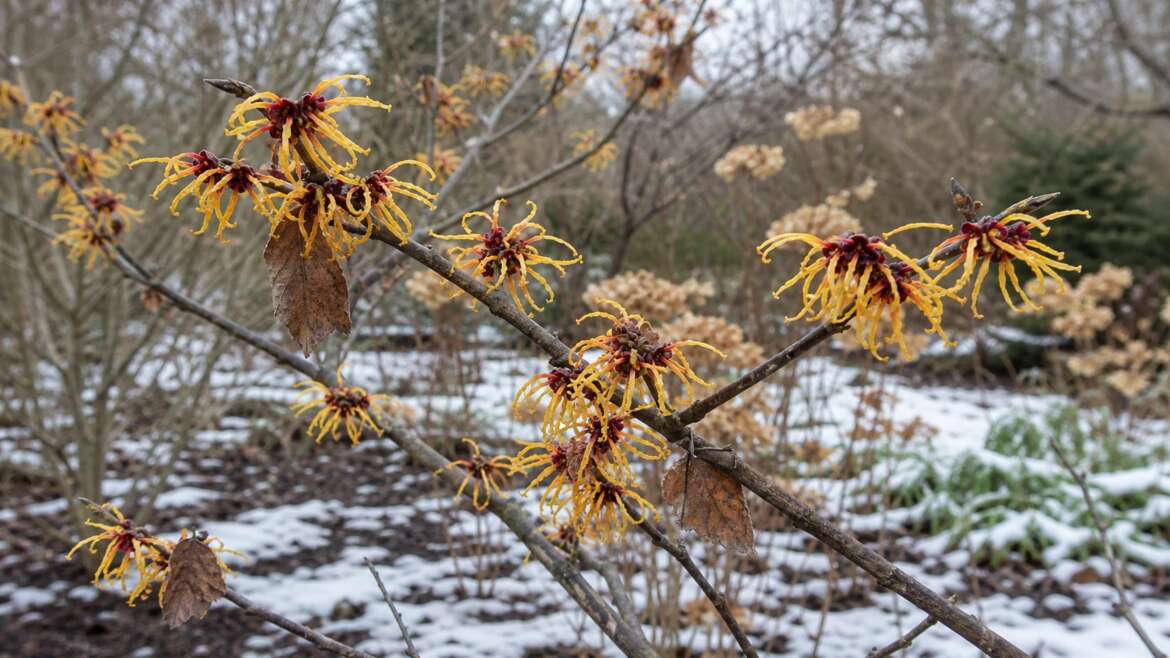
In January, a flowering shrub can feel almost unreasonable. The garden is mostly structure: bark, seed heads, mulch, stone, the green insistence of evergreens. Then witch hazel opens on bare wood. Its flowers do not arrive as soft spring cups or summer trumpets. They arrive as thin ribbons, yellow or copper or red, curling and uncurling in the cold like sparks that have learned patience.
That is what makes witch hazel so useful in a real garden. It does not pretend winter is spring. It works with winter’s own materials: low light, open branches, cold air, and the sudden importance of scent. Plant it where you can pass close on a mild day, and the shrub becomes less like a background plant and more like a seasonal event.
Witch hazel is also a good reminder that flowering is not only a spring behavior. Plants bloom when their developmental schedule, tolerance of the weather, and chances of pollination overlap. For witch hazel, that overlap can run straight through the coldest-looking part of the year.
A flower made of ribbons
The flowers are the first lesson. Instead of a broad petal, each witch hazel flower carries four narrow, strap-like petals. Iowa State University Extension notes that the petals curl on cold days and unfurl in warmer weather; the flowers are often fragrant, long-lasting, and still present when snow is on the ground.1
That movement is part of their charm. A witch hazel on a freezing morning may look shy, its petals twisted close. On a softer afternoon, the same branch can open into a loose constellation of yellow threads. The flower is not necessarily dead when it curls. It may simply be in the contracted state that cold weather brings.
Cold-season bloom is not one unbroken performance. On a freezing morning the ribbons may be wound tight; when the air warms, they extend again. The visible display tracks short weather windows rather than pretending the temperature is constant.
Not all witch hazels bloom at the same time
“Witch hazel” is not one single winter plant. The genus Hamamelis includes species and hybrids with different bloom seasons, flower colors, scents, sizes, and garden habits. The common witch hazel, Hamamelis virginiana, is usually an autumn bloomer. Iowa State places its typical flowering from mid-October to early December.1
For January and February drama, gardeners often look to Ozark witch hazel, Hamamelis vernalis, and hybrid witch hazels. North Carolina Extension describes H. vernalis as beginning in mid- to late winter and flowering from January into early March, with colors from yellow to reddish-purple.2
The hybrids are often grown for stronger garden display. Hamamelis × intermedia, a cross between Japanese and Chinese witch hazels, generally flowers from early February to late March in Iowa. Cultivars range through yellow, orange, red, and purple, although their fragrance is often milder than that of the species.1
This matters when buying. A gardener who wants the first January fragrance near a path may not want the same plant as a gardener who wants a woodland-edge shrub that glows in November. The label should say more than “witch hazel.” It should name the species or hybrid and, for a selected plant, the cultivar too.
Why bloom when the garden is cold?
Winter bloom looks risky because we judge flowers by summer rules. A rose petal is broad and held open. A witch hazel petal is narrow and able to curl. That response does not make every flower immune to every freeze, but it does let the display contract during colder weather and extend again when conditions ease.
Pollination is intermittent too. A mild spell can bring insects into the flowers; a harsher day can stop visits. Fewer neighboring flowers do not automatically make reproduction easy when potential pollinators are active only in short windows.
The best-studied case is the autumn-flowering H. virginiana, not every winter-flowering witch hazel. A reproductive study found visitors from six insect orders, with flies the most frequent and small bees carrying high proportions of witch hazel pollen; experiments made wind pollination less likely. Visits were infrequent, and the authors proposed that fall flowering may reduce competition for pollinators with H. vernalis.3 That is more useful than assigning the whole genus one tidy pollinator.
For gardeners, the larger point is that a cold-season flower is not blooming into emptiness, but neither is it operating as if the calendar said June. Witch hazel uses the milder intervals within its flowering season. Its moving petals make those intervals visible.
The scent belongs where people pass
A witch hazel flower is visually interesting from across the garden, but fragrance is the reason to place it carefully. Scent varies by species and cultivar. It may be strong and spicy or earthy, or mild enough that you need to lean close; Iowa State notes that the hybrids tend to be less fragrant than the species.1
Do not hide a fragrant witch hazel at the far back of a border unless the view is the only goal. Put it near a winter path, a gate, a greenhouse door, a kitchen window, a bench that catches low sun, or the place where you pause with compost in hand. Winter scent is most effective when it surprises you at close range.
Backlighting helps too. The thin petals look especially alive when low winter sun catches them from behind. A dark evergreen, weathered fence, brick wall, or shadowed woodland edge can make yellow flowers visible from farther away. Copper and red flowers may need a pale background, such as snow, stone, or light siding, to keep them from disappearing into winter bark.
Give it room to become itself
Witch hazels are not tiny shrubs. Many become large, graceful, vase-shaped shrubs or small trees. Iowa State notes that they are often more than 10 feet tall and wide, with plants in part shade developing a more open habit.1 They look best when allowed to make their natural branching structure rather than being clipped into a tight ball.
North Carolina Extension recommends hybrid cultivars such as ‘Arnold Promise’, ‘Ruby Glow’, and ‘Primavera’ for consistent flowering, scent, and fall color, while also pointing gardeners to H. virginiana and H. vernalis as North American species.4 “Native” still needs a location: H. vernalis, for example, is native to the Ozark Plateau rather than the entire continent.2
Most witch hazels appreciate moist, well-drained soil and sun to part shade. Full sun generally brings more flowers and a denser habit; full shade reduces growth and bloom. Avoid both poorly drained ground and sites that stay dry. The genus tolerates a wider pH range than the label “acid-loving shrub” suggests, including slightly alkaline soil in Iowa.1
Planting and care without fussing
The best time to think about witch hazel care is when planting. Container-grown plants are usually the easiest choice. Plant as early in the season as local conditions allow, then provide consistent moisture through the first couple of growing seasons. A 2- to 4-inch layer of organic mulch helps moderate soil moisture, but keep it clear of the stems.1
Pruning should be light. Remove dead or crossing branches from their point of origin rather than shearing the shrub. Iowa State recommends late winter or early spring; because flowering time differs among species, wait until your particular plant has finished its display. Remove suckers at the base, especially when a named hybrid is grafted onto common witch hazel rootstock.1
Do not overfeed. Regular fertilizer is not essential for a witch hazel growing well in suitable soil. If growth is weak or foliage suggests a problem, test the soil and investigate the site before guessing. Iowa State recommends a balanced, all-purpose fertilizer in spring only when feeding is actually needed.1
The odd pleasure of fruit and seed
The name Hamamelis is often translated as “together with fruit,” a reference to the way flowers and maturing fruit can occur on the plant at the same time. Penn State’s Arboretum notes this unusual overlap as one of the distinctive features of witch hazels.5
That detail is easy to miss if you only visit the shrub in bloom. Look again later in the year. Witch hazel can carry woody seed capsules that mature long after the flowers that made them. When ripe capsules dry, they split and scatter seed several feet from the parent plant.1 It is a shrub with a quiet winter flower and a surprisingly forceful seed story.
This is part of why witch hazel fits Soil Sages so well. It is not merely pretty at an inconvenient time. It is a plant with timing, motion, scent, delayed fruit, weather response, and a useful place in garden design. The flower is the invitation. The rest of the shrub rewards looking again.
A January way to choose one
If possible, choose witch hazel in bloom. This is one of those plants that should be bought with the nose as well as the eyes. Flower color, petal length, fragrance, and bloom time vary enough that a catalog description can only take you part of the way. Visit a nursery, arboretum, or public garden in January or February and notice which plants make you turn back.
Look at the whole plant, not only the flower close-up. Is the branching graceful? Is the color visible from ten paces? Does the scent travel, or is it only present when you lean into the branch? Is the plant blooming while the leaves are fully gone, or are old leaves holding on and hiding the flowers? Some cultivars shed their old leaves more cleanly before bloom than others.
Then imagine the plant in your own winter garden. A yellow cultivar may glow against dark yew or spruce. A copper cultivar may be perfect beside pale stone. A red cultivar may need snow or a light wall behind it. The point is not to collect a novelty. The point is to place a winter event where it will actually be experienced.
Useful witch hazel supplies
- Felco F-2 bypass pruners: one durable option for occasional selective cuts and rootstock suckers; choose pruning shears that fit your hand and the branch diameter.
- Treegator original slow-release watering bag: one way to water a newly planted tree-form specimen during dry spells where the bag fits safely; still check the root-zone soil rather than watering by a fixed calendar.
Final thoughts
Witch hazel changes the emotional weather of a winter garden. It does not make January warm. It makes January worth walking through. The shrub holds its flowers on bare stems, curls them against the cold, opens them again when the air softens, and releases fragrance when almost nothing else is asking to be smelled.
Grow it with enough room, place it where people pass, and choose the species or cultivar for the season you want. Autumn-flowering common witch hazel, late-winter Ozark witch hazel, and the showier hybrids all have their own uses. The best one is the one whose timing and mature size match your garden’s quietest gap.
A January flower is not a mistake. In witch hazel, it is a weather-responsive display and a small act of brightness on winter wood.
References
- Iowa State University Extension: All About Witch Hazels
- North Carolina Extension Gardener Plant Toolbox: Hamamelis vernalis
- American Journal of Botany: Many to flower, few to fruit—the reproductive biology of Hamamelis virginiana
- NC State Extension Gardener: Witchhazel, the Gardener’s Missing (Winter) Link
- The Arboretum at Penn State: Witch Hazels—Flowering Shrubs with Year-Round Interest