
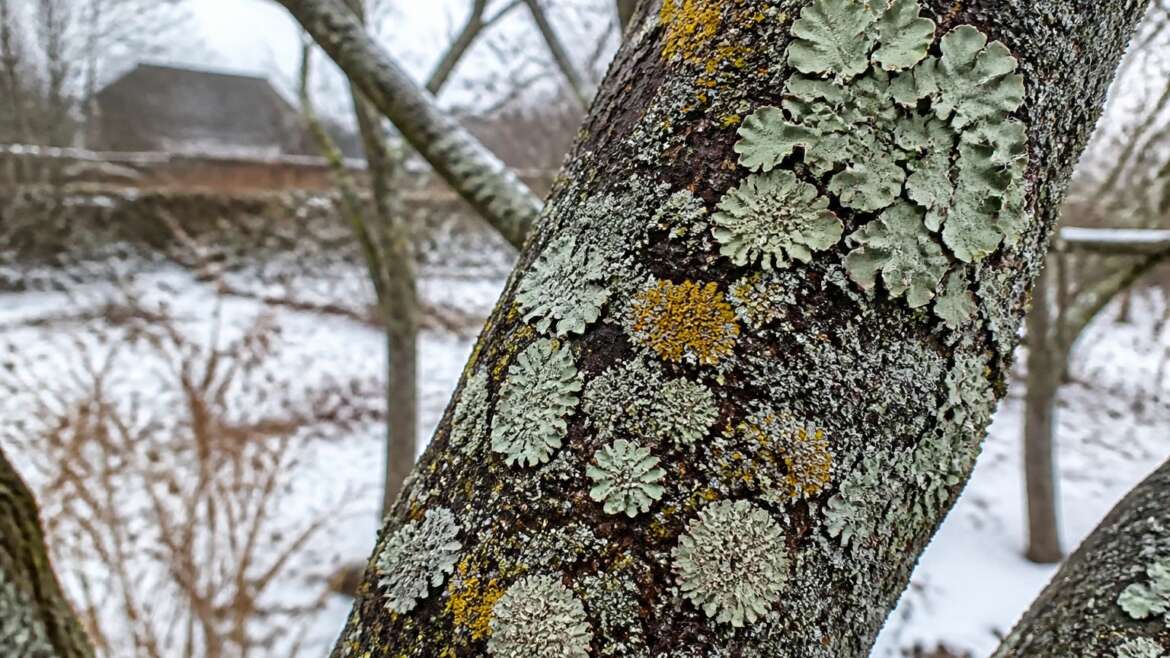
January makes tree bark readable. The leaves are gone, the herbaceous border has collapsed into stems and seed heads, and the garden has stopped distracting us with flowers. What remains is quieter but not empty: twigs, buds, bark plates, old pruning cuts, and pale islands of green, gray, yellow, and blue-green spreading across trunks like weather maps.
Those patches are often lichens. Gardeners sometimes notice them suddenly in winter and assume they have arrived all at once, or that they are a sign of decay. In truth, lichens are usually slow, patient residents. They have been there through the louder months, working at a scale that asks you to come closer.
A lichen on a tree is not a flower, not a moss, not a stain, and not a simple fungus. It is one of the garden’s most elegant collaborations, living on the surface of bark without asking the tree for food. Once you learn to see it clearly, an old apple trunk or a shaded fence rail becomes less like a blank support and more like a miniature landscape.
A lichen is a partnership
The USDA Forest Service describes the core lichen partnership as a fungus plus a photosynthetic partner: a green alga, a cyanobacterium, or sometimes both.1 The fungus gives the lichen much of its body shape and structure. The photosynthetic partner makes carbohydrates from light. Together they can live on bark, stone, soil, old wood, roof tiles, fence posts, and places that would be too exposed or nutrient-poor for many ordinary plants.
That two-part description is a useful starting model, not a complete census. Modern lichen research treats the thallus as a small ecosystem that can also include bacteria, yeasts, and other microscopic partners.7
That partnership is why lichens are so easily misunderstood. They look plant-like, but they are not plants. They may grow on trees, but they are not roots. They may include a fungus, but they are not behaving like a wood-decay fungus that eats its way through living tissue. A lichen is a surface dweller, a small living skin that has learned to make a life from light, air, rain, mineral dust, and time.
This also explains their patience. A patch of lichen is not racing through the garden like powdery mildew on a susceptible squash leaf. Many lichens grow slowly, especially in dry or exposed conditions. They become softer and more translucent when wet, then dry and become brittle again.2 In winter, when bark stays damp longer and the garden has fewer competing colors, their quiet persistence becomes visible.
The three shapes gardeners notice first
You do not need to identify every species to enjoy lichens. Begin with form. The USDA Forest Service groups lichens into three main growth forms: foliose, fruticose, and crustose.2 Those words sound technical at first, but they quickly become useful garden language.
Crustose lichens are the painted ones. They lie tight against bark or stone, often looking like flat coins, maps, freckles, or splashes of pale mineral color. You cannot lift an edge without damaging them because the lichen is closely attached to its surface.
Foliose lichens are the leafy ones. They form lobed, papery plates with visible edges, often gray-green or sea-green, sometimes curling slightly away from the bark. These are the lichens that make a trunk look as if it has grown small lettuce leaves or weathered rosettes.
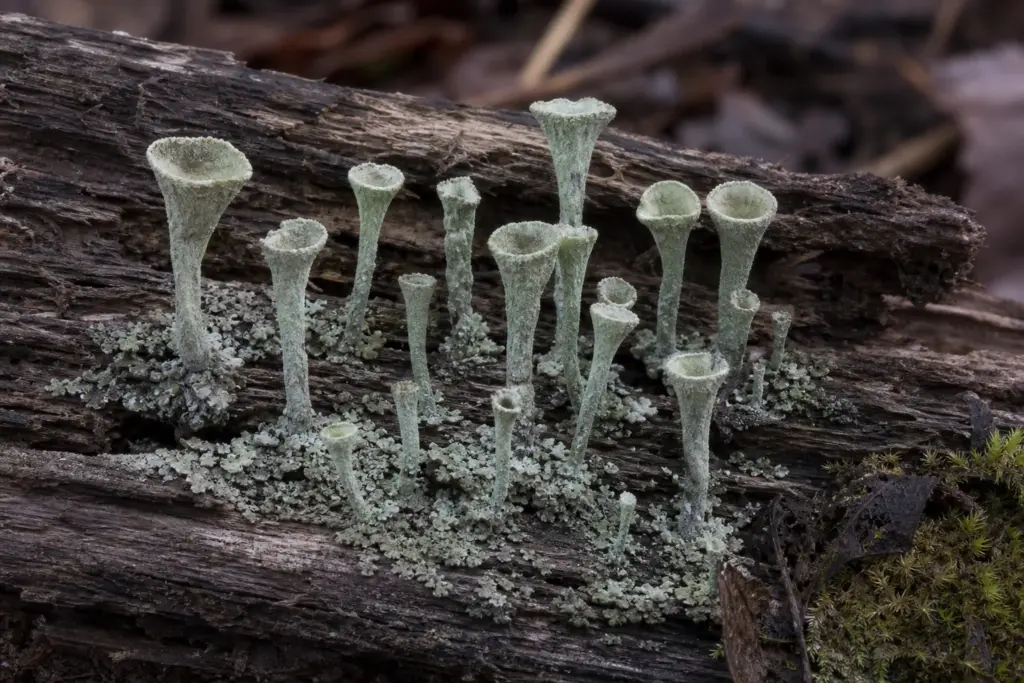
Fruticose lichens are the shrubby or hair-like ones. They may stand upright in branching tufts, form cups, or hang in strands. A cup-forming Cladonia at ankle height can look nothing like the flat patches on a trunk, yet both are lichens.2
Are lichens hurting the tree?
For most garden questions, this is the important part: lichens are not feeding on the tree. Clemson Extension explains that because the photosynthetic partner makes food, lichens do not take nutrition from their host, which is why they can also grow on rocks where there is no living food source to steal.3
That is very different from the leafy mistletoes found in winter trees. Many are flowering hemiparasites: they photosynthesize, but specialized tissue enters a branch to draw water and mineral nutrients from the host.
University of Maryland Extension gives the same practical reassurance, describing lichens as non-destructive organisms that grow harmlessly on tree trunks, rocks, and fences.4 In other words, a lichen-covered branch is not automatically a sick branch. The lichen is using the bark as a place to sit in the light.
The confusion comes because lichens are easier to see on slow-growing, older, or stressed trees. A dense, vigorous canopy can shade bark and keep lichens less conspicuous. A thinning canopy lets in more light. Bark on older branches may be rougher, slower to shed, and more inviting as a surface. The lichen did not necessarily cause the tree’s decline. It may simply be taking advantage of conditions that the decline created.
So if an old fruit tree is full of lichens and also has dieback, the right response is not to scrub the bark clean. Look instead at water, soil compaction, root injury, drainage, planting depth, mulch piled against the trunk, borers, cankers, pruning history, and general age. Lichens can be a clue that asks you to look carefully, not a verdict.
What lichens can tell you
Lichens take much of what they need from the air and from water moving across their surfaces. That makes them sensitive to local conditions. The National Park Service uses epiphytic lichen communities and lichen tissue samples as bioindicators, including for changes in nitrogen and sulfur air pollution.5
A home garden is not an air-quality laboratory, and a single patch of lichen cannot give you a clean or polluted label for your neighborhood. Still, the pattern is worth respecting. A garden with many kinds of lichens on bark, old fences, stones, and dead wood is often giving you evidence of surfaces that have been left in peace long enough for slow life to settle.
They also reflect microclimate, but not by a single north-side rule. Different lichen species occupy different substrates and environmental niches, so moisture, light, exposure, and the surface itself all matter.45 Walk around a tree and the pattern changes. North side, south side, branch crotch, exposed limb, shaded trunk: each surface offers a different set of conditions, not a universal compass.
A January walk with a hand lens
The best way to begin is not with a field guide open on the kitchen table. Begin outside, with a hand lens and one familiar tree. Look at the trunk first from several feet away. Notice whether the lichens form speckles, islands, leafy rosettes, or hanging threads. Then come close enough to see edges. Is the patch flat as paint, or does it have lifted lobes? Does it change color when damp? Are there tiny cups, dots, ridges, or powdery areas?
Compare surfaces rather than chasing names. Lichens on smooth young bark may differ from those on old cracked bark. The top of a fence rail may host a different community from the shaded side. A boulder near a downspout may carry more growth than a dry wall cap. The garden becomes more interesting when you start asking why one surface invited a colony and another stayed bare.
Leave the lichen where it is. Some lichens are slow to recover from disturbance, and some are difficult to identify without specialized work. For a gardener, the point is usually not collection. It is attention.
How to garden around lichens
Lichens do not need pampering, but they do benefit from a garden that is not scrubbed into sterility. Leave some old wood where it is safe. Let a weathered fence rail age. Keep a few stones in the shade border. Avoid unnecessary broad-spectrum sprays on bark and nearby hard surfaces. Do not power-wash every outdoor surface just because it has become biologically interesting.
At the same time, do not confuse appreciation with neglect. If a tree is struggling, improve the tree’s growing conditions. Water deeply during drought. Keep mulch broad and shallow, pulled away from the trunk. Reduce compaction over the root zone. Prune dead, damaged, or hazardous wood properly. Penn State Extension likewise notes that lichens do not cause tree decline; if a lichen-covered tree is unhealthy, look for drainage, water, pest, or disease problems rather than blaming the surface growth.6
There is rarely a good reason to remove lichens from a healthy tree. Scraping or scrubbing them away can permanently damage the tree’s protective bark.6 Because the lichen is not causing decline, treating it does not correct the underlying tree stress. If lichens are growing on a bench, pot, or stone where you simply do not want them, treat it as a cleaning decision for that object, not as plant health care.
Useful lichen watching supplies
- Carson MicroBrite Plus pocket microscope: useful for looking at texture, tiny cups, powdery surfaces, and edges after you have found a patch worth studying.
- Lichens of North America: a substantial reference for gardeners who want to move from casual noticing toward more serious identification.
Final thoughts
Lichens ask for a slower kind of gardening attention. They do not need watering charts, bloom times, or pruning schedules. They ask you to notice a surface and wonder why life chose that particular place: the old apple trunk, the shaded stone, the damp fence post, the branch that catches winter light.
Once you stop reading them as damage, they become part of the garden’s intelligence. They show where air, light, moisture, bark, age, and patience meet. In January, when the border is quiet and the trees are bare, those small maps on bark may be one of the most alive things you can see.
References
- USDA Forest Service: About Lichens
- USDA Forest Service: Lichen Biology
- Clemson Extension: Gardening Myths: Lichens Kill Trees
- University of Maryland Extension: Lichen, Algae, and Moss on Trees
- National Park Service: Bioindicators – Air
- Penn State Extension: Animal? Vegetable? Mineral? No, It’s Lichen
- Hawksworth and Grube: Lichens redefined as complex ecosystems