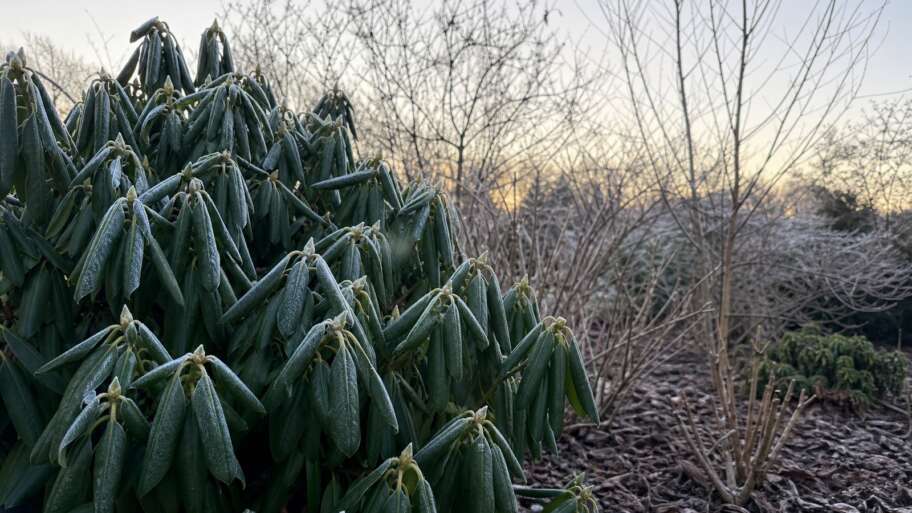

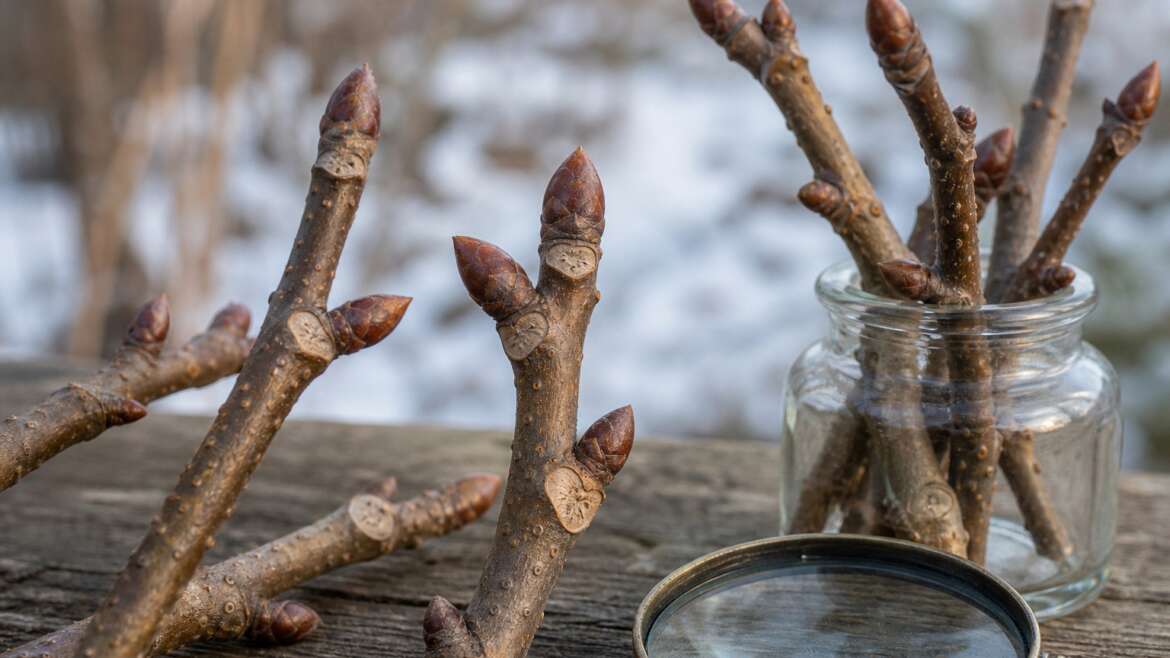
In January, a deciduous shrub can look as if it has been reduced to punctuation: lines, dots, scars, angles, and small brown commas at the tips of twigs. The leaves are gone. The flowers are months away. The garden seems to have removed every clue except shape.
Look closer. A bare twig is not empty. It is labeled. Every bud is a stored decision. Every leaf scar marks where last year’s leaf was attached. Every ring of bud-scale scars records a previous season’s growth. The winter plant is not asleep in the way a stone is asleep. It is paused, protected, and already carrying part of spring in miniature.
That makes winter buds one of the most useful January lessons in the garden. They teach pruning, plant identification, bloom timing, and patience, all before a single green leaf appears.
A bud is not just a bump
A winter bud is a small protected growing point. Inside may be a folded shoot, a future leaf, a flower, or some mixture of both. Indiana University’s Plants in Motion follows an apical bud on a tulip tree (Liriodendron tulipifera): its scales open, preformed leaves unfold, and the shoot tip begins to elongate in spring.1
Bud scales are the plant’s winter packaging. They are often small, tough, overlapping, and sometimes resinous or hairy. Their job is not to make the twig look tidy. Their job is to protect delicate living tissue from cold, drying wind, sun, and repeated wetting and freezing. A fat bud is not a decoration on a dead stick. It is a guarded room.
This is why forcing flowering branches indoors works at all. The flower or leaf was not invented by the vase; it formed earlier. Once that species has received enough winter chilling, warmth and water encourage a ready bud to resume development, although timing varies among species.7
The twig keeps a record
Once you know the marks, a twig becomes surprisingly readable. Virginia Tech Dendrology teaches winter tree identification through twig features such as buds, leaf scars, bundle scars, pith, lenticels, and bud arrangement.2 These are not obscure details for specialists only. They are the same details a gardener can use while standing beside a border in winter.
The leaf scar is the mark left where a leaf stalk detached in autumn. On some plants it is a neat crescent. On others it looks like a shield, a horseshoe, a narrow line, or a small face. Inside that scar, tiny bundle scars mark where veins once connected the leaf to the stem. Nearby, lenticels appear as small dots or slits that allow gas exchange through bark.
The University of Vermont’s twig guide describes winter twig features including terminal buds, lateral buds, bud scale scars, leaf scars, lenticels, and pith.3 A hand lens turns those words into landscape. The twig that looked plain from a few feet away becomes a map of last year and next year touching.
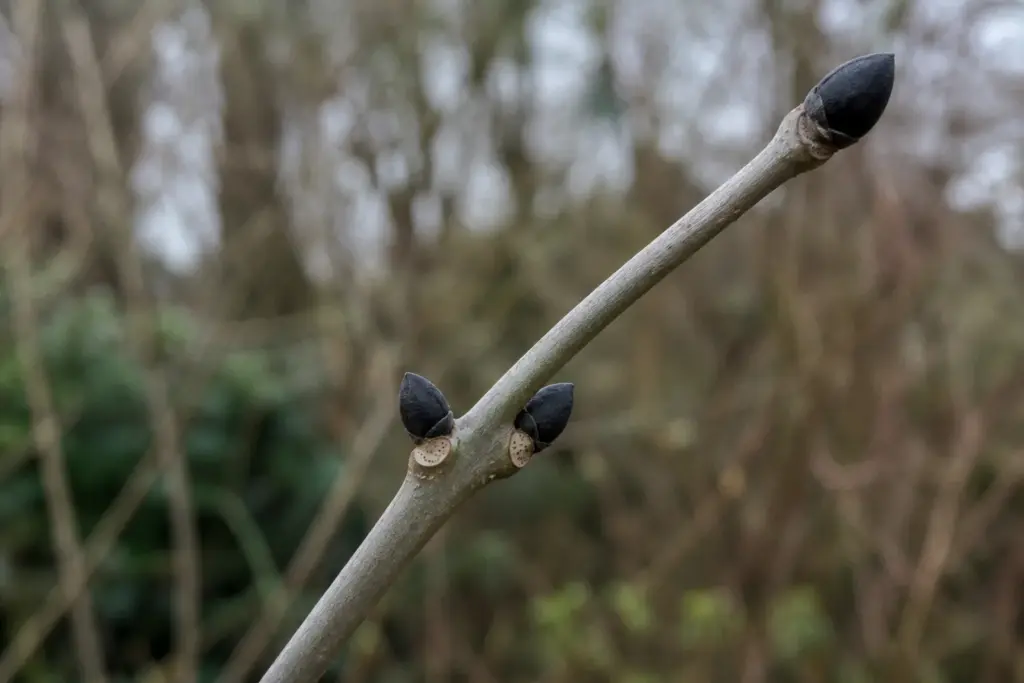
Opposite, alternate, and unmistakable
One of the fastest winter clues is bud arrangement. Opposite buds sit in pairs across from each other. Alternate buds take turns along the stem. This simple pattern can narrow a mystery plant quickly. Maples, ashes, dogwoods, and horse chestnuts are classic examples of opposite branching. Oaks, apples, birches, cherries, willows, and many shrubs are alternate.
The pattern matters in pruning as well as identification. A heading cut just above an outward-facing bud encourages new growth in that direction. A cut made carelessly above an inward-facing bud may steer the next shoot toward the center of the shrub. In winter, before leaves hide the structure, the buds are the arrows.
Do not make the exercise harder than it needs to be. Choose one twig. Ask whether the buds are opposite or alternate. Look for the terminal bud at the end. Find a leaf scar below a side bud. Notice whether the buds are round, sharp, sticky, hairy, paired, crowded, or held away from the stem. You are learning the plant’s handwriting.
Flower buds change pruning time
Winter buds are also a practical warning. Some shrubs carry next spring’s flowers through winter on old wood. Forsythia, lilac, early spirea, weigela, mock orange, viburnum, and many spring-flowering shrubs formed their flower buds during the previous growing season. Cut them hard in January and you may remove the very bloom you were waiting for.
Rutgers Cooperative Extension explains that shrubs blooming before late June generally flower on wood from the previous season and should usually be pruned after bloom, while many shrubs blooming after late June flower on current season’s growth and can be pruned in late winter or early spring.4 Penn State Extension gives the same basic distinction for pruning flowering shrubs.5
This does not mean you should never cut a spring-flowering shrub in winter. Dead, broken, diseased, or crossing wood may still need attention. But if the goal is flowers, winter pruning should be deliberate. Learn the buds first. A rounder, fuller bud on some plants may be a flower bud. A slimmer pointed one may be mostly leaf. The exact look varies by species, but the habit of checking changes the way you prune.
Bud-scale scars measure a season
At the base of a twig’s current year’s growth, you may find a tight ring or cluster of marks. These are bud-scale scars, left after the terminal bud opened and its protective scales fell away. The distance from one ring to the next can show how much that shoot grew in a season.
Iowa State University Extension notes that bud-scale scars encircle a twig where terminal-bud scales fell away; the distance from the tip to the nearest ring shows the most recent season’s growth.6 For a gardener, the pattern is less about naming every tree and more about noticing vigor. A young apple shoot with long annual growth tells one story. A stressed shrub with barely any distance between bud-scale scars tells another.
This is a quiet way to read plant health without guessing from leaf color alone. Good growth is not always long growth, and short growth is not always trouble, but a sudden change in annual growth can point to drought, shade, root competition, heavy fruiting, poor pruning, or age.
Useful winter-bud supplies
You do not need much to read dormant twigs. A few small tools make the practice easier and more accurate.
- Carson MicroBrite Plus pocket microscope for seeing bud scales, bundle scars, lenticels, and tiny twig details.
- Fiskars micro-tip pruning scissors for taking small twig samples cleanly without shredding bark.
- Carson 10x LumiLoupe magnifier for a simple non-battery look at buds and leaf scars outdoors.
A small January exercise
Pick three woody plants in the garden: one shrub, one young tree, and one fruiting plant if you have one. Cut nothing at first. Just look. Notice whether the buds are opposite or alternate. Find the terminal bud. Find the leaf scars. Look for the ring of bud-scale scars that marks last spring’s opening. If you can, sketch one twig or take a photo and label it later.
Then compare. A blueberry twig will not read like an apple twig. A lilac will not read like a birch. Dogwood buds have a different posture from maple buds. Once these differences become familiar, the winter garden stops being a collection of anonymous sticks and becomes a set of named, waiting structures.
That is the pleasure of winter buds. They make spring less sudden. By the time leaves appear, you have already seen the folded version. By the time flowers open, you know where some of them were stored. The garden was never empty. It was holding its next sentence tightly closed.
References
- Indiana University Plants in Motion: Leaf bud growth
- Virginia Tech Dendrology: ID it
- University of Vermont: Characteristics of twigs
- Rutgers Cooperative Extension: Pruning flowering shrubs
- Penn State Extension: How and when to prune flowering shrubs
- Iowa State University Extension: Tips for selecting and purchasing trees and shrubs
- Missouri Botanical Garden: How do I force branches of spring-flowering plants indoors?