
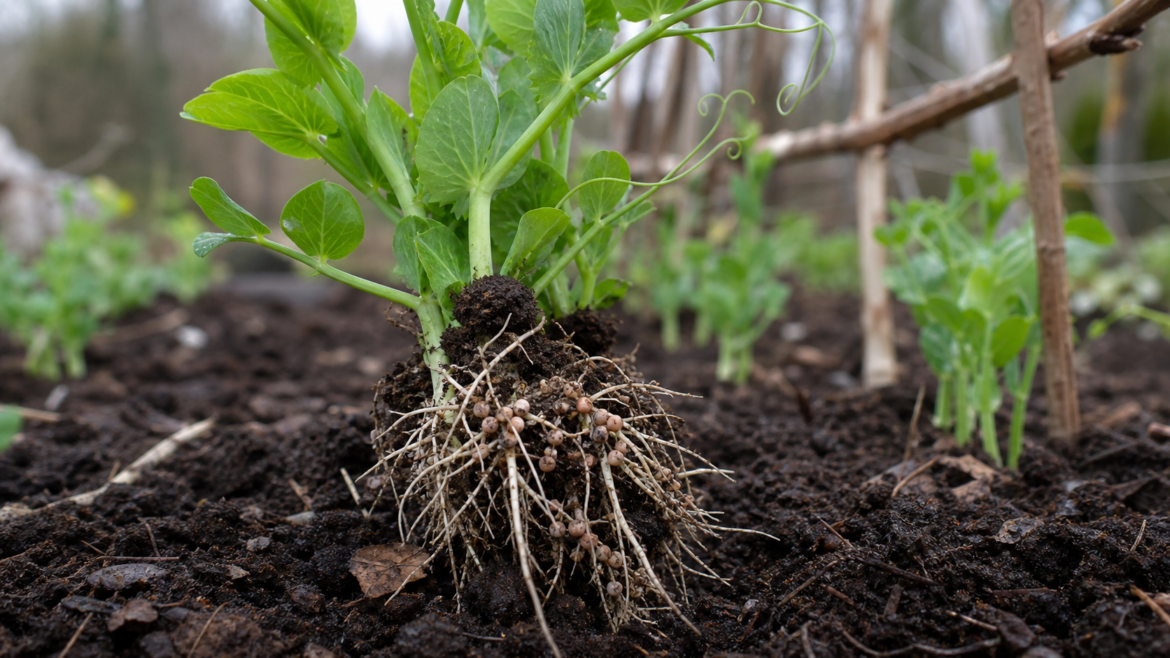
A pea seedling looks simple when it first breaks the soil. Two pale halves of a seed have done their work below, a green shoot has hooked upward, and the first tendrils begin searching for something to hold. From above, it is all freshness and appetite. From below, if you lift the plant carefully a few weeks later, there may be something stranger: small nodules swelling from the side roots.
Those nodules are not eggs, disease, or grains of fertilizer stuck to the roots. They are plant-made structures occupied by compatible rhizobia bacteria. Inside them, a quiet trade is taking place. The pea sends carbon compounds made through photosynthesis to the bacteria; the bacteria reduce atmospheric nitrogen to ammonia, which the plant can incorporate into usable nitrogen compounds.1 It is one of the most useful bargains in the vegetable garden, and one of the easiest to misunderstand.
This is why peas can feel almost old-fashioned in spring. Their pods are only part of the interest. Below ground, they show how fertility can depend on a relationship too small to see until it makes a swelling on a root.
Peas belong to the cool part of spring
Peas are one of the first vegetable crops many gardeners sow outdoors because they are suited to the cool shoulder of the year. Utah State University Extension recommends starting as soon as the soil can be tilled in spring and notes that seedling emergence takes about seven to ten days in soil at 55 to 65 degrees Fahrenheit. Its planting guidance begins once soil is above 40 degrees.2 Those temperatures are guides, not a dare to plant into mud.
The timing matters because peas do poorly in heat; Utah State notes that growth suffers when temperatures exceed 80 degrees Fahrenheit.2 A late sowing may germinate, then hurry into flowering as warm weather arrives. The useful calendar therefore depends on climate: in a cool coastal spring the window may be long, while a fast-warming inland garden may need an earlier sowing.
Peas do not need a heavily fed bed. They need workable, well-drained soil, steady moisture, and support appropriate to the variety. Fertilizer should follow a soil test or a demonstrated need. Extra nitrogen can produce excessive leafy growth, delay flowering, reduce pod set, and make nitrogen fixation a less attractive bargain for the plant.12
The bargain inside a nodule
The air around a garden is full of nitrogen gas, but that abundance is mostly unavailable to plants in its atmospheric form. New Mexico State University Extension explains that biological nitrogen fixation changes inert nitrogen gas into ammonia and that, in legumes, compatible rhizobia carry out this work in root nodules.1 A pea plant is not fixing nitrogen alone. It is hosting the organisms that can do it.
The relationship begins when compatible rhizobia encounter young roots. The bacteria enter root hairs and multiply in the outer root tissue; the plant forms the protective nodule around them. The pea supplies energy from photosynthesis, while the bacteria use nitrogenase to reduce nitrogen gas. The resulting nitrogen is assimilated into compounds the plant can use.3
That trade is elegant, but it is not free. NMSU Extension emphasizes that the plant must contribute a significant amount of energy, in the form of photosynthesis-derived sugars and other nutrients, to support the bacteria.1 A healthy pea vine is not getting something from nothing. It is paying for nitrogen with photosynthate built using sunlight.
Why gardeners look for pink
If you dig up a pea plant gently, rinse a few roots, and see nodules, you have found the architecture. To judge whether the nodules are likely active, cut open several rather than relying on the outside color. Young nodules may be white or gray inside, while actively fixing nodules are often pink or reddish because of leghemoglobin.1
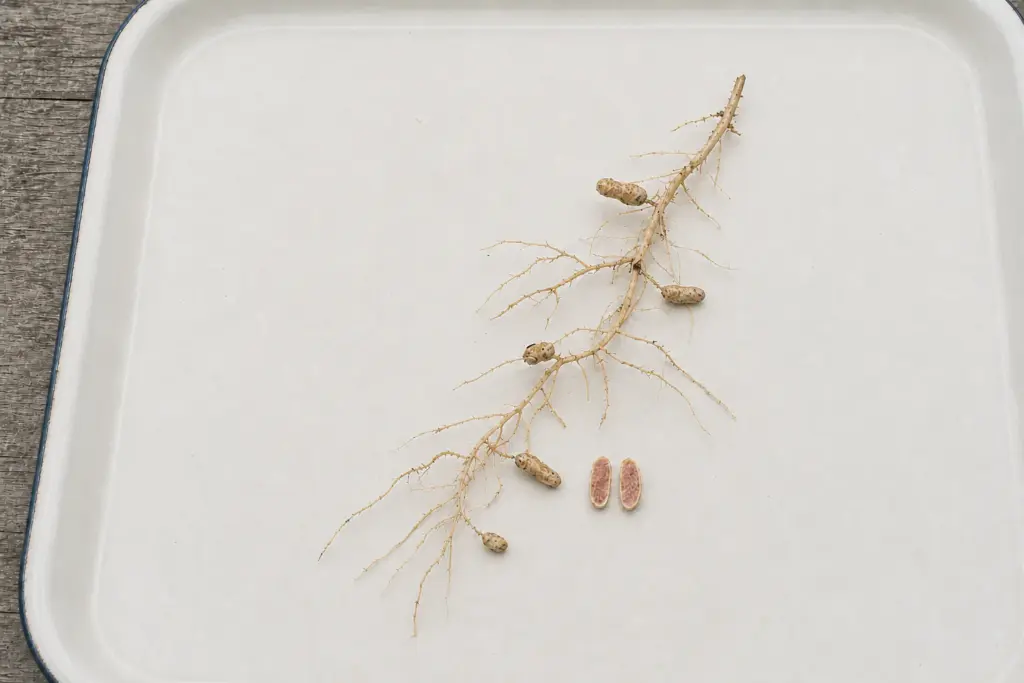
A working nodule has to solve an oxygen problem. Respiration needs oxygen to supply energy, but high free-oxygen concentrations can damage nitrogenase. A peer-reviewed review describes how the nodule combines a barrier to oxygen diffusion with leghemoglobin, which buffers and transports oxygen while keeping the free concentration low enough for nitrogen fixation.4 The pink interior is therefore evidence of a managed biochemical environment, not decoration.
Color is a clue, not a complete diagnosis. NMSU notes that green nodules may be senescing, while white, gray, or green interiors can accompany weak fixation, an ineffective rhizobial strain, pod filling, poor nutrition, or other plant stress.1 Read several nodules alongside the whole crop and its conditions. Pale vines can also reflect wet roots, drought, disease, nutrient or pH constraints, and weed competition.235
When inoculant is worth using
Rhizobia are not one universal substance called good bacteria. Some form nodules only with certain legumes, while others can nodulate several species. Commercial inoculants are labeled for the crops their strains support, so read the current crop list rather than assuming any legume inoculant will suit peas.35
Where peas have grown and nodulated well in recent years, the right rhizobia may already be present, and yearly inoculation may offer no advantage. In a new bed, a raised bed filled with purchased mix, or a garden whose pea history is unknown, inoculation is a reasonable precaution. NMSU recommends it when the intended legume has never grown in the site, has been absent for more than five years, or previously showed poor or uncertain nodulation.5
Treat inoculant like a living product, not a seasoning. Keep it cool and out of direct sunlight, check the expiration date, choose a product whose label names peas, and follow its application directions. Powder applied to seed should be planted promptly. If the seed is chemically treated, check the inoculant and seed labels for compatibility because some treatments can harm rhizobia.35
Planting for the partnership
Good pea culture is not complicated, but it is site-dependent. Sow into soil that is moist but not smeared. If a handful forms a shiny lump or a worked surface closes into a slick ribbon, wait. If it crumbles when pressed, the bed is closer to ready. Peas tolerate cool air, but cold, waterlogged soil slows growth and favors root disease.2
Avoid a heavy nitrogen application before sowing peas unless a soil test and local recommendation call for it. Excess available nitrogen can reduce fixation because taking nitrogen from soil costs the plant less energy than supporting the nodule partnership.1 This does not mean peas want poor soil. Moisture, drainage, pH, and other nutrients still affect root growth, nodulation, and fixation; correct a measured limitation rather than feeding by habit.3
Give tall or climbing varieties support early. Fine netting, twiggy brush, string, or small mesh matches the way pea tendrils find a handhold better than a broad rail. Use shallow cultivation to avoid root damage, and add a light organic mulch after establishment where conserving moisture and suppressing weeds are useful.2 The best mulch timing will depend on local soil temperature, rainfall, and pest pressure.
What peas leave behind
Gardeners sometimes hear that peas add nitrogen to the soil and imagine a row of vines quietly fertilizing the whole bed for the next crop. The truth is more restrained. Most of the nitrogen fixed during growth goes into the pea plant. Harvested pods remove some of it, and removing the vines carries away more.
NMSU Extension explains that most fixed nitrogen returns to soil for neighboring or following plants only when roots, leaves, stems, and other plant material die and decompose. It also cautions that harvested grain legumes leave relatively little nitrogen credit for the next crop.1 In a healthy garden bed, cutting spent vines at soil level can leave roots to decompose without extra disturbance; disease-free tops can be composted or used as suitable residue. That is organic-matter management; it does not establish that the following crop needs no fertilizer.
Peas are one instrument in thoughtful soil building. Rotate crops where practical, return suitable organic matter, keep soil covered when conditions allow, and feed the next crop according to its needs. A spring pea bed still offers a fine reminder: some fertility is applied, and some is built through living partnerships.
Useful pea-growing supplies
- Nature’s Aid granular garden soil inoculant: a multi-strain product whose current label includes garden peas and several garden beans, but not soybeans. Check the crop list, storage directions, and expiration date before purchase and use.
- REOTEMP soil thermometer: useful when soil temperature, rather than a warm afternoon, should decide whether a cool-season sowing is timely.
- Luster Leaf Rapiclip trellis netting: one fine-textured support option for climbing peas where twiggy prunings or reusable mesh are not available.
Final thoughts
A pea row is easy to enjoy for the obvious reasons: the first tendrils, the white flowers, the snap of a pod eaten before it reaches the kitchen. But its most interesting work may be hidden in the small swellings on its roots. Those nodules make the garden feel less like a set of separate parts and more like a series of agreements.
Plant peas early enough for local conditions, avoid unnecessary nitrogen, use a compatible inoculant when the site’s history makes it useful, and return healthy residues where appropriate. The reward is a bowl of spring peas and a clearer view of one partnership in the garden’s nutrient cycle—not proof that the bed will fertilize itself.
References
- New Mexico State University Extension: Nitrogen Fixation by Legumes
- Utah State University Extension: How to Grow Peas in Your Garden
- Colorado State University Extension: Legume Seed Inoculants
- Plants: Regulation of Symbiotic Nitrogen Fixation in Legume Root Nodules
- New Mexico State University Extension: Inoculation of Legumes