
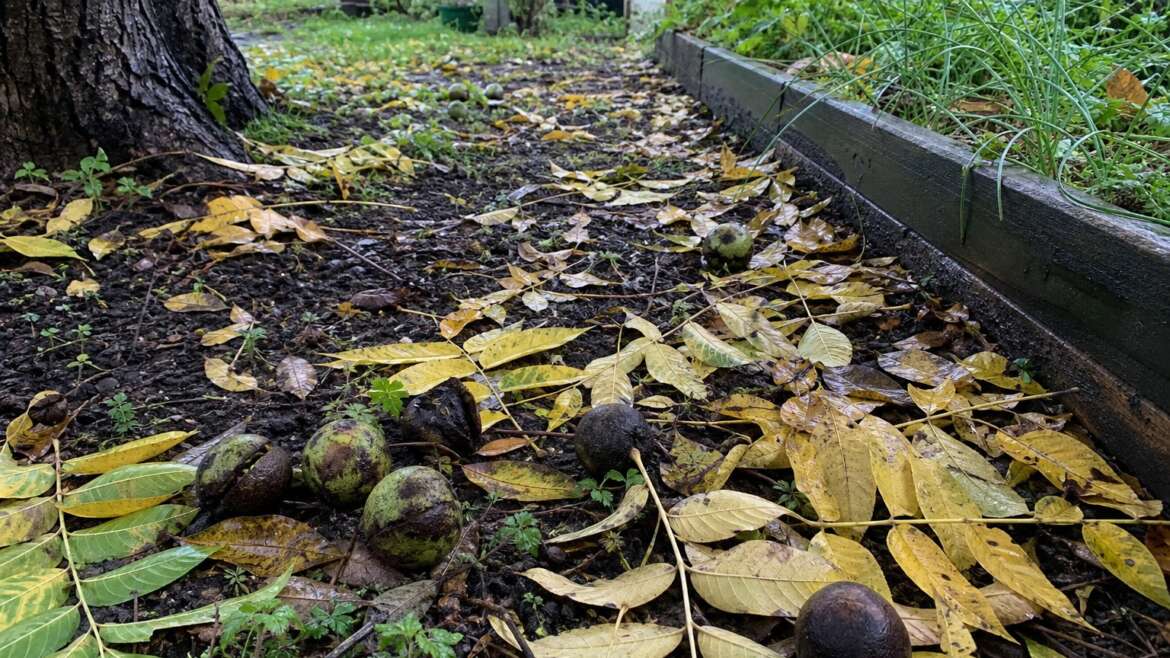
A black walnut makes itself known in October. The leaves yellow and fall in long, feathery pieces. The nuts drop with a weight you can feel through the soles of your shoes. Their green husks darken, bruise, and stain almost anything that touches them. Under the tree, the ground becomes a small map of influence: shade, roots, shells, leaflets, squirrels, and the gardener’s uneasy questions.
For many gardeners, black walnut is the tree with a reputation. Stories travel about tomatoes failing near it, peonies sulking, and potatoes wilting. Someone says the word juglone, and suddenly the tree seems less like a plant and more like a landlord with strict rules.
The truth is more interesting than the warning. Black walnut can be a difficult garden neighbor, but the chemical case against it is less settled than traditional plant lists suggest. It is also a major native hardwood across the central and eastern United States, with kernels eaten by wildlife and people.7 Its physical influence is undeniable: shade, a large root system, falling nuts, and competition for water and space all change a garden. Poor drainage, compaction, and ordinary plant disease can also dress up as walnut trouble.
That is why the black walnut deserves a careful reading. It is not a curse in the garden. It is a complicated shadow.
What juglone is—and what a walnut contains
Black walnut, Juglans nigra, is associated with juglone, a biologically active quinone that can injure plants when researchers apply it at sufficient concentrations. But a living walnut is not simply pumping purified juglone into a fixed circle of soil. A Washington State University Extension review explains that intact walnut tissues contain a non-toxic precursor called hydrojuglone, which can be transformed into juglone. The review reports that most hydrojuglone is in roots and shells, with little in leaves and virtually none in wood.1
That distinction matters. Laboratory extracts, purified juglone, seedlings in solution, and plants in soilless media can reveal toxicity without reproducing a garden soil. The WSU review stresses that a chemical must accumulate to a harmful concentration and reach another plant’s roots before it is ecologically relevant. Clay and organic matter can bind it, while microbes and other soil processes can break it down.1
Field results are correspondingly untidy. A study in four mixed hardwood stands measured extractable juglone in soil beneath black walnuts and found seasonal changes. Yet vegetation beneath walnut differed clearly from maple and oak controls in only one stand, and the authors did not attribute that difference to a strong allelopathic effect. They concluded that juglone’s allelopathic role under those field conditions was questionable.4
A separate study of black-walnut alley soils found estimated juglone concentrations above the lowest solution-culture toxicity levels reported for some plants, but below reported inhibition thresholds for common intercrops such as maize and soybean. It also found that juglone is degraded by both microbial and non-biological processes, while leaving open the possibility of accumulation in low-fertility soils.5 The honest conclusion is conditional, not absolute.
On Halloween morning, a walnut-strewn garden can look dramatic enough to invite superstition. The practical lesson is not to read the fallen leaves and husks as a map of an invisible poison circle. Read the entire site, above and below ground.
Why the story has become more nuanced
Garden advice about black walnut often sounds absolute. Never plant under it. Never compost the leaves. Never try tomatoes within sight of it. University of Maryland Extension now points readers to the WSU review and summarizes its conclusion: there is no conclusive, science-based evidence confirming juglone as the cause of poor growth near black walnut trees.2 The review itself argues that laboratory effects and observational lists have too often been treated as proof of what happens in functioning landscape soil.1
Iowa State University Extension makes a similar practical point. It says very little research in native or garden soils shows that juglone has a consistent impact on garden plants, even though some plants have been observed to grow poorly near walnuts.3 That does not prove every old observation wrong. It means the gardener should avoid turning one chemical into the answer for every failure under a tree.
A mature walnut creates several hard conditions at once. The canopy reduces light. The roots compete for moisture and nutrients. The soil under a tree can be drier than it looks after rain. If the site is compacted, shaded, and full of thirsty roots, a sun-loving tomato may suffer even if juglone were not part of the story. When the plant wilts, it is tempting to blame the invisible chemical because that feels more dramatic than shade and thirst.
The best working attitude is neither panic nor proof-free certainty. Treat black walnut as a major site condition. Diagnose the whole site.
What walnut trouble can look like
Plants struggling near a black walnut may yellow, grow slowly, wilt, or die back. None of those symptoms identifies juglone. Iowa State notes that poor growth and stunting blamed on walnuts can also result from dry soil and low light—two conditions that are ordinary beneath a mature tree.3 Root damage, compacted soil, drainage trouble, herbicide drift, and plant disease can add similar clues.
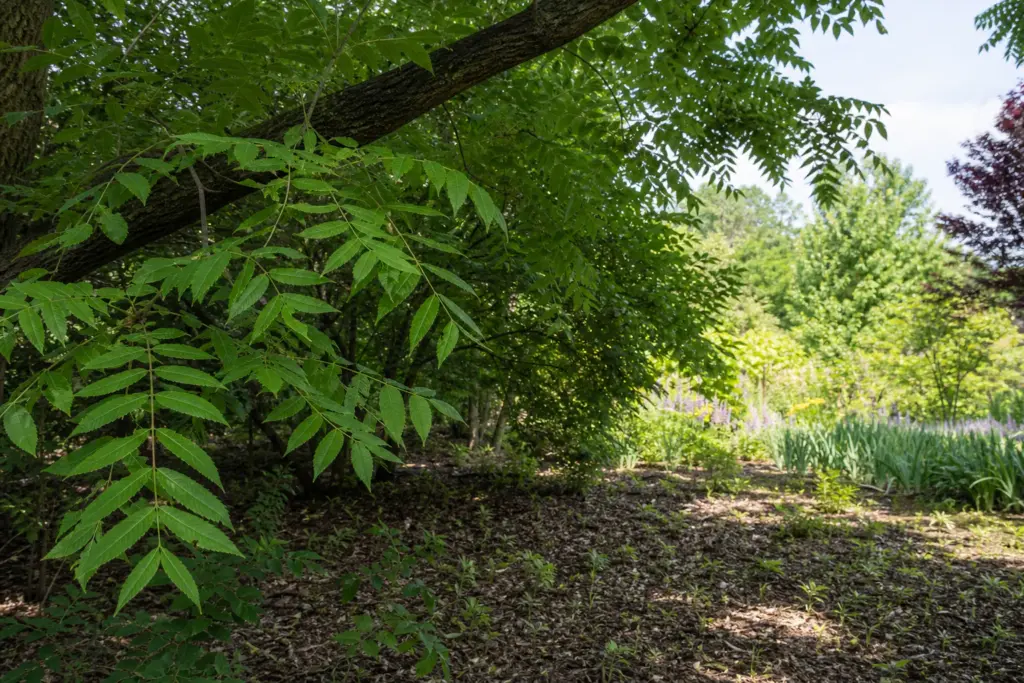
Slow change is what makes the tree feel mysterious. A garden may work for several seasons, then begin to fail as the walnut’s canopy broadens and its roots occupy more soil. The gardener remembers success in the same spot and reasonably asks what changed. Sometimes the answer is the growing tree, but the mechanism may be less exotic than the reputation.
Start with observations you can test. Count the hours of direct sun rather than describing the bed as generally bright. Check moisture several inches below the surface in both the troubled bed and a comparison spot. Look for girdling roots, recent excavation, stem lesions, leaf spots, insect feeding, or a sharp injury pattern that follows spraying. If the same species thrives nearby in similar soil but more light, that contrast is useful. If a potted plant fails alongside an in-ground plant, walnut roots alone cannot explain both.
A single garden cannot settle an allelopathy debate, and a wilted tomato cannot serve as a chemical test. But careful notes can reveal a solvable constraint: not enough sun, irrigation that wets only the surface, a disease moving through one plant family, or a bed being colonized by tree roots. A walnut may be part of the answer; it should not end the diagnosis.
How to use “sensitive” and “tolerant” lists
The plants gardeners worry about most are often the crops they most want to grow: tomatoes, potatoes, peppers, and eggplants. Those nightshades appear on Wisconsin Horticulture’s list of plants reported to be sensitive, along with ornamentals such as lilac, peony, rhododendron, and azalea.6 The careful word is reported.
Wisconsin says its table is based on observation rather than formal testing, is incomplete, and includes cases where sources disagree.6 The WSU review goes further: it traces influential sensitivity lists to dated extension material, including one publication later withdrawn, and argues that proximity alone does not show that juglone caused a plant’s decline.1 A list can suggest what to watch; it cannot predict every garden.
There is still a practical reason to move a sun-hungry tomato away from the tree: it needs strong light, steady moisture, and room for its own roots. A large container on an adequately sunny, root-separated surface gives the gardener more control over potting mix and water. If the plant succeeds, that does not prove juglone was the original problem; several conditions changed at once.
Use a “tolerant” label with the same restraint. Start with plants suited to the actual shade, moisture, drainage, soil, climate, and mature size available. A woodland sedge may prosper where a squash fails because their needs differ, not because one has passed a universal walnut test. The closer you are to the trunk, the less a vegetable bed makes sense. As you move into stronger light and away from dense tree roots, more options open.
What to do with leaves, hulls, and wood
Black walnut leaves and nut hulls make gardeners nervous because they are visible, abundant, and, in October, everywhere. The husks can stain hands, paving, baskets, and tools as they darken. Whole nuts also roll underfoot and can smother small seedlings when they collect in a heap. Those are good reasons to gather them from paths and intensively managed beds; “detoxifying” the soil is not.
The chemistry is frequently misstated here. According to the WSU review, intact tissues contain hydrojuglone rather than juglone itself, with little of the precursor in leaves and virtually none in wood.1 A normal fall of leaflets therefore does not demonstrate that the bed has received a toxic dose. It is ordinary tree litter, subject to decomposition and the same questions of volume, aeration, and balance as other compost ingredients.
Do not make a thick, wet mat of fresh husks around small plants. Their bulk and texture alone make that poor mulch. Add leaves to a working compost pile with other materials, keep it aerated, and wait until the result is dark, crumbly, and mature before spreading it. That is sound compost practice, not a walnut-specific ritual.
Walnut wood chips need not be banished either. Both WSU and Iowa State recommend arborist wood chips as mulch beneath walnuts, including chips that contain walnut wood.13 Apply them on the soil surface rather than mixing them into a planting hole, keep mulch away from the trunk flare, and replenish as it breaks down. The chips help conserve moisture and protect the soil surface—two practical benefits under trees.
Raised beds control a site, not a proven toxin zone
A raised bed near a black walnut can be useful. It can improve drainage, define paths, make soil easier to reach, and give young plants a volume of prepared soil. An open-bottomed bed will not remain root-free, however. Tree roots can enter from below, particularly where the bed receives regular water.
Older advice sometimes recommends an impermeable barrier beneath the bed to isolate crops from walnut roots and juglone. That changes root contact, but it does not by itself prove or solve a chemical problem. Shade, irrigation, heat, drainage, soil volume, and disease still differ from one setup to another. A lined bed over compacted ground can also trap water like a shallow bathtub.
If you want to compare conditions, a container on a sunny, hard surface creates a cleaner separation from tree roots than a bed beneath the canopy. Use a large enough container, fresh growing medium, and regular irrigation, and remember that containers heat and dry faster than garden soil. Treat the result as a useful trial, not a laboratory verdict on juglone.
For most gardeners, the cleanest solution is spatial. Put sun-hungry annual crops in the best open light. Use the walnut area for shade-adapted perennials, woodland groundcovers, paths, sitting space, or a managed leaf-and-nut collection zone. Let the tree shape the design instead of asking a June vegetable bed to thrive in a woodland site.
A better way to garden under the tree
Under a mature black walnut, the question should not be “How do I force this site to behave like a sunny vegetable bed?” It should be “What kind of garden does this place already want to become?” Start by designing for the shade you actually have, including the moving patches of light at the canopy edge.
Map where soil remains bare, where rain reaches, and where roots or dropped nuts make digging awkward. Keep new planting holes small enough to avoid cutting major roots. Rather than importing a generic walnut-tolerant palette, choose plants adapted to your region and to the site’s real moisture and light. The WSU and Iowa State guidance is refreshingly ordinary: irrigate during dry weather, reserve full sun for sun-loving plants, use shade plants beneath the canopy, and mulch the soil.13
A deciduous canopy also changes over the year. Spring ephemerals use the brief bright interval before leaves fill the branches; our look at spring flowers that borrow light from bare trees explains that timing. Whether a particular species belongs under your walnut still depends on its native range, soil, moisture, and local ecology.
A walnut garden can be beautiful if you stop asking it to be a tomato patch. Think region-appropriate ferns, sedges, spring ephemerals, woodland asters, shrubs, and paths that make nut collection easier. Leave room for the tree itself: black walnut is a native forest species across much of the central and eastern United States, and its nuts feed wildlife as well as people.7 The tree is editing the possibilities, but it is not erasing them.
Useful black walnut garden supplies
- Garden Weasel medium nut gatherer: helpful for collecting fallen black walnuts and similarly sized nuts without stooping through the whole yard.
- Atlas nitrile garden gloves: useful when handling walnut hulls, which can stain skin and tools as they darken.
- VIVOSUN 10-gallon grow bags: one way to trial a crop in fresh growing medium on an adequately sunny, root-separated surface. They control more site variables than an open bed, but do not prove which variable caused an earlier failure.
Final thoughts
The black walnut is not an easy tree to garden beneath, but easy is not the only measure of a good garden. It asks you to read root zones as well as sunlight. It asks you to separate a plausible chemical effect from shade, drought, soil, disease, and competition. Most of all, it asks you to choose plants for the place you actually have.
That is why October is such a useful time to study it. The nuts are on the ground. Fallen leaflets make the canopy’s reach easy to see. The vegetable beds are quieter, and the season gives you room to think. If tomatoes failed there, move them to better light and compare. If a shade border could thrive there, begin planning. If the tree is healthy and valuable, do not reduce it to a villain.
A black walnut does cast a shadow. The gardener’s work is to understand what kind.
References
- Washington State University Extension: Do black walnut trees have allelopathic effects on other plants?
- University of Maryland Extension: Walnut Toxicity—Juglone
- Iowa State University Extension: What plants are sensitive to the juglone produced by black walnuts?
- B. de Scisciolo et al.: Seasonal patterns of juglone in soil beneath Juglans nigra and influence on understory vegetation
- G. R. von Kiparski et al.: Occurrence and fate of the phytotoxin juglone in alley soils under black walnut trees
- Wisconsin Horticulture: Black Walnut Toxicity
- U.S. Forest Service: Black Walnut (Juglans nigra)