
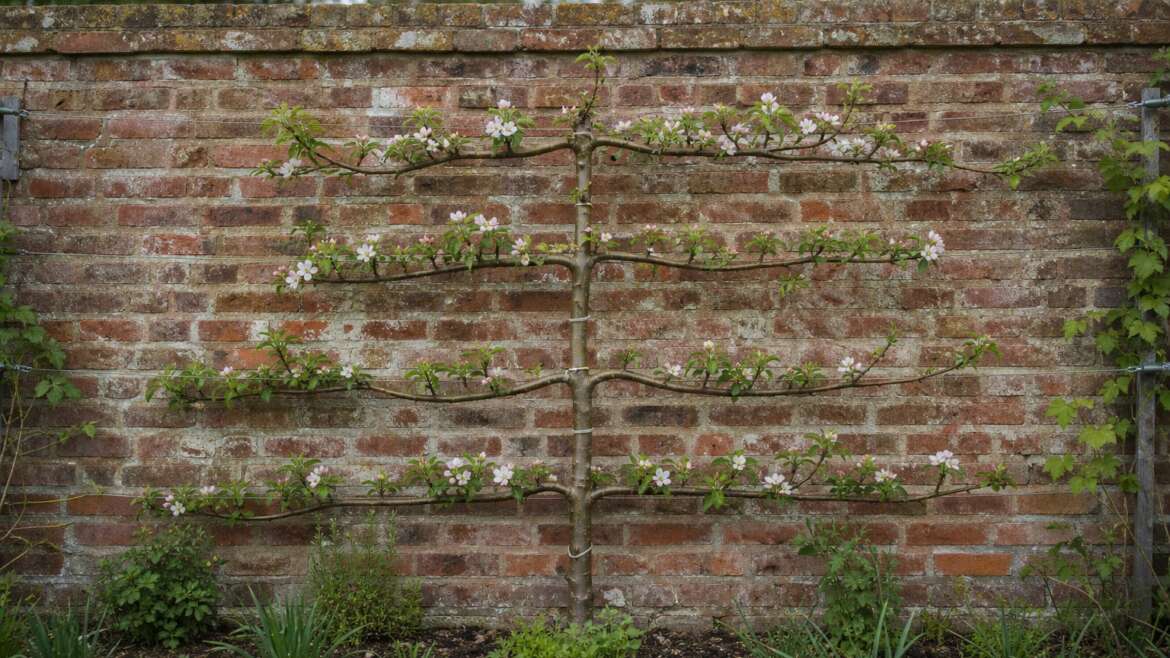
An espalier is a fruit tree taught to draw a line. Instead of letting an apple or pear become a rounded little cloud of branches, the gardener trains it flat against a wall, fence, or freestanding wire frame. The result is part orchard, part architecture: a tree with a trunk like a spine and fruiting arms laid out in deliberate tiers.
It can look formal, almost too elegant to be practical, but its practical virtues are plain. A flat tree catches light, fits where a full canopy would not, and turns a blank boundary into a productive edge. That double duty also makes espalier useful in edible landscapes designed to look like gardens. The Royal Horticultural Society describes the classic apple or pear espalier as a tree trained against support with a central vertical stem and several tiers of horizontal branches.1 That simple geometry is why the form still feels fresh in narrow side yards, kitchen gardens, courtyards, and small gardens.
Why Flat Trees Work
A tree does not naturally want to become a diagram. Left alone, it follows light, gravity, hormones, and the inherited habits of its species. Espalier works because the gardener redirects those tendencies rather than fighting them all at once. Young shoots are flexible enough to bend, dormant buds can be encouraged into growth, and repeated pruning tells the tree where its energy is useful.
The important word is repeated. Espalier is not a one-afternoon craft project. It is a conversation over several seasons. While the framework is being formed, dormant-season cuts help set the next tier; during active growth, useful shoots are tied in and misplaced growth is removed. Once the permanent framework is complete, routine pruning generally shifts to late summer.1 Oregon State University Extension is blunt about the commitment: an espalier saves space and can make harvest easier, but it is not less work than a normal tree.6
Choosing the Right Tree
Apples and pears are the traditional choices because they tolerate pruning well and can form short fruiting spurs along older wood. The best candidates are spur-bearing cultivars, because they carry fruit on compact side shoots rather than only at the tips of long branches. The RHS recommends spur-bearing apples and pears for espalier; partial tip-bearers can sometimes be trained, but fully tip-bearing cultivars are challenging in this form.2
Rootstock matters just as much as cultivar. It influences the tree’s vigor, eventual span, and the number of tiers it can fill. Match the rootstock to the intended space, soil, climate, and permanent support rather than assuming every espalier should be extremely dwarf. The RHS notes that a more vigorous rootstock can support a larger framework, while less vigorous rootstocks suit smaller designs.2 Local disease resistance matters too: a cultivar that handles the scab, fire blight, or other problems common in your region is usually a better garden choice than one selected by name alone.
If you want fruit, plan for light and pollination before planting. Choose an open site with full sun and well-drained soil. Oregon State University Extension recommends considering pollination when selecting a fruit tree; for apples, cross-pollination is recommended, and a crabapple can serve as a pollinizer when its bloom overlaps.3 Check the cultivar’s flowering group and self-fertility rather than assuming any two apples will be compatible.
The Support Is Part of the Tree
Think of the support as the tree’s permanent scaffolding. It must be strong, level, and installed before the tree starts growing into its role. For a wall espalier, the RHS recommends robust 2.5-millimetre (12-gauge) galvanized wire, held at least 10 centimetres (4 inches) off the wall so air can move behind the canopy.2 Use fixings designed for the actual substrate—masonry anchors for sound masonry, or suitable eyes in sturdy timber—and make sure a fence or post system can outlast the tree’s training years.
A classic horizontal espalier often begins with three or four tiers. A useful starting layout is a first wire about 40 centimetres (16 inches) above the soil, with later wires 35 to 45 centimetres (14 to 18 inches) apart, adjusted for rootstock vigor and the space available.2 Keep the upper tiers reachable. One of the pleasures of espalier is harvesting without a ladder, so do not train a small garden tree into a chore.
Training the First Tiers
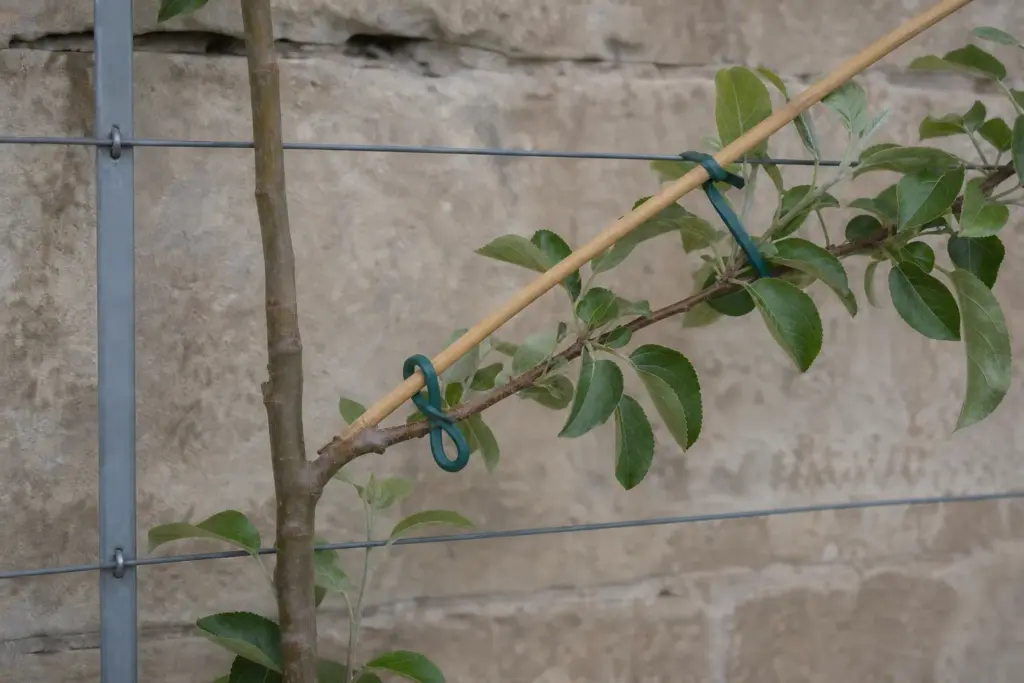
Start with a young, unbranched maiden tree, often called a whip, or a lightly feathered tree. Plant it near the support without pressing the trunk against the wall. As shoots develop, retain one to continue the central leader and select two well-placed laterals for the first left and right arms. Rather than pulling those young laterals straight onto the horizontal wire, tie each one loosely to a bamboo cane set at about 40 degrees. The angled start preserves extension growth; the branches can be lowered after growth slows in late summer.1
Do not force a branch into a hard right angle if it resists. The UC Marin Master Gardeners advise lowering lateral branches in stages if necessary, with time between adjustments.4 Check every tie as the branch thickens, leaving enough slack that it cannot cut into bark. A cracked or girdled limb is not a trained limb. The best espalier work often feels slow because the tree is allowed to keep growing while it changes direction.
Once the first tier is established, let the leader rise to the second wire, then repeat the process. Each year adds a little more structure. For a while the tree may look awkward, like handwriting practice on a wall. That is normal. The clean pattern emerges as the permanent arms thicken and the temporary shoots are edited away.
The Plant Science Behind the Pattern
Espalier is beautiful because it exposes something usually hidden inside pruning: branch angle changes growth. Upright shoots tend to behave like leaders. They race, extend, and claim dominance. Horizontal limbs are calmer, but they can push vigorous upright shoots from their upper sides. The University of Georgia’s pruning guidance explains that horizontal limbs lose apical dominance and often produce strong upright water sprouts, which then need to be managed.5
This is why an espalier is never finished in the way a fence is finished. Every summer, the tree tries to become three-dimensional again. Your job is not to punish that growth, but to sort it. Short fruiting spurs are kept. A well-placed extension shoot may become part of the design. Strong vertical water sprouts are rubbed out while young or removed cleanly. The pattern survives because attention returns at the right moments.
Care Through the Seasons
For a young tree still forming tiers, winter or early-spring cuts establish the next stage of the framework. Once the main structure is complete, routine maintenance belongs mainly to late summer, after extension growth has slowed and terminal buds have formed; dormant pruning is then reserved for renovation, spur thinning, damaged wood, or a specific structural correction.1 Exact timing varies with cultivar and local season, so use the tree’s growth stage as well as the calendar.
Water a young espalier as you would any newly planted fruit tree: deeply and consistently, with attention to soil and weather rather than calendar ritual. Mulch the root zone to conserve moisture, but keep mulch clear of the trunk. Keep grass and weeds from competing while the root system establishes. Before adding fertilizer, assess the tree’s growth and use a soil test or local extension guidance; routine feeding can create more vigorous shoots than the flat framework needs.
The flat framework can also make inspection easier. Aphids on tender tips, scale insects on old wood, cankers, damaged ties, blossom problems, and crowded fruit are less likely to disappear inside a dense canopy. That does not make the tree pest-proof, but it does make regular observation part of the design.
Where Espalier Belongs
A sunny wall is the classic setting, but choose its aspect for the local climate rather than assuming the warmest wall is always best. Oregon State notes that, in Central Oregon, south- and west-facing sites may bring earlier bloom and greater frost risk.3 Wherever you garden, weigh full sun, airflow, drainage, irrigation access, and spring frost patterns together. A freestanding espalier can also divide a garden without making it feel closed; in a kitchen garden, a flat apple or pear can become a fruiting backdrop to herbs, currants, strawberries, or low perennial flowers.
The form suits gardeners who like close observation. If you prefer plants that can be left alone for long stretches, choose a less exacting fruit-tree style. If you enjoy a little seasonal ritual, a few careful cuts, and the satisfaction of seeing a living structure sharpen over time, espalier is deeply rewarding.
Useful Espalier Supplies
- Felco F-2 bypass pruners (affiliate link): a durable hand pruner for clean dormant and summer cuts on young fruit wood.
- VELCRO Brand ONE-WRAP garden ties (affiliate link): adjustable ties for fastening young shoots to canes or wires. Leave slack for growth, inspect them during the season, and loosen or replace any tie before it constricts the bark.
- Robust 2.5-millimetre (12-gauge) galvanized wire: suitable for the permanent horizontal support lines recommended by the RHS.2
- Stainless-steel screw eyes or purpose-made vine eyes: choose fittings and anchors rated for the support material and the tensioned-wire load.
Final Thoughts
Espalier asks a gardener to think in both time and line. The first year is mostly promise. The second year begins to show intention. Over several seasons, the tree starts to read as design: bark thickening along the arms, blossom held close to the support, fruit arranged where your hands can reach it.
That is the charm of the form. It is disciplined without being static. Every cut, tie, bud, flower, and watersprout reminds you that the pattern is alive. A good espalier is not a tree forced into obedience. It is a collaboration between plant habit and human patience, and in a small garden, that collaboration can turn one plain boundary into the most interesting line in the landscape.
References
- Royal Horticultural Society: Apples and pears, espalier pruning and training
- Royal Horticultural Society: Apples and pears, starting an espalier
- Oregon State University Extension: Selecting Fruit Tree Varieties for Central Oregon Landscaping and Home Orchards
- UC Marin Master Gardeners: How to Espalier
- University of Georgia Extension: Basic Principles of Pruning Woody Plants
- Oregon State University Extension: Train Fruit Trees as Espaliers for Beauty and Easy Harvest