
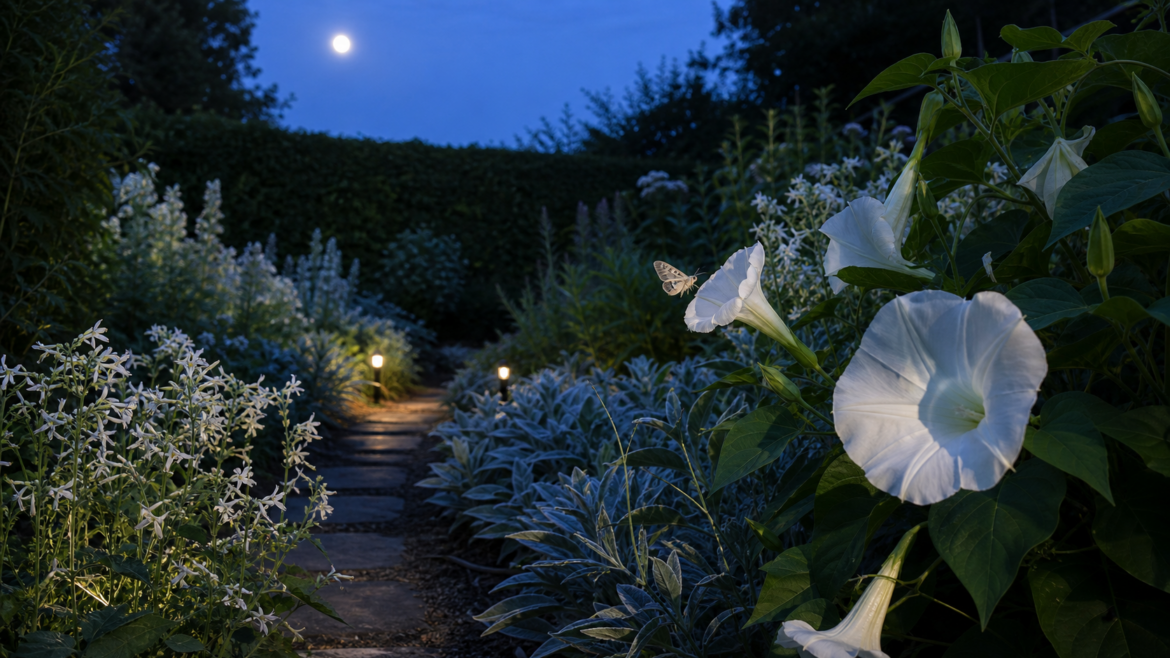
A garden does not go dark all at once. First the reds lose their heat. Then the blues and purples fold into shadow. What remains visible is shape, pale color, scent, and movement: a white flower catching the last sky, a silver leaf holding a little moonlight, a moth taking the path that bees worked a few hours earlier.
That is the real charm of a moon garden. It is not a novelty border made only of white flowers. It is a garden designed for a different sense of time. During the day it may look calm, even restrained. At dusk it begins to clarify. The pale plants come forward, fragrant flowers start sending messages through the air, and the space becomes useful exactly when many gardeners are finally home to enjoy it.
A good moon garden is also more than atmosphere. It can support nocturnal pollinators, soften a path, make a small seating area feel intentional, and teach you to design with contrast rather than color alone. The trick is to let the night do some of the work.
Why a Moon Garden Works
In daylight, gardeners often design by flower color. At night, subtle differences in hue become harder to read, so contrast, reflective surfaces, strong silhouettes, and scent carry more of the design. White petals, cream-colored blooms, variegated leaves, and gray or silver foliage can remain easier to distinguish against dark surroundings.
This is not just a human preference. The USDA Forest Service notes that many moth-pollinated flowers are pale or white, fragrant, nectar-rich, and open in the late afternoon or at night.1 A moon garden works because it borrows from those same cues.
Think of the evening border as a small theater. Dark shrubs and fences become the back curtain. Pale flowers become the lamps. Silver leaves become the quiet understory that keeps the picture from collapsing into black. The most successful moon gardens use all three.
The Night Shift in the Flower Border
By dusk, many daytime visitors become less active and a different set begins to move: moths, beetles, and some flies. Nectar-feeding bats are important pollinators in tropical and subtropical parts of the Americas, including some southwestern parks, rather than a feature of every temperate garden.11 A pale flower is not automatically a moth flower, and not every moth is a pollinator, but evening bloom, pale color, tubular shape, and fragrance are common clues.
It helps to think beyond nectar. Many moths need host plants as caterpillars before they become the fluttering adults we notice at porch lights. The National Park Service notes that butterflies and moths rely on nectar flowers, that some caterpillars require particular host plants, and that different life stages may overwinter in deep leaf litter, stone crevices, or loose bark.2 A moon garden that is too spotless can become a room with refreshments but no place to live.
Leave a little leaf litter under shrubs. Keep a few native grasses, vines, or shrubs that feed larvae in your region. Avoid routine use of broad-spectrum insecticides, especially near flowering plants, and use the least disruptive control that solves an identified problem.12 The evening garden becomes more interesting when it is not only designed for people looking outward from a patio, but also for small lives moving through it.
Build Around Three Signals
Start with brightness. Use white and cream flowers where you want the eye to land: beside a gate, at a bend in a path, around a bench, or near the steps where a visitor naturally slows down. Repetition matters more than variety. A single white bloom may vanish in a large border, but three or five repeated pockets of pale flowers can stitch the whole garden together.
Then place scent where noses will actually find it. Fragrant plants are often wasted in the middle of a bed. Put them near a chair, a kitchen door, a narrow path, or a warm wall that releases heat slowly after sunset. Evening scent is intimate. It should meet you at arm’s length, not drift vaguely from a corner you never visit.
Finally, build shelter. A moon garden with only annual flowers can look charming for a season, but shrubs, trellises, evergreen structure, ornamental grasses, and leaf layers make it feel settled. They also create sheltered edges where night-flying insects can pause between feeding trips. The garden should have edges, not just flowers.
Plants That Earn Their Place After Dark
The famous moonflower vine, Ipomoea alba, is a good symbol for this kind of garden, but it should not be asked to do all the work. NC State Extension describes moonflower as a tender, low-maintenance vine often grown as an annual, with fragrant nocturnal white flowers that open rapidly and a need for a support such as a trellis, arbor, or fence.3 Missouri Botanical Garden notes that it is winter hardy only in USDA Zones 10 to 12, but can be grown as a warm-season annual in full sun and moist, well-drained soil, with nicking of the seed coat helping germination.4
Use moonflower where a vertical gesture makes sense: on an arbor over a path, a trellis near a porch, or a fence where the large leaves can make a dark wall for the white trumpets. Its growth accelerates in warm weather and it can self-seed, so check state or regional guidance before allowing seed to mature, especially outside its native range. The seeds contain toxic alkaloids and can cause vomiting; large ingestions may cause hallucinations, so keep seed pods and stored seed away from children and pets.3
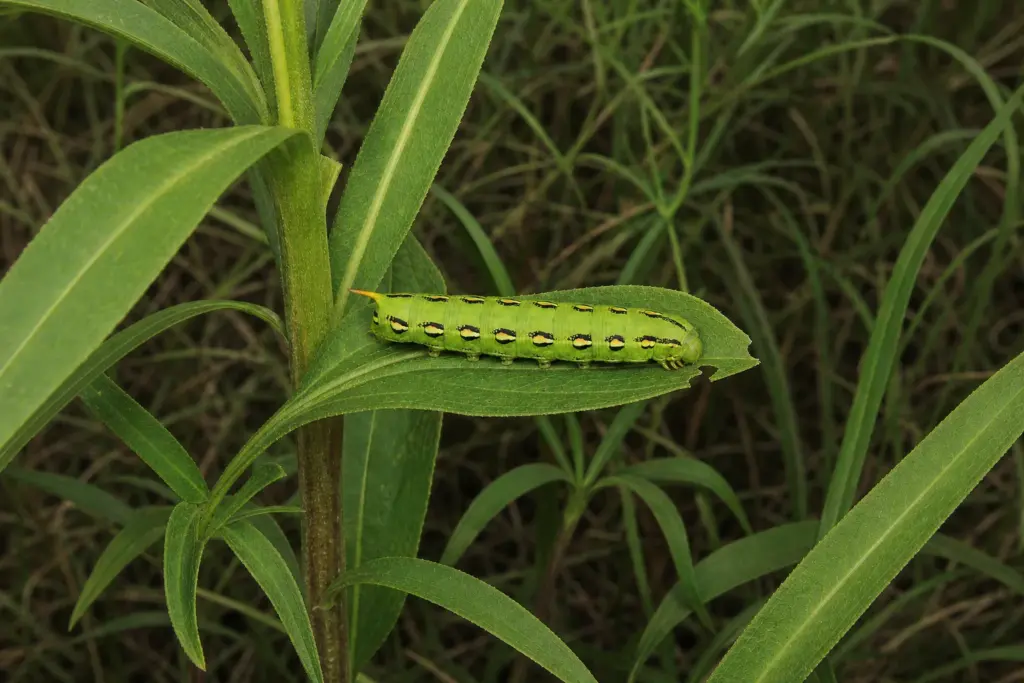
A more resilient moon garden mixes plant roles, but any list needs local filtering. Match candidates to climate, light, soil, drainage, mature size, local ecology, and invasive-plant guidance. For annual brightness, try white cosmos, sweet alyssum, flowering tobacco, white zinnias, evening stock, or four o’clocks where they are appropriate. For perennial substance, consider white garden phlox, Shasta daisy, white coneflower, white yarrow, or native evening primroses suited to your region. For shrubs, mock orange, oakleaf hydrangea, white roses, viburnum, and pale hydrangeas can give the garden larger luminous anchors. In the eastern United States, evening primroses can also feed white-lined sphinx caterpillars, one concrete example of choosing plants for the insect’s whole life cycle rather than only the adult’s nectar visit.5
Treat this as an ornamental palette, not an edible-flower list. Four o’clocks (Mirabilis jalapa) have poisonous seeds and roots if ingested, and UC Agriculture and Natural Resources lists Nicotiana species, including ornamental tobaccos, among poisonous landscape plants.67 Supervise children and pets around these plants and seek professional advice after a suspected ingestion.
The silver layer is just as important as the flowers. Lamb’s ear, artemisia, santolina, culinary sage, lavender, dusty miller, and silver-edged variegated plants can keep the border readable even when nothing is in bloom. Use them like punctuation. A strip of lamb’s ear along a path, or a gray mound beside a dark-leaved shrub, can make the whole design feel deliberate after sunset. Treat silver foliage as a visual role, not a promise that all these plants share the same needs; choose among them for your drainage, humidity, winter cold, and available space.
The Geometry of Night Design
Night rewards simple geometry. In full sun, we can admire tiny color shifts and botanical complexity. In low light, the garden needs clearer gestures: a pale curve along a path, a repeated clump near each stair, a white-flowering shrub set against a yew, holly, fence, or deep green hedge.
Design the first view from the place where you actually stand at dusk. That might be a back door, a kitchen window, a balcony chair, or the spot where you pause with a watering can. From there, arrange the brightest plants in a loose sequence. The eye should have somewhere to go.
A narrow moon garden can be especially effective. A side passage with white flowers at ankle height, silver foliage at the edge, and a vine overhead can feel more immersive than a broad bed. Night compresses space. Use that to make small gardens feel deeper and more private.
Keep the Light Honest
A common mistake in a moon garden is overlighting it. If every plant is lit like a stage set, the garden stops being a night garden and becomes an outdoor room with lamps. Artificial light should help people walk safely and gather comfortably. It should not erase the darkness that makes pale flowers and moth behavior meaningful.
There is a practical ecological reason for restraint. A field study by Macgregor and colleagues compared matched lit and unlit sites and found lower ground-level moth abundance and species richness at lit sites, along with reduced nocturnal pollen transport. It examined street lighting rather than domestic garden fixtures, so its results should not be assigned unchanged to every home light; they do show that night lighting is an ecological intervention, not neutral furniture.8
Use the lowest light level that solves the human problem. The National Park Service recommends light only where it is needed, fully shielded downward fixtures, the lowest practical output, controls such as timers or motion sensors, and warmer color where lighting is necessary.9 Avoid uplighting flowering shrubs, and leave at least part of the garden truly dark. A good moon garden should have shadows. They are part of the design.
Care Through the Season
Most moon gardens are not difficult, but they do ask for timing. Start tender annuals only when you can give them warmth. Plant moonflower and other heat-loving vines after frost danger has passed and local conditions are warm enough for establishment. Give climbers their supports early, before the stems have made a knot of themselves.
Deadhead species that rebloom after spent flowers are removed, but leave seedheads where they add winter structure. Water needs differ across this palette, so group plants with similar needs and check the root zone instead of following one schedule. When irrigation is needed, less frequent, deep watering is preferable to frequent light sprinkling for established annuals and perennials.10 Use mulch where it suits the plant and drainage, keeping it clear of crowns and woody stems, and watch beds beside heat-reflecting paving or walls because they may dry faster than open beds.
At the end of the season, resist the urge to make everything disappear at once. Use selective fall cleanup: remove diseased material and anything collapsed over paths, but leave some leaves under shrubs and retain safe, sound stems where they are not causing trouble. Leaf litter can shelter overwintering moth stages, while retained stems and seedheads preserve winter structure.2
Useful Moon Garden Supplies
- Barebones Hori Hori garden knife: handy for planting plugs, dividing small clumps, loosening roots, and measuring planting depth near established borders.
- Fiskars bypass pruning shears: a simple pair of bypass pruners for deadheading, trimming fragrant stems, and keeping paths clear without crushing green growth.
Final Thoughts
A moon garden asks the gardener to trust quieter things. It values white over bright, fragrance over display, and shadow as much as illumination. It makes a familiar border feel newly legible at the hour when the day has stopped demanding so much.
Start small. Plant a white-flowering vine where evening light reaches it, edge a path with silver leaves, add one fragrant plant near the chair where you actually sit, and turn the lights down. If you find yourself stepping outside after dinner just to see what has opened, the garden is doing exactly what it was designed to do.
References
- USDA Forest Service: Moth Pollination
- National Park Service: Butterflies and Moths at Great Falls Park
- NC State Extension Gardener Plant Toolbox: Ipomoea alba
- Missouri Botanical Garden Plant Finder: Ipomoea alba
- USDA Forest Service: Attracting Pollinators to Your Garden Using Native Plants
- UC Agriculture and Natural Resources: Mirabilis jalapa
- UC Agriculture and Natural Resources: Poisonous Plants
- Macgregor et al., Global Change Biology: The dark side of street lighting
- National Park Service: Outdoor Lighting Principles
- Illinois Extension: Planting and Care of Perennials
- National Park Service: Benefits of Bats
- UC Statewide IPM Program: Protecting Natural Enemies and Pollinators