
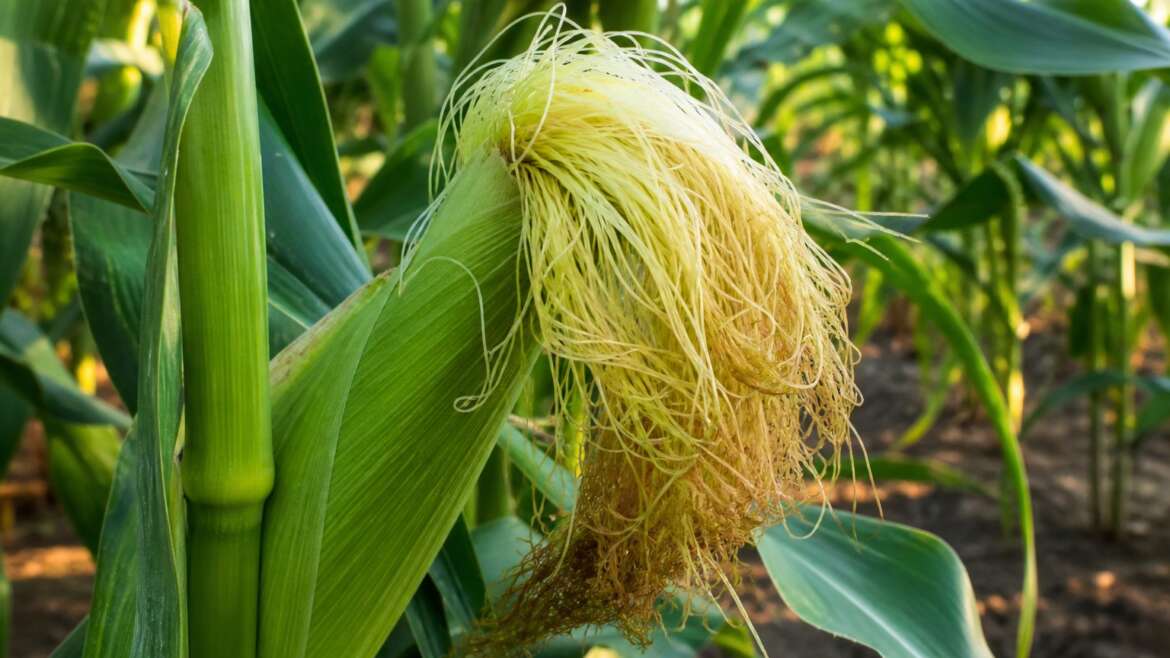
When sweet corn reaches pollination, it begins to reveal the part of itself that was hidden. The tassel has lifted above the leaves like a loose flag. Lower down, an ear presses against its husk, and from the top spills a soft tangle of silk. It looks decorative, almost accidental, the sort of thing a cook later pulls away by the handful and complains about.
But corn silk is not packaging. It is the crop’s most delicate wiring. Each thread is a living path from the outside air to one possible kernel inside the husk. If pollen reaches that silk at the right time, a kernel can form. If it does not, that place on the cob remains empty.
This is why a half-filled ear of corn can feel so mysterious. The plant looked tall enough. The leaves were green enough. The tassels were there. Then harvest arrives and the cob has gaps, blank tips, or scattered missing kernels. Often the answer lies in the brief pollination window, where planting layout, weather, soil moisture, and the timing of the silks meet.
The ear is a hidden flower
Corn makes its male and female flowers on the same plant, but in different places. The tassel at the top produces pollen. The ear, wrapped in husks along the stalk, carries the female flowers. Iowa State University Extension explains that the silks emerging from an ear shoot are the functional stigmas of those female flowers, and that every potential kernel, or ovule, develops its own silk.1
That is the small astonishment tucked inside an ordinary ear of corn. The silk is not a shared fringe. It is individual correspondence. One silk belongs to one ovule. A single ear can carry hundreds of these threads, each trying to reach beyond the husk far enough to meet wind-borne pollen from the tassels above.
Once a pollen grain lands on a receptive silk, it germinates and sends a pollen tube down the silk toward the ovule. Iowa State notes that fertilization of the ovule occurs within about 24 hours after pollen lands on a silk.1 The kernel you later butter and salt begins as a successful meeting between one drifting grain of pollen and one waiting thread.
Why the silks keep growing
Fresh corn silk looks almost too fragile for the job. It is pale, moist, and easily bruised between fingers. That softness is part of its function. Purdue’s corn specialists describe silks as having the greatest water content of any corn plant tissue, which makes them especially sensitive to the plant’s moisture status.2 A silk has to elongate from the ovule, travel through the husk, and emerge into the air while it is still receptive.
Under good conditions, the timing is elegant. Silks emerge while the tassels are shedding pollen, and the plant gives itself a moving window of possibility. Iowa State notes that silks may grow about 1 to 1.5 inches per day and continue elongating until fertilized.3 That is why unfertilized silks can become long and tangled. They are still searching.
After successful fertilization, the story changes. Purdue describes a simple field check: within two to three days after an ovule is fertilized, the base of its silk collapses and detaches from the immature kernel, while silks attached to unfertilized ovules remain attached and may continue to lengthen.4 That detachment—not color alone—is what the test uses. Exposed silks also brown as they age or dry, so brown silk by itself does not prove every ovule was fertilized.
Corn wants company
Because corn is wind-pollinated, a single proud row is often a poor design. Pollen falls and drifts from tassels. Some lands on leaves. Some lands on soil. Some may reach silks, but a long thin line of plants gives the wind too many chances to carry pollen away from the ears that need it.
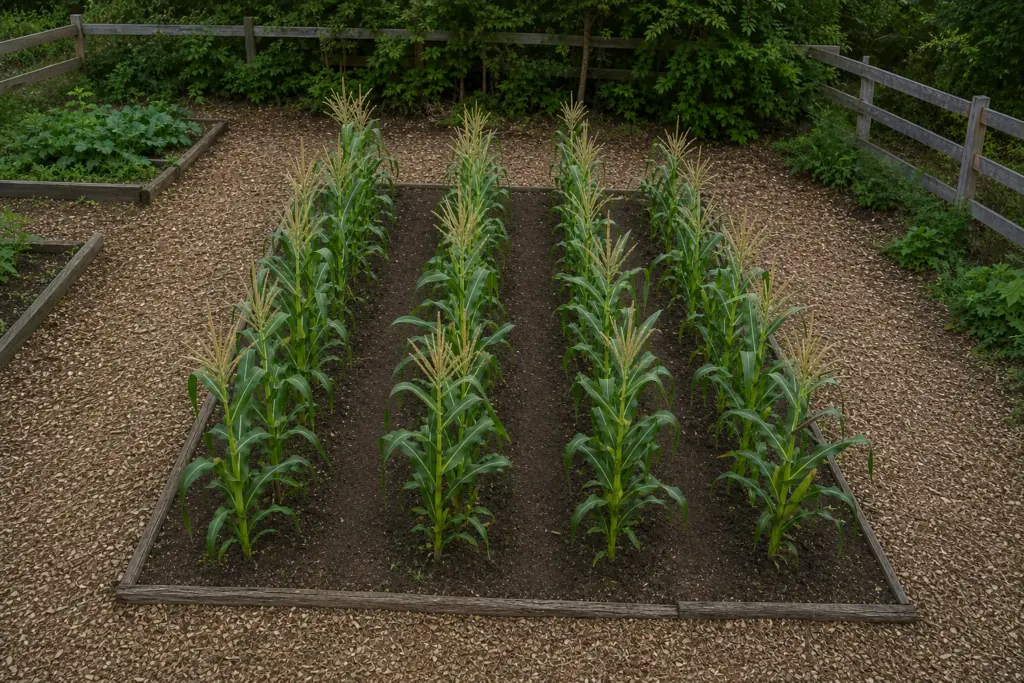
This is why extension guides keep repeating the same advice: plant sweet corn in blocks, not in one or two lonely rows. Iowa State’s home garden sweet corn guide recommends blocks of four or more short rows to promote pollination, and notes that poorly filled ears are usually the result of poor pollination.5 Utah State University Extension gives the same broad instruction: plant corn in blocks to ensure good pollination and ear development.6
A block is not fancy. It simply places tassels and silks near one another from several directions. Four short rows are often better than one long row with the same number of plants. In a small garden, that can mean a square bed, a broad patch, or several tight rows tucked together where the wind can stir pollen through the planting instead of past it. The same geometry matters in a Three Sisters planting: one decorative trio can show the crop architecture, but it is unlikely to pollinate corn reliably.
The vulnerable week
Corn can look sturdy enough to ignore until you understand how narrow its pollination moment is. The plant may stand shoulder-high and muscular, but the future ear depends on tender silks emerging at the same time pollen is available. If that rhythm slips, kernels are lost before they ever become visible.
Heat and drought can interfere from both sides. Iowa State explains that high temperatures above 95 degrees Fahrenheit with low relative humidity can dry exposed silks, while stress during pollination can affect kernel development.3 Purdue points to severe drought stress as the most common cause of incomplete silk emergence, because moisture deficits slow or delay silks as they try to grow out of the husk.2
That delay matters because pollen does not wait forever. If a dry spell holds the silks back while tassels shed their pollen, the plant’s two flower systems fall out of conversation. The tassel has spoken. The silks arrive late. The cob records the missed timing as blanks.
For gardeners, the practical lesson is plain: do not let corn struggle for water during tasseling, silking, and early ear fill. Utah State warns that water stress reduces yield and ear quality, and Iowa State advises watering sweet corn during pollination if the soil is dry.65 This is not the week for heroic drought tolerance. It is the week when the plant is building the map of the ear.
How to help a small patch
If your corn patch is small, pollination may need a little assistance. The first help is design: plant enough plants close enough together. The second is timing: water deeply before severe wilt, keep weeds from competing, and avoid letting the bed dry hard just as tassels and silks appear.
Hand-pollination can also help in tiny plantings, especially where only a few stalks are shedding pollen at once. UF/IFAS Gardening Solutions suggests two simple methods: use a cut tassel like a wand to shake pollen onto the silks, or strip pollen from the tassel and deposit it directly on the silks.7 Early to mid-morning is usually the better time because pollen shed normally occurs then, before temperatures climb.3
This does not need to become laboratory work. A gentle shake of tassels over fresh silks on one or more mornings while pollen is visibly shedding can improve the odds. The goal is not to coat the whole plant in yellow dust. It is to help more receptive silks receive pollen while they are still alive and connected.
Reading a patchy ear
A poorly filled ear is frustrating, but it is also informative. Bare cob where a kernel never began points toward failed pollination. Shrunken whitish or yellowish remnants indicate kernels were fertilized and then aborted. Tip gaps can arise when later-emerging tip silks miss available pollen, but tip kernels are also the youngest and most vulnerable to stress during early grain fill.8 A sparse cob can therefore reflect too few plants, a timing mismatch, silk clipping, drought and heat, or stress after fertilization.
Iowa State’s home garden guide links poorly filled ears to poor pollination, hot dry winds, dry soil conditions, and improper planting layout.5 Purdue’s distinction between blank ovules and shriveled aborted kernels makes that harvest inspection more useful. The ear is not simply bad corn. It is evidence of weather, spacing, water, and timing during pollination and early fill.
There are other causes of small or imperfect ears, of course. Crowding and low fertility can delay silking or restrict ear development. Raccoons, birds, earworms, and disease can damage a crop after pollination. The ear is evidence, not a diagnosis by itself; read it alongside silk condition, recent weather, spacing, and the health of the whole plant.
Harvest after the silk has done its work
The silk also helps tell you when to harvest, though it should not be the only clue. Fresh silk is pale and moist while the ear is still developing. As kernels fill, the silk dries and turns brown. Utah State recommends harvesting sweet corn when ears are plump, silks are dry, and kernels are milky.6 The milky kernel test matters because dry silk alone can mislead you after heat, wind, or uneven pollination.
Peel back only a small part of the husk if you need to check. Press a kernel with a thumbnail. Watery juice means the ear is still young. A milky liquid marks the fresh-eating harvest stage. Doughy paste means the ear is overmature. Use or refrigerate sweet corn promptly; standard sugary cultivars lose sweetness faster after harvest than sugary-enhanced and supersweet types.5
Final thoughts
Corn silk is easy to treat as a nuisance because we meet it most often at the kitchen counter, clinging to the ear after the husk is gone. In the garden, it deserves more respect. It is not waste. It is the visible part of a hidden flowering system, each strand reaching from a possible kernel toward the weather.
Once you know this, a corn patch becomes easier to read. Blocks make sense. Watering at silking makes sense. Patchy ears become records rather than riddles. Even the act of shucking changes a little. Those threads were not in the way. They were the way the ear was made.
References
- Iowa State University Extension: The birds and bees of corn pollination
- Purdue University Agronomy Extension: Silk development and emergence in corn
- Iowa State University Extension: Corn pollination, effect of high temperature and stress
- Purdue University Agronomy Extension: A fast and accurate pregnancy test for corn
- Iowa State University Extension: Growing sweet corn in the home garden
- Utah State University Extension: How to grow sweet corn in your garden
- UF/IFAS Gardening Solutions: Corn
- Purdue University Agronomy Extension: Causes of poor kernel set in corn