

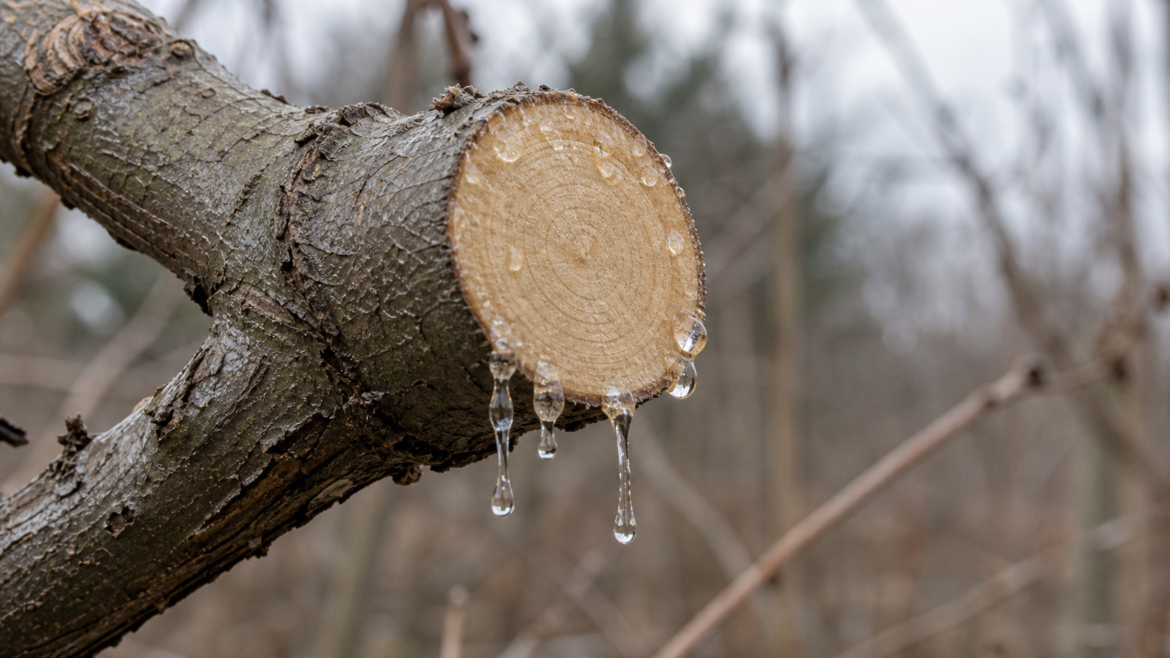
A fresh cut on a March branch can look unexpectedly dramatic. One minute you are doing the sensible work of late-winter pruning. The next, a maple twig or grape cane is shining with clear drops, and the cut seems to be weeping as if the plant has changed its mind about the whole operation.
This is the sort of small garden mystery that invites either panic or folklore. The sap looks precious. It beads on the pale cut surface, runs down the bark, and sometimes keeps going long after the pruners have been put away. But in many cases, especially with a fresh cut on a healthy deciduous tree or vine, that bright spring bleeding is not an emergency. It is a visible sign that the plant’s plumbing has started moving again.
The cut is not bleeding like an animal
The word “bleeding” is useful because it describes what we see, but it can also mislead us. A tree is not losing blood. It is leaking sap from its vascular system, the network that moves water, minerals, sugars, and chemical signals through stems and roots. The Royal Horticultural Society explains the useful distinction: phloem sap carries sugars from leaves to storage tissues, while xylem sap is the more watery stream that carries root-absorbed nutrients upward.3
In late winter and early spring, that system begins to stir before the garden looks fully awake. Roots take up water when soil conditions allow it. Stems respond to changing temperatures. Buds begin preparing for leaf expansion. If a branch is cut while internal pressure is pushing sap toward the canopy, the cut face becomes the easiest exit.
Purdue Extension describes early spring trees as moving water, minerals, and carbohydrates upward to support new buds, leaves, and shoots. If a limb has just been removed, some of that flow reaches the wound and has nowhere to go but out.2 Maples add a distinctive freeze-thaw pressure cycle; our closer look at why maple sap runs before the leaves follows that mechanism in detail. That is why the sight can be so sudden. Yesterday the branch was dry and gray. Today the same cut looks as if a tiny tap has been opened.
Which plants make the showiest droplets
Nearly any woody plant can leak sap from a wound, but some are famous for it. Maples, birches, elms, walnuts, hornbeams, grapevines, and a handful of other trees and climbers can bleed noticeably when cut at the wrong point in the season. Iowa State University Extension notes that maple, birch, and elm may bleed heavily when pruned in late winter or early spring, but that this sap loss does not harm the tree and will eventually slow and stop.1
The timing is part of the trick. Many deciduous plants are quietest after leaf fall and before the strongest spring pressure begins. By March, however, some species have already started moving sap upward. The RHS lists grapevines, birches, walnuts, and maples among plants that can be particularly prone to bleeding, with late winter to early spring as the common season for seeing it.3
This is also why two shrubs can respond very differently to the same pair of pruners. A dogwood cut may stay dull and dry. A birch cut nearby may sparkle. The difference is not guilt, weakness, or a sign that the tree is being emptied. It is species, timing, and pressure.
Should you be worried?
For a fresh, clean pruning cut on an otherwise healthy plant, usually not. The amount looks alarming because it is concentrated at one small wound, but the plant is not a closed vessel draining away. It is a living system continually moving water through roots, wood, buds, and leaves. As the wound begins to dry and the plant responds around the cut, the flow slows.
Purdue puts it plainly: this spring sap flow is not a cause for alarm, and the overall health of the tree is not affected under normal circumstances. The source also notes that as callus material develops around the wound, the flow slows to a stop.2 Iowa State’s maple advice is even shorter and kinder to nervous gardeners: the trees will not bleed to death.1
There are still sensible limits. A large, ragged wound is not good pruning simply because sap loss is tolerable. A tree with many big limbs removed at once has other problems: lost leaf area, altered structure, sun exposure on bark, and more wound surface to close. The sap is the visible drama. The pruning decision itself is usually the more important story.
What to do when the cut is dripping
The first step is boring and correct: do very little. Do not plug the cut with wax. Do not wrap it in tape. Do not paint it with tar, wound dressing, or any homemade paste. The RHS says there is no practical way to stop bleeding from a wound and no longer recommends binding, wrapping, or painting pruning cuts, since trapped moisture and poor ventilation can encourage fungal problems.3 Purdue gives the same practical advice: leave the area uncovered so the tree can respond naturally.2
If sap is dripping where it will stain a bench, car, or walkway, redirect the object, not the tree. Place a bucket or scrap board underneath for a day or two if needed. The cut is already made, and fussing with it usually adds damage rather than protection.
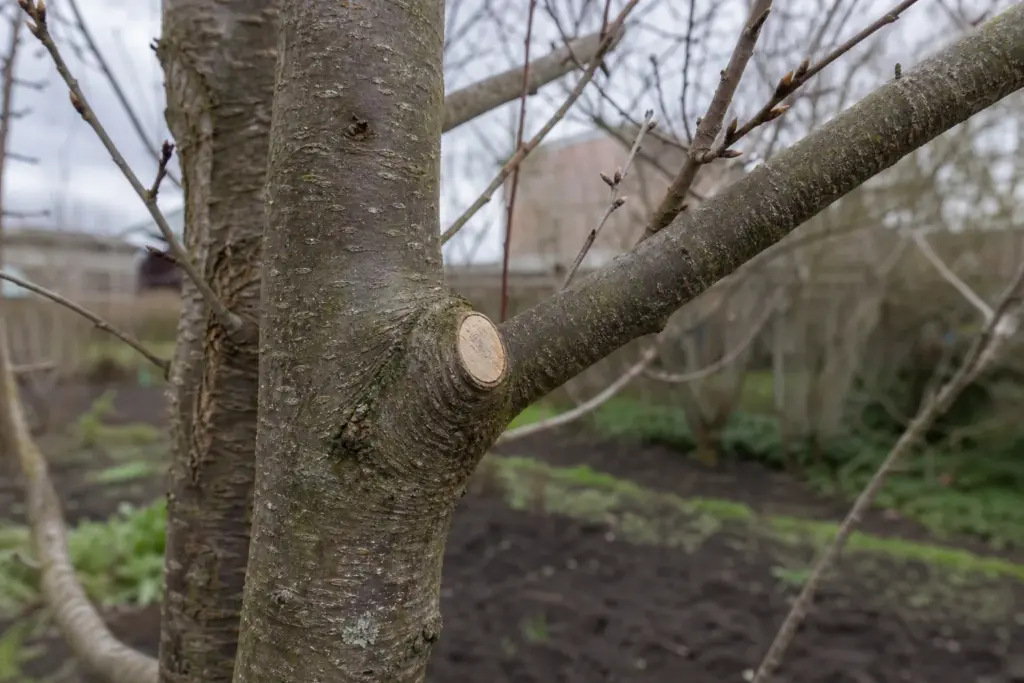
Then look at your pruning technique. Good cuts matter more than heroic aftercare. Iowa State’s pruning guide points gardeners to the branch collar and branch bark ridge as the proper landmarks, and warns against flush cuts.4 A cut just outside the collar leaves the tree’s natural wound response zone intact. A flush cut removes too much. A long stub leaves dead wood that the tree cannot close over neatly.
Timing without superstition
Once you have watched a maple or birch drip for a whole afternoon, it is tempting to decide that winter pruning is dangerous. That is too broad. Late winter remains a common pruning season for many shade trees and fruit trees because branch structure is visible and the tree is close to spring growth. Iowa State’s pruning FAQ lists February and March as a common window for shade trees, and late February through early April for many fruit trees.4
The better rule is narrower: learn which plants in your garden are bleeders, then check guidance for the species and your region. Birches are best left unpruned unless a cut is needed; the RHS recommends late summer to mid-winter. For Japanese maples, it recommends after leaf fall but before January. Grapevines show why local guidance matters: the RHS recommends pruning after leaf fall but before Christmas to reduce bleeding, while Iowa State’s fruit guidance gives late February through early April.34
In other words, timing is not a moral test. It is a way of matching the job to the plant. Remove dead, broken, rubbing, or hazardous wood when it needs attention. Save optional shaping on known bleeders for a less dramatic season.
When sap means something else
Fresh, clear sap from a recent pruning cut is one story. Dark, frothy, foul-smelling liquid from an old wound is another. Old pruning cuts, cracks, or injuries that ooze stained liquid may be associated with bacterial wetwood or slime flux, a condition Iowa State describes on elm, cottonwood, mulberry, maple, birch, ash, linden, redbud, and other deciduous trees.5
The difference matters because the response is different. You cannot cure slime flux by painting the trunk, and you cannot make a spring sap drip safer by treating it like disease. With old, smelly ooze, the best practical care is to reduce stress where you can: avoid trunk wounds, keep soil from being compacted over roots, water during real drought, and prune properly. With fresh spring bleeding, patience is usually the right medicine.
Useful sap-season pruning supplies
Bleeding cuts do not need a special sealant, but the work is much better with sharp, clean tools. A small kit is enough for most home gardens.
- Bypass pruning shears for live stems and small branches, where a clean slice is kinder than crushing.
- A folding pruning saw for branches that are too large for hand pruners, especially when you need a controlled three-cut removal.
- A compact garden tool sharpener to keep pruner and saw edges from turning neat pruning into torn pruning.
A small window into spring
There is a quiet lesson in a bleeding pruning cut. Long before the garden has leaves, the plant is already reorganizing itself around the next season. Roots are awake enough to pull water. Buds are close enough to growth to draw it. The gardener happens to make one opening in that hidden circulation and suddenly the invisible becomes visible.
So if a March cut begins to shine, pause before worrying. Read it as a sign of motion. Make better cuts next time, choose better timing for the species if needed, and leave the wound open to air. The tree is not asking for a bandage. It is showing you that spring has already begun inside the wood.
References
- Iowa State University Extension and Outreach: Sap is flowing from a pruning cut on my maple tree. Should I be concerned?
- Purdue Extension Forestry and Natural Resources: Tree has large icicle from where it is dripping sap. Is this a concern?
- Royal Horticultural Society: Bleeding from pruning cuts
- Iowa State University Extension and Outreach: Pruning FAQs
- Iowa State University Extension and Outreach: Sap is oozing out of an old pruning cut on my tree. Is this a serious problem?