
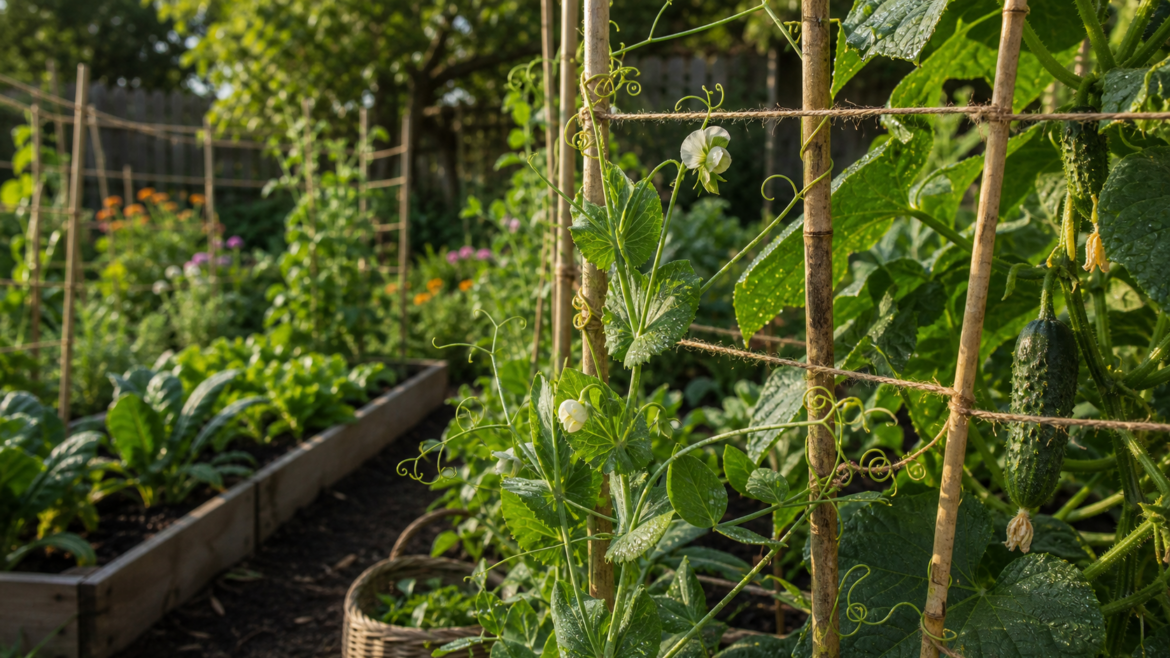
A climbing plant begins with an apparent problem: it wants light, but it has not paid the full woody price of a tree. Rather than relying on a self-supporting trunk, it borrows the garden. A pea finds netting. A cucumber finds twine. A clematis catches a wire with a curling leafstalk. A grapevine reaches, touches, tightens, and turns a fence into a ladder.
To a gardener, this can look charmingly accidental. One morning the vine is leaning. A few days later it has made a green decision and fastened itself to something nearby. But the habit is not vague enthusiasm. Climbing plants use different tools, and each tool asks for a different kind of support.
Understanding those tools makes trellising less frustrating. It explains why peas love fine mesh, why pole beans need something they can wrap around, why some vines cling too aggressively to walls, and why a heavy cucumber plant needs a structure before it becomes a sprawling argument in the path.
The economy of climbing
Climbing is a botanical shortcut. Instead of investing heavily in self-supporting wood, a vine can use a twining stem, a tendril, a petiole that coils around a thin support, aerial rootlets, or adhesive disks to reach upward. Illinois Extension emphasizes that the attachment method and the support have to suit each other.1
The tradeoff is obvious in a vegetable bed. A cucumber sprawled on the ground occupies precious space and makes harvesting and inspection awkward. The same plant trained upward can turn one narrow strip into a leafy wall. Illinois Extension notes that supports free ground space, improve access, and can help cucumbers grow straighter with fewer ground spots.2
That does not mean every vine wants the same trellis. A structure that suits a bean may not suit a pea. A wall that supports ivy may be useless to a cucumber. The first question is not “How tall should the support be?” but “How does this plant climb?”
Tendrils are touch made visible
Tendrils are the most enchanting climbers because they make plant movement visible at human scale. A young tendril extends like a green question mark, slowly sweeping the air. When it brushes something narrow enough to grip, it begins to curl. Botanists call that touch-directed growth thigmotropism.3
Cucumber tendrils have been studied closely because their coils behave like remarkable springs. In the original experiments, older tendrils overwound rather than uncoiled under tension, responding softly at first and then stiffening at larger extensions.4 In garden terms, the coil is not decoration: it is a spring whose response changes with the load.
This is why fine support matters. A pea tendril cannot clasp a thick fence rail the way a hand grasps a handle. It needs slender contacts: string, brushy twigs, netting, narrow bamboo, wire, or small mesh. If the support is too broad or too far away, the tendrils will keep searching while the plant leans and tangles with its neighbors.
Peas want something fine and early
Peas are a good teacher because they are eager but delicate. Their tendrils cling beautifully to fine mesh, string, twiggy pea brush, or narrow fencing. Utah State University Extension notes that taller varieties are more productive and easier to harvest when supported, while snap and snow peas climb naturally once the structure is in place.5
Install the support at planting or soon after. Waiting until the vines flop is the classic mistake. Peas do not enjoy being untangled and stood upright after their stems have bent. A simple support can be enough: two stakes with netting, a panel of lightweight wire, a line of twiggy prunings pushed into the row, or a temporary frame with compostable twine.
The mesh should begin low. The first tendrils often appear when the plant is still modest, and a support that starts twelve inches above the soil may be invisible to them. Give peas something to find before they need it, and they will make you look more organized than you are.
Cucumbers need strength before they need rescue
Cucumbers have tendrils, but a mature cucumber plant is heavier and more assertive than a pea vine. Its leaves are broad, its stems are juicy, and its fruit adds weight exactly when summer storms and hurried harvesting begin testing the support. Utah State University Extension notes that most long cucumber varieties are curved unless grown on a trellis.6
The structure should be ready before the plant begins running sideways. Once cucumber vines have sprawled, lifting them can kink or snap stems, damage blossoms, and tear the small tendril attachments the plant has already made. A sturdy A-frame, cattle panel, wire mesh, bamboo ladder, or twine grid can all work if it is anchored well. The test is not whether it looks upright in June. The test is whether it will still stand in August when it is carrying wet leaves and fruit.
Small cucumbers usually hang without slings, while heavier fruit and melons may need hammocks so their weight does not pull on the vine.2 Check small mesh as fruit develops so it does not become trapped. A trellis should hold the plant, not imprison the harvest.
Twiners are a different kind of climber
Not every climber uses tendrils. Pole beans, morning glories, honeysuckle, and many other vines climb by twining their stems around a support. They need something narrow enough for the stem to wind around: poles, strings, canes, wire, or thin rails. Flat lattice can work if the openings and edges are usable, but a broad board is not a pole.
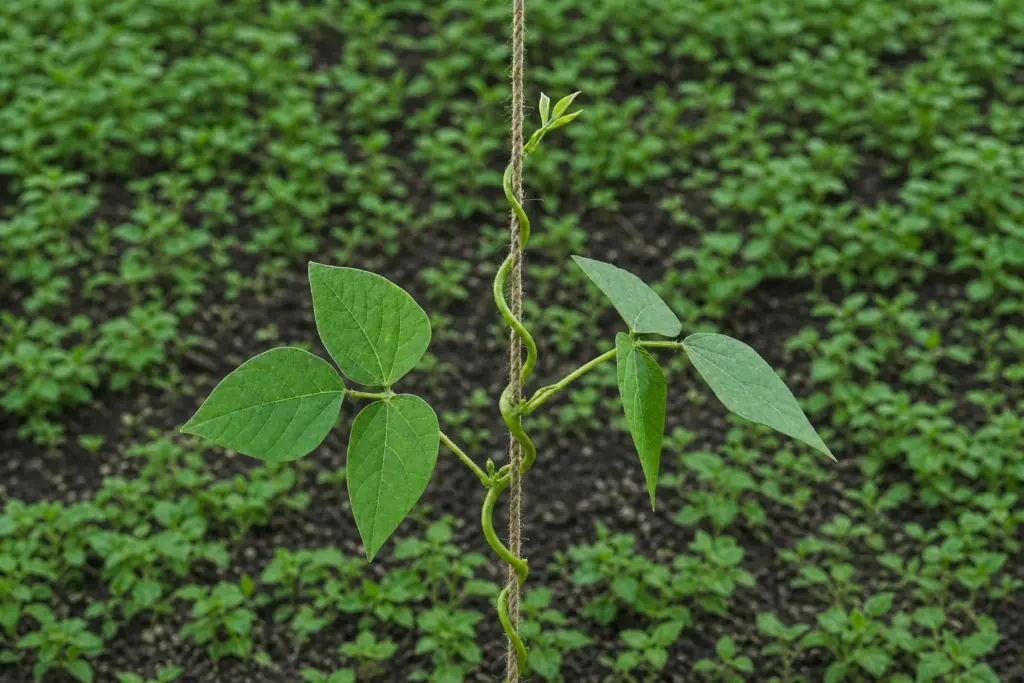
Twining also has handedness, although labels such as “clockwise” become confusing when the viewpoint changes. A global survey of 1,485 stems found that 92 percent formed right-handed helices, independent of latitude or hemisphere; individual species can still differ.7 In the garden, follow the turn a young shoot has already begun rather than winding it the other way.
Scramblers and ramblers are different again. Some climbing roses, long-caned blackberries, and sprawling ornamentals do not truly climb by tendril or twining stem. They lean, hook, and extend. They need tying, training, and pruning. Give them a trellis as if they were peas, and they will ignore your optimism.
Match the support to the plant
Good support starts with scale. Fine tendrils need fine contacts. Vigorous twiners need vertical lines. Heavy fruit needs a structure with real anchoring. Self-clinging vines need a surface you are willing to let them touch for a long time.
For peas, use netting, twiggy brush, or closely spaced string. For cucumbers, use a stronger mesh, angled panel, cattle panel, or well-braced frame. For pole beans, use poles, teepees, or vertical twine. For clematis, use thin wires or mesh because the plant climbs by wrapping leaf petioles; a suitably sized cultivar may also thread through a robust companion shrub if it will not overwhelm it. For grapevines, use strong permanent wires because the plant becomes woody and heavy.
Also think about light. Tall supports belong where they will not shade crops that need full sun, unless shade is part of the plan. For a Northern Hemisphere bed, NC State Extension recommends grouping tall crops and trellised vines on the north side to reduce shade on shorter plants.8 Apply the same poleward-edge principle south of the equator, and check the actual seasonal sun path around walls and trees. In a small garden, that decision can make the difference between a productive vertical wall and a leafy shadow problem.
Guide, do not strangle
A plant tie should behave like a hand on the elbow, not a knot around the wrist. Use soft ties, loose loops, cotton twine, jute, stretch tie, or clips that do not cut into stems. Leave room for growth. Check ties after a week of warm weather, because June growth can make yesterday’s gentle loop become today’s constriction.
Guide the growing tips while they are young and flexible. Weave cucumber tips gently through mesh every few days. Lean pea vines toward netting before they fall outward. Help a pole bean find its pole once, then let the stem take over. Do not keep rearranging every tendril. The plant is not asking for choreography. It is asking for a usable handhold.
At the end of the season, choose your cleanup based on the material. Compostable twine can often go with spent pea vines if it is untreated and free of plastic. Plastic netting must be removed carefully, especially if birds, snakes, or beneficial insects could become entangled. Permanent wire panels are easiest when vines are cut at the base and allowed to dry before removal.
Useful climber supplies
- VIVOSUN trellis netting: useful for peas, beans, cucumbers, and other light to moderate climbers when stretched tightly between sturdy supports.
- Luster Leaf Rapiclip soft wire tie: helpful for guiding stems without cutting into them. Keep loops loose and check them as vines thicken.
- Vivifying garden jute twine: good for temporary pea strings, bean lines, and soft tying where a natural-looking, cut-to-length material is useful.
Final thoughts
A trellis is not just a garden ornament. It is an invitation written in the plant’s own language. Peas read fine mesh. Beans read poles. Cucumbers read strength and proximity. Grapes read permanence. Scramblers read the gardener’s willingness to tie and prune.
Once you notice the difference, climbing plants become easier and more interesting. The tendril that looked decorative is a sensor, a spring, and a contract with the support beside it. Give it the right thing to hold, and the garden gains height without losing grace.
References
- Illinois Extension: Attachment methods for vines
- Illinois Extension: Starting a Garden: Supporting Plants
- USDA National Agricultural Library: Thigmotropism
- Gerbode et al.: How the cucumber tendril coils and overwinds
- Utah State University Extension: How to Grow Peas in Your Garden
- Utah State University Extension: How to Grow Cucumber in Your Garden
- Edwards, Moles, and Franks: The global trend in plant twining direction
- NC State Extension Gardener Handbook: Vegetable gardening