

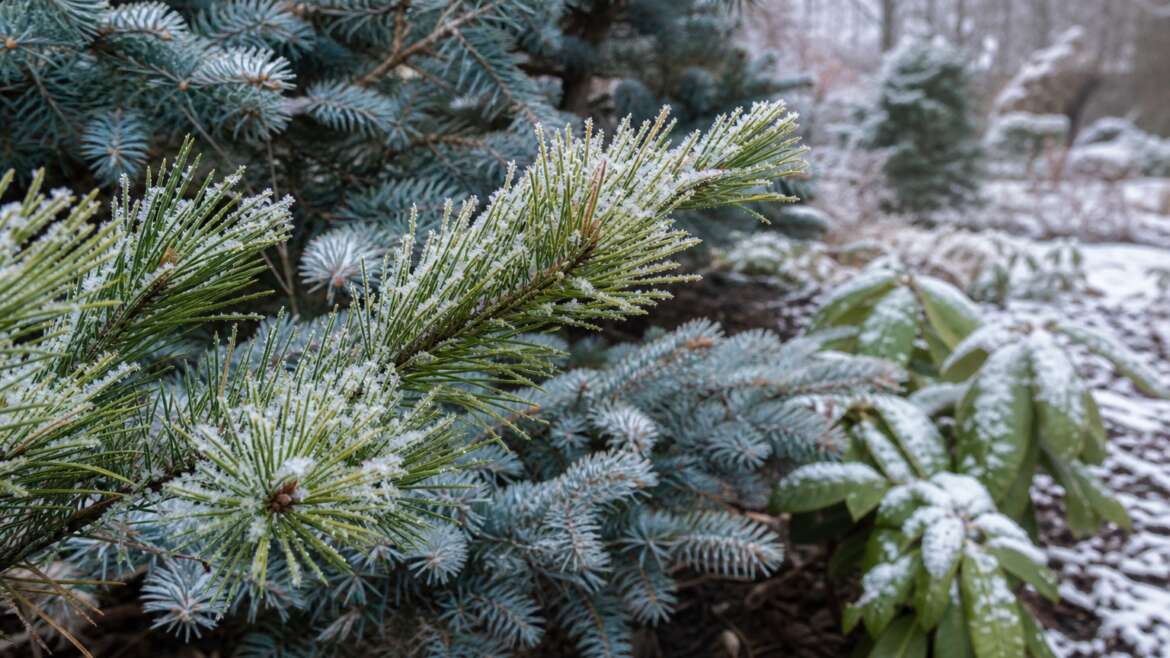
In December, a garden becomes very honest. The flowers have stopped covering weak structure. Herbaceous stems have collapsed or turned to seed. Deciduous trees have taken their color down to bark, bud, and branch. Then the evergreens begin to look almost improbable: pine, spruce, yew, holly, boxwood, rhododendron, juniper. They stand in the cold with leaves still attached, as if they missed the message that winter had arrived.
Evergreen does not mean untouched by winter. It means the plant has chosen a different bargain. A maple avoids winter leaf trouble by dropping its broad leaves in autumn. A pine keeps its needles and accepts a harder problem: how to hold green tissue through cold, dry air, low sun, frozen soil, and wind without losing more water than the roots can replace.
That bargain is why evergreens are so valuable in garden design. They give winter shape and color, but they also reveal plant physiology at its most disciplined. Their beauty is not simply that they stay green. It is that they stay green carefully.
Evergreen leaves are still leaves
A pine needle is not a different category of organ from a maple leaf. It is a leaf that has been built small, tough, and economical. It contains chlorophyll. It exchanges gases. It loses water. It can photosynthesize when light, temperature, and water allow. Its narrow form simply changes the terms.
College of Saint Benedict and Saint John’s University describes conifer needles as having a waxy layer that reduces water loss, with stomata recessed in chambers that help protect them from wind.1 That is the essence of many evergreen needles: less surface exposed, more protection at the surface, and tighter control over the openings that let carbon dioxide in and water vapor out.
This is not only a cold-weather trick. Many evergreen leaves are also drought-aware leaves. Winter can behave like drought even when snow is on the ground. The National Park Service notes that winter snow must melt before a tree can use it and that conifer needles lose less water to the air than broad leaves.2
That is a useful way to think about December: the garden may look wet, but the plant may be thirsty. An evergreen leaf is a living surface exposed to air while the soil below may be locked, cold, or slow. The plant survives by spending water cautiously.
Green does not mean growing fast
Because evergreens stay green, it is tempting to imagine they are simply ignoring winter. They are not. Their growth slows. Their chemistry changes. Photosynthesis is reduced or carefully regulated. On mild days, some evergreen leaves may still use light, but the plant has to balance that light against the danger of cold-damaged photosynthetic machinery.
A Nature Communications study of Scots pine and Norway spruce described boreal evergreen conifers as having strongly regulated seasonal photosynthetic activity, with different mechanisms used to reactivate photosynthesis in spring.3 That phrase, strongly regulated, is the part gardeners should keep. The winter evergreen is not a summer plant wearing green paint. It is a plant managing light under restriction.
This explains why winter sun can be both gift and hazard. Light gives an evergreen the possibility of carbon gain when conditions are mild. But bright sun on a freezing, windy day can increase water loss and stress leaf tissue when roots cannot respond quickly. The plant must keep its green machinery intact until the season becomes safe enough to use it fully again.
Needles are not kept forever
The word evergreen can mislead gardeners into expecting permanent leaves. In reality, evergreens shed foliage too. They simply do it gradually, usually keeping enough young foliage that the plant remains visibly green.
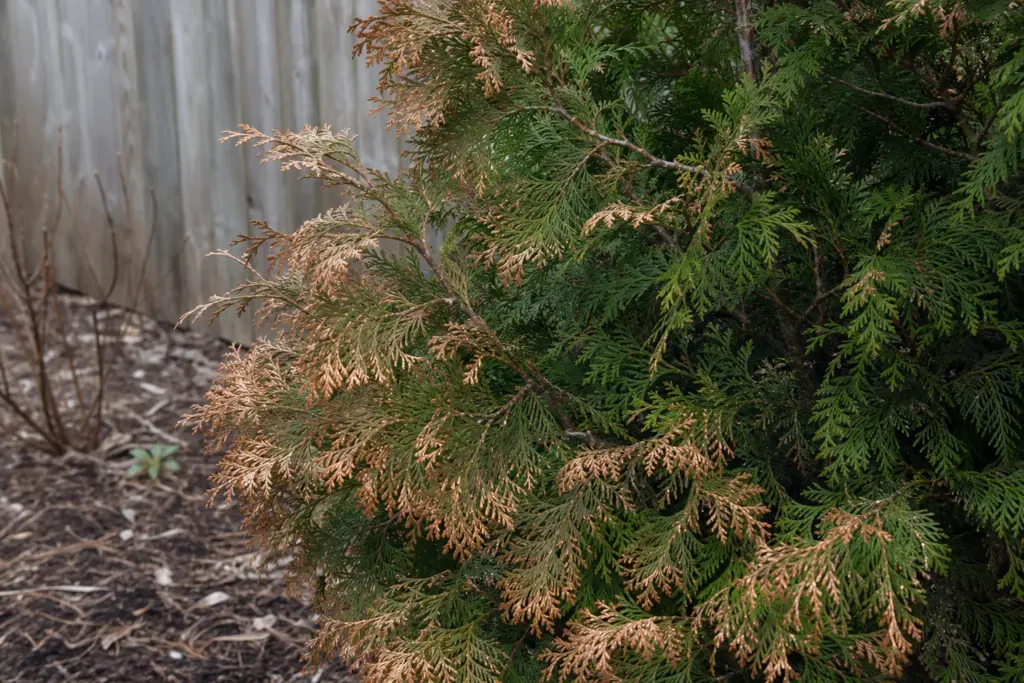
Iowa State University Extension explains that seasonal needle loss is normal: older inner needles on conifers turn yellow or brown and fall, while newer outer needles remain.4 White pines and arborvitae can look especially dramatic when old needles let go. Spruces and firs often hold needles longer, so their turnover is less obvious.
This distinction matters in winter troubleshooting. Brown inner needles, evenly distributed through the older shaded parts of the plant, are often normal aging. Brown tips, scorched outer foliage, one-sided damage, or entire branches dying may point to winter burn, drought, salt, disease, insects, or root trouble. Evergreens are not supposed to look plastic. Some shedding is part of the plant’s bookkeeping.
The danger is drying, not only freezing
Gardeners often worry about cold as if temperature alone were the enemy. For evergreens, winter damage is often a water problem wearing a cold-weather mask. Needles and broad evergreen leaves can continue to lose moisture on sunny, windy days. If the ground is frozen, dry, or root-damaged, the plant cannot replace that moisture fast enough.
PlantTalk Colorado describes needled and broadleaved evergreens as prone to winter desiccation because they retain leaves and continue to transpire, especially when dry soils leave roots unable to replace water lost from foliage.5 This is the logic behind winter burn: the plant browns because it has dried, even though the calendar says winter.
The pattern is often revealing. Damage may be worst on the south or southwest side, where winter sun is strongest, or on the windward face of a shrub. It may show most clearly above the snow line. A low branch buried under snow may stay green while exposed tips bronze or brown. Snow, for all its inconvenience, can be a very good blanket.
Broadleaf evergreens have a harder bargain
Conifer needles are the classic evergreen example, but many gardens also rely on broadleaf evergreens: rhododendron, holly, boxwood, mountain laurel, leucothoe, pieris, skimmia, bay laurel in mild climates, and many others. These plants keep broad leaves through winter, which gives them a different kind of beauty and a different risk profile.
A rhododendron leaf curled and drooping on a cold morning is not necessarily dying. In several broadleaf Rhododendron species, these are reversible, temperature-driven movements: leaves curl and change angle as they get colder, then relax as they warm. Research distinguishes the curl from the change in leaf angle and does not treat either movement as proof that the leaf is injured or simply dehydrated.9 Our closer look at why rhododendron leaves curl in the cold explains how to separate that normal response from lasting winter burn.
Site matters. A broadleaf evergreen on the east or north side of a structure may avoid the worst afternoon winter sun. The same plant facing a reflective driveway with dry wind may brown every March. Hardiness zones tell you whether a plant can survive regional cold. They do not tell you whether the plant will enjoy your particular winter wind tunnel.
How to help evergreens before the ground freezes
The best winter care for evergreens often happens before winter looks dramatic. Water is the first task. Utah State University Extension recommends deep fall watering before the ground freezes to reduce winter desiccation.11 Wisconsin Horticulture gives similar advice, recommending that evergreens enter fall well hydrated and receive water into mid or late November if the ground has not frozen and rain is lacking.7
Do not translate that into soggy soil. Evergreens need moisture, not a swamp. Water deeply, then let the soil drain. New plantings, shallow-rooted plants, sandy soils, and exposed sites deserve the most attention. A well-established pine in good soil may need very little help. A newly planted arborvitae hedge beside a windy driveway may need a great deal.
Mulch is the second task. A loose organic mulch over the root zone moderates soil temperature and protects shallow roots from freeze-thaw swings. Keep it pulled back from trunks and stems; University of New Hampshire Extension warns that mulch piled against trunks can encourage insect, disease, and rodent problems.6
Wind screens work better than wrapping
When a plant is exposed, a winter screen can help. The important word is screen. The goal is to interrupt drying wind and harsh sun, not to mummify the shrub. Missouri Botanical Garden recommends adequate watering, organic mulch over the root zone, and a burlap barrier to deflect wind for winter desiccation problems.8
For a small evergreen, set stakes or a simple frame on the side facing the prevailing wind, then attach breathable burlap so the fabric stands away from the foliage. University of New Hampshire Extension recommends this kind of framed burlap or canvas windbreak.6 A freestanding screen leaves the foliage open to air and light and is easy to remove in spring.
Snow management also matters. If loose, heavy snow is bending branches, brush it gently upward from below rather than beating or shaking frozen growth. Let ice melt naturally; trying to break it away can damage branches.10 Light snow can stay. It shades and insulates rather than acting only as a burden.
Choosing evergreens with winter in mind
A good evergreen is not simply the one that looks best in a nursery pot in May. It is the one whose natural habits match the winter you actually have. In windy open gardens, dense upright arborvitae may need more protection than expected. In dry shade, some broadleaf evergreens may limp through winter with browned edges. In heavy snow country, flexible forms often fare better than brittle ones.
Look at nearby mature plantings before buying. Which evergreens in your neighborhood look clean in March, not just December? Which ones brown every year? Which are protected by buildings, fences, or taller deciduous trees? The best local information is often growing quietly within a few blocks.
Use evergreens as structure, but avoid making them the only structure. Mix needled conifers, broadleaf evergreens where they are suited, deciduous shrubs with strong branching, seed heads, bark, and winter stems. A garden made only of evergreens can feel static. A garden with evergreens as anchors and deciduous plants as changing weather instruments feels more alive.
A winter evergreen check
On a mild December day, walk the garden and look closely. Are old inner needles yellowing evenly, or are outer tips browning? Is the soil dry beneath the mulch? Is a newly planted evergreen sitting in a pocket where wind rushes between buildings? Is road salt or shoveled snow landing on one side? Is a broadleaf evergreen curling temporarily in cold, or staying browned and brittle after thaw?
Do not diagnose too quickly. Winter injury often waits until late winter or early spring to show the full story. Clearly brown foliage may be dead, but green stem or bud tissue can still produce new foliage. Wisconsin Horticulture recommends waiting until mid-spring, after new growth appears, before pruning dead or damaged tissue on many common landscape evergreens.12
What you can do now is practical and quiet: water if the soil is dry and unfrozen, correct mulch that is piled against stems, install a wind screen for the most exposed new plants, and take notes. Winter is a good season for seeing where the garden is generous and where it is severe.
Useful evergreen winter supplies
- Burloptuous gardening burlap roll: useful for making freestanding wind screens around exposed shrubs. Keep the burlap on stakes rather than wrapped tightly around foliage.
- Greenes Fence 4-foot garden stakes: sturdy stakes for holding burlap away from evergreen branches and building simple temporary winter screens.
- Gilmour flat weeper soaker hose: useful for distributing slow water across a small hedge or shrub root zone before the ground freezes; placement and run time still depend on soil and rainfall.
- Luster Leaf digital soil thermometer: can document soil temperature near exposed new plantings. Watering decisions should still depend on soil moisture and whether water can infiltrate, not a universal temperature threshold.
Final thoughts
Evergreens are not winter decorations that happen to be alive. They are living plants holding a difficult line between light and water. Their needles and leaves are built for thrift: wax, shape, stomata, chemistry, and timing all working together so the plant can remain ready without spending itself too fast.
That is why evergreen care is mostly restraint and preparation. Water before the freeze when autumn is dry. Mulch the root zone, not the trunk. Screen the worst wind. Do not panic at normal inner needle drop. Choose plants for the winter you actually have.
In a December garden, green is not an easy color. It is a strategy. Once you see that, every frosted pine needle and curled rhododendron leaf becomes more than seasonal structure. It becomes a small lesson in how plants endure.
References
- College of Saint Benedict and Saint John’s University: Conifer adaptations
- U.S. National Park Service: How do trees change in the fall?
- Nature Communications: Two dominant boreal conifers use contrasting mechanisms to reactivate photosynthesis in the spring
- Iowa State University Extension: Seasonal needle loss
- PlantTalk Colorado: Winter desiccation of evergreens
- University of New Hampshire Extension: Do my new evergreen shrubs need winter protection?
- Wisconsin Horticulture: Keep watering in fall to protect evergreens from winter burn
- Missouri Botanical Garden: Desiccation or winter burn
- E. T. Nilsen: The relationship between freezing tolerance and thermotropic leaf movement in five Rhododendron species
- Iowa State University Extension: How to prevent ice and snow damage on trees and shrubs
- Utah State University Extension: Winter injury
- Wisconsin Horticulture: Winter burn