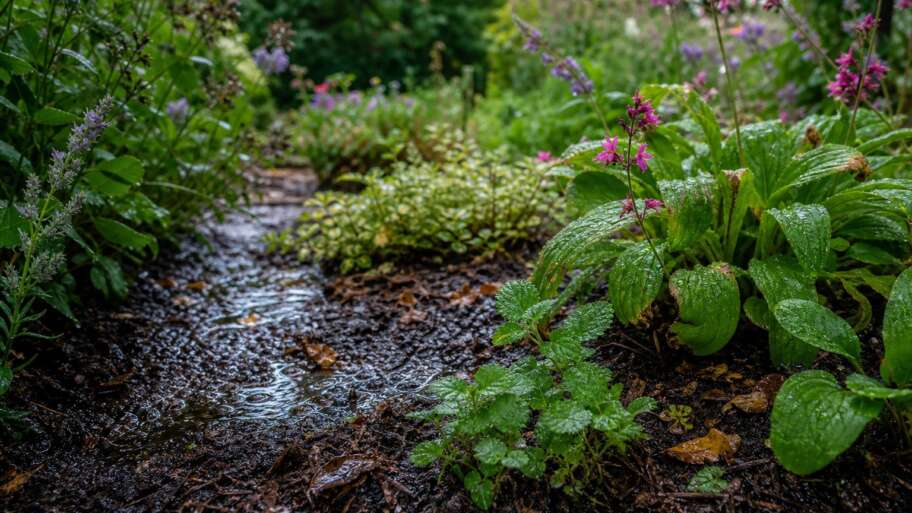

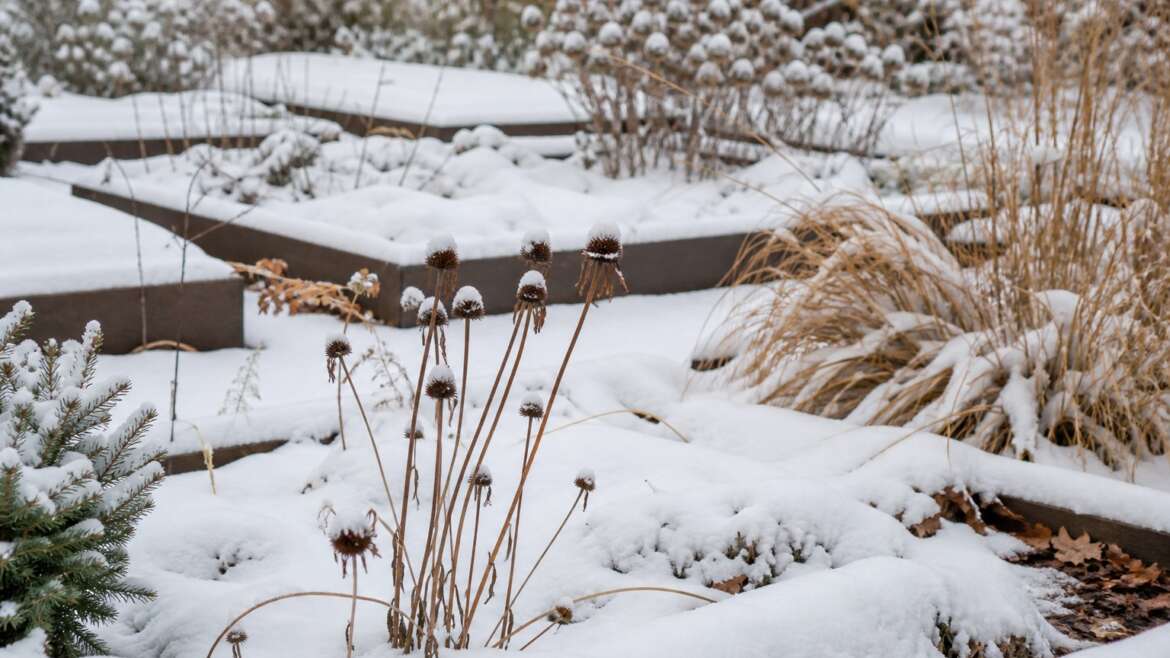
By mid-December, a garden can vanish in the night. Paths soften, beds lose their edges, and the seed heads that looked architectural in November become little dark punctuation marks above a white page. Snow seems to simplify everything. It hides the unfinished jobs, the uncut stems, the fallen leaves that escaped the rake, and the soil you meant to mulch before the cold arrived.
But snow is not just concealment. In a winter garden, it behaves like a temporary structure: roof, blanket, shade cloth, water reserve, and sometimes a small problem waiting for spring. A useful snow is not glamorous. It does not bloom. It does not feed bees. It simply changes the weather at the surface of the ground, and that quiet change can decide how well roots, crowns, bulbs, and young shrubs come through winter.
Snow is cold, but it is also shelter
The first surprise is that snow protects because it is full of air. A fresh snowpack is not a solid slab of ice. It is a loose architecture of crystals with tiny spaces between them, and those spaces slow the movement of heat. The National Snow and Ice Data Center notes that snow acts like an insulating blanket, helping protect soil and the organisms within it from swings in the air above.1
This is why a garden with steady snow cover can be safer than a bare garden in bitter wind. The air temperature may drop sharply, but the soil beneath snow changes more slowly. Moisture is held in place. The upper few inches of earth are less exposed to drying wind and sudden sunlight. The garden is still cold, of course, but it is less violently cold.
Fresh, uncompacted snow contains far more trapped air than a dense, worked layer. A footprint does not ruin a bed, but repeated traffic over shallow crowns compacts the very pore space that provides insulation. The useful part of snow is not its whiteness alone. It is the airy, quiet space it makes between the roots and the weather.
Why roots care more than branches
Gardeners often think of winter hardiness in terms of stems and buds. We ask whether a shrub can take a certain minimum temperature, whether a rose cane will survive, whether flower buds on a hydrangea will be lost. Those questions matter, but shallow roots and new root systems can be more vulnerable to winter injury than the branches above suggest.
North Dakota State University Extension notes that shallow-rooted plants are especially susceptible to winter injury and that snow traps heat, helps soil retain moisture, and limits frost penetration.2 This is the practical heart of snow cover in a garden: it protects the part of the plant that cannot simply grow a thicker bark.
New plantings benefit especially. A shrub planted in autumn may not have a deep, settled root system yet. A perennial divided late in the season may be holding itself with a smaller crown than usual. Garlic, strawberries, shallow-rooted perennials, young trees, and many bulbs all spend winter close to the line between sleeping and suffering. A layer of snow can help keep that line from moving too fast.
If your climate has unreliable snow, an appropriate organic mulch can provide some of the same buffering. Shredded leaves, straw, pine needles, and wood chips are not interchangeable for every plant, so match the material and depth to the crop, drainage, and local winter pattern. Around trees and shrubs, keep mulch pulled back from the trunk in a broad donut rather than packed against bark.
Snow keeps winter from stuttering
Plants are good at winter when winter behaves like winter. Trouble often comes from the awkward middle: a surface thaw followed by a hard freeze, a sunny day that warms bark, a night that drops suddenly. Repeated freeze-thaw cycles can lift shallow-rooted plants from the soil, expose roots, and damage crowns. Illinois Extension describes snow as useful because it moderates soil temperature, minimizes freeze-thaw cycles, and protects the crown of perennial plants.3
This is one reason old gardens can look calmer under snow. The mulch layer is hidden, the leaves are pinned in place, and the soil is not being asked to freeze, thaw, crust, heave, and freeze again every few days. Snow does not make the garden warmer in the way a greenhouse does. It makes the garden less erratic.
That steadiness matters for spring bulbs and crowns. A bare bed in a sunny winter spell may warm at the surface, then freeze hard again. A snowy bed often stays slower and dimmer. It waits. For many plants, waiting is exactly the right winter skill.
When the snow is too heavy
Not every snow is kind. Light powder settles like insulation. Heavy wet snow can behave more like a load. It bends arborvitae, flattens young boxwood, pulls stems of ornamental grasses apart, and can split multi-stemmed shrubs that were already carrying weak angles.
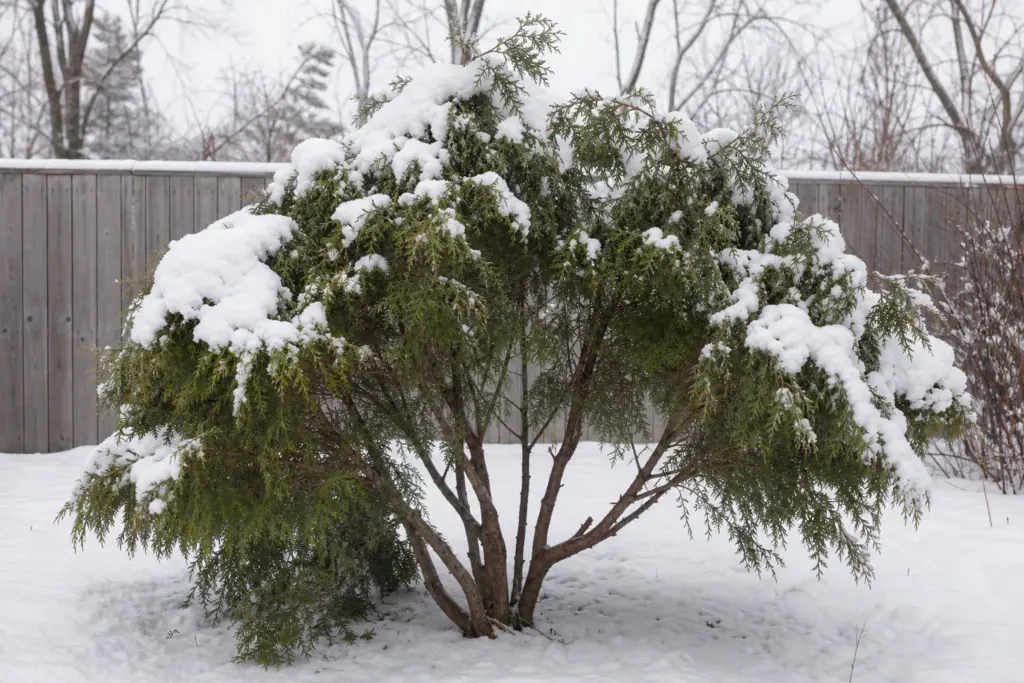
Iowa State University Extension recommends carefully brushing heavy wet snow from small trees and shrubs with a broom using an upward motion so the branches are not pushed farther down.4 That upward motion is a small detail, but it matters. A branch under snow is already stressed. Brushing downward can add force in the direction of breakage.
Ice is different. If a shrub is glazed with ice, it is usually better to leave it alone unless a branch is creating an immediate hazard. Beating ice from branches can cause more damage; in most cases, let the ice melt naturally and later prune what has truly broken.4
For narrow evergreens that splay open every winter, prevention is cleaner than rescue. Before heavy-snow season, broad flexible strips of fabric or flexible cord can support a columnar arborvitae or upright juniper and help it shed snow. Avoid narrow ties that can cut into bark, and remove the support after the risk of heavy snow has passed.4
The trouble hidden under the white
Snow shelters plants, but it also shelters anything living close to the ground. Voles, mice, and rabbits can use snow as cover while feeding on bark, crowns, bulbs, and grass. Iowa State University Extension notes that prolonged snow cover can make animal damage more likely, and that mice and rabbits may girdle small trees while voles and mice can feed on bark and perennial crowns.5
The important lesson is that animal protection must be taller than the winter garden, not just taller than the autumn garden. A young fruit tree with a short trunk guard may look protected in November. After two feet of snow, a rabbit can feed higher than expected. One-quarter-inch hardware cloth cylinders around vulnerable trunks should stand above likely snow depth; bury the lower edge 2 to 3 inches where voles are a concern, or pin it firmly to the soil so rabbits cannot slip underneath.5
Mulch plays a double role here. It protects roots, but deep mulch pressed against trunks can create a comfortable hidden corridor for rodents. Keep the root zone covered, but leave a clear ring around bark. In winter gardening, kindness to roots should not become hospitality for bark-chewers.
Clean snow, salty snow, and shoveled snow
Clean snow from a path can be useful. If a bitter cold period is coming and a perennial bed is bare, moving a little unsalted snow over exposed crowns is a reasonable act of gardening.2 Do it lightly. You are adding insulation, not building a compacted wall.
Snow from streets, salted sidewalks, and treated driveways is different. It may contain deicing salts and road grit that you do not want concentrated around roots. Iowa State University Extension explains that excessive salt in soil can keep roots from taking up enough water even when moisture is present, while salt spray can dehydrate foliage; evergreens often show the injury as browning needles and twig dieback.6
That makes snow storage a design issue. Try not to pile salty snow on vegetable beds, rain gardens, young shrubs, or the same strip of lawn every storm. If salt accumulates, water the area deeply after the ground thaws where the soil drains freely, and redirect runoff if it repeatedly enters plantings. Better still, shovel early, use deicers sparingly, and keep treated snow out of beds when you can.6
How to work with snow
The best winter snow work is quiet. Leave light snow on perennial beds. Let it settle over leaves and seed heads. Avoid compacting planted areas with repeated foot traffic. If stems of grasses or perennials collapse, resist the urge to tidy everything in midwinter unless the mess is causing a real problem. Those stems can catch more snow, and more snow can mean a steadier crown.
After a storm, check the plants that carry weight: young evergreens, hedges, boxwoods, upright conifers, espaliered fruit, and shrubs near rooflines. Brush heavy snow up and out. Look at animal guards after snow depth rises. Notice where shoveled snow lands. These small observations are more useful than heroic winter gardening.
When the thaw finally comes, let the garden drain. Snowmelt is gentle when it can soak in, but damaging when it pools, refreezes, or carries salt into the same root zone year after year. If a low bed repeatedly sits under icy meltwater, the winter problem may really be a grading problem, a path problem, or a downspout problem waiting for spring repair.
Useful winter garden supplies
- Origin Point galvanized hardware cloth: useful for making cylinders around young trunks and vulnerable shrubs where rabbits and voles feed under snow.
- Buryeah natural burlap fabric roll: helpful for temporary wind or salt-spray screens near exposed evergreens and walkways.
- Luster Leaf Rapitest dial soil thermometer: a simple way to learn how slowly mulched or snow-covered soil warms compared with bare soil in late winter and spring.
Final thoughts
A snow-covered garden can look paused, but it is not empty. Roots are being buffered. Crowns are being held in place. Soil moisture is being protected. Voles may be tunneling, salt may be waiting at the path edge, and a wet storm may be leaning too heavily on an evergreen, but even those troubles are part of the winter system rather than exceptions to it.
The point is not to romanticize snow or fear it. The point is to read it. A light, steady cover over a mulched bed is a gift. A heavy load on a young shrub asks for a broom. A salty pile beside a border asks for a better place to shovel. Snow is weather, but in the garden it is also a material. Used gently, and watched carefully, it becomes one of winter’s best plant protectors.
References
- National Snow and Ice Data Center: Why Snow Matters
- North Dakota State University Extension: Winter Insulation
- Illinois Extension: Cold Temps, Snow Cover and Dormancy
- Iowa State University Extension: How to Prevent Ice and Snow Damage on Trees and Shrubs
- Iowa State University Extension: How to Protect Trees and Shrubs from Animal Damage Over Winter
- Iowa State University Extension: Using Deicing Salts in the Home Landscape