
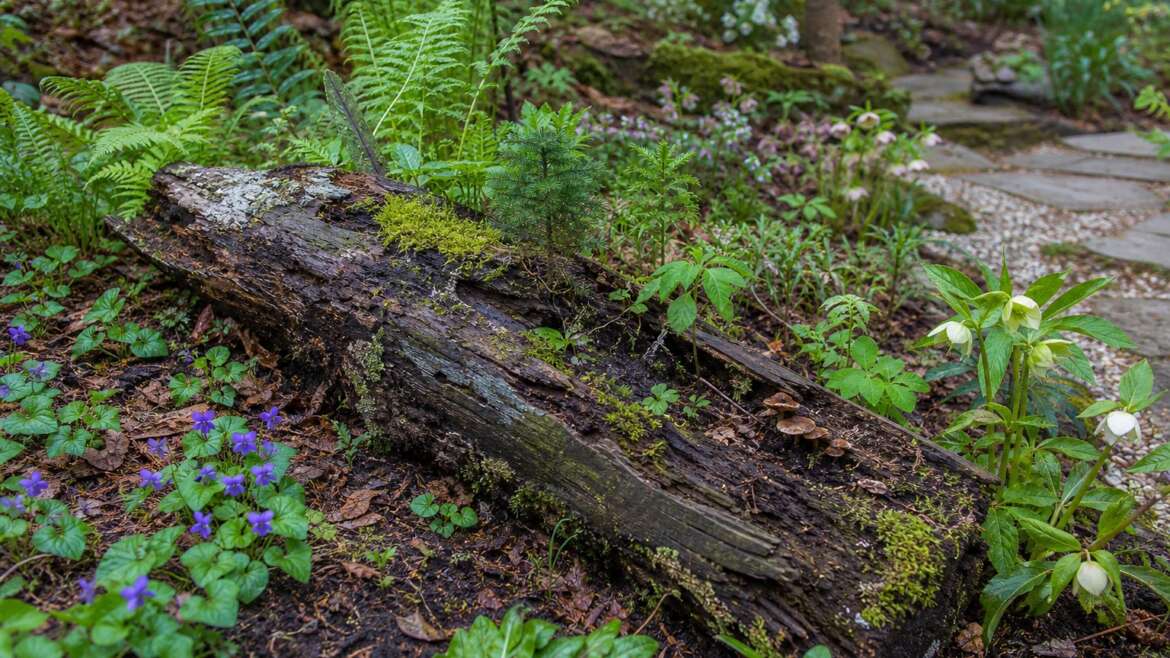
A fallen log can look like the end of a tree, but in a forest it often behaves more like a beginning. Moss settles on the bark. Fungi open the wood. Water gathers in the softened grain. Then, one spring, a seedling appears on top, holding its tiny green weight above the leaf litter as if the old trunk has become a bench, a sponge, and a nursery all at once.
Foresters call this a nurse log. The National Park Service describes how downed trees can give seedlings a perch above dense fern growth, open the canopy to light, release nutrients as they decay, and hold water with the help of moss.1 Gardeners do not need an old-growth forest to learn from that pattern. A single thoughtful log in a shade border, rain garden edge, woodland path, or native planting can make a garden feel older, softer, and more alive.
A log that grows by disappearing
The most interesting thing about a nurse log is that it works by slowly losing itself. A fresh trunk is firm, barked, and mostly closed to small roots. Over time, weather, fungi, insects, bacteria, and moisture change its structure. The wood becomes fissured. The bark loosens. Pockets collect leaf mold. Instead of shedding water like a roof, the log begins to drink like a sponge.
At Mount Rainier, the National Park Service describes fallen trees holding rain like sponges while mosses and other plants colonize them; fungi help break down the wood, and invertebrates tunnel through it as nutrients are recycled.2 That is the heart of the idea. The log is not fertilizer in the quick sense. It is a slow substrate, a moist edge, a piece of structure that invites a different community to gather around it.
In a garden, that slow pace is a virtue. Many features ask for constant intervention: pruning, staking, deadheading, feeding, dividing. A nurse log asks for placement and patience. It changes, but it does not perform on command. Each year it becomes more porous, less separate from the soil, and more useful to plants that appreciate cool roots and organic crevices.
Why seedlings like rotten wood
A seed on the forest floor can vanish into competition. It may land under a mat of leaves, beneath aggressive groundcover, or in soil already occupied by roots. A decaying log lifts the seed slightly above that scramble. It gives the seed a damp, textured surface where fine roots can explore without immediately wrestling every established plant nearby.
The USDA Forest Service notes that nurse logs and other large down wood often serve as nurse sites for tree and shrub species, and that decomposing nurse logs can concentrate nutrients, store water, speed soil development, reduce erosion, and lower competition from mosses and herbs.3 Those benefits are not identical in every garden, but the pattern translates well: rotten wood creates a microsite.
That word, microsite, is worth keeping. Gardeners often think in broad zones: sunny, shady, wet, dry. Plants experience the garden more finely. The north side of a log may stay cooler. The downhill side may collect more leaf mold. The crack where bark has peeled away may hold enough moisture for a fern spore. A nurse log makes these tiny differences visible.
Where it belongs in a garden
A nurse log belongs where decay feels like design, not neglect. Woodland gardens are the obvious home. So are shaded borders, fern collections, native plant beds, rain garden shoulders, the edge of a wildlife corner, and quiet paths where visitors are meant to slow down. It can also soften the base of a hedge or solve the awkward space under mature shrubs where grass has no real interest in living.
Place the log in contact with soil, not floating on a thick layer of mulch. It should be able to share moisture and decomposer communities with the ground. If the site is very dry, nestle it into a shallow hollow and pack leaf mold or composted bark around the lower edge. If the ground stays waterlogged rather than merely moist, use the shoulder of the wet area or choose a better-drained position; a log cannot correct oxygen-poor soil around plant roots. You are trying to imitate a forest floor, not dam a drain.
Raised-bed principles help with the practical side. Oregon State University Extension recommends planning access, irrigation, and soil preparation before filling a bed, and notes that high-quality soil mix, organic matter, and proper watering all matter in raised growing areas.4 A nurse log is not a raised bed, but it creates raised pockets. Before you wedge plants into the cracks, think about how you will reach them, water them, and keep feet off the loose soil around the log.
Choosing the right wood
The best wood is already partway into decay. A log with loose bark, cracks, and some give is more immediately useful than a freshly cut, sealed-looking branch. Do not use “hardwood” and “softwood” as a durability shortcut: species, diameter, existing decay, moisture, and climate all affect how wood persists, and even different-sized pieces host different decomposer communities.3 Choose a piece you can move without injury and one that fits the garden without looking as though it fell from a truck.
Avoid pressure-treated lumber, painted wood, stained wood, and any timber that may carry preservatives, glues, or demolition debris. Avoid logs from trees recently killed by serious pests or diseases if there is a risk of spreading the problem to related plants nearby. If emerald ash borer, oak wilt, sudden oak death, or another regulated issue is active in your region, follow local extension and forestry guidance before moving wood.
Black walnut deserves special caution. University of Wisconsin Extension advises against using black-walnut bark and wood as mulch near sensitive plants, including tomatoes, peppers, potatoes, and eggplants; it also notes that many ornamental sensitivity lists rest on observation rather than formal testing.5 For a nursery log meant to support a mixed planting, choosing another tree species is the simpler experiment.
Planting into the pattern
Do not force the log to become a planter on the first day. Begin by planting around it. Ferns, sedges, violets, foamflower, wild ginger, woodland phlox, heuchera, Solomon’s seal, and small spring ephemerals can make the log feel settled while the wood continues to soften. In a moist, acidic, shaded garden, moss may arrive on its own. If it does not, the garden may be telling you that the site is brighter, drier, or less sheltered than it first appeared.
For true planting pockets, look for existing cracks, hollows, and bark seams. Add a small amount of leaf mold, composted bark, or fine compost mixed with local soil. The goal is not to fill the log like a pot. The goal is to give roots a bridge between the decaying wood and the living soil below. Tiny divisions and seedlings handle this better than large nursery plants with dense root balls.
Fresh wood and very woody amendments can temporarily tie up nitrogen as they decompose. Oregon State University Extension warns that excessively woody materials may rob plants of soil nitrogen, and that rapidly decomposing materials can temporarily tie up nitrogen and reduce in volume as decay proceeds.6 That is one reason to avoid mixing large amounts of raw sawdust or fresh chips directly into planting pockets. Keep the rich planting material close to young roots, and let the log decay at its own speed.
Wildlife comes with the wood
A nurse log is never only about plants. Dead wood is habitat. UF/IFAS Gardening Solutions notes that logs can provide shelter, a humid microclimate, and food relationships in a landscape.7 Rotting wood may host fungi and invertebrates such as spiders, beetles, ants, grubs, worms, snails, and slugs, along with the animals that feed on them.
This is where garden style matters. A nurse log near the front walk should look intentional: partially settled into the bed, repeated with stones or leaf mulch, and framed by plants. A wildlife corner can be looser. Add smaller branches behind it, allow leaves to gather, and resist cleaning every fragment of bark. A garden that welcomes decay does not need to look abandoned. It needs to look observant.
There are limits. Do not stack rotting wood against house siding, wooden fences, or the base of valuable trees. Keep it away from structures where moisture and insects would be a problem. In fire-prone landscapes, follow local defensible-space rules before adding woody material near buildings. Ecological gardening is still gardening. Placement is part of care.
Water, shade, and patience
A new nurse log may need help during its first year in the garden. Water the soil around it during dry spells, especially if you have planted small ferns or woodland perennials beside it. The log itself should become damp after rain and gradually dry at the surface. If it stays bone-dry through spring, move it to shade, tuck leaf mold along the lower edge, or choose plants that prefer drier woodland conditions.
Shade is not a single condition. Morning sun and afternoon shade may suit violets, foamflower, and many ferns. Dense dry shade beneath conifers may require tougher plants and more patience. Bright wet shade can be surprisingly lush. The log helps, but it does not overrule the site. Watch where moss persists, where leaves stay damp longest, and where seedlings volunteer. The garden will mark its own best planting pockets.
Expect change. Bark will slump. Mushrooms may appear and vanish. A plant that looked perfect in year one may need moving in year three as the wood collapses. That is not failure. It is the point. A nurse log is a garden feature with an ending built into it, and the ending is soil.
What not to do
Do not scrape a wild forest for its prettiest nurse log. Old decaying wood is already habitat, often for organisms that do not move quickly or recover easily. Use wood from your own property, stormfall, arborist chips and logs that are safe to move, or material from a managed source.
Do not bury a huge fresh log under a small perennial bed and expect instant magic. That is a different technique, closer to building a hugelkultur bed that behaves like soil, and it has its own water, nitrogen, and settling issues. A garden nurse log works best at the surface, where you can see it, plant around it, and let air, fungi, insects, and moisture work from the outside inward.
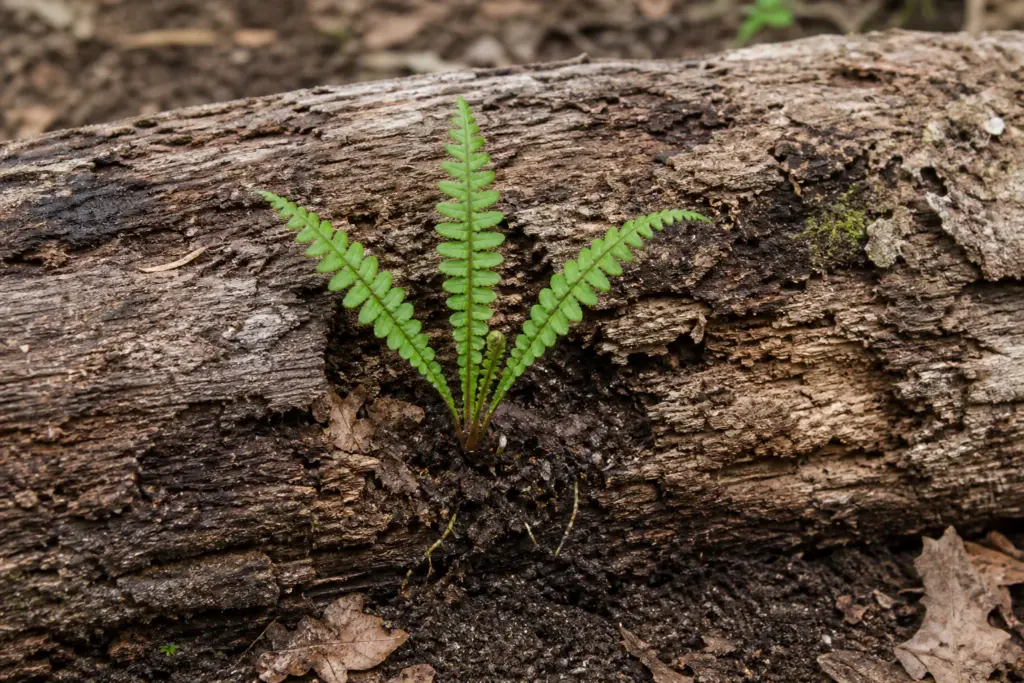
Finally, do not overplant. The beauty of a nurse log is partly negative space: dark wood, green moss, one fern frond, a violet, a seedling finding purchase. Give the scene enough room to read. The forest does not hurry this pattern, and neither should the garden.
Useful nurse log garden supplies
- Corona RazorTOOTH pruning saw: helpful for cutting small fallen branches or trimming manageable wood before placing it. Leave heavy or unstable logs to a qualified arborist.
- Fiskars Ergo garden trowel: useful for making small planting pockets around the log without tearing up the whole bed.
- Luster Leaf 1820 soil moisture meter: useful for rough comparisons between the upper side of a log bed and damper pockets; treat the dial as a relative reading, not a laboratory measurement.
- HongWay landscape staples: handy for pinning temporary irrigation line, cardboard, or lightweight erosion fabric while a new woodland bed settles.
Final thoughts
A nurse log changes the mood of a garden because it refuses the idea that usefulness belongs only to green, upright growth. It lets a fallen tree keep participating. It holds moisture, loosens into humus, shelters small life, and gives seedlings a place to begin above the crowd.
Start with one log in the right place. Plant lightly. Let moss and leaf litter do some of the design work. If a fern roots into a crack or a seedling rises from the softened bark, the garden has understood the lesson: sometimes the most generous thing a tree can do is fall.
References
- National Park Service: Nurse Log in Bartlett Cove
- National Park Service: Old Mine Tour—Nurse Logs
- USDA Forest Service: Ecosystem Processes Related to Wood Decay
- Oregon State University Extension: Raised Bed Gardening
- University of Wisconsin Extension: Black Walnut Toxicity
- Oregon State University Extension: Improving Garden Soils with Organic Matter
- UF/IFAS Gardening Solutions: Creating Wildlife Habitats with Dead Wood