
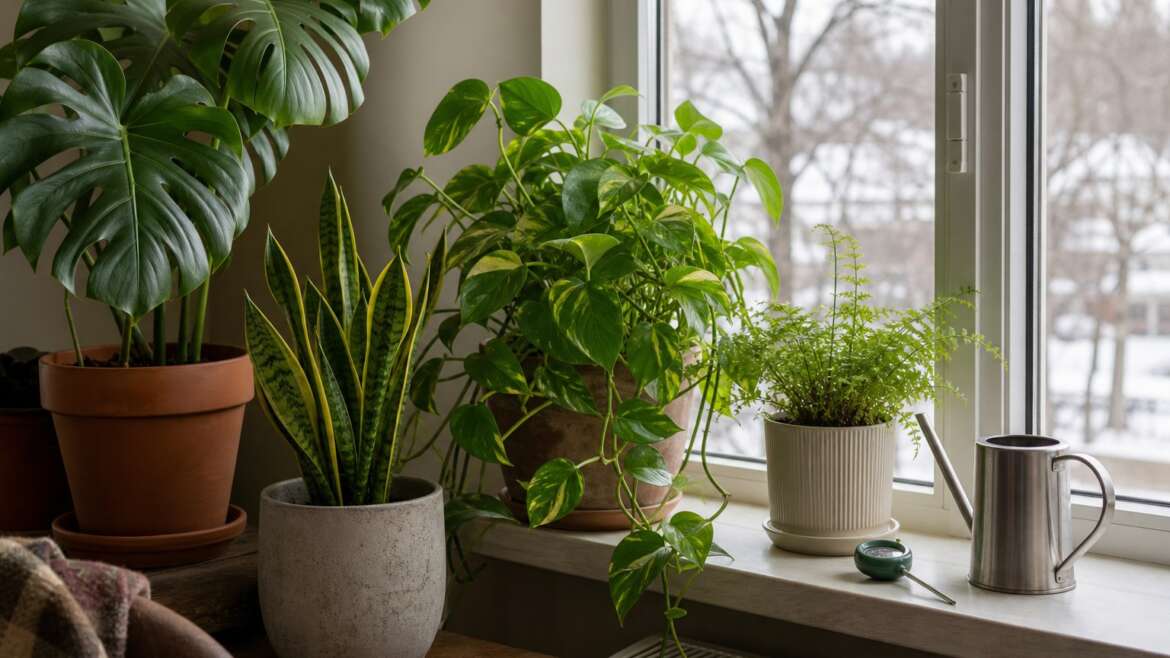
By late December, a houseplant can look both present and paused. The pothos is still green. The snake plant still stands like a row of quiet blades. The fern still catches light with all its small hands. Nothing has died, exactly, but the room has changed around them. The window is colder. The sun leaves early. The heater dries the air. The watering can that made sense in June begins to feel slightly too eager.
This is the season when many indoor gardeners accidentally love plants too hard. They water by memory, fertilize out of concern, mist leaves because the air feels dry, and move pots around in search of a cure for a plant that is simply growing more slowly. Winter houseplant care is often less about doing more and more about doing the right smaller things.
Many common foliage houseplants in northern-temperate homes are not experiencing winter the way an oak, peony, or tulip bulb does outdoors. They are usually in heated rooms, protected from freezing weather. But they still read the season through light, temperature, humidity, and the rhythm of the room. In December, those signals change. Their needs change with them.
Most of all, many of them ask for less.
The light has changed more than the plant has
In a northern-temperate winter, the biggest change is often light. A window that felt generous in May may become a narrow ration in December. The sun is lower, days are shorter, outdoor trees may be bare but skies are often dimmer, and interior plants may sit just far enough from the glass to miss much of what is available.
Illinois Extension notes that the very low light of late fall and early winter limits houseplant growth; plants that are not actively growing use water more slowly, so watering intervals usually lengthen.1 That relationship explains a lot of winter houseplant trouble. Less light can mean less photosynthesis, slower growth, and less water moving through the plant.
University of Maryland Extension classifies south-facing windows as high-light sites and notes that season, weather, curtains, screens, nearby structures, and distance from the source all affect how much light reaches a plant.2 That does not mean every plant belongs pressed against cold glass. It means the winter map of a room is different from the summer map. A plant that was content several feet from a window in July may need to move closer in December.
Watch the leaves. A plant stretching toward the window is not being dramatic. It is showing you the direction of the season. Turn pots every couple of weeks so growth does not become too one-sided. Clean dusty leaves so the light that does arrive can actually reach the surface. Open blinds during the day. In winter, small light habits matter.
Water follows light
Watering is where winter care most often goes wrong. The plant looks quiet, the gardener worries, and the watering can becomes an apology. But water is not encouragement. It is a resource the plant can use only when roots, leaves, light, and air are working together.
North Carolina Cooperative Extension gives the basic winter adjustment clearly: houseplants generally need significantly less water in winter because growth decreases and plants take up less water.3 Iowa State University Extension advises checking the mix rather than watering on a fixed schedule, then watering thoroughly when needed and emptying excess water from the saucer or outer pot.4
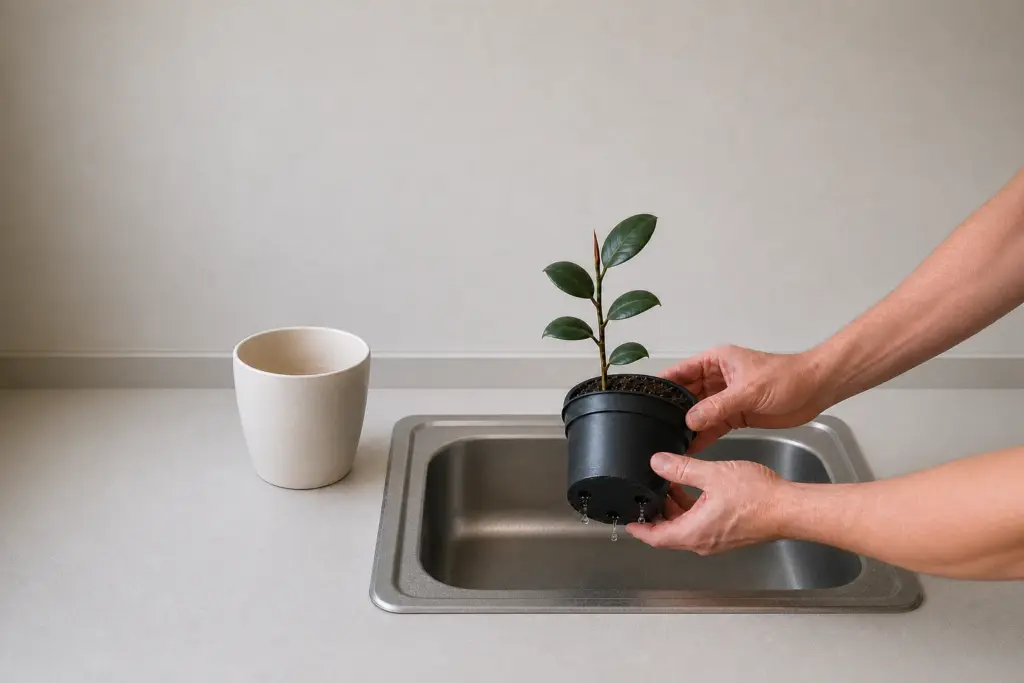
The practical method is simple but requires discipline. Check the soil, not the calendar. Feel the top inch or two with a finger. Lift the pot and learn the difference between heavy and light. For a plant in a cachepot or decorative sleeve, remove the inner pot before watering and let it drain fully before returning it. A plant can be thirsty. It can also be suffocating in wet soil.
Different plants have different thresholds. Many commonly grown ferns and tropical foliage plants may dislike going bone dry. Snake plants, jade plants, cacti, and succulents often want a much longer dry interval. The shared winter rule is not “never water.” It is “water when the plant and potting mix have made a case for it.”
Fertilizer can wait
Fertilizer feels like care because it comes in a bottle with promises. In winter, it is often unnecessary. A plant that is barely growing does not need a steady push of nutrients. Feeding a plant when light is limiting can encourage weak growth or leave fertilizer salts accumulating in the potting mix.
Illinois Extension advises fertilizing only while houseplants are actively growing and says short winter days usually call for very little or no additional fertilizer.5 Cornell Cooperative Extension gives the same seasonal pattern: fertilization is generally not necessary in winter because most plants are growing very little or resting.6
There are exceptions. A plant under bright supplemental light, actively pushing new leaves, may need modest feeding. A blooming holiday plant has its own schedule. But for the ordinary foliage plant in an ordinary winter room, fertilizer can usually stay on the shelf until light returns and growth resumes.
Humidity is not the same as wet soil
Winter air can be dry enough to make leaves tell on the house. Low humidity can contribute to brown tips, curling edges, and crisp fern fronds, while warm, dry conditions favor spider mites. None of those symptoms diagnoses humidity by itself: watering, root health, fertilizer salts, drafts, and pests can produce similar damage. The temptation is to water more. That often solves the wrong problem.
Penn State Extension notes that most indoor plants benefit from humidity higher than what is typical in a heated winter home, with cacti and succulents as exceptions.7 North Dakota State University Extension puts numbers to the discomfort: winter homes can have relative humidity around 10 to 20 percent, while many houseplants prefer 40 to 50 percent.8
Moist air around leaves and wet soil around roots are different things. A fern with crisp edges may need more humidity but not more water in the pot. Grouping plants can create a slightly more humid pocket, but a room humidifier is more dependable than occasional misting. Pebble trays are widely recommended, yet any humidity rise is small and very local.7 Keep the pot above, not in, the water; otherwise the humidity tray has become a root-rot tray.
Also watch the room’s hot and cold edges. A plant beside a forced-air vent may dry at leaf edges even when the pot is damp. A plant touching cold glass may be chilled at night. Winter houseplant care is partly the art of moving plants a few inches.
A grow light is a clock, not just a bulb
Supplemental light can be genuinely useful, especially for plants that are stretching, dropping leaves from low light, or living far from a good window. But a grow light should be thought of as a schedule as much as an object. Plants need darkness too. Leaving a lamp on at random for long nights is not the same as giving a plant a steady day.
Iowa State University Extension recommends using a timer so supplemental lights turn on and off consistently; for most species, 12 to 14 hours is a useful starting point, with no more than 16 hours a day.9
Distance matters. A lamp across the room may make the room feel brighter without giving the plant much useful light. A light placed too close can create heat or uneven growth. Start with the manufacturer’s guidance, watch the plant, and adjust. Leaves stretching upward may need more intensity or closer placement. Pale, stressed leaves may be getting too much or too little of something else entirely.
Pests like winter rooms too
Winter pests often arrive quietly. A plant brought indoors from a porch carries a few insects. Warm, dry conditions favor spider mites. Aphids cluster on tender new growth and may leave sticky honeydew. Fungus gnats appear when potting mix stays too wet for too long. Because windows are closed and plants are clustered, a small problem can become a room problem.
UC Statewide IPM recommends examining plants before bringing them indoors, isolating a plant when a problem is detected, and routinely checking leaves and stems. It also notes that some soft-bodied insects and mites can be washed off with water, while fungus gnats can often be managed through better watering.10
The winter habit is inspection. Look under leaves. Check where stems meet soil. Notice sticky windowsills, fine webbing, cottony white clusters, or small flies rising when you water. Isolate new or suspicious plants. A plant that needs less water still needs attention.
Useful winter houseplant supplies
- Barrina full-spectrum LED grow light strips: useful when winter window light is too weak or plants are stretching toward the glass.
- BN-LINK 24-hour outlet timer: keeps supplemental lighting on a steady schedule instead of relying on memory.
- XLUX soil moisture meter: can add a deeper moisture reading in a larger pot; treat it as one clue alongside touch and pot weight, not as an automatic watering instruction.
Final thoughts
Winter houseplant care is not neglect. It is restraint with attention. The plant near the window is still alive, still responding, still making small decisions with light and water. It is simply not living in June anymore.
Move plants toward better light when you can. Water by soil, not habit. Hold fertilizer until growth returns or light is strong enough to support it. Raise humidity around leaves without drowning roots. Watch for pests before they become a collection. In winter, a good indoor gardener becomes less of a provider and more of an interpreter.
The quiet plant is not always asking to be fixed. Often, it is asking you to notice that the room has changed.
References
- Illinois Extension: Houseplants, winter watering, and humidity
- University of Maryland Extension: Lighting for Indoor Plants
- N.C. Cooperative Extension: Winter Considerations for Houseplants
- Iowa State University Extension: How to Care for Houseplants
- Illinois Extension: Houseplant Care
- Cornell Cooperative Extension: Houseplants and Holiday Plants
- Penn State Extension: Humidity and Houseplants
- North Dakota State University Extension: Winter Houseplant Care
- Iowa State University Extension: How to Set Up Supplemental Lights for Indoor Plants
- UC Statewide IPM: Houseplant Problems