
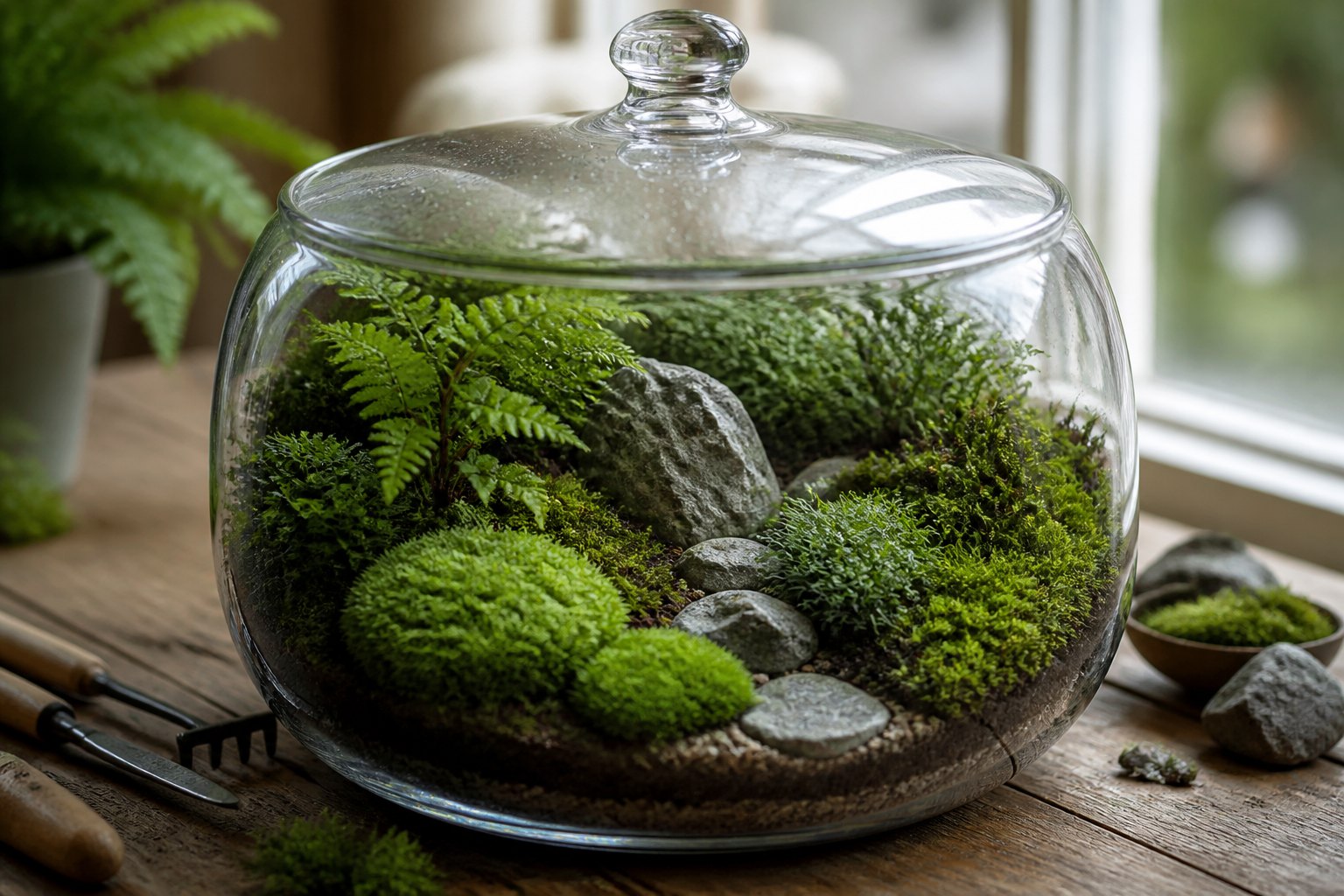
A mossarium is a garden reduced to its most intimate scale: a pane of glass, a few spoonfuls of substrate, a soft green colony of moss, and enough moisture to make a miniature weather system. It looks decorative, almost like a living object from a cabinet of curiosities, but it is also a small lesson in plant biology.
Unlike a potted basil plant or a tomato seedling, moss does not ask you to think first about deep roots, fertilizer schedules, or tall stems reaching toward the sun. It asks you to think about surfaces, humidity, light, and patience. Build the little world correctly, and it may need only occasional attention. Build it carelessly, and it becomes a foggy jar of rot.
A Little History Under Glass
The modern terrarium descends from the Wardian case, a sealed glass plant container developed in the nineteenth century. Kew Gardens describes how Nathaniel Bagshaw Ward noticed fern growth in a sealed glass bottle in 1829, where condensation formed on the glass and returned moisture to the soil.1 What began as a botanical curiosity became a technology for moving living plants across oceans.
A mossarium is a quieter descendant of that idea. It is not trying to move tea plants across the world or stock a Victorian fern collection. It simply uses the same principle: glass slows water loss, light powers photosynthesis, and moisture cycles through the container in miniature.
Why Moss Behaves Differently
Mosses belong to the bryophytes, a group that also includes liverworts and hornworts. They are non-vascular plants, meaning they do not have the same internal plumbing as flowering plants. The Smithsonian Tropical Research Institute describes bryophytes as plants without true roots or vascular tissue, absorbing water and nutrients through their surfaces instead.2
That biology is exactly why moss works so well in a terrarium. Moss has no true roots to fill a deep pot, although any companion plant still needs enough substrate for its own roots. What the moss needs is close contact with a suitable surface, gentle moisture, brief ventilation if condensation stays heavy, and enough indirect light to photosynthesize without overheating under glass.
Closed or Open?
A closed mossarium is the classic version: a jar, cloche, lidded box, or glass vessel that holds humidity. Penn State Extension notes that a properly made closed terrarium can establish its own rain cycle and require minimal maintenance.3 This is ideal for mosses, small ferns, fittonia, pilea, peperomia, and other plants that enjoy humid, sheltered conditions.
An open terrarium is better for plants that dislike constant humidity, such as many succulents and cacti. A mossarium, however, usually wants the opposite: a cool, stable, humid atmosphere. If your home is dry, a lid makes the project much easier.
The Basic Layers
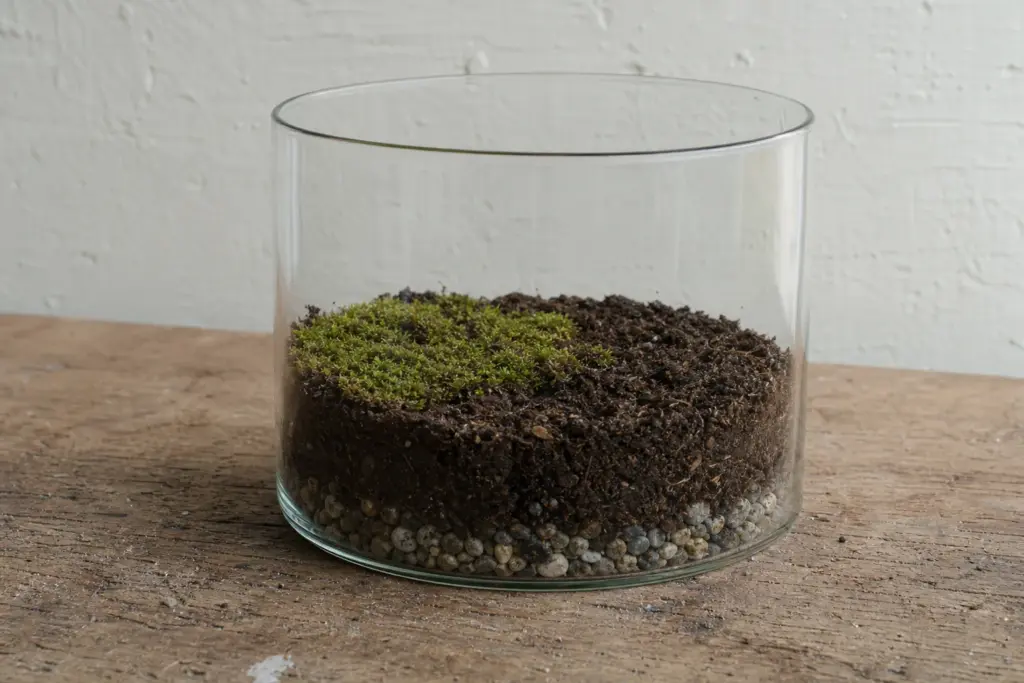
Because most terrariums have no drainage hole, water control matters more than the appearance of the layers. Iowa State University Extension recommends a bottom layer of gravel, pebbles, or perlite to hold excess water, followed by a thin layer of charcoal and then a light, well-drained potting mix.4 Penn State Extension offers a useful caution: a layer of rocks does not improve drainage from a sealed vessel because the water still cannot leave.3 If you use a pebble layer, think of it as a small reservoir and visual element, not protection against overwatering.
- Optional reservoir layer: small pebbles, pumice, or perlite at the bottom, with no assumption that they create an outlet.
- Charcoal: a modest amount of horticultural charcoal, either as a thin layer or mixed into the substrate, may help control odors but does not prevent rot.
- Optional barrier: fine mesh can keep the growing mix from sifting into a pebble reservoir.
- Growing layer: enough moist, airy potting mix or terrarium substrate for the companion plants you actually choose.
- Surface layer: moss, small ferns, stones, and tiny contours that create the miniature landscape.
The most common beginner mistake is adding too much water, not failing to build enough decorative layers. Moss grows on surfaces. A mossarium should feel like a damp forest edge, not a swamp.
Choosing Moss and Companion Plants
Use nursery-grown moss whenever possible, and avoid collecting from protected areas, public parks, or fragile habitats. Moss colonies can grow slowly, and wild patches often shelter small invertebrates and microorganisms. If you do collect from your own property, take only tiny pieces, replace disturbed soil, leave the colony mostly intact, and match the fragment to a similar surface; our guide to choosing and preparing a moss-growing surface explains why habitat matters.
For a closed terrarium, choose plants that enjoy high humidity and lower light. University of Minnesota Extension lists ferns, pilea, peperomia, and moss among good closed-terrarium options.5 Keep scale in mind: a plant that looks charming in a nursery pot may become a giant in a jar. Small-leaved, slow-growing plants are easier to manage.
Try combining different textures rather than many different species. Cushion moss can suggest hills. Sheet moss can become a meadow. A tiny fern can act like the canopy. Stone can become a cliff. The art is not in cramming the container full, but in leaving enough negative space for the scene to breathe.
Light: Bright, Indirect, and Never Scorching
Terrariums need light, but glass changes the stakes. Direct sun can heat a closed container quickly, damaging or killing the plants inside. Mississippi State University Extension recommends bright, indirect light for closed-system terrariums and warns against placing them where solar energy can build heat inside the container.6
An east-facing window with gentle morning light can work well if the container does not heat up. A bright room away from direct sun is often safer. Watch the plants rather than using color as a single diagnosis: pale or elongated companion-plant growth may mean the light is too weak, while browning moss can also reflect overheating or moisture trouble. Condensation heavier than a light fog and never clearing is a reason to ventilate briefly.3
Water: The Condensation Test
Closed terrariums should not need frequent watering. MU Extension notes that a closed terrarium normally may not need water for four to six months, and that lack of condensation or wilting plants can signal the need for water.7 That does not mean the glass should be dripping all day. A little morning or evening fog is normal. Constantly wet glass and soggy substrate suggest excess water.
Use a fine mister or a spoon to add water gradually. If you overdo it, leave the lid open until excess condensation clears, then replace it. Moss species differ in their tolerance of drying, so do not make deliberate drying part of the routine. Add water cautiously instead: excess is difficult to remove, and persistent sogginess encourages root disease in companion plants.7
Maintenance: Editing a Living Landscape
The best mossariums are not static. They settle, lean, fog, clear, shed, and regrow. Trim ferns before they press against the glass. Remove dead leaves before they mold. Rotate the vessel occasionally if growth becomes one-sided. If condensation never clears, ventilate more often. If the moss dries at the edges, mist lightly and check whether the lid leaks too much humidity.
Do not fertilize routinely. Iowa State University Extension recommends avoiding fertilizer because it hastens crowding; if plants show specific deficiency symptoms, it suggests a balanced fertilizer at quarter strength.4 For a moss-centered planting, diagnose first and feed only when the companion plants actually need it.
Useful Mossarium Supplies
- NCYP small glass terrarium with lid: a compact lidded container for a first mossarium or small fern display. Check size and ventilation details before choosing plants.
- Ohtomber aquascape and terrarium tool kit: long tweezers, scissors, and a substrate spatula make it much easier to plant and edit a narrow glass container.
- Hoffman horticultural charcoal: an option if your chosen terrarium method uses a modest amount of horticultural charcoal.
Final Thoughts
A mossarium is less like owning a houseplant and more like curating a small climate. You are not simply watering leaves. You are balancing light, glass, air, mineral, moisture, and time. That is what makes the project so satisfying: the finished piece is beautiful, but the real pleasure comes from learning how little a garden can be and still feel alive.
Start with a small container, a few kinds of moss, one companion plant at most, and the humility to adjust. If the glass fogs, listen. If the moss pales, listen. If a fern slowly unfolds a new frond in the miniature shade, you have built something more interesting than decor. You have built a tiny weather system that grows.
References
- Kew Gardens: The Wardian case, botany game changer
- Smithsonian Tropical Research Institute: Bryophytes
- Penn State Extension: Creating a Closed Terrarium
- Iowa State University Extension: How to Create and Care for a Terrarium
- University of Minnesota Extension: Terrarium Gardening
- Mississippi State University Extension: How to Design a Closed-System Terrarium
- MU Extension: Terrariums