
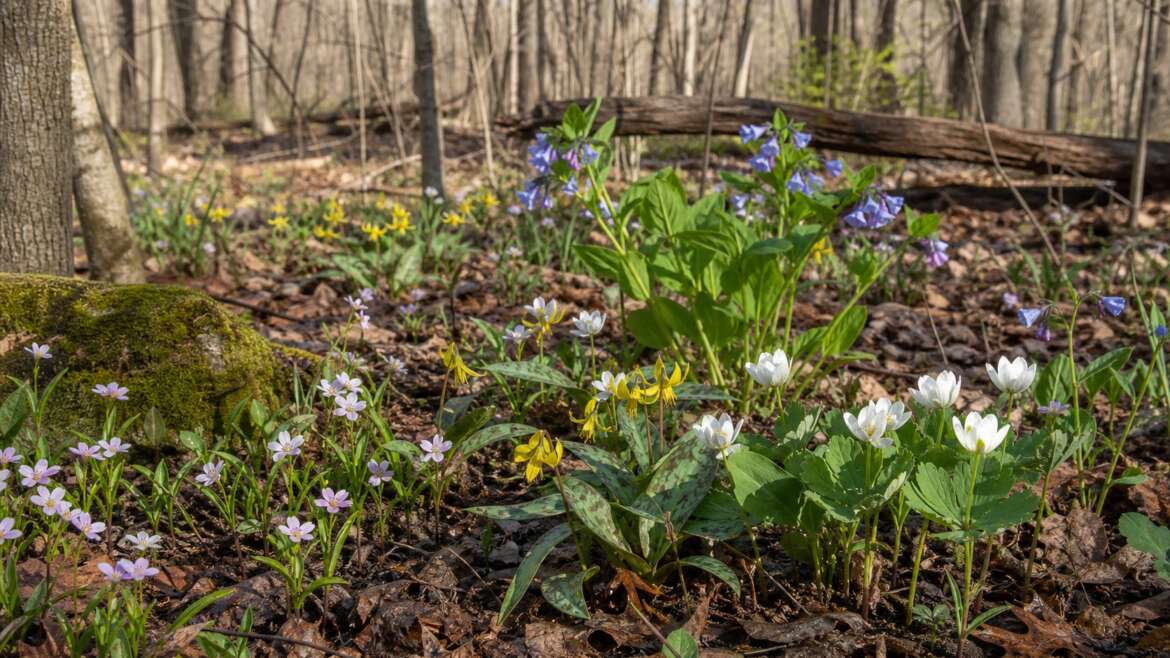
In an eastern North American woodland, a mild day in March or April can make the forest floor seem to wake before the trees have heard the news. The canopy is still a gray net overhead. Last year’s leaves are flattened and wet. Then, almost at ankle height, small flowers begin taking possession of the light: bloodroot opening like white paper, trout lily lifting yellow bells above mottled leaves, spring beauty threading pink-veined stars through the leaf litter.
These plants are easy to miss because they do not stay long. Many complete their visible season in the bright interval between snowmelt and deep shade, blooming while the upper branches are still bare and then yellowing into dormancy as the canopy fills. The exact timing varies by species, place, and weather. Their beauty is brief, but it is not fragile in the sentimental sense. It is a strategy.
Spring ephemerals are woodland perennials that grow and flower early, before deciduous trees and shrubs leaf out enough to darken the forest floor. Penn State Extension describes them as plants that use this early window of sunlight and provide nectar for early emerging insects.1 In a garden, they can turn a shady bed into a spring event without occupying much visible space later in the year. The trick is understanding that their season is not short because something has gone wrong. Their season is short because the whole plant is built around timing.
A race before the roof closes
A deciduous woodland in early spring is brighter than it looks. Sun passes through bare branches and reaches the soil in a way it will not again once maples, oaks, beeches, hickories, and understory shrubs unfold their leaves. For a plant only a few inches tall, that brief opening matters enormously.
Many spring ephemerals use it for most of their above-ground work: sending up leaves, opening flowers, and feeding pollinators while light is abundant. Seed development and the replenishment of underground reserves continue on species-specific schedules as the canopy closes. Research on northeastern forest wildflowers has shown why this timing is so important. Many understory wildflowers leaf out and flower when light is highest before canopy closure, and earlier tree leaf-out can shorten that high-light period enough to reduce their spring carbon budgets.2
That phrase, carbon budget, sounds clinical for such delicate plants. But it is the heart of the story. A trout lily leaf is not just decoration beside a yellow flower. It is a solar panel working under a deadline. A bloodroot leaf is not only a handsome gray-green wrapper around a bloom. It is collecting the energy that will let the rhizome survive summer, winter, and next spring’s performance.
The plant disappears, but it has not left
When spring ephemerals vanish in late spring or early summer, it can look like failure to a gardener who expects perennials to remain present all season. The foliage yellows. The stems soften. The planting space seems suddenly empty. In most cases, this is dormancy, not death.
The plant has moved its working life below the soil surface. Some species rely on rhizomes, some on corms, bulbs, tubers, or thickened roots. NC State Extension describes trout lily as an early spring ephemeral that goes dormant after the surrounding trees leaf out, leaving its underground parts to carry the plant through the shaded part of the year.3 That is why disturbing a dormant patch in July can do real damage even though nothing green is showing.
This underground habit also explains why many ephemerals are slow to settle. A plant that spends much of the year out of sight may be building a rootstock, not failing to thrive. Trout lily can take several seasons before flowering, and NC State notes that seed-grown plants may need four or five years before they bloom.3 The gardener has to think in colonies, not instant displays.
Flowers for the first small pollinators
Spring ephemerals are not only borrowing light. They are also feeding an early crowd. Before summer flowers are abundant, their pollen and nectar can matter to early-active bees and flies, including bumblebee queens and small solitary mining bees moving through cold-edged weather.
The relationships can be surprisingly specific. Penn State notes that spring beauty is a nectar source for the spring beauty bee, Andrena erigeniae, as well as small bees and flies, while trout lilies attract mining bees.1 NC State Extension notes that members of the genus Erythronium support the specialist bee Andrena erythronii.3 In a small shade garden, that means a drift of little flowers can be more than seasonal ornament. It can be part of the first working pantry of the year.
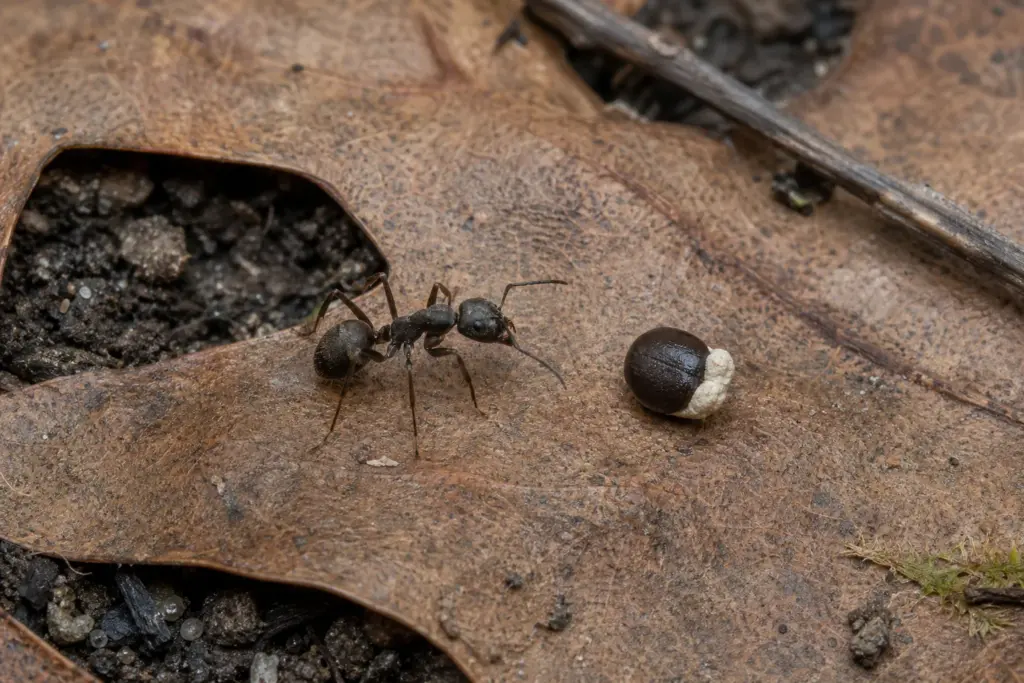
Several ephemerals also use ants as seed movers, a detail worth noticing because it changes how colonies spread. Seeds of bloodroot, Dutchman’s breeches, trillium, trout lily, and hepatica can carry elaiosomes, fatty attachments that attract ants.1 Chicago Botanic Garden describes the exchange simply: the ant gets food, and the plant gains seed dispersal into a rich organic setting.4 If seedlings appear a little away from the parent clump, the garden may be less random than it looks.
Choosing plants for a living spring layer
A good spring ephemeral planting does not need to look like a collector’s tray. It is often more convincing when it behaves like a woodland edge: repeated plants, loose drifts, leaf litter, ferns waiting in the background, and enough space for each species to spread slowly if it likes the place.
Start with the conditions and the plant’s documented native range rather than a generic woodland wish list. The eastern species discussed here overlap in preferring spring moisture and some shade, but their needs for drainage, soil chemistry, summer moisture, and room to spread are not identical. Under an established tree, use small plugs and narrow hand-dug pockets, moving the hole rather than cutting a woody root. Penn State advises against building a raised bed over tree roots and recommends no more than a thin surface layer of soil or compost.5 Keep that layer away from the trunk and root flare.
For a soft naturalized effect, spring beauty is one of the gentlest choices. NC State Extension describes Claytonia virginica as a low-growing wildflower native to the eastern United States, with pale pink or white striped flowers, narrow leaves, and foliage that disappears as the plant becomes dormant.6 It can tuck into the front of a shade bed, beside rather than in a walked path, or along the edge of a lightly managed lawn where mowing can wait until its foliage yellows naturally.
Virginia bluebells bring a fuller presence. They emerge in clumps, rise higher than many small ephemerals, and open pink buds into blue bells. NC State describes Mertensia virginica as native to eastern Canada and the central and eastern United States; it grows in compact clumps and goes dormant by mid-summer.7 Use it within its appropriate range and where its summer absence will not leave a visual hole: among ferns, sedges, woodland phlox, wild ginger, or later-emerging shade perennials.
For a bolder colony-forming layer, see how mayapple hides its flower beneath umbrella-shaped leaves. Its rhizomes can spread into a broad patch, so give it room rather than asking it to share a small pocket with delicate species.
Bloodroot is more dramatic and should be treated with respect. The flower can be luminous, and the lobed leaf remains interesting after bloom, but the plant is named for its orange-red sap. NC State classifies the roots as highly poisonous because they contain isoquinoline alkaloids.8 Do not ingest bloodroot or use it as a home remedy, and keep dug rhizomes where children cannot mistake them for food. Gloves are sensible when handling the staining sap; wash hands and tools afterward.
How to garden with a vanishing act
The main design challenge is not spring. Spring usually takes care of itself. The challenge is July, when the ephemerals have gone quiet and the bed still needs to look intentional.
Plant them with companions that rise after the early show has done its work. Ferns, locally appropriate sedges, heuchera, foamflower, woodland phlox, Solomon’s seal, wild ginger, and shade-tolerant grasses can cover the retreat without smothering it. Check mature size and spreading habit before mixing them. The best companions are patient in spring and fuller in summer: they let the first flowers have their light, then take over when the canopy becomes green.
Leave green foliage in place while the plant completes its cycle. Illinois Extension describes nutrients being stored underground as growth slows and the leaves die back naturally.9 The same energy accounting explains why spring bulb leaves have to linger after bloom. Wait until ephemeral foliage yellows naturally and loosens from the plant instead of cutting it for tidiness.
Mark the planting area. A quiet July bed can tempt even careful gardeners into digging, dividing, or adding something on top of sleeping crowns and corms. Small labels, a simple map, or a few stones at the edge of the drift can prevent a surprising amount of accidental damage.
Buy them like you care where they came from
The ethics matter. Do not take plants from natural areas: Illinois Extension warns that collecting can disrupt habitat.9 The National Park Service advises buyers to verify that retail plants were propagated rather than wild-collected.10 Choose a reputable native-plant nursery or grower who can explain the source of the stock, and select species native to your region rather than treating “native” as a continent-wide label.
Propagation method and timing differ by species. Established trout lilies, for example, do not transplant well, and seed-grown plants are slow to flower.3 Before dividing a lawful garden planting, check guidance for that species rather than assuming every dormant rhizome or corm should be moved. Work in small sections when division is appropriate, water during establishment, and give the parent colony time to recover.
Useful spring ephemeral supplies
- NISAKU NJP650 hori hori knife: useful for easing leaf mold aside and making narrow planting pockets between roots. Move the pocket rather than cutting a woody root.
- Fiskars bulb planter: helpful for planting small corms and plugs in open soil. In tree-rooted beds, use it carefully and switch to a hand tool where roots are dense.
- KINGLAKE 100-piece plastic plant labels: practical for marking ephemerals after they disappear, especially in beds that will be edited or replanted later in summer.
Final thoughts
Spring ephemerals make the garden feel more intelligent. They remind us that a plant does not need to be visible all year to belong deeply to a place. Their timing is exacting: a few weeks of strong light, a few passing bees, cool spring rain, and the slow storage of energy below the leaves.
Plant them where spring sun reaches the ground and summer shade will later keep the soil cool, matching each species to local drainage and moisture. Keep a light leaf layer where it will not bury tender shoots. Pair the ephemerals with plants that understand how to wait their turn. Then, when early spring opens the woodland floor for a little while, the bed will answer with flowers that seem sudden only because most of their work has been happening quietly underground.
References
- Penn State Extension: Spring Ephemerals
- Heberling et al., 2019: Phenological mismatch with trees reduces wildflower carbon budgets
- NC State Extension Gardener Plant Toolbox: Erythronium americanum
- Chicago Botanic Garden: The Secrets of Spring Ephemerals in the Woods
- Penn State Extension: Underplanting Trees—Respect the Roots
- NC State Extension Gardener Plant Toolbox: Claytonia virginica
- NC State Extension Gardener Plant Toolbox: Mertensia virginica
- NC State Extension Gardener Plant Toolbox: Sanguinaria canadensis
- Illinois Extension: Early-blooming spring ephemerals welcome warmer weather
- National Park Service: Blue Ridge Parkway wildflowers